
RAC-420 · Lesson 12 of 12 · 19 min
Emergency response and the Hillcrest Arena capstone
In October, two things happened in the same week. Grand Valley held its annual tabletop exercise of its environmental emergency plan, with Luis, Hannah, the operators, Ingrid's group and two officers from the fire department around a table with the plant's drawings. And Ingrid and Theo finished their assessment of Hillcrest Arena, which they would present to the city's council committee in November. Ingrid asked Theo to write both reports. "You've learned the plants," she said. "Now show me you can think about what happens on the worst day, and what the city should spend its money on so that day never comes." This last lesson covers emergency planning and response for ammonia and carbon dioxide systems, and then works through the arena capstone.
Emergency planning
Every plant with a hazardous refrigerant needs written emergency procedures, whatever its size, and larger plants need a full emergency plan. In Ontario, the Occupational Health and Safety Act requires employers to have measures and procedures for emergencies and to train workers in them, CSA B52 requires emergency procedures and information at the machinery room, and Grand Valley's E2 plan, required by the Environmental Emergency Regulations because its ammonia exceeds 4,500 kg, must cover prevention, preparedness, response and recovery, be exercised every year and in a full-scale exercise at least every five years, and be coordinated with the local responders who would be called. A plant also needs a decision about who will respond: some plants train and equip their own response team, while many, like Grand Valley, have their employees evacuate and rely on a trained fire department hazardous materials team.
A good emergency plan answers practical questions. How is a release detected and the alarm raised? Who decides to evacuate or to shelter in place, and how is everyone accounted for? Where do people assemble, upwind and away from the plant? Who calls the fire department and what do they tell them? Who meets the responders and gives them the drawings, the charge information, the location of the emergency shutdown and isolation valves, and the safety data sheet? How are neighbours warned? Who reports the release to the regulators, and when? And how does the plant recover: who decides when it is safe to re-enter and restart?
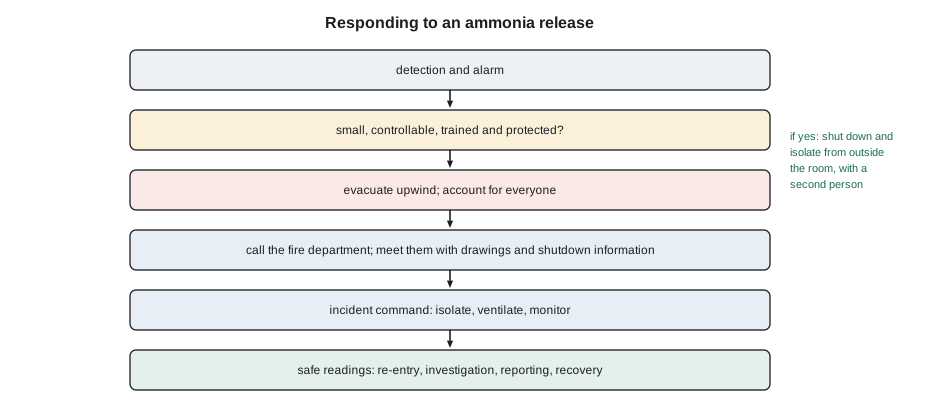
Responding to a release
The first minutes of a release decide most of its outcome. The priorities, in order, are the safety of people, stopping the release if it can be done safely, and protecting property and the environment. Operators who detect a release follow the plant's procedure: raise the alarm, evacuate the affected area, and, if trained and protected to do so and the release is small, shut down the machinery and close isolation valves from outside the room, using the emergency controls described in lesson 6. They do not enter a release area without the protection the concentration calls for, which for any large or unknown release means SCBA and chemical protective clothing worn by trained responders under incident command, never an untrained person with an escape respirator.
Whether to evacuate or shelter in place depends on the release and the location. People inside a building away from the release may be safer staying inside with doors and windows closed and ventilation shut off, while a cloud passes, than walking out into it. People in or near the release area must leave, moving upwind or crosswind. The plan sets these decisions in advance, and the fire department may change them on the day.
When the fire department arrives, it takes command, usually under an incident command system in which one incident commander directs the response and plant staff act as technical advisers. Plant staff tell the incident commander what they know: what has been released, from where, roughly how much, what has been shut down and isolated, who is unaccounted for, and where the drawings and safety data sheet are. Responders may use water spray to knock down ammonia vapour, which absorbs it, but the run-off water then contains ammonia and must be contained. After the release has been stopped and the area ventilated, monitoring decides when people can re-enter without protection.
For carbon dioxide, the response is similar but the hazards differ: no smell, a heavier-than-air gas collecting in low areas, and an asphyxiation and toxic hazard rather than an irritant one. Responders enter low areas, walk-ins and machine rooms only with detectors and, where concentrations could be high, with SCBA, and rescue of a collapsed person must not be attempted without protection, because would-be rescuers can be overcome too.
The Grand Valley tabletop exercise
The scenario Hannah wrote for the tabletop was a release from a broken liquid line on the dock side of the plant at two in the morning, after a forklift struck it, with one operator on site and a truck driver waiting at the dock. The group talked through each step on the plant drawings. Three gaps came out. First, the dock area had no fixed ammonia detector, so the only warning would be the smell and the driver's call, and the plan assumed the operator would hear an alarm. Second, the isolation valve that would stop the flow to the dock lines was inside the engine room, not at a remote point, so closing it would require entry. Third, the drivers waiting at the dock had never been told what to do if they smelled ammonia. The fire officers added a fourth: the plant's emergency information box at the main entrance still showed the 1998 plant, before the two expansions.
The actions that followed went into Hannah's tracking system: a detector at the dock, a remotely operated emergency isolation valve on the dock liquid main, which went through management of change, a one-page instruction for drivers at the gate, and updated drawings in the emergency box. Theo wrote up the exercise, with the gaps, the actions and their owners, and the date of the full-scale exercise with the fire department in the spring. "That's what an exercise is for," Ingrid said. "If it doesn't find anything, you didn't try hard enough."
The Hillcrest Arena assessment
The arena report brought together everything in the course. Its first section described the plant and its condition. The chiller was nearly forty years old, beyond the twenty to twenty-five years usually expected; its shell had external corrosion under failed insulation, and its tubes had never been eddy current tested. The compressors had been rebuilt twice and were serviceable. The plant room met an older edition of CSA B52 but not the current one: it had one ammonia detector, an emergency fan sized for a smaller charge, a door to the lobby, and no emergency shutdown switch outside the door. The brine expansion tank was open to the room. The emergency procedures were seven years old and had never been practised with the fire department. The rink floor, as lesson 11 found, would need replacing within about ten years.
The second section set out the immediate actions, which the report recommended whatever the long-term decision: continue monthly laboratory testing of the brine for ammonia, with the shutdown instruction on any positive result; eddy current test the chiller tubes at the end of the season; add detectors, upgrade the emergency fan and add an emergency shutdown switch and alarms outside the door; replace the open brine tank with a closed one vented outdoors; seal the door to the lobby and use the outside door as the main entrance; update the emergency procedures and practise them with the fire department; and train the arena operators, with refresher training every year.
The third section compared three long-term options, using weighted scores agreed with Pat and the city's engineer, and a 25-year life-cycle cost. Option A was a like-for-like replacement of the chiller, keeping the flooded brine design and its charge. Option B was a packaged low-charge ammonia chiller outdoors with a glycol loop, reusing the floor until it needed replacing. Option C was a direct transcritical carbon dioxide system with heat recovery to the building, its hot water and the snow melt pit, installed with a new floor.
# Arena refrigeration options: weighted scores and 25-year life-cycle cost (illustrative)
weights = {"safety": 0.35, "cost": 0.25, "energy and carbon": 0.20, "operations and skills": 0.10, "schedule": 0.10}
options = {  # capital $, electricity kWh/yr, natural gas m3/yr saved by heat recovery, scores 1 to 5
    "A like-for-like flooded chiller": (450_000, 420_000, 0, {"safety": 2, "cost": 5, "energy and carbon": 2, "operations and skills": 4, "schedule": 5}),
    "B low-charge ammonia + glycol":   (780_000, 400_000, 15_000, {"safety": 4, "cost": 3, "energy and carbon": 3, "operations and skills": 4, "schedule": 4}),
    "C CO2 direct + heat recovery":    (1_150_000, 330_000, 45_000, {"safety": 5, "cost": 2, "energy and carbon": 5, "operations and skills": 3, "schedule": 3})}
elec, gas, rate, years = 0.15, 0.45, 0.04, 25      # $/kWh, $/m3, discount rate, life
pvf = (1 - (1 + rate) ** -years) / rate
for name, (cap, kwh, gas_saved, sc) in options.items():
    annual = kwh * elec - gas_saved * gas
    lcc = cap + annual * pvf
    score = sum(weights[k] * v for k, v in sc.items())
    co2 = kwh * 0.04 / 1000 - gas_saved * 1.9 / 1000    # t/yr: Ontario grid about 40 g/kWh, gas 1.9 kg/m3
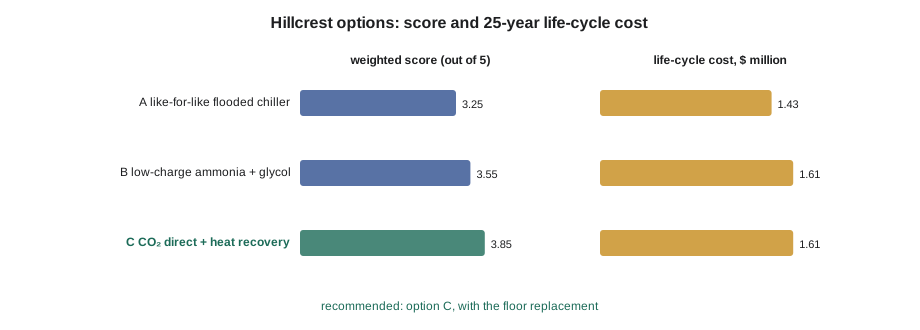
print(f"{name:32s} score {score:.2f} LCC ${lcc / 1e6:.2f} M net CO2 {co2:5.1f} t/yr")A like-for-like flooded chiller score 3.25 LCC $1.43 M net CO2 16.8 t/yr B low-charge ammonia + glycol score 3.55 LCC $1.61 M net CO2 -12.5 t/yr C CO2 direct + heat recovery score 3.85 LCC $1.61 M net CO2 -72.3 t/yr
Option A had the lowest life-cycle cost, about $1.43 million, but the lowest score, because it kept 360 kg of ammonia in a room beside the lobby. Options B and C had almost the same life-cycle cost, about $1.61 million, because C's heat recovery saved enough natural gas to offset much of its higher capital cost, and C scored highest, with no ammonia at all and the largest carbon savings on Ontario's low-carbon grid, about 72 tonnes of CO₂ a year net. The report recommended option C, timed with the floor replacement, and, because the floor could not wait ten years without risk, recommended bringing the floor replacement forward by three years, with the immediate actions carrying the plant safely until then. In each case the report showed the scores, the costs and the assumptions behind them, so the council could see how a change in the weights or the prices would change the answer.
Presenting to the council
Ingrid coached Theo on the presentation. The council members were not refrigeration experts, and they would remember three things at most. Theo chose them carefully: the plant could keep running safely only with the immediate actions done this year; the long-term choice was between a small ammonia charge outdoors and no ammonia at all, both far safer than today; and the choice depended on how the council weighed cost, carbon and the floor's remaining life. He used one slide with the scores and costs, one with a photograph of the corroded chiller shell, and one with Fernie's lessons, stated respectfully and simply: act on warning signs, plan for aging equipment, and practise the emergency plan.
The committee approved the immediate actions and the design of option C, with the floor replacement brought forward, subject to a grant application under a federal and provincial infrastructure program. Pat asked Northfield to manage the immediate actions over the winter. Theo, now near the end of his apprenticeship, would lead the work under Ingrid's supervision, his first project of that size.
Looking back on the course
The course followed Theo from his first morning in an ammonia plant to leading a project. Along the way it covered the properties and hazards of ammonia and carbon dioxide; the types of industrial ammonia systems, their compressors, vessels, valves, relief and oil systems; machinery rooms, detection and ventilation; process safety programs and the rules behind them; the routine tasks that bring people and ammonia together; carbon dioxide's high pressures and transcritical cycles; secondary and cascade systems; and emergency planning. The common thread was that safety in these systems is not one device or one rule. It is many layers, design, maintenance, procedures, training, detection and emergency response, each of which has to be kept in place, and a technician's daily work, done carefully and recorded honestly, is one of the most important of them.
| Layer of protection | Example in this course |
|---|---|
| Inherent safety | Low-charge designs, cascades and direct CO₂ that remove or reduce the ammonia |
| Design and codes | Machinery rooms, rated components, relief to safe locations |
| Mechanical integrity | Scheduled relief valve replacement, vessel inspection, eddy current testing |
| Procedures and permits | Oil draining with two valves, isolation plans, management of change |
| Detection and alarms | Machinery room detectors, brine testing, CO₂ detectors low in rooms |
| Emergency response | Practised plans, emergency controls outside the door, coordination with responders |
Common mistakes
MistakeWriting an emergency plan and filing it away.
InsteadPractise it with the people and responders who would use it, and fix what the exercise finds.
MistakeEntering a release to close a valve without SCBA and training.
InsteadEvacuate, use the emergency controls outside the room and let trained responders enter.
MistakeTrying to rescue a person collapsed in a CO₂ release without protection.
InsteadRaise the alarm; rescuers need detection and breathing apparatus.
MistakePresenting only the cheapest option to an owner.
InsteadCompare options on safety, cost, energy, carbon and skills, and show the assumptions.
MistakeDeferring immediate safety actions while a long-term decision is made.
InsteadCarry out the immediate actions now; they protect people in the meantime.
Summary and key terms
- Every plant needs written emergency procedures; larger plants need full emergency plans coordinated with responders and practised.
- In Ontario, OHS law, CSA B52 and, above 4,500 kg of ammonia, the E2 Regulations set the requirements. Many plants evacuate and rely on fire department hazardous materials teams.
- Priorities in a release are people, then stopping the release safely, then property and the environment; entry requires SCBA and trained responders.
- Exercises are for finding gaps; Grand Valley's found missing detection, a valve requiring entry, uninformed drivers and outdated drawings.
- The Hillcrest assessment combined immediate safety actions with a long-term option comparison on safety, cost, energy, carbon and skills.
- Safety in natural refrigerant systems depends on many layers, each of which must be maintained.
- Emergency plan
- A written plan for preventing, preparing for, responding to and recovering from a release.
- Shelter in place
- Staying inside a building with doors, windows and ventilation closed while a hazardous cloud passes.
- Incident command system
- A standard structure in which one incident commander directs the response to an emergency.
- Tabletop exercise
- A discussion-based exercise in which participants walk through their response to a scenario.
- Life-cycle cost
- The total cost of owning a system over its life, including capital, energy and maintenance, discounted to the present.
- Layers of protection
- Independent safeguards that each reduce the chance or consequences of an incident.
Practice problems
Work each problem on paper first, then reveal the answer to check.
An option costs $900,000 and saves $20,000 a year in energy. At a 4 % discount rate over 25 years, what is the present value of the savings?
Show answer
The factor is about 15.6, so about $312,000.
Give three questions an emergency plan must answer.
Show answer
Any three: how releases are detected, who decides to evacuate, where people assemble, who calls and meets responders, how people are accounted for, who reports, how recovery is managed.
Why should someone not attempt to rescue a person collapsed in a CO₂ release without protection?
Show answer
The rescuer can be overcome by the same concentration.
Name two immediate actions recommended for Hillcrest regardless of the long-term option.
Show answer
Any two: monthly brine testing, eddy current testing, more detectors and ventilation, emergency shutdown outside the door, closed brine tank, updated and practised procedures, operator training.
Lesson quiz · 5 questions
Score 60% or more to complete this lesson.
Create a free account to save your progress, take quizzes and earn a certificate.