
RAC-420 · Lesson 1 of 12 · 18 min
Natural refrigerants and industrial refrigeration
In January of Theo's fourth year, Dana moved him from the chiller work at Riverbend to Northfield's small industrial group for six months. The group had four people, led by Ingrid Sorensen, who had spent twenty-five years in ammonia plants before Northfield hired her to build an industrial service business. Ingrid held the refrigeration and air conditioning mechanic certificate with a Red Seal and a TSSA refrigeration operator certificate. "Everything you know still applies," she told Theo on his first morning. "The cycle is the same. What changes is the size, the refrigerant and the consequences. In this work you do nothing until you know where the ammonia is and how it could get out."
This course is about the two natural refrigerants that dominate large systems: ammonia, which has been the refrigerant of industrial cold storage, food processing and ice rinks for more than a century, and carbon dioxide, which has become the main low-GWP choice for supermarkets and a growing choice for rinks and industrial freezers. It covers their properties and hazards, the systems built around them, the codes and process safety programs that govern them, and how to operate, maintain and respond to emergencies safely. This first lesson sets out why these refrigerants are used and introduces the three sites the course follows.
Why natural refrigerants
Ammonia (R-717) and carbon dioxide (R-744) are called natural refrigerants because they occur in nature and are made in large quantities for other uses, not designed as refrigerants. Neither depletes the ozone layer. Ammonia has a global warming potential of zero, and carbon dioxide, by definition, has a GWP of one. As RAC-120 and RAC-310 described, the HFC phasedown under the Kigali Amendment and the rules that implement it in Canada are pushing large commercial and industrial systems away from high-GWP refrigerants, and for many of those systems the practical alternatives are ammonia, carbon dioxide or hydrocarbons.
Ammonia was never pushed out of industrial refrigeration, even when CFCs took over most other uses. It is the most efficient common refrigerant in large systems: it has a very high latent heat, about 1,300 kJ/kg at typical evaporating temperatures, roughly six times that of R-134a, so the mass flow for a given capacity is small and pipes, valves and compressors can be smaller. It is cheap. It tolerates water better than fluorocarbons, it is lighter than air, and its sharp smell warns people of a leak at concentrations far below those that cause harm. Its drawbacks are serious: it is toxic, it is mildly flammable, it attacks copper and copper alloys, so systems are built of steel, and its strong smell can cause panic. Every one of those drawbacks shapes the way ammonia plants are designed, run and regulated.
Carbon dioxide has very different strengths and weaknesses. It is non-flammable and of low toxicity, cheap and widely available, and it has excellent heat transfer and a very high volumetric capacity, so compressors and pipes are small. But it works at very high pressures, several times those of HFC systems, and its critical temperature is only about 31 °C, so in warm weather a carbon dioxide system cannot condense its refrigerant and must reject heat as a supercritical gas. Lessons 9 to 11 cover what that means.
What makes a system industrial
The term industrial refrigeration has no exact definition, but technicians recognize it by its features: large capacities, often hundreds or thousands of kilowatts; low temperatures for freezing and frozen storage; steel piping welded and flanged rather than brazed copper; refrigerant charges measured in tonnes or thousands of pounds; engineered vessels such as receivers, recirculators and intercoolers; screw and reciprocating compressors with oil systems the size of small cars; and owners with full-time operators. Cold storage warehouses, meat and poultry plants, dairies, breweries, frozen food factories, ice rinks and chemical plants are typical. The systems are usually built for one site, from components selected by a design engineer, rather than bought as packaged units.
Industrial plants also differ in who works on them. The owner's operators run the plant and do routine checks. Specialist contractors, like Northfield's industrial group, do major maintenance, repairs, start-ups and modifications. Engineers design changes, and the owner's process safety staff manage the programs that lesson 7 describes. A technician coming from commercial work must learn new equipment, new procedures and a new level of formality: permits, written procedures, isolation plans and records for almost everything.
The three sites in this course
Ingrid's group had three clients that would teach Theo most of what he needed. The first was Grand Valley Cold Storage, a public refrigerated warehouse on the edge of Kitchener that stored frozen food for processors and grocery chains. Its freezer rooms ran at −25 °C (−13 °F), with loading docks and coolers at about 2 °C (36 °F). The plant was a two-stage ammonia system with liquid recirculation, built in 1998 and expanded twice, with screw compressors, an evaporative condenser, a large high-pressure receiver and a pumped recirculator feeding the freezer evaporators. The plant manager, Luis Ortega, had two operators per shift, and a process safety coordinator, Hannah Kowal, ran the plant's programs.
The second was the community ice arena whose ice machine Theo had looked after since his first year. Hillcrest Arena, owned by the city, had a single ice pad and an ammonia plant from 1986: two reciprocating compressors and a shell-and-tube chiller in which ammonia cooled calcium chloride brine, which was pumped through pipes in the rink floor. The city's facilities supervisor, Pat Morrison, had asked Northfield to assess the plant, because the chiller was nearly forty years old and the council wanted to know whether to rebuild, replace or switch refrigerants. The capstone in lesson 12 is that assessment.
The third was a new client: Harvest Lane Market, the grocery Theo had helped start up in RAC-310, was building a second, larger store, and its owner, Meera Shah, had decided on a transcritical carbon dioxide booster system instead of HFC racks. The designer, Nadia Brooks, would specify the system, and Northfield would install and service it. Lesson 10 follows its design and start-up.
Charge: how much, and where
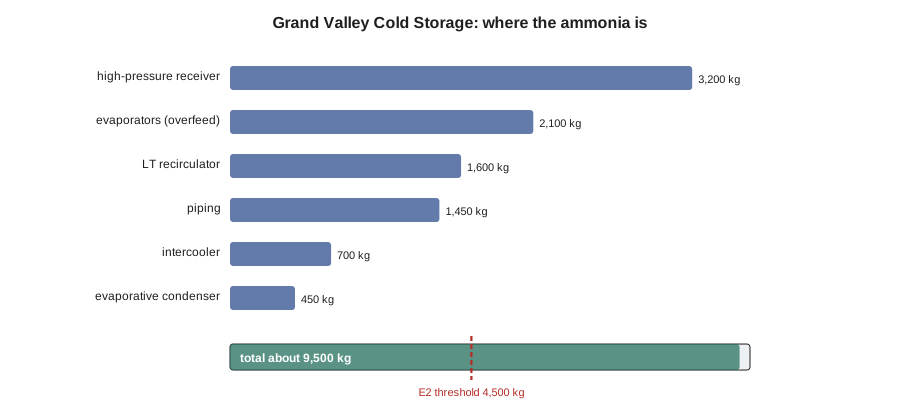
Ingrid's first lesson for Theo was the plant's charge. In an industrial plant, the quantity of ammonia and where it sits decides which rules apply, how bad a release could be and which parts of the plant deserve the most attention. Hannah kept an inventory estimate, updated whenever the plant changed, that divided the charge among the vessels, evaporators and piping. The script totals it, works out the charge per unit of capacity, and checks it against the threshold quantity that brings in Canada's Environmental Emergency Regulations, 2019.
# Grand Valley Cold Storage: where the ammonia is, and which rules the total triggers
inventory_kg = {  # estimated normal operating inventory by component (illustrative)
    "high-pressure receiver": 3200, "low-temperature recirculator": 1600,
    "intercooler": 700, "evaporative condenser": 450,
    "evaporators (liquid overfeed)": 2100, "piping": 1450}
total = sum(inventory_kg.values())
for part, kg in inventory_kg.items():
    print(f"{part:31s} {kg:6,d} kg  {kg / total:5.1%}")
print(f"{'total charge':31s} {total:6,d} kg")
capacity_kw = 1400 + 700           # freezer (booster) load plus cooler and dock load
print(f"charge per kW of refrigeration: {total / capacity_kw:.1f} kg/kW")
e2_threshold = 4500                # kg, anhydrous ammonia under the Environmental Emergency Regulations, 2019
print(f"E2 threshold 4,500 kg: {'exceeded, so an environmental emergency plan is required' if total >= e2_threshold else 'below'}")
print(f"ratio to threshold: {total / e2_threshold:.1f} times")
# the arena and a modern packaged low-charge unit, for comparison
for name, kg, kw in [("arena flooded brine chiller", 360, 350), ("packaged low-charge chiller", 25, 350)]:
print(f"{name:28s} {kg:5d} kg for {kw} kW = {kg / kw:.2f} kg/kW")high-pressure receiver 3,200 kg 33.7% low-temperature recirculator 1,600 kg 16.8% intercooler 700 kg 7.4% evaporative condenser 450 kg 4.7% evaporators (liquid overfeed) 2,100 kg 22.1% piping 1,450 kg 15.3% total charge 9,500 kg charge per kW of refrigeration: 4.5 kg/kW E2 threshold 4,500 kg: exceeded, so an environmental emergency plan is required ratio to threshold: 2.1 times arena flooded brine chiller 360 kg for 350 kW = 1.03 kg/kW packaged low-charge chiller 25 kg for 350 kW = 0.07 kg/kW
Grand Valley held about 9,500 kg of ammonia, about 4.5 kg per kW of refrigeration, which is typical for an older recirculated plant. That is about twice the 4,500 kg threshold for anhydrous ammonia under the Environmental Emergency Regulations, so the company must have an environmental emergency plan, test it and report to Environment and Climate Change Canada, as lesson 7 describes. Ontario's occupational health and safety rules, the operating engineers regulation and CSA B52 apply whatever the quantity. A third of the charge sat in the high-pressure receiver, and more than a fifth in the evaporators, which is why the plant's procedures concentrated on those parts.
The comparison at the end of the script shows how far the industry has moved. The arena's flooded brine chiller held about 1 kg per kW, while a modern packaged low-charge ammonia chiller of the same capacity holds less than a tenth of that, about 0.07 kg per kW. Reducing charge is now one of the main safety strategies for ammonia, and lessons 3 and 12 return to it.
The rules in outline
Large ammonia and carbon dioxide systems are governed by several layers of rules, which lessons 5 to 8 explain in detail. Safety codes set the requirements for design, installation, machinery rooms, pressure relief and detection: CSA B52, the Mechanical Refrigeration Code, adopted in Ontario through TSSA, with Ontario's boiler and pressure vessel rules for the vessels. Industry standards, especially those of the International Institute of All-Natural Refrigeration, known as IIAR, set recognized practice for design, installation, start-up, inspection and maintenance, operating procedures and older systems. Occupational health and safety rules set exposure limits, lockout and confined space requirements and employers' duties. And process safety and environmental emergency rules apply to plants above threshold quantities.
In Ontario, refrigeration plants above certain sizes must also be registered with TSSA and operated under the supervision of certificated operators, under the operating engineers regulation, O. Reg. 219/01; the class of plant and certificate depends on the plant's size and refrigerant, so the regulation should be checked for each site.
How this work is done safely
Ingrid's rules were simple and absolute. Nobody opened any part of an ammonia system without a written procedure, a permit and an isolation plan reviewed by a second person. Everyone carried a personal ammonia monitor, wore the protective equipment the procedure required and knew where the nearest emergency shower, eyewash and escape route were. Nobody worked alone on an ammonia system. And anyone could stop a job at any time if something did not look right, without having to justify it first. "You're going to hear me say 'stop' a lot," she said. "It's not because you're doing it wrong. It's because stopping is cheap and ammonia isn't."
Those rules come from experience. Ammonia releases have injured and killed workers and members of the public, and carbon dioxide releases have killed people in confined spaces. Lesson 12 examines one of the most important recent incidents in North America, the 2017 release at an arena in Fernie, British Columbia, in which three workers died. The point of studying incidents is not to frighten anyone, but to understand how ordinary decisions, put off or overlooked over years, line up into a disaster, and how each layer of the system, from design to procedures to emergency response, can stop that from happening.
| Topic | Ammonia (R-717) | Carbon dioxide (R-744) |
|---|---|---|
| Safety group | B2L: higher toxicity, lower flammability | A1: lower toxicity, non-flammable |
| GWP (100-year) | 0 | 1 |
| Typical uses | Cold storage, food plants, rinks, chillers | Supermarkets, rinks, freezers, heat pumps |
| Pressure level | Moderate, similar to R-22 | Very high, several times HFC levels |
| Main hazard | Toxicity, with a strong warning smell | Asphyxiation and very high pressure, no smell |
| Materials | Steel; no copper or brass | Steel and copper rated for high pressure |
Common mistakes
MistakeTreating an industrial ammonia plant as a large commercial system.
InsteadLearn the vessels, procedures, permits and process safety programs before touching it.
MistakeAssuming that a strong ammonia smell means a dangerous concentration.
InsteadThe smell is detectable far below harmful levels; use a monitor to know the concentration.
MistakeThinking carbon dioxide is harmless because it is non-flammable and non-toxic at low levels.
InsteadHigh concentrations displace oxygen and act on the body; it has no smell to warn you.
MistakeIgnoring how much refrigerant is in a system.
InsteadThe charge and where it sits decide which rules apply and where the risks are greatest.
MistakeWorking alone, or without a written procedure, on an ammonia system.
InsteadUse procedures, permits, isolation plans, monitors and a second person every time.
Summary and key terms
- Ammonia and carbon dioxide are natural refrigerants with zero or negligible GWP and no ozone depletion.
- Ammonia is very efficient and cheap but toxic and mildly flammable; carbon dioxide is non-flammable but works at very high pressures and is transcritical in warm weather.
- Industrial systems are large, site-built, steel-piped plants with engineered vessels and large charges, run by operators.
- The charge and its location decide which rules apply; reducing charge is a major safety strategy.
- Safety codes, IIAR standards, occupational health and safety rules and process safety and emergency rules all apply to large ammonia plants.
- Ammonia work is done with written procedures, permits, isolation plans, monitors and a second person.
- Natural refrigerant
- A refrigerant that occurs in nature, such as ammonia, carbon dioxide or a hydrocarbon.
- Industrial refrigeration
- Large, site-built refrigeration systems for cold storage, food processing, rinks and process cooling.
- Charge
- The quantity of refrigerant in a system.
- Threshold quantity
- The quantity of a substance above which process safety or emergency planning rules apply.
- Low-charge system
- A system designed to hold far less refrigerant per unit of capacity than a traditional design.
- IIAR
- The International Institute of All-Natural Refrigeration, which publishes standards for ammonia and other natural refrigerant systems.
Practice problems
Work each problem on paper first, then reveal the answer to check.
A plant holds 6,200 kg of ammonia. Is it above the Environmental Emergency Regulations threshold?
Show answer
Yes: the threshold for anhydrous ammonia is 4,500 kg.
Why are ammonia plants built of steel rather than copper?
Show answer
Ammonia attacks copper and its alloys.
A packaged chiller holds 30 kg of ammonia for 400 kW. What is its charge per kW?
Show answer
About 0.075 kg/kW.
Name two strengths and two weaknesses of carbon dioxide as a refrigerant.
Show answer
Strengths: non-flammable, low toxicity, high capacity, cheap. Weaknesses: very high pressures, transcritical operation in warm weather, asphyxiation hazard.
Lesson quiz · 5 questions
Score 60% or more to complete this lesson.
Create a free account to save your progress, take quizzes and earn a certificate.