
RAC-410 · Lesson 7 of 12 · 17 min
Chilled-water piping arrangements
Grace's complaint from lesson 1 had stayed on Raj's list all summer: the plant ran a second chiller when the first was only half loaded. In July, with the controls contractor's trend data in hand, Raj sat down with Theo and a marker at the whiteboard in the plant office and drew the plant's piping. "Every chilled-water problem starts here," he said, tapping a short length of pipe between the supply and return headers. "This is the decoupler. Tell me which way the water is flowing in it, and I'll tell you what's wrong with the plant."
This lesson describes the main ways chilled-water plants are piped: constant flow, primary-secondary, and variable primary flow, and the problem that troubles many of them, low delta-T syndrome, in which the chilled water returns too cold and the plant has to run more chillers and pumps than the load needs.
Why the temperature difference matters
Every chilled-water system obeys a simple relationship between the heat it carries, the flow and the temperature difference between supply and return, the delta-T:
For a given load, a larger delta-T means less flow, smaller pumps and pipes and less pumping energy. A chiller's capacity is also tied to its flow: it is selected to deliver its rated cooling at its design flow and delta-T, so if the returning water is not as warm as the design, the chiller cannot be fully loaded at that flow. Riverbend's coils and chillers were designed for a delta-T of 6.7 K (12 °F), chilled water supplied at 6.7 °C (44 °F) and returned at 13.3 °C (56 °F).
Constant flow
The simplest system pumps a constant flow through the chillers and the coils, with three-way valves at the coils that bypass water around them when they need less cooling. The flow never changes, so the chillers always see their design flow, but the return water becomes colder at part load because bypassed supply water mixes into it, and the pumps run at full power all the time. Older buildings still have constant-flow systems, and many older wings of hospitals have three-way valves left from them.
Primary-secondary
A primary-secondary plant separates the chillers' flow from the buildings' flow. Each chiller has its own constant-speed primary pump, sized for the chiller's design flow, circulating water through the chiller and a short loop. Variable-speed secondary pumps take water from that loop and send it to the coils, which have two-way valves that throttle the flow as the load falls; the secondary pumps slow down to hold a differential pressure at the far end of the system. The two loops are joined by the decoupler, a short, open pipe between the supply and return headers, sometimes called the common pipe or bypass, which lets the two flows differ.
Which way the water flows in the decoupler shows the balance between them.
- If the running chillers' primary flow is greater than the coils' secondary flow, the surplus flows from supply to return through the decoupler. The chillers receive slightly diluted return water, but the buildings get water at the chillers' leaving temperature. This is the normal condition.
- If the secondary flow exceeds the primary flow, return water flows backward through the decoupler from the return to the supply, mixes with the chillers' cold water and warms the supply to the buildings. The coils then need even more flow, which makes the deficit worse. The usual response, by an operator or a control sequence, is to start another chiller and its primary pump, even though the chillers already running are not fully loaded.
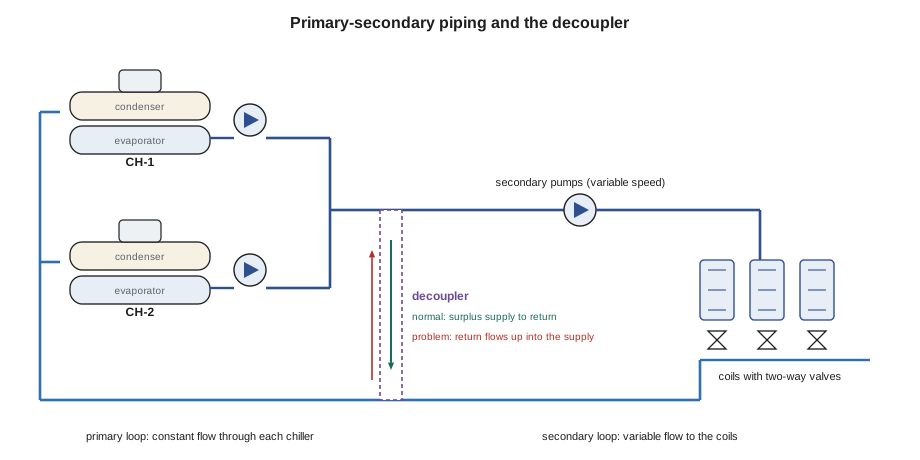
Primary-secondary plants are reliable and easy to understand, and they protect each chiller's evaporator from low flow. Their weakness is that the number of chillers running is set by flow, not just by load. If the coils return water colder than the design, they draw more flow than the design for the same load, and the plant starts chillers to supply it.
Low delta-T syndrome
Low delta-T syndrome is the name for a system whose coils return chilled water much colder than the design, so the delta-T is small. Its common causes are:
- Three-way valves left in parts of the system, which pass supply water straight into the return.
- Coil control valves that leak through, are oversized and hunt, or have failed open, so coils pass more water than they need.
- Supply air setpoints too low, or air handlers with economizers fighting their cooling coils.
- Dirty or poorly piped coils, coils piped in parallel flow instead of counterflow, and air bound coils with poor heat transfer, which need more flow for the same heat.
- Chilled water supplied warmer than design, which makes every coil open wider; and bypasses, such as open balancing bypasses or a decoupler on the wrong side of a pump, that short-circuit supply to return.
- Coils selected for a delta-T smaller than the plant's design, so the plant can never reach its design delta-T.
The controls contractor's trends showed what Riverbend's plant was doing on a typical July afternoon: a load of about 2,100 kW (600 tons), one chiller's worth, but a coil delta-T of only about 3.9 K (7 °F). The script models the plant at that load with one chiller and with two, and then with the delta-T partly restored.
# Primary-secondary plant at Riverbend: what low delta-T does to the decoupler (flows L/s, temperatures C)
chiller_flow, supply = 75.0, 6.7                # constant primary flow per chiller; chiller leaving temperature
def plant(load_kw, coil_dt, chillers):
    sec = load_kw / (4.19 * coil_dt)            # flow the coils draw
    prim = chiller_flow * chillers
    if prim >= sec:                             # surplus primary water returns through the decoupler
        ret = supply + coil_dt * sec / prim     # chillers see return water diluted by supply water
        return sec, prim, supply, ret, "surplus " + f"{prim - sec:.0f} L/s back through the decoupler"
    # deficit: return water flows forward through the decoupler and warms the supply
    t = supply
    for _ in range(50):
        ret_c = t + coil_dt
        t = (prim * supply + (sec - prim) * ret_c) / sec
    return sec, prim, t, t + coil_dt, "deficit " + f"{sec - prim:.0f} L/s of return water mixing into the supply"
for dt in (3.9, 6.1):
    for n in (1, 2):
        sec, prim, ts, tr, note = plant(2100, dt, n)
        load_on = 2100 / (2110 * n)
print(f"coil dT {dt} K, {n} chiller(s) for 2,100 kW ({load_on:.0%} each): coils {sec:.0f} L/s, supply {ts:.1f} C; {note}")coil dT 3.9 K, 1 chiller(s) for 2,100 kW (100% each): coils 129 L/s, supply 9.5 C; deficit 54 L/s of return water mixing into the supply coil dT 3.9 K, 2 chiller(s) for 2,100 kW (50% each): coils 129 L/s, supply 6.7 C; surplus 21 L/s back through the decoupler coil dT 6.1 K, 1 chiller(s) for 2,100 kW (100% each): coils 82 L/s, supply 7.3 C; deficit 7 L/s of return water mixing into the supply coil dT 6.1 K, 2 chiller(s) for 2,100 kW (50% each): coils 82 L/s, supply 6.7 C; surplus 68 L/s back through the decoupler
With a 3.9 K delta-T, the coils needed about 129 L/s, but one chiller's primary pump supplied only 75 L/s. About 54 L/s of return water flowed backward through the decoupler, and the supply to the buildings rose to about 9.5 °C, unacceptable for the operating rooms, so the plant started CH-2 and ran both chillers at about 50 % load. With the delta-T raised to 6.1 K, the coils needed only 82 L/s; one chiller nearly carried it, with the supply only slightly warmed, and a little more flow capacity or delta-T would have let it run alone.
That was Grace's problem, explained. The second chiller was not starting because of load; it was starting because of flow, and the flow came from the coils' low delta-T. Two chillers at half load used more energy than one near full load, plus a second primary pump, a second condenser pump and more tower flow. Lesson 12 shows what fixing it was worth.
Finding the causes
Raj and Theo spent two days in the buildings with the controls contractor's technician, Anika, following the trend data to the worst coils. They found three-way valves still in service on the older outpatient wing's air handlers, two large coil valves leaking through when closed, an air handler whose discharge setpoint had been lowered by 2 K (4 °F) years earlier to fix a humidity complaint that no longer existed, and a coil so dirty on its air side that it needed twice its design water flow. A simple way to rank coils is to compare each one's water delta-T with its design while it is under load, from the building automation trends or with a temporary thermometer at the coil. The coils with the smallest delta-T are where to look first.
Fixing low delta-T is rarely one big repair. It is a list: convert three-way valves to two-way and remove their bypasses, replace leaking and oversized valves with pressure-independent control valves that limit the flow to the coil's design, clean coils, correct setpoints, and keep the chilled-water supply at its design temperature. Some plants also raise the supply setpoint in mild weather to save chiller energy, but that increases coil flows and can worsen delta-T, so it must be done carefully.
Variable primary flow
Many newer plants, and many retrofits, use variable primary flow. There are no separate primary pumps: variable-speed pumps send water through the chillers and directly to the coils, and the flow through the chillers varies with the load. A small bypass with a control valve, instead of an open decoupler, opens only to keep each running chiller above its minimum evaporator flow. Variable primary saves pumping energy and space and avoids the decoupler's mixing problem, but it needs chillers that can tolerate changing flow, at a limited rate of change, and a control sequence that handles staging and the minimum-flow bypass well. Modern chillers are designed for it.
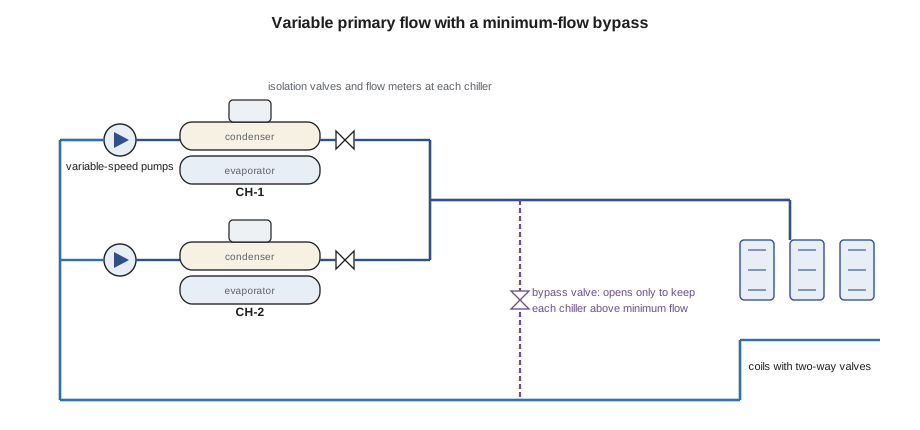
Variable primary does not cure low delta-T. With colder return water, a variable primary plant still needs more flow and may still stage chillers early, though it can run each chiller at more than its design flow, up to the manufacturer's limit, which helps. The cure is still at the coils.
Other arrangements
Large campuses add more layers. A primary-secondary-tertiary system has building pumps that draw from a campus distribution loop. District energy systems connect buildings through heat exchangers or direct connections, often with contractual delta-T requirements and penalties for low delta-T, because a district plant suffers from it as a whole. Thermal energy storage, chilled water or ice made at night, decouples production from load and changes the staging picture entirely. Whatever the arrangement, the questions from this lesson apply: what flow does each part need, which way is water flowing in each bypass, and what delta-T are the coils actually returning?
Measuring delta-T in the field
Building automation trends are the easiest source of delta-T data, but they are only as good as the sensors. When Theo found a coil whose trend showed almost no temperature rise, he checked it with a pair of calibrated strap-on probes on the coil's supply and return pipes, insulated from the room air, and found the return sensor had been mounted on the wrong pipe during the renovation. Spot checks like this, at the plant headers and at a few key coils, should come before any conclusions about the plant.
Common mistakes
MistakeStarting another chiller because the supply water is warm without checking the decoupler.
InsteadLook at the flow direction and the coil delta-T first.
MistakeLeaving three-way valves in a variable-flow system.
InsteadConvert them to two-way valves so coils stop passing supply water to the return.
MistakeRaising the chilled-water supply temperature without watching the delta-T.
InsteadWarmer supply makes coils draw more flow; watch the result.
MistakeExpecting variable primary flow to cure low delta-T.
InsteadIt reduces pumping, but the cure is at the coils.
MistakeTreating low delta-T as a chiller problem.
InsteadIt is a distribution and coil problem that the chillers suffer from.
Summary and key terms
- Heat carried equals flow times delta-T; a low delta-T means more flow for the same load.
- Constant-flow systems with three-way valves return colder water at part load and pump at full power.
- Primary-secondary plants decouple chiller flow from building flow; flow direction in the decoupler shows the balance.
- Reverse decoupler flow warms the supply and leads plants to start extra chillers at low load.
- Low delta-T syndrome comes from three-way valves, leaking or oversized valves, low setpoints, dirty coils and other causes at the coils.
- Variable primary flow saves pumping energy, using a controlled bypass for chiller minimum flow, but does not cure low delta-T.
- Delta-T
- The temperature difference between chilled-water supply and return.
- Primary-secondary
- Piping with constant-flow chiller pumps and variable-flow distribution pumps joined by a decoupler.
- Decoupler
- A short open pipe between supply and return headers that lets primary and secondary flows differ.
- Low delta-T syndrome
- A chilled-water system returning water much colder than design, needing excess flow.
- Variable primary flow
- A plant in which the flow through the chillers varies with the load.
- Two-way valve
- A coil valve that throttles flow, so system flow varies with load.
- Three-way valve
- A coil valve that diverts water around the coil, keeping system flow constant.
- Pressure-independent control valve
- A coil valve that limits flow to a set value regardless of system pressure changes.
Practice problems
Work each problem on paper first, then reveal the answer to check.
A coil carries 500 kW with a 5 K delta-T. What flow does it need?
Show answer
500 ÷ (4.19 × 5) = about 24 L/s.
In a primary-secondary plant, water flows from return to supply in the decoupler. What does that mean?
Show answer
Secondary flow exceeds primary flow; return water is mixing into the supply.
Name three causes of low delta-T.
Show answer
Any three of: three-way valves, leaking or oversized valves, low air setpoints, dirty coils, wrong coil piping, warm supply water, open bypasses.
Why does variable primary flow need a bypass?
Show answer
To keep each running chiller above its minimum evaporator flow at low load.
Lesson quiz · 5 questions
Score 60% or more to complete this lesson.
Create a free account to save your progress, take quizzes and earn a certificate.