
RAC-410 · Lesson 6 of 12 · 17 min
Water treatment for open and closed loops
In June, CH-1's condenser approach began to climb, as lesson 10 will show in the logs. Before anyone opened the chiller, Raj called Sam Delgado, the water treatment company's representative for Riverbend, and asked for the last two months of tower water test results. Sam came the next morning with his test kit and a laptop. Within an hour he had found the problem: the inhibitor feed pump had lost its prime in May, and for three weeks the tower had run with almost no scale inhibitor and erratic biocide. "The chiller is telling you about the water," he said. "Fix the water and then we'll clean the tubes."
Technicians do not usually run a water treatment program, but they need to understand it, because its failures show up as chiller problems: high approach, fouled tubes, corrosion, plugged strainers and biological growth. This lesson explains what the program controls in open tower systems and closed chilled-water and heating loops, how cycles of concentration and blowdown work, how scaling tendency is judged, and what a technician should check.
The four problems
Water in a cooling system can cause four kinds of trouble, and a treatment program is designed to control all of them at once:
- Scale. Dissolved minerals, mainly calcium carbonate, come out of solution on hot surfaces such as condenser tubes when their concentration or the temperature rises. Even a thin layer insulates the tubes and raises the condenser approach.
- Corrosion. Water and oxygen attack steel, copper and galvanized surfaces. Corrosion thins pipes and tube sheets, produces deposits that foul heat exchangers and can perforate tubes.
- Fouling. Suspended solids, silt, airborne dust scrubbed by the tower, corrosion products and debris settle in low-velocity areas and on tube surfaces.
- Biological growth. Bacteria, algae and other organisms grow in warm, nutrient-rich tower water. They form slime layers, called biofilm, that insulate surfaces, shelter corrosion and harbour Legionella bacteria, the health risk RAC-210 lesson 7 described.
The problems feed each other. Biofilm traps silt and promotes corrosion under it; corrosion products give bacteria a surface; scale traps debris. A good program uses scale and corrosion inhibitors, biocides, dispersants and filtration together, and is monitored closely.
Cycles of concentration
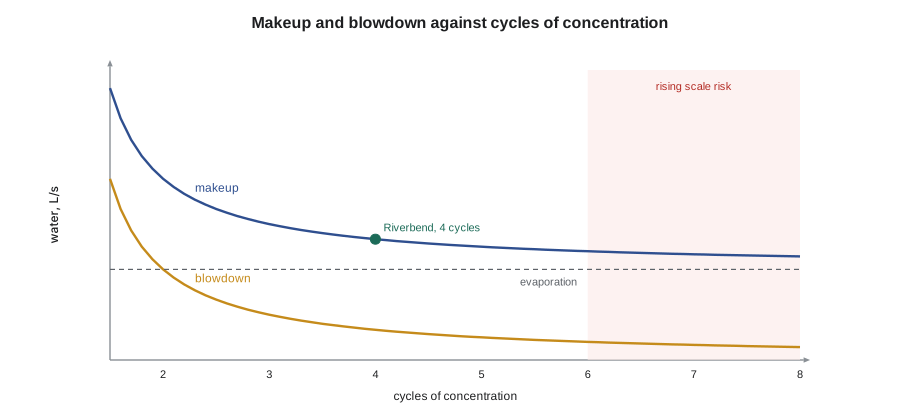
When water evaporates in a tower, the dissolved minerals stay behind, so the tower water becomes more concentrated than the makeup water. The ratio of the two concentrations is the cycles of concentration. It is usually measured by comparing the conductivity, or the chloride or another stable ion, of the tower water with that of the makeup. To keep the concentration from rising without limit, some water is deliberately drained, the blowdown or bleed, and replaced with fresh makeup. A small amount also leaves as drift.
Here E is the evaporation rate, B the blowdown, including drift, and M the makeup. Raising the cycles reduces blowdown and makeup, saving water and chemicals, but raises the concentration of minerals and the risk of scale. The program sets the highest cycles that the water chemistry and the inhibitors can handle, and a conductivity controller opens the blowdown valve to hold it.
Sam's report showed Riverbend's tower at 1,800 µS/cm with makeup at 450 µS/cm, four cycles. The script calculates the blowdown and makeup at that rate and at three and six cycles, using the design evaporation from lesson 5, and then judges the scaling tendency.
import math
# cycles of concentration, blowdown and makeup for the Riverbend towers
cond_tower, cond_makeup = 1800.0, 450.0        # microsiemens per cm
cycles = cond_tower / cond_makeup
evap = 1.72                                     # L/s at design, from lesson 5
for c in (cycles, 3.0, 6.0):
    blow = evap / (c - 1)
    makeup = evap + blow
    print(f"{c:3.1f} cycles: blowdown {blow:.2f} L/s, makeup {makeup:.2f} L/s, {makeup * 3600 * 1500 / 1000:,.0f} m3 over 1,500 full-load hours")
# Langelier saturation index of the tower water (positive = tends to scale, negative = tends to dissolve)
def lsi(ph, temp_c, tds, ca_hard, alk):
    a = (math.log10(tds) - 1) / 10
    b = -13.12 * math.log10(temp_c + 273.15) + 34.55
    c = math.log10(ca_hard) - 0.4
    d = math.log10(alk)
    return ph - ((9.3 + a + b) - (c + d))
print(f"tower water at 4 cycles, 35 C: LSI {lsi(8.6, 35, 1300, 400, 320):+.2f}")
print(f"same water at 6 cycles:       LSI {lsi(8.8, 35, 1950, 600, 480):+.2f}")
print(f"makeup water at 15 C: LSI {lsi(7.9, 15, 320, 100, 80):+.2f}")4.0 cycles: blowdown 0.57 L/s, makeup 2.29 L/s, 12,384 m3 over 1,500 full-load hours 3.0 cycles: blowdown 0.86 L/s, makeup 2.58 L/s, 13,932 m3 over 1,500 full-load hours 6.0 cycles: blowdown 0.34 L/s, makeup 2.06 L/s, 11,146 m3 over 1,500 full-load hours tower water at 4 cycles, 35 C: LSI +1.90 same water at 6 cycles: LSI +2.43 makeup water at 15 C: LSI -0.33
At four cycles, the tower needed about 0.57 L/s of blowdown and 2.3 L/s of makeup at design load; dropping to three cycles would raise the makeup by about 13 %, and pushing to six would cut it by about 10 %. The savings from higher cycles shrink as the cycles rise, because evaporation, which cannot be reduced, dominates.
Judging scaling tendency
Whether calcium carbonate will deposit depends on the water's pH, calcium hardness, alkalinity, dissolved solids and temperature. The Langelier saturation index, LSI, is a simple way to combine them. It compares the water's actual pH with the pH at which it would be exactly saturated with calcium carbonate, pHs. A positive LSI means the water tends to deposit scale; a negative one means it tends to dissolve it, and may be corrosive.
The script's LSI for the tower water at four cycles and 35 °C was about +1.9, and at six cycles about +2.4, strongly scale-forming, which is normal for tower water: concentrated and warm, it would scale quickly without inhibitors. The inhibitors in the program allow the water to stay supersaturated without depositing, up to a limit that depends on the product. The makeup water, at about −0.3, was slightly aggressive, as many municipal waters are. When the inhibitor feed failed, the tower water was left supersaturated with nothing to hold the calcium in solution, and the hottest surfaces, the condenser tubes, collected it first.
Water treaters use more detailed indices and software for their limits, and the numbers in the script are illustrative. The point for a technician is the direction: higher cycles, higher pH and higher temperature push toward scale, and the program depends on the inhibitor feed working every day.
Biological control and Legionella
Biocides control bacteria and algae. Oxidizing biocides, such as chlorine or bromine compounds, are fed continuously or in regular doses and measured as a residual; non-oxidizing biocides are fed periodically, often alternating types so that organisms do not adapt. Dispersants help the biocide reach organisms inside biofilm. The program's results are checked with dip slides or laboratory counts of general bacteria, and with periodic Legionella testing as the facility's water management plan requires.
In Ontario there is no province-wide cooling tower registry, as RAC-210 noted, but the facility's own water management plan, public health requirements and the owner's insurers and accreditors set expectations, and Quebec and New Brunswick have specific cooling tower regulations for towers in those provinces. Riverbend's plan named the tower as a critical control point with defined limits for biocide residual, bacteria counts and corrective actions. During the inhibitor pump failure the biocide had also run low for several days, so Sam's corrective action included an extra disinfection and a Legionella sample, which came back clear.
Closed loops
Chilled-water and heating loops are closed: the water is not evaporated or exposed to air, so it does not concentrate and needs little makeup. Its treatment aims to prevent corrosion and biological growth in a system that should stay sealed for years. A closed loop is typically treated with a corrosion inhibitor, such as nitrite, molybdate or an organic blend, kept within a concentration range, with the pH controlled and a biocide added when needed. Filters or a side-stream filter remove corrosion products. Glycol loops, like the brewery's, use inhibited glycol whose inhibitor is checked and topped up.
In a closed loop, makeup is the warning sign. A loop that needs water regularly is leaking, through a relief valve, a pump seal, a coil or a buried pipe, and the fresh water brings in oxygen and minerals that dilute the inhibitor and cause corrosion. Many plants fit a water meter on the closed-loop makeup line and log it; a sudden increase is a call for a leak search. At Riverbend, the chilled-water makeup meter had read almost the same for months, which suggested a tight loop, and Sam's test showed the inhibitor in range.
What the technician checks
On each visit, Raj and Theo looked at the water treatment equipment along with the chillers, because it is part of the system:
- The chemical feed pumps: running, primed, with their suction lines in the drums and the drum levels falling at the expected rate.
- The conductivity controller and blowdown valve: the probe clean, the reading matching a hand meter, the valve opening when it should.
- The makeup and blowdown meters: readings logged, cycles calculated from them as a check on the conductivity controller.
- Strainers and side-stream filters: pressure drops, cleaning dates, and what came out of them.
- The treatment company's log and test results: within limits, with corrective actions recorded.
- The tower itself: slime or algae on the fill and basin, scale on the fill edges, debris, foam or unusual colour.
Most of these take minutes. They would have caught the dry feed pump in May, a month before the condenser approach did. After the incident, Riverbend's operators added the feed pump check and drum levels to their daily round sheet, and Sam's company fitted a flow switch on the inhibitor line that alarmed through the building automation system.
Filtration and the tower basin
Towers scrub dust, pollen, leaves and insects out of the air they move, and that debris settles in the basin, where it feeds bacteria, shelters corrosion and ends up in the condenser tubes. Many plants fit a side-stream filter, which takes a small part of the circulating flow, often 5 to 10 %, through a sand filter, a cartridge filter or a centrifugal separator and returns it clean. Some plants also sweep the basin floor with nozzles that keep solids moving toward the filter's suction. Riverbend had a centrifugal separator whose purge valve dumped the collected solids to drain once an hour; part of Theo's spring checklist was to open it and look at what came out.
Debris also collects in the condenser water strainers and, if they are bypassed or broken, in the chiller's condenser tubes, where a single leaf or a piece of broken fill can block a tube and start erosion around the blockage. The eddy current reports in lesson 11 often show damage that began this way. Basin cleaning during the spring start-up, intact inlet screens, and strainers with logged pressure drops are the defence.
Records and limits
A water treatment program is written down. It lists the control limits for each loop, conductivity or cycles, pH, inhibitor concentration, biocide residual and bacteria counts, how often each is tested and by whom, and what to do when a result is out of range. The treatment company's service reports and the operators' daily readings should agree. When Raj reviewed the spring reports after the incident, he noticed that the operators had logged the conductivity every day, and it had risen above the controller's setpoint for several days in May without anyone acting, because the limit was not written on their sheet. The new sheet printed the limits beside each reading.
Common mistakes
MistakeTreating high condenser approach only as a tube cleaning job.
InsteadCheck the water treatment first; fix the cause before cleaning.
MistakeRunning the tower at the highest possible cycles to save water.
InsteadRun at the cycles the chemistry and inhibitors can support.
MistakeIgnoring closed-loop makeup water.
InsteadMeter and log it; regular makeup means a leak.
MistakeAssuming biocide residual means no Legionella risk.
InsteadFollow the water management plan's testing and corrective actions.
MistakeLeaving chemical feed checks to the treatment company alone.
InsteadCheck feed pumps, drums and controllers on every visit.
Summary and key terms
- Water treatment controls scale, corrosion, fouling and biological growth, which reinforce one another.
- Cycles of concentration compare tower and makeup water; blowdown equals evaporation divided by cycles minus one.
- Higher cycles save water and chemicals but raise scale risk; the gains shrink at high cycles.
- The Langelier saturation index shows scaling tendency; tower water is scale-forming and depends on inhibitors.
- Biocides and a water management plan control bacteria and Legionella; results and corrective actions are recorded.
- Closed loops need corrosion inhibitor and should need little makeup; rising makeup means a leak.
- Cycles of concentration
- The ratio of dissolved solids in tower water to those in the makeup water.
- Blowdown
- Water deliberately drained from a tower to limit concentration.
- Makeup
- Fresh water added to replace evaporation, blowdown and drift.
- Scale
- Mineral deposits, mainly calcium carbonate, on heat transfer surfaces.
- Biofilm
- A slime layer of microorganisms on wetted surfaces.
- Langelier saturation index
- pH minus saturation pH; positive values indicate scaling tendency.
- Inhibitor
- A chemical that slows scale formation or corrosion.
- Closed loop
- A recirculating water system not open to the atmosphere.
Practice problems
Work each problem on paper first, then reveal the answer to check.
Tower water conductivity is 1,500 µS/cm and makeup is 300 µS/cm. What are the cycles?
Show answer
Five cycles.
A tower evaporates 1.0 L/s at four cycles. What is the blowdown?
Show answer
1.0 ÷ 3 = about 0.33 L/s.
What does a positive LSI indicate?
Show answer
The water tends to deposit calcium carbonate scale.
A chilled-water loop's makeup meter shows ten times its usual use this week. What should be done?
Show answer
Search for a leak and check the inhibitor concentration.
Lesson quiz · 5 questions
Score 60% or more to complete this lesson.
Create a free account to save your progress, take quizzes and earn a certificate.