
RAC-410 · Lesson 4 of 12 · 17 min
Absorption and heat-recovery chillers
On a shelf in the Riverbend plant office, Theo found a binder labelled with the name of a chiller he had never seen in the plant. Grace explained that until 2009 the hospital had cooled with a large steam-fired absorption chiller, fed from the boiler plant next door, and that CH-1 had replaced it. "Everyone was glad to see it go," she said. "But now the energy people are talking about heat recovery, and somebody asked me last week whether we should have kept it." She asked Raj and Theo to put together a short note on both technologies for the hospital's energy committee.
This lesson explains the absorption cycle, where absorption chillers make sense and what their care involves, and then the heat-recovery chiller, which delivers useful heat and cooling at the same time and is becoming a common part of hospital and campus plants that are reducing their use of fossil fuels.
The absorption cycle
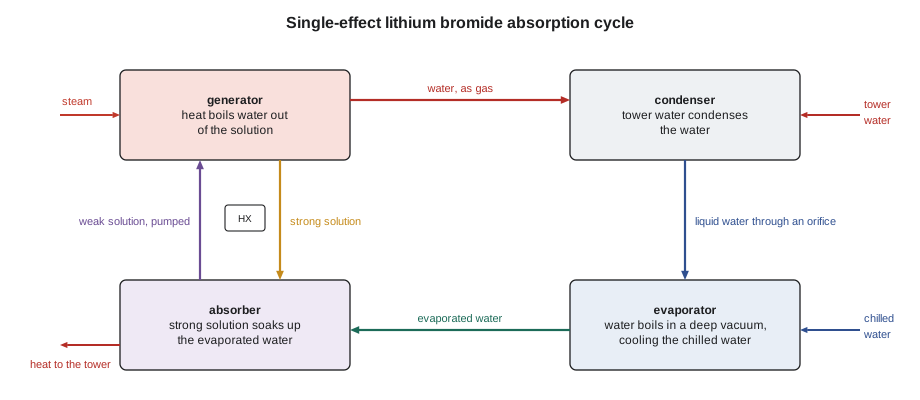
An absorption chiller uses the same idea as every refrigeration system, a refrigerant boiling at low pressure to absorb heat, but it replaces the compressor with a chemical process driven by heat. In the common lithium bromide machine, the refrigerant is water and the absorbent is a concentrated solution of lithium bromide salt, which has a strong attraction for water vapour.
- In the evaporator, held at a deep vacuum, water sprayed over the tubes boils at about 4 to 5 °C (39 to 41 °F), cooling the chilled water inside the tubes.
- In the absorber, the water vapour is soaked up by the concentrated lithium bromide solution, which keeps the pressure low. Absorbing the vapour releases heat, which cooling-tower water carries away.
- A pump sends the now diluted solution up to the generator, where a heat source, steam, hot water or burner flame, boils the water back out of it, concentrating the solution again.
- The water vapour from the generator goes to the condenser, is condensed by tower water, and returns through an orifice to the evaporator. The concentrated solution returns to the absorber through a heat exchanger that recovers heat from it.
The only significant electrical loads are the small solution and refrigerant pumps. The price is the heat input and the extra heat rejection: the towers must reject the chilled-water heat plus the generator heat, roughly 25 to 40 % more than for an electric chiller of the same capacity, which means larger towers and more condenser water and makeup water.
Single-effect and double-effect machines
Absorption efficiency is expressed as a COP: cooling delivered divided by heat input. A single-effect machine, using low-pressure steam or hot water, has a COP of about 0.7. A double-effect machine adds a second, higher-temperature generator, whose vapour drives the first, and needs higher-pressure steam or direct firing, but reaches a COP of about 1.0 to 1.3. These numbers look poor beside an electric chiller's COP of 6, but they compare heat with electricity, and a unit of heat from a boiler costs much less than a unit of electricity, and in a plant with waste heat it may cost almost nothing.
The comparison depends on prices, on carbon and on what the heat would otherwise do. The script compares absorption with electric chilling for 1,400 kW of cooling, using illustrative energy prices, and then sets up the heat-recovery chiller that the second half of this lesson describes.
# Absorption versus electric chilling, and what a heat-recovery chiller does (illustrative prices)
cool = 1400.0                                  # kW of cooling for the comparison
steam_latent = 2050.0                          # kJ/kg released by condensing low-pressure steam
for name, cop in (("single-effect absorption", 0.70), ("double-effect absorption", 1.20)):
    heat = cool / cop
    steam = heat * 3600 / steam_latent         # kg/h
    gas = heat / 0.82 * 3600 / 37300           # m3/h of natural gas at 82 % boiler efficiency, 37.3 MJ/m3
    print(f"{name}: heat input {heat:,.0f} kW, steam {steam:,.0f} kg/h, gas {gas:,.0f} m3/h, cost ${gas * 0.45:,.0f}/h")
elec = cool * 0.17
print(f"electric centrifugal: {elec:,.0f} kW, cost ${elec * 0.14:,.0f}/h (plus about 25 % more heat rejected by absorbers)")
# heat-recovery chiller: 700 kW of cooling with 150 kW of compressor power gives 850 kW of 50 C hot water
qc, w = 700.0, 150.0
qh = qc + w
print(f"heat-recovery chiller: cooling COP {qc / w:.2f}, heating COP {qh / w:.2f}, combined {(qc + qh) / w:.2f}")
hours = 4000 * 0.6                             # equivalent full-load hours of simultaneous heating and cooling
boiler_gas = qh * hours / 0.85 * 3600 / 37300  # m3 the boilers would have burned for the same heat
chiller_saved = qc * hours * 0.17              # kWh the main chillers would have used for that cooling
extra = w * hours - chiller_saved
print(f"per year: gas avoided {boiler_gas:,.0f} m3 (${boiler_gas * 0.45:,.0f}), extra electricity {extra:,.0f} kWh (${extra * 0.14:,.0f})")
co2 = boiler_gas * 1.9 / 1000 - extra * 0.040 / 1000
print(f"net carbon saving about {co2:,.0f} t CO2 a year at 1.9 kg/m3 for gas and 40 g/kWh for Ontario electricity")single-effect absorption: heat input 2,000 kW, steam 3,512 kg/h, gas 235 m3/h, cost $106/h double-effect absorption: heat input 1,167 kW, steam 2,049 kg/h, gas 137 m3/h, cost $62/h electric centrifugal: 238 kW, cost $33/h (plus about 25 % more heat rejected by absorbers) heat-recovery chiller: cooling COP 4.67, heating COP 5.67, combined 10.33 per year: gas avoided 231,635 m3 ($104,236), extra electricity 74,400 kWh ($10,416) net carbon saving about 437 t CO2 a year at 1.9 kg/m3 for gas and 40 g/kWh for Ontario electricity
A single-effect machine would need about 3,500 kg/h of steam, and the gas to make it would cost about three times as much per hour as the electricity for a centrifugal. Even a double-effect machine would cost nearly twice as much. With Ontario's low-carbon electricity, burning gas for cooling would also add carbon instead of saving it. That is why Riverbend replaced its absorber, and why absorption chillers are now mostly found where heat is genuinely surplus: at plants with combined heat and power, where the generator's exhaust or jacket water would otherwise be wasted, at industrial sites with process heat, in district energy systems with steam already distributed, and in places where electrical service is the limit.
Living with an absorption chiller
Absorption chillers need care of their own, and a technician who meets one should know the main risks:
- Crystallization. If the lithium bromide solution becomes too concentrated or too cold, as can happen after a power failure, with too-cold tower water or an air leak, salt crystals form and block the solution heat exchanger. Machines have controls and dilution cycles to prevent it, and clearing a crystallized machine is specialist work.
- Vacuum. The whole machine runs in a deep vacuum, so air leaks in; a purge system removes non-condensables, and its rate is logged, as with a low-pressure centrifugal.
- Corrosion. Lithium bromide is corrosive to steel when air is present; the solution carries an inhibitor and its chemistry is tested regularly by the manufacturer's service.
- Tower water. Absorbers are sensitive to condenser water that is too cold as well as too warm, so their towers usually have bypass or fan control to hold a minimum temperature.
None of these concerns applies to the refrigerant itself, which is water, so absorption chillers have no refrigerant emission or phasedown issues.
Heat-recovery chillers
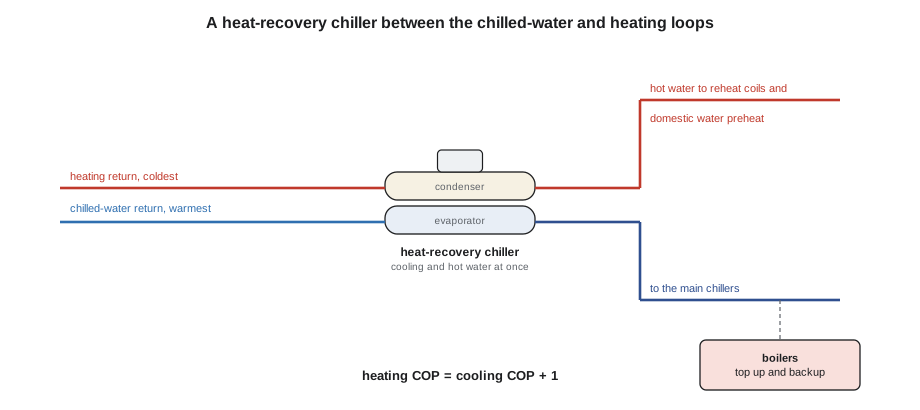
A heat-recovery chiller is an electric chiller designed to deliver its condenser heat as useful hot water instead of rejecting it to a tower. Every chiller's condenser rejects the cooling it delivers plus its compressor energy; in an ordinary plant that heat goes to the towers. A hospital, though, also needs heat all year: for reheat coils that keep operating rooms and patient rooms at the right temperature after air has been cooled and dried, for domestic hot water and for perimeter heating in winter. A heat-recovery chiller sized to the hospital's year-round simultaneous heating and cooling makes both at once.
Such a machine is selected to produce hot water at a useful temperature, typically 45 to 60 °C (113 to 140 °F) for a low-temperature heating loop or preheat, which means a higher lift and a lower cooling COP than a comfort chiller. But it delivers two useful products from one input. Its cooling COP is the cooling divided by the compressor power; its heating COP is the heat delivered divided by the same power, which is always one more than the cooling COP, because the condenser heat is the cooling plus the compressor energy. The combined COP, counting both products, is the sum.
The script's second part looks at a heat-recovery chiller of 700 kW (200 tons) for Riverbend, delivering about 850 kW of water at 50 °C to the reheat and domestic hot water preheat loops. With a cooling COP of about 4.7 and a heating COP of about 5.7, each kilowatt of compressor power produced more than ten kilowatts of useful output. Over a year of about 2,400 equivalent full-load hours, the machine would avoid about 230,000 m³ of boiler gas at the cost of about 74,000 kWh of extra electricity, after subtracting what the main chillers would have used for the same cooling, and save more than 400 tonnes of CO₂.
Making heat recovery work
A heat-recovery chiller only pays when it runs, and it only runs when there is simultaneous demand for both products. The design questions are about matching:
- Size. It is sized to the base of the simultaneous load, the heating and cooling that occur together most of the year, not the peak of either, so that it runs long hours near full output. The main chillers and the boilers handle the peaks.
- Temperature. The lower the hot water temperature it must make, the better its efficiency, so heat recovery works best with low-temperature heating loops, reheat coils sized for lower water temperatures and domestic hot water preheat rather than final heating. Older buildings with coils designed for 80 °C (180 °F) water often need changes.
- Piping. It is usually piped in the chilled-water return, upstream of the main chillers, so that it takes the warmest return water, and into the heating return, so that it heats the coldest heating water. The controls run it to the smaller of the two demands and let the main plant make up the rest.
- Controls. If heat demand falls, a heat-recovery chiller must either stop or reject its surplus heat, which some designs do through a separate condenser or to the tower. Good sequences avoid running it as an expensive chiller that heats nothing.
Air-source and water-source heat pumps and heat-recovery chillers are central to many hospitals' plans to electrify heating, because the heat they move would otherwise be wasted to the towers. For a technician, they combine everything in this course: a chiller, a heat pump and a hydronic system with two loops, whose controls decide whether the machine is saving energy or wasting it.
The note for the energy committee
Raj and Theo's note was a page long. Absorption, they wrote, made sense where heat would otherwise be wasted, and Riverbend had no such heat; its boilers burned gas for the purpose. Heat recovery, on the other hand, used heat the plant already had and was paying to throw away. They recommended a study of the hospital's simultaneous heating and cooling, which the meter data could provide, to size a heat-recovery chiller properly, and flagged that the reheat and domestic water systems would need to accept lower water temperatures. Grace forwarded it to the committee with one line: "This answers the question I was asked." Lesson 12 shows how the heat-recovery option fared in the full plant study.
Common mistakes
MistakeComparing an absorption COP of 0.7 directly with an electric COP of 6.
InsteadCompare costs and carbon of the actual heat and electricity used.
MistakeForgetting the extra heat an absorber's towers must reject.
InsteadAllow roughly a quarter to two-fifths more tower capacity.
MistakeSizing a heat-recovery chiller to the peak heating load.
InsteadSize it to the base of the simultaneous heating and cooling demand.
MistakeFeeding a heat-recovery chiller's hot water to coils designed for very hot water.
InsteadLower the hot water temperature where possible; efficiency depends on it.
MistakeLetting a heat-recovery chiller run when there is no heat demand.
InsteadControl it to the smaller of the two demands.
Summary and key terms
- Absorption chillers replace the compressor with a heat-driven absorber and generator, using water as refrigerant and lithium bromide as absorbent.
- Single-effect machines have a COP of about 0.7, double-effect about 1.0 to 1.3, and they reject much more heat to the towers.
- Absorption makes sense where heat is surplus or electrical capacity is limited; crystallization, vacuum and corrosion need attention.
- A heat-recovery chiller delivers its condenser heat as useful hot water; heating COP equals cooling COP plus one.
- Heat recovery pays when sized to the base simultaneous load and paired with low-temperature heating uses.
- Electrified heating in hospitals and campuses relies increasingly on heat-recovery chillers and heat pumps.
- Absorption chiller
- A chiller driven by heat, using an absorbent solution instead of a compressor.
- Lithium bromide
- A salt whose solution absorbs water vapour; the absorbent in most absorption chillers.
- Generator
- The part of an absorption chiller where heat boils refrigerant out of the solution.
- Absorber
- The part of an absorption chiller where the solution absorbs refrigerant vapour.
- Crystallization
- Formation of salt crystals in an overly concentrated or cold absorbent solution.
- Double-effect
- An absorption cycle with two generators, using higher-temperature heat for better efficiency.
- Heat-recovery chiller
- A chiller that delivers its condenser heat as useful hot water.
- Simultaneous load
- Heating and cooling demand that occur at the same time.
Practice problems
Work each problem on paper first, then reveal the answer to check.
A heat-recovery chiller has a cooling COP of 4.0. What is its heating COP?
Show answer
5.0.
Why do absorption chillers need larger cooling towers than electric chillers?
Show answer
The towers reject the generator heat as well as the chilled-water heat.
What can cause crystallization in an absorption chiller?
Show answer
Over-concentrated or overcooled solution, for example after a power failure, very cold tower water or an air leak.
Where in the chilled-water loop is a heat-recovery chiller usually connected?
Show answer
In the return, upstream of the main chillers, to take the warmest water.
Lesson quiz · 5 questions
Score 60% or more to complete this lesson.
Create a free account to save your progress, take quizzes and earn a certificate.