
RAC-230 · Lesson 8 of 12 · 17 min
Economizers and ventilation control
The dental clinic's rooftop unit had a history with Northfield. In RAC-110, its condenser was dirty and its humidity control was poor; in RAC-130, its economizer actuator had overloaded the control transformer. In late April, the clinic manager called again: on mild days the operatories were warm and sticky by mid-afternoon, and the compressor seemed to run all the time, even when it was only 14 °C (57 °F) outside. Dana looked at the unit's economizer module on the service display before she climbed onto the roof. "Outdoor air is cool enough to do most of the cooling today," she said, "and the economizer says it's free cooling. So why is the compressor running flat out?"
Most commercial rooftop units and air handlers bring in outdoor air for two different reasons. Ventilation supplies the minimum outdoor air that people need, all year, whatever the weather. Economizing uses extra outdoor air for cooling when it is cool and dry enough, saving compressor energy. Both are done with the same dampers and controls, and both are easy to get wrong. This lesson covers the dampers, sensors and control logic of air-side economizers, minimum ventilation and demand-controlled ventilation, and how to check them.
Dampers, actuators and the mixing box
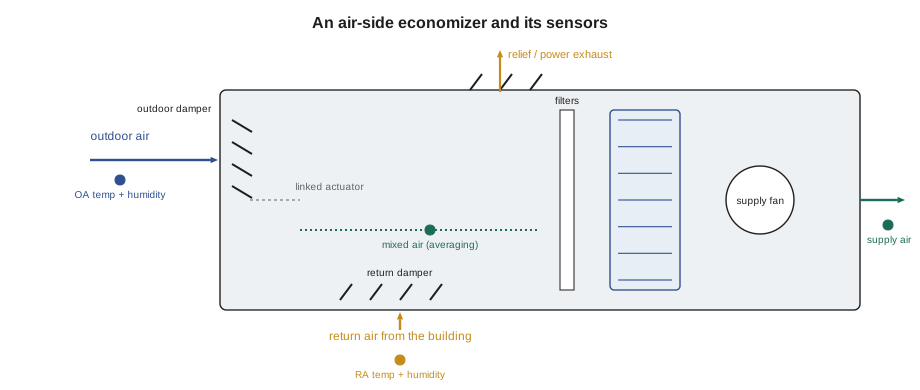
A typical economizer has three sets of dampers: an outdoor air damper, a return air damper and a relief or exhaust damper, often with a power exhaust fan. The outdoor and return dampers are linked so that as one opens, the other closes, keeping the airflow through the unit roughly constant. An actuator, usually a spring-return electric motor driven by a 2–10 V or 0–10 V signal, positions the dampers. Spring return closes the outdoor damper on a loss of power, so a failed unit in winter does not freeze its coils. The air leaving the mixing box is called mixed air, and its temperature lies between the outdoor and return temperatures in proportion to the outdoor air fraction.
This relation, with x_oa the outdoor air fraction and T_ra, T_ma and T_oa the return, mixed and outdoor air temperatures, is the technician's best check of whether the dampers are actually doing what the controller commands. It works best when the outdoor and return temperatures differ by at least 10 K (18 °F). Mixed air temperature sensors must be averaging types or well placed, because mixing boxes stratify badly.
Minimum ventilation
Ventilation requirements come from building codes and the ventilation standards they reference, commonly ASHRAE 62.1 in both countries, with CSA Z317.2 for health care facilities in Canada. The designer calculates the minimum outdoor airflow, and the balancer sets the minimum damper position to deliver it. Minimum position is not a percentage chosen by feel: a damper set at 20 % open may deliver much more or much less than 20 % outdoor air, depending on the damper, the duct pressures and the fan speed. On variable-air-volume and variable-speed fan systems, the minimum position must be reset as the fan slows, or the outdoor air falls below the minimum at low fan speeds.
Demand-controlled ventilation, or DCV, reduces outdoor air when a space is lightly occupied. A carbon dioxide sensor in the space or return air measures how much CO2 people are adding, and the controller opens the outdoor damper above its base minimum as CO2 rises. DCV saves heating and cooling energy in spaces with variable occupancy, such as meeting rooms, gyms and classrooms. CO2 sensors drift, so they need periodic calibration or the self-calibrating type, and outdoor CO2 levels of roughly 400 to 450 ppm are a useful sanity check on a sensor reading outside air.
When to economize: changeover strategies
An economizer should use outdoor air for cooling only when it reduces the cooling load. The decision, called the changeover or high limit, is made in one of four ways.
- Fixed dry bulb: economize when the outdoor temperature is below a set value. Simple, and suitable for dry climates.
- Differential dry bulb: economize when the outdoor air is cooler than the return air.
- Fixed enthalpy: economize when the outdoor air's enthalpy, its total heat content including moisture, is below a set value.
- Differential enthalpy: economize when the outdoor air's enthalpy is below the return air's. This uses the most information but needs accurate humidity sensors.
Energy codes set which strategies are allowed and at what settings, by climate zone, and also when economizers are required at all. In Canada, the National Energy Code of Canada for Buildings and provincial requirements, such as Ontario's supplementary standard SB-10, set these rules. Humid climates usually favour enthalpy-based or differential strategies, because cool, saturated air can bring in more latent load than it saves in sensible load. Check the unit's design documents and the applicable code before changing a changeover setting.
import math
# Should the economizer use outdoor air? Dry-bulb versus enthalpy changeover (moist air at sea level, approximate)
P = 101.325   # kPa
def enthalpy(t_c, rh):
    pws = 0.61094 * math.exp(17.625 * t_c / (t_c + 243.04))     # saturation pressure of water, kPa (Magnus form)
    w = 0.622 * rh * pws / (P - rh * pws)                        # humidity ratio, kg water per kg dry air
    return 1.006 * t_c + w * (2501 + 1.86 * t_c)                 # kJ per kg dry air

def show_t(t): return f"{t:.1f} C"
def show_h(h): return f"{h:.1f} kJ/kg"

ret = (24.0, 0.50)                                                # return air: temperature C, relative humidity
cases = [("cool and dry", 14.0, 0.45), ("cool and foggy", 17.5, 1.00), ("warm and dry", 22.0, 0.25), ("mild and humid", 21.0, 0.85)]
h_ret = enthalpy(*ret)
print(f"return air {show_t(ret[0])}, {ret[1]:.0%} RH, enthalpy {show_h(h_ret)}")
for name, t, rh in cases:
    h = enthalpy(t, rh)
    dry = "yes" if t < 18.0 else "no"
    diff = "yes" if h < h_ret else "no"
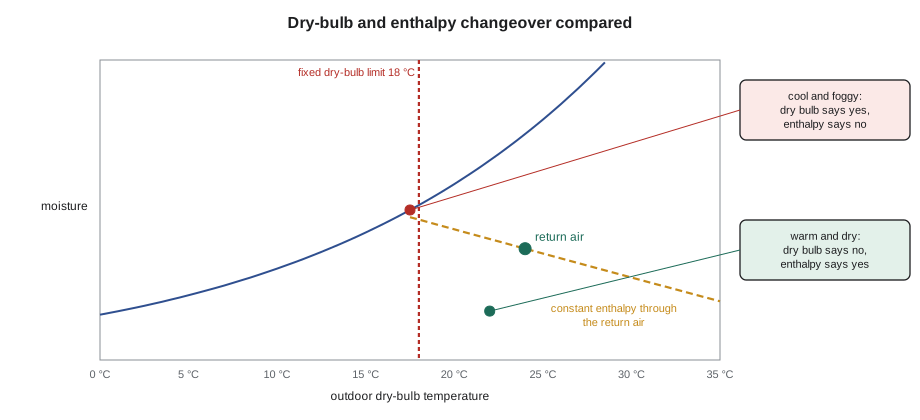
print(f"{name:15s} {show_t(t):>8s} {rh:4.0%} RH h = {show_h(h):>14s} fixed dry bulb (18 C): {dry:3s} differential enthalpy: {diff}")return air 24.0 C, 50% RH, enthalpy 47.8 kJ/kg cool and dry 14.0 C 45% RH h = 25.3 kJ/kg fixed dry bulb (18 C): yes differential enthalpy: yes cool and foggy 17.5 C 100% RH h = 49.3 kJ/kg fixed dry bulb (18 C): yes differential enthalpy: no warm and dry 22.0 C 25% RH h = 32.5 kJ/kg fixed dry bulb (18 C): no differential enthalpy: yes mild and humid 21.0 C 85% RH h = 54.7 kJ/kg fixed dry bulb (18 C): no differential enthalpy: no
The program shows the cases where the strategies disagree. Cool foggy air passes a fixed dry-bulb test but carries more total heat than the return air, so differential enthalpy rejects it. Warm dry air fails a fixed dry-bulb test even though its enthalpy is below the return air's, so differential enthalpy uses it. In a humid summer, the wrong choice can raise the indoor humidity, the very problem the dental clinic had complained about years before.
Integrated economizers and compressor operation
An integrated economizer lets the compressor run while the economizer is open, so outdoor air does as much of the cooling as it can and the compressor supplies the rest. A non-integrated economizer locks the compressor out while economizing, or closes the economizer when the compressor runs, which wastes free cooling on mild days. Most current energy codes require integrated operation on new equipment. In integrated mode, the controller usually holds a mixed air or supply air setpoint with the dampers first and stages compressors only when the dampers are fully open and the supply air is still too warm. A mixed air low limit, often about 10 to 13 °C (50 to 55 °F), keeps the dampers from opening so far in cold weather that they overcool the space or freeze the coil.
Economizer faults and diagnostics
Field surveys have repeatedly found that a large share of rooftop economizers do not work as designed. The common faults are a damper stuck closed, stuck open or disconnected from its actuator; a failed actuator; a sensor that has failed, drifted or been mounted in the sun; a changeover setting that was never set up for the climate; and wiring that was never completed at installation. A stuck-closed damper wastes energy quietly. A stuck-open damper overloads the cooling in summer and the heating in winter, and in cold weather can freeze coils. Newer units have fault detection and diagnostics, called FDD, built into the economizer controller, which flags problems such as a damper not modulating, a sensor out of range or the unit economizing when it should not. Energy codes now require FDD on many new rooftop units.
- Command and confirm: drive the damper through its full stroke from the controller's test menu and watch the blades move.
- Check the linkage: an actuator can turn its shaft while a loose clamp lets the damper stay put.
- Check the sensors: compare outdoor, return and mixed air readings with a calibrated instrument.
- Calculate the outdoor air fraction from temperatures and compare it with the commanded position.
- Check the changeover setting and strategy against the design and the code.
What was wrong at the clinic
On the roof, Dana had Theo command the economizer to 100 % from the controller's test menu. The actuator turned smoothly to full stroke, but the outdoor damper blades barely moved. The actuator's shaft clamp had slipped on the damper jackshaft, so the controller believed it was supplying all the outdoor air it wanted while the dampers sat near minimum. With 14 °C (57 °F) air available, the unit was cooling the clinic almost entirely with the compressor, and with a mostly closed outdoor damper, the space humidity rose from the patients and staff. Theo calculated the outdoor air fraction from the readings before the repair: return 24 °C (75 °F), outdoor 14 °C (57 °F), mixed 22.5 °C (72 °F), about 15 %. After he reset the damper to fully closed, reset the actuator to its closed end and tightened the clamp to the manufacturer's torque, the mixed air at full command read 15 °C (59 °F), about 90 % outdoor air, close enough for a mixing box with some leakage. He then checked the minimum position against the balancer's report, confirmed that the changeover was set to differential enthalpy as the design specified, and checked that the outdoor humidity sensor read within a few percent of his hand-held meter. The compressor cycled off for the rest of the afternoon.
Economizers in winter
In cold weather, the economizer's job changes. Most of the time the outdoor damper should sit at minimum position, because the building needs heat, not cooling. Interior zones with high internal loads may still need cooling in winter, and an integrated economizer can provide it by mixing in enough cold air to hold the mixed air setpoint, but only if the mixed air low limit and the freeze-stat are working. A damper that drifts open on a frozen linkage, a mixed air sensor reading high, or a minimum position set too high can expose the coils to air well below freezing. Before winter, check that the outdoor damper closes fully when the unit is off, that the spring return works on loss of power, that the low limit and freeze-stat are set and tested, and that the minimum position delivers the design airflow and no more.
One more check is easy to forget: the relief path. When an economizer brings in extra outdoor air, the same amount must leave the building, through relief dampers, a power exhaust fan or the building's own exhaust. If the relief path is blocked or the power exhaust fails, the building pressurizes, doors whistle and stand open, and the economizer cannot deliver its full outdoor airflow. Check that the relief dampers open freely and that any power exhaust starts when the outdoor damper passes its set position.
Common mistakes
MistakeSetting minimum outdoor air by damper percentage alone.
InsteadUse the design airflow and the balancer's measurements, and reset minimum position on variable-speed fans.
MistakeAssuming the damper moves because the actuator moves.
InsteadWatch the blades and check the linkage clamp.
MistakeUsing fixed dry-bulb changeover in a humid climate without checking the code and design.
InsteadUse the strategy and setting the design and energy code specify.
MistakeTrusting an uncalibrated humidity sensor for enthalpy control.
InsteadCheck humidity sensors against a calibrated instrument.
MistakeLocking out the compressor whenever the economizer is open.
InsteadUse integrated operation so outdoor air and the compressor share the load.
Summary and key terms
- Ventilation provides the minimum outdoor air all year; economizing adds outdoor air for free cooling.
- The outdoor air fraction can be calculated from return, mixed and outdoor air temperatures.
- Demand-controlled ventilation uses CO2 to vary outdoor air with occupancy.
- Changeover can be fixed or differential, by dry bulb or enthalpy, as the energy code and design require.
- Integrated economizers let outdoor air and compressors work together, with a mixed air low limit.
- Stuck dampers, slipped linkages, bad sensors and wrong settings are common economizer faults.
- Economizer
- Dampers and controls that use outdoor air for cooling when it is cool or dry enough.
- Mixed air
- The blend of outdoor and return air leaving the mixing box.
- Minimum position
- The damper position that provides the design minimum outdoor airflow.
- Changeover
- The rule that decides whether outdoor air is suitable for economizing.
- Enthalpy
- The total heat content of moist air, including the heat in its water vapour.
- Demand-controlled ventilation
- Varying outdoor air with occupancy, usually measured by CO2.
- Integrated economizer
- An economizer that can operate at the same time as mechanical cooling.
- Fault detection and diagnostics
- Built-in logic that identifies faults in equipment such as economizers.
Practice problems
Work each problem on paper first, then reveal the answer to check.
Return air is 24 °C, outdoor air 4 °C and mixed air 20 °C. What is the outdoor air fraction?
Show answer
(24 − 20) ÷ (24 − 4) = 0.20, or 20 %.
An economizer actuator strokes fully, but the mixed air temperature barely changes. What should be checked?
Show answer
The damper linkage and blades.
On a cool, foggy day the economizer opens under fixed dry-bulb control. Would differential enthalpy agree?
Show answer
Not if the outdoor enthalpy is higher than the return air's.
Why does a spring-return outdoor air actuator close on power loss?
Show answer
To keep cold outdoor air from freezing coils when the unit is off.
Lesson quiz · 5 questions
Score 60% or more to complete this lesson.
Create a free account to save your progress, take quizzes and earn a certificate.