
RAC-230 · Lesson 5 of 12 · 17 min
Defrost control
Northfield had already been to the first restaurant's walk-in freezer twice in RAC-210, once for floodback and once for an iced coil caused by a loose defrost termination thermostat. This time the owner had decided to replace the old mechanical defrost timer with an electronic controller during a kitchen renovation, and Dana gave Theo the job of setting it up. On the bench in the van, the new controller came with a forty-page manual and more than sixty parameters. "Most of them can stay at the factory value," Dana said. "About ten of them decide whether this freezer lives or dies. Defrost is where controls and refrigeration meet."
RAC-210 explained why frost forms on evaporators below freezing, how off-cycle, electric, hot-gas and reverse-cycle defrost melt it, and why ice on a coil is so damaging. This lesson covers the control side: how a defrost is started, how it is ended, what happens to the fans, the heaters and the refrigeration during each phase, and how demand defrost decides when a coil really needs it. It also covers heat pump defrost controls, which work on the same principles.
The phases of a defrost cycle
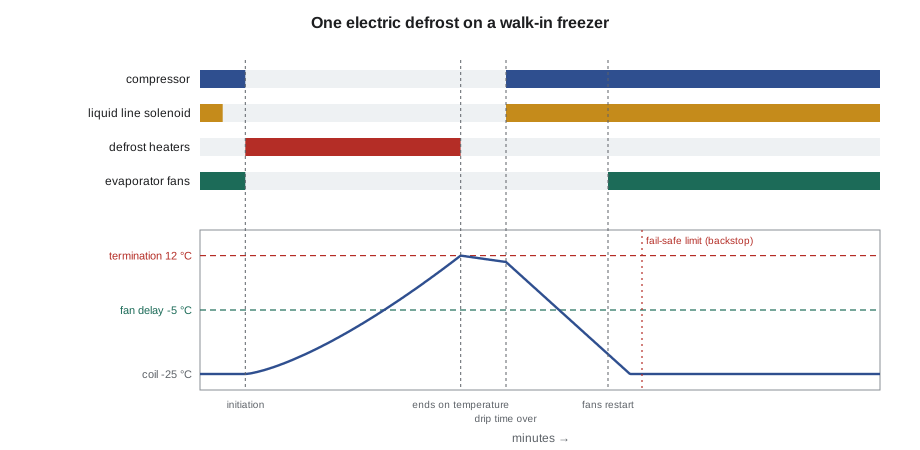
Every controlled defrost has the same phases, whatever the method. A well-set controller moves through each one deliberately.
- Initiation: a clock, a run-time counter or a demand sensor decides that a defrost is due.
- Pump-down or refrigeration off: the liquid line solenoid closes and the compressor stops, often after pumping down, so the heaters are not fighting the refrigeration.
- Defrost: the heaters are energized, or hot gas is valved into the coil, and the evaporator fans normally stop so the heat stays in the coil and is not blown into the box.
- Termination: the coil temperature, the elapsed time or a pressure shows the coil is clear, and the heat is switched off.
- Drip time: a short delay, often a few minutes, lets meltwater drain from the coil and pan before refrigeration restarts.
- Fan delay: after refrigeration restarts, the fans stay off until the coil is cold again, so water droplets are refrozen on the coil instead of being blown onto product and the box does not get a blast of warm air.
Starting a defrost
Time initiation is the oldest and still the most common method. A mechanical timer, a clock in an electronic controller, or a rack controller schedule starts defrosts at fixed times of day or at fixed intervals. A typical walk-in freezer might be set for four defrosts a day; a medium-temperature display case for one to four. Fixed schedules are simple and predictable, and on rack systems, staggered schedules keep many cases from defrosting at once, but they ignore how much frost is actually on the coil. A freezer that is hardly opened overnight still defrosts on schedule, wasting heat, while on a busy humid afternoon it may need defrost sooner than the schedule allows.
Run-time initiation counts compressor running time and starts a defrost after a set number of running hours. It is a better proxy for frost than clock time, because frost builds only when the coil is refrigerating. Many heat pump boards and some case controllers use it.
Demand initiation tries to measure frost directly. Common methods include the temperature difference between the air entering the coil and the coil itself, which grows as frost insulates the fins; the air pressure drop across the coil, which rises as frost blocks it; the evaporator fan motor's power or speed on electronically commutated motors; and the gap between the evaporating temperature and the box temperature. Manufacturers combine these with minimum and maximum intervals, so a coil is never defrosted too often or left too long. Demand defrost can save a large share of defrost energy on equipment whose load varies widely, but it depends on sensors placed exactly where the manufacturer specifies.
Ending a defrost
Defrost should end as soon as the coil is completely clear. Ending too early leaves a ring of ice that grows with every cycle until the coil is a block; ending too late wastes energy, warms the box and can cook frost into steam that refreezes on the ceiling. Temperature termination is the normal method for freezers: a sensor or snap disc clamped to the coil at the last place to clear, usually specified by the coil manufacturer, ends the defrost when it reaches a set temperature, commonly about 10 to 15 °C (50 to 60 °F). Pressure termination, used with hot-gas defrost, ends when the coil pressure rises to a value corresponding to a coil above freezing. Time termination alone is acceptable only for off-cycle defrost on medium-temperature coolers.
Every controlled defrost also needs a fail-safe or maximum time, which ends the defrost even if the termination sensor never satisfies. On electric defrost freezers it is often about 30 to 45 minutes. The fail-safe is a backstop for a failed or loose sensor, not the normal way a defrost ends. A controller that logs every defrost as ending on time, rather than on temperature, is telling you something: the sensor is misplaced, a heater has failed, or the defrost is too short for the frost load.
| Parameter | What it does | Typical starting value (freezer, electric defrost) |
|---|---|---|
| Defrost interval or schedule | How often a defrost may start | Four per day, or demand with limits |
| Termination temperature | Coil temperature that ends defrost | 10 to 15 °C (50 to 60 °F), at the manufacturer's location |
| Fail-safe (maximum) time | Ends defrost if termination never comes | About 30 to 45 minutes |
| Drip time | Delay before refrigeration restarts | 2 to 5 minutes |
| Fan delay temperature or time | Keeps fans off until the coil is cold | About −5 °C (23 °F) coil, or a few minutes |
| Display hold | Shows the last reading during defrost so staff are not alarmed | Until refrigeration recovers |
| High-temperature alarm delay after defrost | Prevents nuisance alarms during recovery | Often 30 to 60 minutes |
Heaters, drain lines and interlocks
Electric defrost heaters are switched by a contactor or relay controlled by the defrost control, and each heater circuit should have its own over-temperature limit, a snap disc that opens if the heater or coil overheats, for example if the fans have failed to stop or the drain pan has dried and the heater is glowing. The drain line from a freezer coil must be heated and insulated inside the box, often with a self-regulating heat trace powered continuously or during defrost, and trapped outside the box so warm air cannot be drawn in. A frozen drain line looks like a defrost problem: the pan fills, overflows and freezes into a sheet of ice under the coil. Checking defrost always includes checking the drain.
Check heaters by current and resistance. Measuring each heater's current during defrost and comparing it with the nameplate wattage at the supply voltage, as in RAC-130, finds a failed element quickly. A coil that clears everywhere except one section usually has a failed heater in that section.
Hot-gas and rack defrost controls
On parallel rack systems and large walk-ins, hot-gas defrost valves discharge gas into the coil instead of using heaters. The controller closes the circuit's liquid line solenoid and suction stop valve, opens a hot-gas solenoid and, when the coil pressure or temperature shows it is clear, reverses the sequence. Because the gas condenses in the coil, the liquid must go somewhere: into the liquid header or another evaporator. Rack controllers limit how many circuits defrost at once so the compressors still have enough load to supply hot gas. Lesson 6 and RAC-310 return to rack controls.
Heat pump defrost
An air-source heat pump's outdoor coil is an evaporator in heating mode, so it frosts when the outdoor temperature is near or below freezing and the air is humid. Defrost reverses the refrigeration cycle: the reversing valve shifts to cooling, the outdoor fan stops so the coil heats quickly, and the indoor blower either keeps running with auxiliary heat to temper the air or, on many ductless units, stops so the occupants do not feel cold air. Time-temperature boards start a defrost after a set run time, often selectable at 30, 60 or 90 minutes, but only if a coil sensor shows the outdoor coil below about freezing; they end it when the coil sensor reaches a termination temperature or a maximum time passes. Demand boards compare outdoor air temperature with outdoor coil temperature and start a defrost when the difference shows frost.
Two calls in one week showed the range. The Haddads phoned because their ductless unit kept stopping on a damp −2 °C (28 °F) morning, its outdoor unit hissing and steaming. Theo checked the fault history and the defrost log on the unit's service display: it was defrosting about every 45 minutes, for under ten minutes each time, ending on temperature. That is normal for those conditions, and he explained to the Haddads why the indoor fan stops and the steam is meltwater. The Lindqvists' ducted R-454B heat pump was different: it had iced solid on one side. Its outdoor coil sensor clip had slid along the tube to a spot near the warm discharge line, so the board saw a coil far warmer than it was and never initiated defrost. Theo moved the sensor back to the location in the installation manual, clamped and insulated it, and forced a test defrost to confirm the coil cleared.
Comparing time and demand defrost
# Timed versus demand defrost on a walk-in freezer: frost grows faster when the kitchen is busy (illustrative model)
HEATER_KW = 3.6        # total defrost heater rating
DEFROST_MIN = 22        # minutes of heater time to clear a full frost load
FULL = 1.0              # frost load that needs a defrost

def frost_rate(hour):
    busy = 7 <= hour % 24 < 14 or 16 <= hour % 24 < 21     # deliveries, prep and service
    return 0.16 if busy else 0.03                          # fraction of a full load per hour

def timed(per_day, days=7):
    interval = 24 / per_day
    frost, count, heater_h, worst = 0.0, 0, 0.0, 0.0
    for step in range(days * 24 * 4):
        h = step / 4
        frost += frost_rate(h) / 4
        worst = max(worst, frost)
        if abs(h % interval) < 1e-9:
            count += 1
            heater_h += DEFROST_MIN / 60 * max(0.4, min(frost, 1.4))   # termination ends sooner on a light coil
            frost = 0.0
    return count, heater_h * HEATER_KW, worst

def demand(days=7, trigger=0.8):
    frost, count, heater_h = 0.0, 0, 0.0
    for step in range(days * 24 * 4):
        frost += frost_rate(step / 4) / 4
        if frost >= trigger:
            count += 1; heater_h += DEFROST_MIN / 60 * frost; frost = 0.0
    return count, heater_h * HEATER_KW

for n in (2, 4, 6):
    c, kwh, worst = timed(n)
    note = "  coil overloaded at times" if worst > 1.0 else ""
    print(f"timed, {n} per day: {c} defrosts per week, {kwh:5.1f} kWh of heater energy, worst frost {worst:.2f}{note}")
c, kwh = demand()
print(f"demand: {c} defrosts per week, {kwh:5.1f} kWh of heater energy, frost never above 0.80")timed, 2 per day: 14 defrosts per week, 20.0 kWh of heater energy, worst frost 1.24 coil overloaded at times timed, 4 per day: 28 defrosts per week, 22.9 kWh of heater energy, worst frost 0.86 timed, 6 per day: 42 defrosts per week, 26.6 kWh of heater energy, worst frost 0.64 demand: 19 defrosts per week, 20.4 kWh of heater energy, frost never above 0.80
The model is simple, but its pattern is real. Two timed defrosts a day use the least energy but let the coil overload during the busy part of the day. Six a day protect the coil but defrost a nearly clean coil overnight. Four is a sensible compromise, and demand defrost does about the same protection with less energy, because it defrosts when the frost is there. On the restaurant freezer, the new controller supported demand defrost using a coil and air temperature difference, with a minimum interval of four hours and a maximum of eight.
Setting up the restaurant freezer
Theo set the controller for demand initiation with those limits, termination at 12 °C (54 °F) on a probe clamped to the coil at the location marked in the coil manual, a 35-minute fail-safe, three minutes of drip and a fan delay until the coil reached −5 °C (23 °F). He confirmed that the heater contactor dropped out on termination, measured each heater's current, checked that the drain line heater was warm and that the trap outside the box was clear, and forced a defrost to watch one full cycle. It ended on temperature after 19 minutes. A week later, the controller's log showed between three and five defrosts a day, all ending on temperature.
Common mistakes
MistakeRelying on the fail-safe time to end every defrost.
InsteadTerminate on coil temperature or pressure; the fail-safe is a backstop.
MistakeRestarting the evaporator fans immediately after defrost.
InsteadUse drip time and a fan delay so water refreezes on the coil, not on product.
MistakeIgnoring the drain line when diagnosing defrost problems.
InsteadCheck the drain heater, insulation and trap every time.
MistakePlacing termination and demand sensors wherever they fit.
InsteadMount them exactly where the coil or equipment manufacturer specifies.
MistakeTreating frequent heat pump defrosts as a fault without checking conditions.
InsteadCompare the defrost log with the weather; frequent short defrosts on humid days near freezing are normal.
Summary and key terms
- A defrost has initiation, refrigeration off, heating, termination, drip time and fan delay phases.
- Time, run-time and demand initiation each decide when defrost starts.
- Freezers should terminate on coil temperature or pressure, with a fail-safe time as a backstop.
- Heaters need over-temperature limits, and freezer drain lines need heat, insulation and an outside trap.
- Heat pumps defrost by reversing the cycle, initiated by time and temperature or by demand.
- Demand defrost saves energy only when its sensors are correctly placed.
- Defrost initiation
- The signal or schedule that starts a defrost.
- Defrost termination
- The condition that ends a defrost, normally coil temperature or pressure.
- Fail-safe time
- The maximum length of a defrost, used if the termination condition is never reached.
- Drip time
- A delay after defrost that lets water drain before refrigeration restarts.
- Fan delay
- Keeping evaporator fans off after defrost until the coil is cold again.
- Demand defrost
- Starting defrost when sensors show frost has built up, rather than on a schedule.
- Hot-gas defrost
- Defrosting by valving compressor discharge gas into the evaporator.
- Drain line heater
- A heater that keeps a freezer's condensate drain from freezing.
Practice problems
Work each problem on paper first, then reveal the answer to check.
A freezer controller logs every defrost as ending at its 35-minute fail-safe. What should be checked?
Show answer
The termination sensor's location and clamp, the heaters' current and the frost load.
Why stop the evaporator fans during electric defrost?
Show answer
To keep the heat in the coil and out of the box.
A time-temperature heat pump board is set to 60 minutes. Will it defrost after 60 minutes of heating on a dry, mild day?
Show answer
Only if the coil sensor shows the coil below the initiation temperature.
A defrost clears all of a coil except one section. What is a likely cause?
Show answer
A failed heater in that section.
Lesson quiz · 5 questions
Score 60% or more to complete this lesson.
Create a free account to save your progress, take quizzes and earn a certificate.