
RAC-130 · Lesson 4 of 12 · 20 min
AC power: single-phase and three-phase supplies
The seniors' residence is the largest building on Northfield's service contract: eight storeys of apartments, a dining room, a commercial kitchen and a basement mechanical room with a chiller, two boilers and a row of circulating pumps. Raj took Theo there for the quarterly maintenance visit and opened the main distribution panel for the mechanical room so he could read the labels. 347/600 V, three-phase, four-wire. A transformer in the corner stepped it down to 120/208 volts for the receptacles and small equipment. "Same building, two systems," Raj said. "Your meter has to be set right and rated right for both, and you have to know which one you're on before you open anything."
This lesson explains the alternating current supplies HVAC-R technicians work with. It covers the sine wave, peak and RMS values, frequency, how inductance and capacitance behave on AC, impedance and power factor, single-phase and three-phase systems, the standard voltages in Canada and the United States, equipment voltage ranges, three-phase power and voltage unbalance.
The sine wave
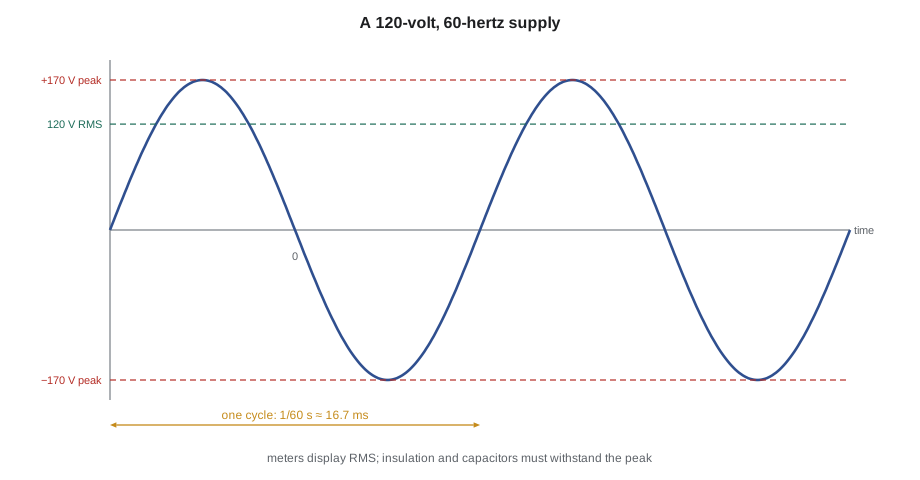
Utility generators produce a voltage that rises and falls smoothly in the shape of a sine wave, because the generator's magnetic field sweeps past its windings as the rotor turns. In North America the voltage completes 60 cycles every second, a frequency of 60 hertz (Hz), so each cycle, or period, lasts 1/60 of a second, about 16.7 milliseconds. During each cycle the voltage rises from zero to a positive peak, falls back through zero to a negative peak, and returns to zero. The current in a load follows the same pattern, reversing direction 120 times a second.
Because the voltage keeps changing, a single number is needed to describe its effect. The RMS value, short for root mean square, is the value of a steady DC voltage that would produce the same heating in a resistor. For a sine wave, the peak is about 1.414 times the RMS value:
When people say "120 volts" they mean 120 volts RMS. Insulation, capacitors and electronic components must withstand the peak, which is why a capacitor used on a 240-volt circuit is rated 370 or 440 volts, comfortably above the 340-volt peak. A true-RMS meter calculates the correct RMS value even when the waveform is distorted, as it often is near variable-frequency drives and electronic loads; a cheaper average-responding meter can read wrongly on those circuits.
Inductance, capacitance and impedance
On AC, two effects add to plain resistance. Inductance is the property of a coil, such as a motor winding, a transformer or a contactor coil, that opposes changes in current. As the AC current rises and falls, the coil's magnetic field builds and collapses, inducing a voltage that pushes back against the change. The opposition is called inductive reactance, measured in ohms, and it rises with frequency. That is why a contactor coil's DC resistance measured with an ohmmeter is lower than its opposition to current when energized, and why it draws a large inrush current for a fraction of a second when first switched on, before the moving iron closes the magnetic circuit.
Capacitance is the property of a capacitor, which stores charge on plates separated by an insulator. A capacitor blocks steady DC but passes AC, because charge flows in and out of its plates as the voltage reverses. Its opposition, capacitive reactance, falls as frequency rises and as capacitance increases. Run capacitors use this effect to shift the current in a motor's start winding, as Lesson 8 explains.
The total opposition to AC current is the impedance, Z, which combines resistance and reactance. Ohm's law on AC is written with impedance: I = V/Z. In a coil, the current lags behind the voltage, reaching its peak a little later in each cycle; in a capacitor the current leads the voltage. A motor behaves mostly like a resistance and an inductance together, so its current lags its voltage by some angle.
Real power, apparent power and power factor
When current and voltage are out of step, part of the current does no useful work: it flows back and forth to build and collapse magnetic fields. The product of RMS voltage and RMS current is the apparent power, in volt-amperes (VA); the power actually converted to heat or mechanical work is the real power, in watts. The ratio is the power factor:
A heater has a power factor of 1: all its current does work. A loaded induction motor typically has a power factor of about 0.8 to 0.9, and a lightly loaded one much less. Transformers are rated in VA or kVA rather than watts because their heating depends on the current they carry, whatever its power factor. This is also why a technician cannot work out a motor's power simply by multiplying its volts and amps.
Single-phase supplies
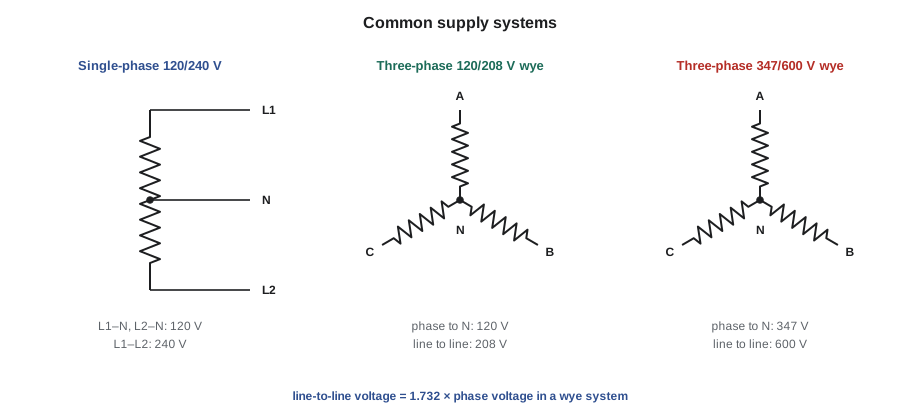
Houses and small buildings in both countries are supplied with single-phase, three-wire 120/240-volt power from a utility transformer whose secondary winding has a centre tap. The centre tap is the grounded neutral. Each end of the winding is a hot leg, L1 and L2. Each hot leg is 120 volts from neutral, and because the two ends are on opposite sides of the centre tap, the voltage between L1 and L2 is 240 volts. Lighting and receptacles use 120 volts; furnaces usually use 120 volts; condensing units, heat pumps, electric heat and water heaters use 240 volts with no neutral needed.
Colour codes help identify conductors, but they must be confirmed with a meter. In Canada the neutral is white or grey, the bonding conductor green or bare, and the hot conductors of a single-phase circuit are usually black and red. For three-phase circuits the Canadian Electrical Code specifies red, black and blue for phases A, B and C.
Three-phase supplies
Larger buildings use three-phase power, which has three hot conductors whose voltages are spaced one third of a cycle, 120 degrees, apart. At any moment the three add to zero, which lets three conductors deliver much more power than two of the same size, and it produces the rotating magnetic field that makes three-phase motors simple, self-starting and efficient. Rooftop units on commercial buildings, the chiller and pumps at the seniors' residence and the compressors in large refrigeration racks all run on three-phase power.
In a wye, or star, system, the three transformer windings are joined at a common point that becomes the grounded neutral. The voltage from any phase to neutral is the phase voltage; the voltage between any two phases, the line voltage, is √3, about 1.732, times larger. In a delta system the windings are connected in a triangle, and line and phase voltages are equal.
The common three-phase systems in Canada are 120/208 volts wye, for commercial buildings, and 347/600 volts wye, for larger commercial and industrial buildings, with 347 volts used for lighting and 600 volts for motors and large equipment. Motors and equipment for 600-volt systems are often nameplated 575 volts, allowing for voltage drop. The 600-volt system is distinctly Canadian, and technicians moving between the countries need meters and PPE rated for it.
| System | Phase to neutral | Line to line | Typical HVAC-R loads |
|---|---|---|---|
| Single-phase 120/240 V | 120 V | 240 V | Furnaces, condensers, heat pumps, ductless units |
| Three-phase 120/208 V wye | 120 V | 208 V | Rooftop units, small commercial equipment |
| Three-phase 347/600 V wye | 347 V | 600 V | Chillers, large pumps and fans, rooftop units on large buildings |
Equipment voltage ratings and ranges
Utilities do not hold voltage exactly at the nominal value. Standards, CSA C235 in Canada and ANSI C84.1 in the United States, set the ranges that supply voltage should normally stay within, roughly within about 5 per cent of nominal at the service under normal conditions. Equipment is designed to work over a range around its nameplate voltage, commonly plus or minus 10 per cent. A unit nameplated 208/230 volts, for example, is usually specified to run on anything from about 197 to 253 volts, measured at the unit while it runs.
Low voltage is hard on motors. To deliver the same mechanical power at a lower voltage, a motor draws more current, and its winding temperature rises with the square of the current. A compressor that starts and runs at 195 volts on a hot afternoon may trip its internal overload repeatedly. High voltage over-excites motor iron and stresses insulation and capacitors. When a unit has repeated motor or compressor failures, measuring supply voltage at the unit, both at rest and while the compressor starts, is one of the first checks.
Three-phase power and unbalance
The real power of a balanced three-phase load is:
In a perfectly balanced system the three line voltages are equal. In practice they differ a little, because single-phase loads are not evenly spread across the phases, connections differ, and utility transformers are not identical. Even a small voltage unbalance causes much larger current unbalance in a motor, often six to ten times the voltage unbalance in per cent, and the extra current heats the windings. The motor standard NEMA MG 1 defines voltage unbalance as the largest deviation of any line voltage from the average, divided by the average:
As a rule of thumb, the temperature rise in the winding with the highest current goes up by about twice the square of the percentage unbalance, so 3 per cent unbalance can add roughly 18 per cent to the temperature rise. Motor manufacturers commonly ask for unbalance under about 2 per cent and NEMA guidance calls for derating motors above 1 per cent, with operation above 5 per cent not recommended. When unbalance is found, the cause is often outside the unit: a loose connection, a failing contactor pole or a utility problem, and the fix is usually for the electrician or the utility.
# Three-phase power and voltage unbalance at the residence's chilled water pump
import math
v = {"A-B": 598.0, "B-C": 590.0, "C-A": 607.0}       # line-to-line readings, volts
amps, pf = 18.4, 0.86                                  # measured current, typical power factor
avg = sum(v.values()) / 3
dev = max(abs(x - avg) for x in v.values())
unb = 100 * dev / avg
print(f"average {avg:.1f} V, max deviation {dev:.1f} V, unbalance {unb:.2f} %")
print(f"approximate extra temperature rise: {2 * unb**2:.0f} %")
p = math.sqrt(3) * avg * amps * pf
print(f"real power: {p / 1000:.1f} kW, apparent power: {math.sqrt(3) * avg * amps / 1000:.1f} kVA")average 598.3 V, max deviation 8.7 V, unbalance 1.45 % approximate extra temperature rise: 4 % real power: 16.4 kW, apparent power: 19.1 kVA
The pump's unbalance is under 2 per cent, acceptable but worth recording. Raj logged it so that a future reading could show whether it was getting worse. He also measured the current in each phase: a current unbalance much larger than the voltage unbalance can point to a problem in the motor itself rather than the supply.
Worked problem
How much power does the rooftop unit draw?
The dental clinic's rooftop unit is supplied at 208 volts, three-phase. With the compressor and fans running, the clamp meter shows an average of 21 amperes per phase. Taking a power factor of 0.85, estimate the real power drawn.
Show solution
- \[P = \sqrt{3} \times 208 \times 21 \times 0.85\]
- \[P \approx 1.732 \times 208 \times 21 \times 0.85 \approx 6430\ \text{W} \approx 6.4\ \text{kW}\]
Answer: About 6.4 kW. If the same unit were wrongly treated as single-phase, 208 × 21 × 0.85 would give only 3.7 kW, which is why the √3 matters.
Phase sequence
The order in which the three phases reach their peaks, A-B-C or A-C-B, is the phase sequence or rotation. It decides which way a three-phase motor turns. Swapping any two supply conductors reverses it. This matters most for scroll compressors, which compress in only one direction: a three-phase scroll compressor running backwards is noisy, draws low current and does not pump, and can be damaged if left running. Many three-phase units have a phase monitor that prevents starting with the wrong sequence or with a missing phase. After any work on the supply to three-phase equipment, the technician checks rotation, usually with a phase-rotation meter before starting, and then by confirming pressures and fan direction.
Common mistakes
MistakeMeasuring a 600-volt or 480-volt circuit with a meter rated only for lower voltages.
InsteadCheck the meter's voltage and category rating against the highest voltage in the enclosure.
MistakeAssuming the voltage between two hot legs is always 240 volts.
InsteadOn a 120/208-volt system it is 208 volts; measure before connecting heaters or 230-volt equipment.
MistakeCalculating three-phase power without the √3.
InsteadUse P = √3 × V × I × PF for balanced three-phase loads.
MistakeIgnoring a voltage unbalance of 3 or 4 per cent.
InsteadSmall voltage unbalance causes large current unbalance and heating; report it.
MistakeStarting a three-phase scroll after supply work without checking rotation.
InsteadVerify phase sequence and confirm the compressor pumps.
Summary and key terms
- North American AC is a 60-hertz sine wave; RMS values are what meters show, and the peak is 1.414 times the RMS value.
- Inductive and capacitive reactance add to resistance to make impedance; motor current lags voltage.
- Power factor is real power divided by apparent power; motors run at about 0.8 to 0.9 when loaded.
- Single-phase 120/240 volts supplies homes; three-phase 120/208 volts supplies commercial buildings.
- Large Canadian buildings use 347/600 volts; line voltage is √3 times phase voltage.
- Equipment runs within about ±10 per cent of nameplate voltage; check unbalance and rotation on three-phase equipment.
- Frequency
- The number of AC cycles per second, 60 Hz in North America.
- RMS value
- The effective value of an AC quantity, equal in heating effect to the same DC value.
- Inductive reactance
- The opposition of a coil to changing current, rising with frequency.
- Capacitive reactance
- The opposition of a capacitor to AC, falling as frequency and capacitance rise.
- Impedance
- The total opposition to AC, combining resistance and reactance.
- Power factor
- The ratio of real power to apparent power.
- Wye system
- A three-phase system with windings joined at a neutral point.
- Delta system
- A three-phase system with windings connected in a triangle.
- Voltage unbalance
- The largest deviation of a line voltage from the average, as a percentage of the average.
- Phase sequence
- The order in which the three phases peak, which sets motor rotation.
Practice problems
Work each problem on paper first, then reveal the answer to check.
What is the peak voltage of a 240-volt RMS supply?
Show answer
About 1.414 × 240 ≈ 339 V.
A three-phase wye system has 277 volts phase to neutral. What is the line voltage?
Show answer
277 × 1.732 ≈ 480 V.
Line voltages are 206, 210 and 202 volts. What is the unbalance?
Show answer
Average 206 V, maximum deviation 4 V, unbalance about 1.9 per cent.
Why are transformers rated in VA rather than watts?
Show answer
Their heating depends on the current carried, whatever the power factor of the load.
Lesson quiz · 5 questions
Score 60% or more to complete this lesson.
Create a free account to save your progress, take quizzes and earn a certificate.