
RAC-130 · Lesson 1 of 12 · 26 min
Electrical safety for HVAC-R work
On Theo Martel's second Monday at Northfield Mechanical, Dana Okafor did not take him to a service call. She took him to the shop's training wall, a sheet of plywood with a disconnect switch, a contactor, a capacitor, a small transformer and a fan motor wired together and fed from a plug-in cord. "Most of our callbacks are electrical," she said. "Most of our injuries could be electrical too, if we got careless. You can't see voltage, you can't smell it, and a refrigeration system can look completely dead with a full 240 volts sitting on one of its terminals. Before you learn how to fix anything with wires in it, you learn how not to get hurt by it."
This lesson is about that first step. It covers how electric current harms the body, the difference between shock and arc flash, the rules and standards that govern electrical work by HVAC-R technicians, how to lock out equipment and prove it dead, stored energy in capacitors and drives, the personal protective equipment for electrical work, and what to do if someone is hurt. Every later lesson in this course assumes the habits introduced here.
Why electricity is the hidden hazard of the trade
A refrigeration or air conditioning system is an electrical machine as much as a mechanical one. A residential condensing unit is fed at 240 volts and draws tens of amperes when its compressor starts. A rooftop unit on a clinic is usually fed with three-phase power. The central plant at the seniors' residence that Northfield services runs pumps and chillers at 600 volts. Inside every one of these machines there are also low-voltage control circuits, capacitors that store charge after the power is off, and, on newer equipment, electronic drives that hold dangerous voltages for minutes after they are switched off.
HVAC-R technicians work on energized equipment more often than most trades, because many problems can only be found by measuring voltage and current while the system is running or trying to run. That makes the job different from new construction wiring, where circuits are normally installed dead and energized only when finished. A service technician's day is full of small decisions about when equipment must be off, when it may be on, and how to measure it safely when it is. Electrical contact is one of the leading causes of serious injury and death in the construction and maintenance trades in both countries, and many of the incidents involve experienced workers doing routine tasks such as replacing a capacitor or checking a contactor.
How current harms the body
Electric current flows when the body becomes part of a circuit: for example, one hand on a live terminal and the other hand, or the feet, touching a grounded metal cabinet, a damp roof or a copper refrigerant line. The voltage pushes the current, and the resistance of the body path limits it. Dry, calloused skin may have a resistance of many thousands of ohms; wet or sweaty skin, a cut, or a large contact area can drop the total body resistance to around 1,000 ohms. Once current passes the skin, the inside of the body conducts well.
The damage depends mainly on the size of the current, the path it takes and how long it flows. A path from hand to hand or from hand to foot crosses the chest and the heart, which is the most dangerous. Current at the power frequency of 60 hertz is particularly good at disturbing the heart's rhythm. The table gives commonly quoted, approximate effects of current through the body from hand to foot for a second or so.
| Current through the body (approximate) | Typical effect |
|---|---|
| About 1 mA | Threshold of feeling: a faint tingle |
| About 5 mA | Slight shock; not painful, but a startle can cause a fall |
| About 6 to 30 mA | Painful shock; muscles may lock so the person cannot let go |
| About 50 to 150 mA | Extreme pain, breathing may stop, severe muscle contraction; death is possible |
| About 1 to 4 A | Ventricular fibrillation (the heart quivers instead of pumping) is likely |
| About 10 A and more | Heart stops; deep burns where current enters and leaves |
The numbers are startling when compared with the equipment. A small condenser fan motor draws about one ampere, which is about a thousand milliamperes. A 15-ampere circuit breaker protects wiring from overheating; it does not trip for the few dozen milliamperes that can stop a heart. Only a ground fault circuit interrupter, which trips at about 5 milliamperes of leakage, is designed to protect people, and most HVAC-R equipment circuits do not have one.
Shock also causes secondary injuries. A technician who gets a small shock on a ladder or a roof edge may jerk back and fall, which is often worse than the shock itself. Muscle contraction can throw a person, or clamp a hand onto a conductor. Burns inside the body may be far worse than the small marks on the skin suggest, so anyone who has had a significant shock needs medical assessment even if they feel fine.
# Ohm's law applied to a body in a circuit: I = V / R
# Resistances are rough illustrative values for a hand-to-foot path.
voltages = [24, 120, 240, 600]
paths = {
    "dry skin, small contact": 50000,
    "damp skin, firm grip":     5000,
    "wet or sweaty, cut skin":  1000,
}
for v in voltages:
    for name, r in paths.items():
        ma = v / r * 1000
        print(f"{v:4d} V, {name:24s}: {ma:7.1f} mA")
print()24 V, dry skin, small contact : 0.5 mA 24 V, damp skin, firm grip : 4.8 mA 24 V, wet or sweaty, cut skin : 24.0 mA 120 V, dry skin, small contact : 2.4 mA 120 V, damp skin, firm grip : 24.0 mA 120 V, wet or sweaty, cut skin : 120.0 mA 240 V, dry skin, small contact : 4.8 mA 240 V, damp skin, firm grip : 48.0 mA 240 V, wet or sweaty, cut skin : 240.0 mA 600 V, dry skin, small contact : 12.0 mA 600 V, damp skin, firm grip : 120.0 mA 600 V, wet or sweaty, cut skin : 600.0 mA
The output shows why technicians treat 120 and 240 volts with respect, and why the 24-volt control circuit is far less dangerous to touch than the line-voltage circuit beside it. At 24 volts even wet skin limits the current to a few tens of milliamperes in the worst case, and usually much less. At 240 volts, the same wet hand can pass a current far into the lethal range. The 24-volt circuit can still start fires and damage equipment, and the line-voltage terminals are often a few centimetres away from the control terminals, so the low voltage is not a reason to relax.
Shock, arc flash and arc blast
Shock is not the only electrical hazard. An arc flash happens when current jumps through the air between conductors or from a conductor to ground, often because a tool slips, a meter is set to the wrong function, a loose part falls, or insulation fails. The arc can reach temperatures several times hotter than the surface of the sun for a fraction of a second. It produces intense light, heat that can ignite ordinary clothing and cause severe burns at a distance, and a pressure wave, the arc blast, that throws molten copper, metal fragments and the worker.
Arc flash energy depends on how much current the electrical system can deliver into a fault and how long the protective device takes to clear it. A residential disconnect fed by a small transformer has far less available energy than a large 600-volt switchboard in a commercial building, but even a residential panel can produce a serious arc flash. Labels on commercial equipment often give the arc flash boundary and the PPE category required, based on an engineering study of the system.
The rules and standards
In Ontario, the Occupational Health and Safety Act and its regulations place duties on employers, supervisors and workers for electrical work. The regulation for industrial establishments requires equipment to be locked out and the work protected before maintenance or repair where starting or moving parts could endanger a worker, and requires electrical equipment to be disconnected and locked out before work on it unless the work must be done live, in which case trained workers must use suitable equipment and procedures. The construction regulation has similar rules for electrical hazards on construction projects. The national standard CSA Z462, Workplace electrical safety, now in its 2024 edition, sets out how to assess shock and arc flash risk, establish an electrically safe work condition, set approach boundaries and select PPE. CSA Z460 covers the control of hazardous energy, including lockout. Installations themselves must follow the Ontario Electrical Safety Code, which adopts the Canadian Electrical Code, Part I, with Ontario amendments; the current 29th edition, based on the 2024 Canadian Electrical Code, took effect on May 1, 2025, and the Electrical Safety Authority (ESA) administers it.
Who may do which electrical work is a separate question. In Ontario, whether an HVAC-R contractor needs an electrical contractor licence depends on the work and on the qualifications of the people doing it. Work done by an authorized refrigeration and air conditioning mechanic within the trade, such as servicing and replacing the electrical components of the equipment, is different from installing a new branch circuit from the panel, which is electrical work that normally needs a licensed electrical contractor and a notification of work filed with ESA. Northfield's rule is simple: if a job needs a new circuit, a new disconnect or a panel change, Dana books one of the licensed electricians the company works with.
Both standards start from the same idea: the safest electrical work is work on equipment that has been put in an electrically safe work condition, meaning isolated, locked out, tested and proven dead, with stored energy released. Energized work is permitted only when there is a real reason, and troubleshooting and testing are the most common reasons in this trade. Even then, only the measurement is done live; the repair is done dead.
Approach boundaries
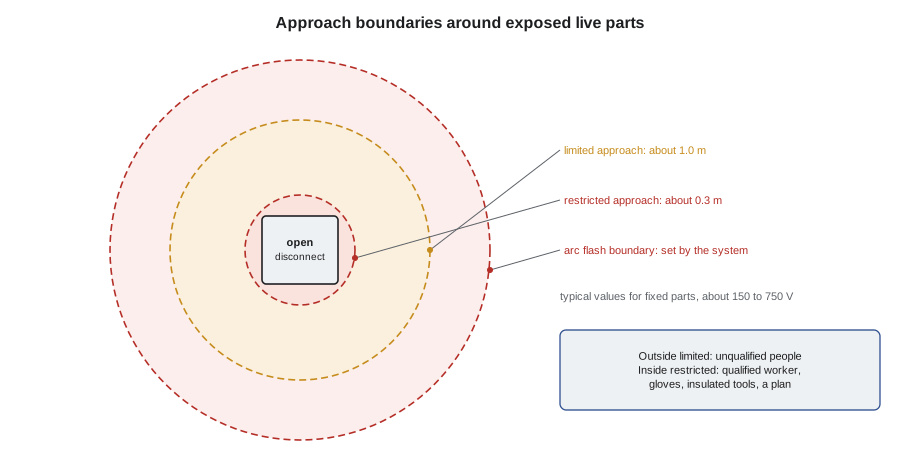
The standards define distances around exposed, energized parts. The limited approach boundary is the distance inside which there is a shock hazard; an unqualified person, such as the building owner watching the work, must stay outside it unless escorted by a qualified person. The restricted approach boundary is closer; only a qualified person using shock protection such as voltage-rated gloves and insulated tools may cross it. The arc flash boundary is the distance at which an arc flash could cause a second-degree burn to unprotected skin; anyone inside it must wear arc-rated PPE.
For the systems HVAC-R technicians usually meet, from about 150 to 750 volts, the tables in both standards give a limited approach boundary of about 1.0 m (3 ft 6 in) for fixed live parts and a restricted approach boundary of about 0.3 m (1 ft). The arc flash boundary depends on the system and comes from the equipment label or the standard's tables. In practice, this means that a technician opening a disconnect on a rooftop unit is inside every boundary as soon as the door is open, and needs to have planned the task before reaching for a meter.
Lockout and an electrically safe work condition
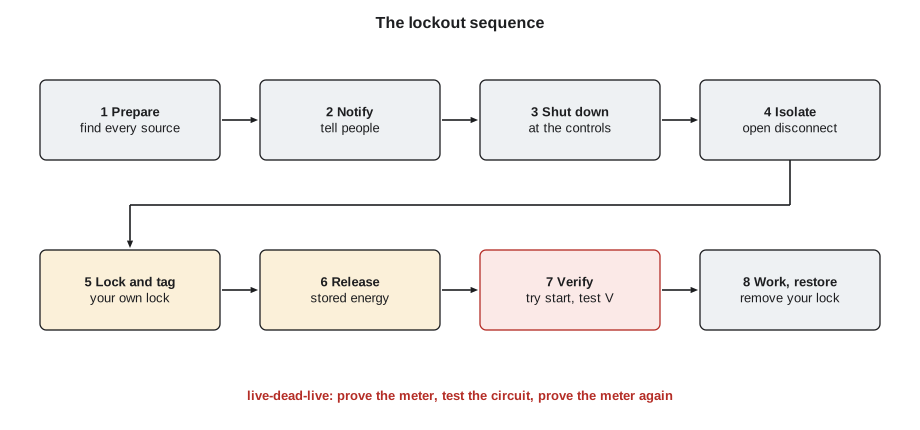
Lockout is the core skill. A technician who will put hands inside a unit, replace a component or tighten a terminal must make sure the equipment cannot be energized while working on it. The general steps are the same in both countries:
- Prepare. Identify every source of energy for the equipment: the main power supply, a separate control or heater supply, a second disconnect on a split system, and stored energy in capacitors, drives and springs. Read the wiring diagram on the unit.
- Notify. Tell the customer or the building operator that the equipment will be off, and anyone else who works on it.
- Shut down. Turn the equipment off at its normal controls, such as the thermostat, so that the disconnect does not break full load current.
- Isolate. Open the disconnect or breaker that feeds the equipment. Stand to the side of the disconnect, turn your face away and operate it with your left hand where practical, so an arc inside the box is less likely to reach your face and chest.
- Lock and tag. Apply your own personal lock, with a tag showing your name and the date, so that only you can remove it. Where a disconnect has no means of locking, use a lockout device made for it, or remove fuses and keep them with you while also locking the panel.
- Release stored energy. Discharge capacitors safely, wait for drive bus voltage to fall, and secure anything that could move.
- Verify. Try to start the equipment at its controls, then test for absence of voltage at the point of work with a meter that you have just proved on a known live source. Return the controls to off.
- Work, then restore. When the work is finished, remove tools, replace covers, tell people the equipment is coming back on, remove your own lock and restart.
The testing step is called live-dead-live: test the meter on a known live source, test the circuit you will work on, then test the meter again on the live source. If the meter failed between the first and second test, the third test catches it. A non-contact voltage tester, the pen that beeps near a live wire, is useful for a quick check, but it is not proof of absence of voltage: it can miss a live conductor inside a cable, behind a grounded shield or when its battery is weak.
Dana showed Theo a trap that has injured many technicians. Many residential condensing units use a single-pole contactor, which opens only one of the two hot legs when the thermostat is satisfied. The other leg stays connected to the compressor and fan motor all the time. A technician who sees the contactor open, assumes the unit is off and touches the compressor terminals can receive a full 240-volt shock to ground or 120 volts from the always-hot leg to the grounded cabinet. Only the disconnect, locked open and tested, makes the unit safe.
Split systems, heat pumps with electric heat, rooftop units with separate heater circuits and buildings with a backup generator can have more than one source of power. The seniors' residence chiller has a separate control power transformer and a crankcase heater fed from a different panel. A lockout is only complete when every source is isolated and the test at the point of work shows zero.
Stored energy: capacitors and drives
Capacitors store electric charge. A motor run capacitor in a residential condenser is usually designed to discharge through the motor windings when power is removed, but a capacitor whose circuit is open, or a start capacitor whose bleed resistor has failed, can hold a charge long after the disconnect is opened. Variable-frequency drives and the inverter boards in ductless heat pumps, like the attic unit Northfield installed last spring, have large filter capacitors on a DC bus at several hundred volts. Manufacturers state a waiting time, often several minutes, on a label on the drive, and many have a light that stays on while the bus is charged.
Never discharge a capacitor by shorting its terminals with a screwdriver. The spark can weld the tool, throw molten metal, damage the capacitor and cause an arc flash. Use a discharge tool with a suitable resistor, hold it with insulated handles, and then confirm with a meter that the voltage is zero. Lesson 8 covers capacitors in detail and Lesson 9 covers drives.
Personal protective equipment and tools
PPE is the last line of defence, used together with lockout and safe procedures, never instead of them. For electrical measurements and work near exposed live parts, the standards call for PPE selected from a risk assessment. For most HVAC-R service work, that includes:
- Safety glasses or goggles at all times, and an arc-rated face shield or hood where the assessment or label requires it.
- Arc-rated clothing with a rating at least equal to the expected incident energy, with cotton or other natural-fibre underlayers; synthetic fabrics can melt into the skin in an arc flash.
- Rubber insulating gloves of the right voltage class, with leather protectors over them, when hands enter the restricted approach boundary. Class 00 gloves are rated for use up to 500 volts AC and class 0 gloves up to 1,000 volts AC. Inspect and air-test gloves before each use, and send them for electrical retesting on the schedule the standard requires.
- Insulated hand tools rated for 1,000 volts for work near live parts, and a meter with the right category rating for the circuit, covered in Lesson 5.
- Fibreglass ladders, never aluminium, near electrical equipment, and footwear with good soles on roofs and in damp mechanical rooms.
Rings, watches, metal-framed glasses on chains and other conductive items should come off before work near live parts. A ring that bridges a 24-volt transformer secondary can heat red-hot in seconds; one that touches a 240-volt terminal is worse.
When someone is hurt
If a co-worker is in contact with a live conductor, do not touch them. Open the disconnect or breaker if you can do so safely; if you cannot, push them free with a dry, non-conductive object such as a wooden broom handle or a fibreglass ladder rail, standing on something dry. Call 911. If they are not breathing normally, start CPR and use an automated external defibrillator if one is available; it is designed to correct the ventricular fibrillation that shocks cause. Anyone who has received a significant shock or an arc flash burn should be assessed by a doctor, even if they seem fine, because internal burns and heart rhythm problems can appear later. Report every incident and near miss, including small shocks, so the cause can be fixed.
Worked problem
How far into the danger zone?
Theo is measuring voltage at a residential condenser's contactor, fed at 240 volts, on a humid summer day. His hands are sweaty and he kneels on damp ground. Estimate the current if his body formed a hand-to-knee path with a total resistance of about 1,500 ohms, and compare it with the let-go range.
Show solution
- \[I = \frac{V}{R} = \frac{240\ \text{V}}{1500\ \Omega} = 0.16\ \text{A}\]
- \[0.16\ \text{A} = 160\ \text{mA} \gg 30\ \text{mA (upper end of the let-go range)}\]
Answer: About 160 mA, well past the level at which a person can let go and in the range where breathing can stop and the heart can be affected. That is why Dana insists on gloves, dry footing and one-hand techniques, and why the repair itself is done only after lockout.
Common mistakes
MistakeAssuming a condenser is dead because the contactor is open.
InsteadMany contactors open only one leg; lock out the disconnect and test at the terminals.
MistakeUsing a non-contact voltage tester as proof that a circuit is dead.
InsteadProve absence of voltage with a meter, testing live-dead-live.
MistakeDischarging a capacitor with a screwdriver.
InsteadUse a resistor discharge tool and confirm zero volts with a meter.
MistakeRelying on someone else's lock.
InsteadEvery worker applies a personal lock and tag and removes only their own.
MistakeTreating the 24-volt control circuit as harmless and working on it with line voltage exposed beside it.
InsteadPlan the task for the highest voltage present in the enclosure.
Summary and key terms
- A few tens of milliamperes through the chest can kill; breakers protect wiring, not people.
- Arc flash and arc blast can burn and injure at a distance; their energy depends on the system and the clearing time.
- CSA Z462 and Ontario's OHS regulations require an electrically safe work condition, with energized work only when justified, such as testing.
- Approach boundaries limit who may come close to exposed live parts and what PPE they need.
- Lockout means isolate every source, lock and tag, release stored energy and prove absence of voltage live-dead-live.
- Capacitors and drives store energy after the power is off; discharge and verify before touching.
- Electrically safe work condition
- Equipment isolated, locked out, tested and proven dead, with stored energy released.
- Arc flash
- An electric arc through air that releases intense heat and light.
- Arc blast
- The pressure wave and flying material produced by an arc fault.
- Limited approach boundary
- The distance from exposed live parts inside which a shock hazard exists.
- Restricted approach boundary
- A closer boundary that only qualified workers with shock protection may cross.
- Lockout
- Isolating an energy source and securing it with a personal lock so it cannot be turned on.
- Live-dead-live
- Testing a meter on a live source, testing the circuit, and testing the meter again.
- Single-pole contactor
- A contactor that opens only one supply leg, leaving the other connected.
- GFCI
- A ground fault circuit interrupter, which trips at about 5 mA of leakage to protect people.
Practice problems
Work each problem on paper first, then reveal the answer to check.
Why can a 15-ampere breaker not protect a person from shock?
Show answer
It trips only at currents far larger than the few tens of milliamperes that can stop the heart; it protects the wiring, not people.
List the three tests in live-dead-live.
Show answer
Test the meter on a known live source, test the circuit to be worked on, test the meter on the live source again.
A condenser's contactor is open and the fan is off. Is it safe to touch the compressor terminals?
Show answer
No. A single-pole contactor may leave one leg live; open and lock the disconnect and test for absence of voltage.
What should you do if a co-worker is stuck to a live conductor?
Show answer
Do not touch them; open the power if safe or push them free with a dry non-conductive object, call 911 and start CPR with an AED if needed.
Lesson quiz · 5 questions
Score 60% or more to complete this lesson.
Create a free account to save your progress, take quizzes and earn a certificate.