
PWR-240 · Lesson 8 of 12 · 19 min
Plant records, logs and reports
▶ Video coming soon A video version of this lesson is on the way.
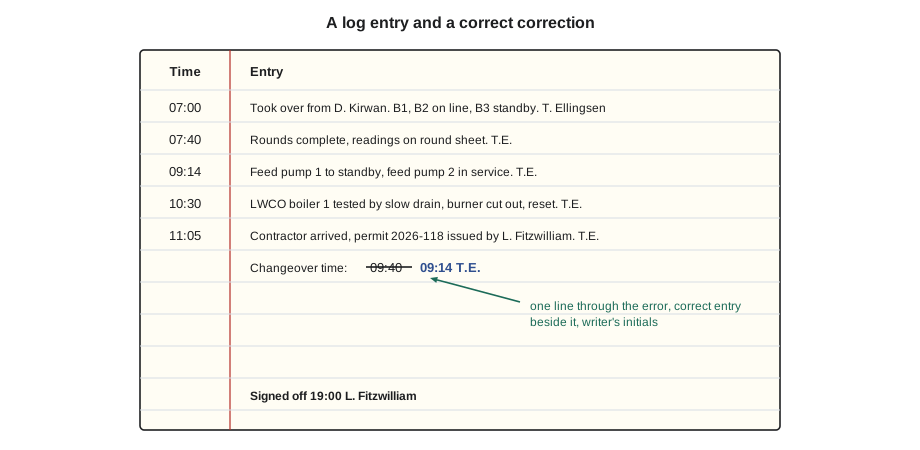
On Sunday, October 11, 2026, Lorne Fitzwilliam handed Tamar Ellingsen the pen and told her that, for the whole day shift, she would write the plant log and he would only countersign. By noon she had made two mistakes. She had written boiler 2's stack temperature in boiler 1's line, and she had recorded the feed pump changeover at 09:40 when it had actually been done at 09:14. Her first instinct was to scribble over the wrong figures. Lorne stopped her. "One line through it, so it can still be read. Write the right figure beside it, and your initials. That book is a legal record. If something goes wrong next month and an inspector reads it, they'll want to see exactly what you wrote and exactly what you changed. A log that's been tidied up is worth less than one with honest corrections in it."
Records are how a plant remembers. A log tells the next shift what happened, shows an inspector that the plant is run properly, gives the chief engineer the evidence to plan maintenance and capital work, and, after an incident, becomes the main account of what was done and when. This lesson covers the legal requirements for logs, how to write them, round sheets and shift reports, equipment and maintenance records, daily and monthly performance reports, incident reports and record retention.
Why records matter
Good records serve several purposes at once:
- Continuity: the oncoming shift learns the state of the plant, what is out of service, what is under lockout and what needs watching.
- Compliance: the plant can show regulators, insurers and auditors that it has been operated, tested and maintained as required.
- Diagnosis: a slow change, such as a boiler's stack temperature creeping up by 18 K (32 °F) over a week, becomes visible only when the readings are written down consistently and compared.
- Planning: run hours, failures and repair costs drive the maintenance plan and the capital budget.
- Evidence: after an accident or a dispute, records made at the time carry far more weight than recollections.
What the law requires
In Ontario, O. Reg. 219/01 under the Technical Standards and Safety Act requires the user of every plant to keep a log, in the form of a book or an electronic log, in the plant. The regulation sets out what must be entered, including the times when each shift starts and ends and who is in charge, any unusual or abnormal condition observed and the time it was observed, any malfunction of equipment, when it happened and what remedial action was taken, the tests carried out on safety devices, and any entry of an unauthorized person to the plant, with the purpose of the entry. Only the chief engineer or chief operator, a shift engineer or a shift operator may make or sign entries; entries are made in ink, and a mistaken entry is crossed out, corrected and initialled, never erased. The chief engineer must read and sign the log at least once each business day, and the log must be kept accessible in the plant for at least three years after its last entry.
Beyond the log itself, inspectors and insurers expect to see the certificates of inspection for each boiler and pressure vessel, the records of safety valve tests and low water cutoff tests, the boiler's history of repairs and alterations, water treatment records, and the records of the plant's lockout, permit and training programs.
Writing a good log entry
A log entry should let someone who was not there understand exactly what happened. The rules Lorne gave Tamar are common to most plants:
- Write it at the time, or as soon afterwards as safely possible, never from memory at the end of the shift.
- Record the time of every entry, using the 24-hour clock.
- Be factual and specific: "Boiler 2 FD fan tripped on overload 06:10, overload set 50 A, nameplate 54 A, reset by R. Brasseur to 54 A 07:25, fan restarted 07:30" rather than "fan tripped, fixed".
- Record readings with units, and the instrument they came from where it matters.
- Name the people involved, by their full name or plant initials, including contractors and visitors.
- Record what was done and what is still outstanding, with any work order or permit numbers.
- Never erase, use correction fluid or tear out pages. A wrong entry gets a single line through it, the correct entry beside it, and the writer's initials.
- Sign the entries you make, and sign on and off at the start and end of each shift.
Opinions and blame do not belong in a log. "Night shift left the softener in regeneration" is an accusation; "Softener B found in regeneration at 07:05, returned to service 07:20" is a record.
Round sheets and log sheets
Most plants separate the narrative log from the routine readings. Round sheets or log sheets, on paper or on a handheld device, list every reading the operator takes on each round, with the normal range printed beside it: drum levels and pressures, feedwater and deaerator conditions, fuel pressures, stack temperatures and oxygen, water treatment results, pump discharge pressures and motor currents, compressor and chiller readings, and the electrical readings added after lesson 1. A reading outside its range is circled, and the action taken goes in the log.
The value of a round sheet comes from consistency. The same reading, taken from the same instrument at the same time of day, shows trends that a single reading cannot. Writing "OK" instead of a figure destroys that value. So does copying the previous reading without looking, a habit that has been found after more than one serious incident in which an instrument had failed days earlier.
Electronic rounds systems scan a tag at each piece of equipment, prompt for the readings and check them against limits on the spot. They make trends easier to see and leave a record of when each reading was taken, but they do not replace the operator's eyes, ears and nose: a reading that is within range from a pump that is leaking, hot or noisy still needs reporting.
Shift turnover and the shift report
The most important moment for records in a plant is the shift turnover. The outgoing shift engineer briefs the oncoming one, face to face, using the log and a written shift report or turnover checklist. A good turnover covers:
- Plant status: which boilers, pumps and auxiliaries are running, on standby or out of service, and the loads.
- Abnormal conditions, alarms in effect, shelved alarms and loops in manual.
- Equipment under lockout, permits open, and contractors on site.
- Work in progress and what the oncoming shift is expected to do.
- Any safety devices bypassed or out of service, with the authorization.
- Messages from the chief engineer and expected events: deliveries, tests, customer requests.
Both engineers walk the plant or at least the control screens together for anything unusual. The oncoming engineer does not accept the shift until satisfied, and signs the log to show the time responsibility passed. Turnover is covered from the supervisory side in lesson 9.
Equipment and maintenance records
Each major piece of equipment has its own history record, increasingly kept in the plant's computerized maintenance management system (CMMS), covered in lesson 10. For a boiler the record includes the manufacturer's data report, the inspection certificate and reports, repairs and alterations with their documentation, safety valve service records, tube failures and their causes, water treatment changes, and combustion test results. For a motor it includes the nameplate data, overload settings, insulation tests, bearing changes and vibration readings. When Ruaridh Brasseur changed the fan motor's overload setting in lesson 2, the change went on the motor's record as well as in the log.
Other records a plant keeps include calibration records for instruments, lockout records and permit copies, training records for each operator, chemical inventories and safety data sheets, management of change records, and the trainee's own record of experience, signed by the chief engineer, which Tamar will need for her certificate application.
Daily and monthly performance reports
From the log and the meters, the shift or the chief engineer compiles daily and monthly reports of the plant's performance: steam and hot water produced, fuel used, electricity, water make-up, chemicals, and the ratios that show how efficiently the plant is running. The ratios matter more than the totals, because they reveal problems that a growing or falling load would hide.
Worked problem
A daily fuel-to-steam efficiency
On October 10, the steam meters at Cantwell totalled 412,000 kg of steam, the feedwater came from the deaerator at 105 °C, and the gas meter recorded 31,600 m³ of natural gas with a higher heating value of 37.3 MJ/m³. Each kilogram of steam received 2,342 kJ of heat. Estimate the plant's fuel-to-steam efficiency for the day.
Show solution
- Heat added to the steam:
- \[412{,}000 \times 2{,}342 = 964.9 \times 10^6 \text{ kJ} = 964.9 \text{ GJ}\]
- Heat supplied in the fuel:
- \[31{,}600 \times 37.3 = 1{,}178{,}700 \text{ MJ} = 1{,}178.7 \text{ GJ}\]
- Efficiency:
- \[\eta = \frac{964.9}{1{,}178.7} = 0.819\]
Answer: About 82 in 100, consistent with the individual boiler tests in PWR-210. A fall of a point or two over several days, with no change in load, is a reason to check combustion, stack temperatures and blowdown.
Other ratios that appear on Cantwell's monthly report include make-up water as a fraction of steam produced, which shows condensate losses and leaks; chemical use per unit of make-up; electricity per unit of heat delivered; and the number of trips, alarms and unplanned outages. The report goes to Grazyna Wolanski, who uses it in her monthly meeting with the plant's owner and in planning the next year's budget.
| Record | Kept by | Typical contents |
|---|---|---|
| Plant log | Shift engineers; signed daily by the chief engineer | Shift times, person in charge, events, abnormal conditions, tests, visitors |
| Round sheets | Operators on each round | Routine readings against normal ranges |
| Shift report | Outgoing shift engineer | Plant status, lockouts, permits, open items for the next shift |
| Equipment history | Maintenance planner, in the CMMS | Inspections, repairs, failures, settings, tests |
| Water treatment log | Operators and the treatment supplier | Test results, chemical feed, blowdown |
| Monthly report | Chief engineer | Production, fuel, efficiency, water, electricity, incidents |
Incident reports
Every incident and near miss in a plant is reported, investigated in proportion to its seriousness, and recorded. The plant's own system usually requires a written report by the end of the shift, with the facts, the immediate actions, the people involved and any injuries. The report is not about blame; its purpose is to find the causes and prevent a repeat.
Some incidents must also be reported to regulators. Under O. Reg. 219/01 the user must notify TSSA promptly, and in any case within eight hours, after an accident involving a plant that causes injury or death, and follow up with a written report within 48 hours where a person is seriously injured or killed or there is property damage. Workplace injuries are also reported under the Occupational Health and Safety Act and to the WSIB, and spills to the Ministry of the Environment, Conservation and Parks, as lesson 11 describes. The plant's emergency procedures list who calls whom.
After any incident, the log entries made at the time are among the most important evidence. That is the final reason Lorne insisted on honest corrections.
Electronic records and retention
Many plants now keep their log electronically, linked to the DCS historian and the CMMS. An electronic log must meet the same tests as a paper one: entries must be attributable to a named person, time-stamped, impossible to alter without leaving a trace, and backed up. Shared log-ins defeat all of those.
Records must be kept for set periods: the plant log for at least three years in Ontario, boiler inspection and repair records for the life of the boiler, training records as long as the person works at the plant and for some time after. The plant's records procedure sets out what is kept, where, for how long, and who may destroy it.
At the end of the shift Lorne read through Tamar's entries, countersigned them, and pointed out one more thing: she had written "checked LWCO boiler 1, OK". "Checked how?" he asked. She added the method, the time and the result: "LWCO boiler 1 tested by slow drain 13:20, burner cut out at correct level, reset." Grazyna read and signed the log on her next working day without comment, which Lorne said was the highest praise a log ever got.
Common mistakes
MistakeCorrecting a log entry by scribbling over it or using correction fluid.
InsteadStrike through with a single line, write the correct entry beside it and initial it.
MistakeWriting all the entries at the end of the shift.
InsteadRecord events at the time, with the time of each entry.
MistakeWriting "OK" instead of a reading on a round sheet.
InsteadRecord the actual value with its units; trends depend on numbers.
MistakeRecording opinions or blame in the log.
InsteadRecord facts: what was found, when, and what was done.
MistakeSharing one log-in for an electronic log.
InsteadEach entry must be attributable to a named person; use your own account.
Summary and key terms
- Records give continuity, compliance, diagnosis, planning and evidence.
- O. Reg. 219/01 requires a plant log with set contents, made in ink, corrected without erasure, signed daily by the chief engineer and kept three years.
- Good entries are timely, timed, factual, specific, signed and never erased.
- Round sheets record routine readings against normal ranges; consistency makes trends visible.
- Shift turnover is a face-to-face briefing supported by the log and a written shift report.
- Performance ratios such as fuel-to-steam efficiency reveal problems that totals hide; incidents are reported internally and, where required, to regulators.
- Plant log
- The legal record of a plant's operation, kept by the shift engineers and reviewed by the chief engineer.
- Round sheet
- A form listing the readings to be taken on an operator's round, with their normal ranges.
- Shift report
- A written summary of plant status and open items handed from one shift to the next.
- Equipment history
- The record of inspections, repairs, failures and settings for a piece of equipment.
- Near miss
- An event that could have caused injury or damage but did not.
Practice problems
Work each problem on paper first, then reveal the answer to check.
A day's production is 380,000 kg of steam receiving 2,342 kJ/kg, from 29,800 m³ of gas at 37.3 MJ/m³. What is the efficiency?
Show answer
Output 890.0 GJ; input 1,111.5 GJ; efficiency 0.80.
Make-up water for a day was 22,800 kg and steam production 412,000 kg. What fraction of the steam was made up?
Show answer
22,800 ÷ 412,000 = 0.055, about 5.5 in 100.
An operator wrote 1,035 kPa for a reading that was actually 1,053 kPa. How should it be corrected?
Show answer
Draw a single line through 1,035, write 1,053 beside it and initial the correction.
Lesson quiz · 5 questions
Score 60% or more to complete this lesson.
Create a free account to save your progress, take quizzes and earn a certificate.