
PRIN-130 · Lesson 5 of 12 · 26 min
The organizing practice I: the project management team
The purpose of the organizing practice is to define and establish the project's structure of accountability and responsibilities, the who of the project. A project brings together people from different parts of an organization, and often from several organizations, for a limited time. Without a deliberately designed structure, decisions stall because nobody knows who can make them, or they are made by people without the authority or knowledge to make them well. The organizing practice prevents both failures by setting out roles, their responsibilities and the relationships between them.
PRIN-110 covered the principle of defined roles, responsibilities and relationships, and PRIN-120 covered roles as people: choosing role holders, onboarding them and supporting them. This lesson and the next focus on the structure itself: the levels of management, the roles in the project management team, what each is responsible for, how assurance and support fit in, and how the structure is documented. Lesson 6 then covers combining roles, delegation, change authority and communication.
Three interests on every project
PRINCE2 starts from the view that every project has three primary interests, which must all be represented in decision-making. The business interest asks whether the project is value for money. The user interest asks whether the products will meet the needs of those who will use them and enable the benefits. The supplier interest asks whether the products can be delivered with the resources and skills available. A project board that represents only one or two of these interests will make decisions with a blind spot.
| Interest | Represented by | Key question | Ridgeline Water |
|---|---|---|---|
| Business | Executive | Is this value for money? | The utility's director of finance and operations |
| User | Senior user (one or more) | Will the products meet our needs and deliver the benefits? | The managers of customer operations and billing |
| Supplier | Senior supplier (one or more) | Can the products be delivered as planned? | The meter supplier's delivery director and the utility's IT manager |
Suppliers may be internal or external. Ridgeline Water's billing integration is delivered by its own IT team, so the IT manager is a senior supplier alongside the external meter supplier. A project can have more than one senior user or senior supplier, but PRINCE2 strongly favours a single executive, so that one person is accountable for the business case and the final decision.
Levels of management
The organizing practice places the project management team within the four layers discussed in PRIN-120: the business layer, which commissions the project and sets project tolerances; directing, the project board; managing, the project manager; and delivering, the team managers and their teams. Each level manages within the tolerances set by the level above and escalates when those tolerances are forecast to be exceeded.
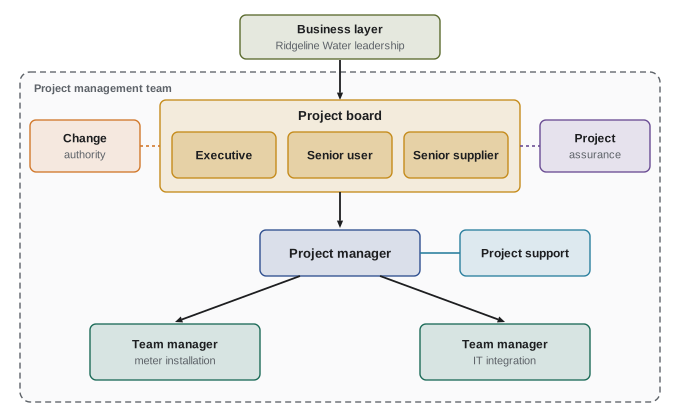
The diagram shows reporting lines, not seniority. The project manager reports to the board, not to any one board member, and team managers report to the project manager for the work in their work packages, even if they belong to a supplier company with its own management chain. The dotted lines for project assurance and change authority show that these roles support the board but do not sit in the line of command between board and project manager.
The project board
The project board is accountable for the success of the project within the remit set by the business layer. It approves the project and each stage, sets stage tolerances, decides on exceptions, provides direction and resources, and authorizes closure. It does not manage the project day to day; that is the project manager's job. PRINCE2 calls this management by exception: the board directs through decisions at key points and through tolerances, rather than through constant involvement.
| Board role | Main responsibilities (summary in our words) | Common failure |
|---|---|---|
| Executive | Owns the business case; chairs the board; makes the final decision; secures funding; ensures the project gives value for money | Delegating ownership to the project manager; being unavailable for decisions |
| Senior user | Specifies user needs and benefits; commits user resources; ensures products are usable; accountable for benefits realization | Sending a junior delegate with no authority; leaving acceptance criteria vague |
| Senior supplier | Represents those designing and delivering products; commits supplier resources; confirms technical feasibility and estimates | Acting only as a salesperson for the supplier; hiding delivery problems |
Board members need authority, credibility, the ability to delegate and enough availability, as PRIN-120 discussed. A useful test for each board member is whether they could commit their part of the organization to a decision in the meeting. If the senior user must go back to their director before agreeing to release staff for training, the wrong person is in the role.
The project manager and team managers
The project manager runs the project day to day on behalf of the board, within the stage tolerances. Their responsibilities include planning, delegating work packages to team managers, monitoring progress, managing risks and issues, reporting to the board and preparing the management products. The project manager is responsible for delivering the project's products to the required quality, within cost and time, and for ensuring the products are capable of achieving the benefits.
Team managers are responsible for producing the products allocated to them in work packages, to the agreed quality, time and cost, and for reporting progress through checkpoint reports. The team manager role is optional in the sense that on small projects the project manager may manage the team directly; on larger projects, and particularly where suppliers deliver products, team managers are essential.
| Role | Reports to | Main focus | Ridgeline Water |
|---|---|---|---|
| Project manager | Project board | Running the project within stage tolerances; delivering products | A project manager from the utility's project office |
| Team manager: meter installation | Project manager | Installing meters district by district | The supplier's installation lead |
| Team manager: IT integration | Project manager | Integrating meter data with billing and the customer portal | The utility's IT development lead |
| Team manager: customer change | Project manager | Customer communications, alerts and follow-up process | A customer operations supervisor |
Note the customer change team. Lesson 4 showed that most of the benefits depend on customers responding to leak alerts. Making that work a team manager's explicit responsibility, with its own work package and products, is the organizing practice responding to what the business case revealed.
Project assurance
Project assurance is the board's own means of checking that the project is being conducted properly. Each board member is responsible for assurance of their interest: business assurance for the executive, user assurance for the senior user and supplier assurance for the senior supplier. Board members may do this themselves or appoint people to carry it out. Assurance must be independent of the project manager; the project manager cannot assure their own work.
| Assurance area | On behalf of | Typical checks |
|---|---|---|
| Business assurance | Executive | Business case kept current; costs and benefits forecasts realistic; risks to the case assessed |
| User assurance | Senior user | User needs and acceptance criteria clear; users involved in quality reviews; benefits measurable |
| Supplier assurance | Senior supplier | Technical approach sound; standards followed; estimates and supplier resources realistic |
Project assurance is different from quality assurance. Quality assurance is an independent check by the wider organization that the project's direction and management are adequate and that organizational standards are followed; it is outside the project management team. Project assurance belongs to the board and is part of the team. PRIN-131 covers quality assurance in the quality practice.
Project support
Project support provides administrative services and guidance to the project: configuration management, record keeping, maintaining registers and logs, supporting meetings and helping with planning tools. In larger organizations, a project office or portfolio office may provide project support to several projects. Project support may be combined with the project manager role on small projects, but it should not be combined with project assurance, because assurance must be independent of those it checks.
Accountable, responsible and consulted
Many organizations describe roles using a responsibility assignment matrix, often called a RACI chart: who is responsible for doing a task, who is accountable for it, who must be consulted and who must be informed. PRINCE2 describes roles through responsibility descriptions rather than a RACI chart, but the two can be used together. What matters most is that every key decision has exactly one accountable role.
roles = ["Exec", "SU", "SS", "PM", "Assur", "Supp"]
decisions = {
    "approve business case":     {"Exec": "A", "PM": "R", "SU": "C", "SS": "C", "Assur": "C"},
    "specify benefits":          {"SU": "A", "PM": "R", "Exec": "C", "Assur": "C"},
    "approve stage plan":        {"Exec": "A", "SU": "C", "SS": "C", "PM": "R", "Assur": "C"},
    "accept a product":          {"SU": "A", "SS": "C", "PM": "R"},
    "approve work package":      {"PM": "A", "SS": "C"},
    "maintain issue register":   {"Supp": "R", "PM": "A"},
    "approve minor change":      {},
}
print("decision".ljust(26) + " ".join(r.ljust(5) for r in roles))
for d, m in decisions.items():
    print(d.ljust(26) + " ".join(m.get(r, "-").ljust(5) for r in roles))
print()
for d, m in decisions.items():
    n = list(m.values()).count("A")
    if n != 1:
print(f"problem: '{d}' has {n} accountable roles")decision Exec SU SS PM Assur Supp approve business case A C C R C - specify benefits C A - R C - approve stage plan A C C R C - accept a product - A C R - - approve work package - - C A - - maintain issue register - - - A - R approve minor change - - - - - - problem: 'approve minor change' has 0 accountable roles
The check finds one gap: nobody is accountable for approving minor changes. In PRINCE2 terms, that gap is exactly what the change authority role addresses: the board may delegate authority for approving changes within limits to a change authority, or keep it itself. Lesson 6 explains how. The matrix also shows that the executive is accountable for the business case while the project manager is responsible for preparing it, which is the distinction lesson 2 made.
Documenting the organization
The project management team structure and role descriptions are documented during starting up and confirmed during initiation, as part of the project initiation documentation. Role descriptions should be tailored to the project: generic descriptions copied from a template, with no mention of the project's products, suppliers or risks, are a warning sign. The structure is reviewed at each stage boundary, because the right team for design may not be the right team for rollout.
Worked problem
Reviewing the team at a stage boundary
Ridgeline Water's project moves from the pilot stage into full rollout. During the pilot, the senior user was the manager of customer operations alone. Full rollout will change billing processes for every customer. Should the project management team change?
Show solution
- Identify whose needs and resources the next stage affects: billing staff will be heavily affected.
- Consider adding the billing manager as a second senior user, or making sure the existing senior user can commit billing resources.
- Check that user assurance covers billing as well as customer operations.
- Update role descriptions and the communication management approach, and have the board confirm the changes when approving the stage.
Answer: The board should add billing representation, most simply by appointing the billing manager as a second senior user, and update assurance and role descriptions before authorizing the rollout stage.
Common mistakes
MistakeBuilding a board that represents only the business and supplier interests.
InsteadRepresent business, user and supplier interests on every project board.
MistakeAppointing several executives to share accountability.
InsteadAppoint a single executive who owns the business case and makes the final decision.
MistakeLetting the project manager carry out project assurance on their own work.
InsteadKeep assurance independent of the project manager.
MistakeConfusing project assurance with quality assurance.
InsteadProject assurance belongs to the board; quality assurance is independent of the project management team.
MistakeSetting up the team once and never reviewing it.
InsteadReview the structure at each stage boundary as the work changes.
Summary and key terms
- The organizing practice defines the project's structure of accountability and responsibilities.
- Every project has business, user and supplier interests, which must be represented on the board.
- The board directs and decides; the project manager manages day to day; team managers deliver products.
- PRINCE2 favours a single executive; there may be several senior users and senior suppliers.
- Project assurance is the board's independent check; it is not the same as quality assurance.
- Project support provides administration and must not be combined with assurance.
- Role descriptions are tailored to the project and reviewed at each stage boundary.
- Organizing practice
- The practice that defines and establishes the project's structure of accountability and responsibilities.
- Project board
- The group accountable for directing the project, made up of the executive, senior user and senior supplier.
- Executive
- The board role that owns the business case and represents the business interest.
- Senior user
- The board role representing those who will use the products and accountable for benefits.
- Senior supplier
- The board role representing those who will design and deliver the products.
- Project manager
- The role that manages the project day to day within the board's tolerances.
- Team manager
- The role responsible for producing products allocated in work packages.
- Project assurance
- The board's independent checks that the project is being conducted properly.
- Project support
- Administrative services and guidance provided to the project.
- RACI chart
- A matrix showing who is responsible, accountable, consulted and informed for each task.
Practice problems
Work each problem on paper first, then reveal the answer to check.
Name the three primary project interests.
Show answer
Business, user and supplier.
Which role represents the business interest?
Show answer
The executive.
Can a project have two senior users?
Show answer
Yes.
Why does PRINCE2 favour a single executive?
Show answer
So one person is accountable for the business case and final decision.
To whom does the project manager report?
Show answer
The project board.
Who carries out user assurance?
Show answer
The senior user or people they appoint, independent of the project manager.
Is project assurance part of the project management team?
Show answer
Yes; quality assurance is outside it.
Which role should project support not be combined with?
Show answer
Project assurance.
What does a RACI check for each key decision?
Show answer
That it has exactly one accountable role.
When is the project management team structure reviewed?
Show answer
At each stage boundary.
Lesson quiz · 5 questions
Score 60% or more to complete this lesson.
Create a free account to save your progress, take quizzes and earn a certificate.