
PRIN-110 · Lesson 8 of 12 · 26 min
Tailor to suit the project
The seventh principle states that PRINCE2 is tailored to suit the project's context: its size, complexity, importance, risk, team capability, delivery approach and the organization around it. Tailoring is not a sign of doing PRINCE2 badly; it is a requirement of doing it well. A method applied identically to a two-week office move and a five-year infrastructure program would either crush the small project with bureaucracy or leave the large one dangerously under-managed. The tailoring principle makes sure the method fits, while the other six principles make sure that what remains is still PRINCE2.
What can and cannot be tailored
The rule is simple to state. The principles are not tailored away. Everything else can be adapted: the practices, the processes, the roles, the management products, the terminology and the techniques. Tailoring changes how the principles are applied, never whether they are applied.
| Element | Can be tailored? | Examples |
|---|---|---|
| Principles | No; how they are applied can be adapted | A brief stage boundary call still applies manage by stages |
| Practices | Yes | Combining risk and issue registers; a one-page business case |
| Processes | Yes | Combining starting up and initiating on a simple project |
| Roles | Yes, within limits | Executive also acting as senior user; project manager also team manager |
| Management products | Yes | Highlight reports as an email; product descriptions as a short table |
| Terminology | Yes | Using the organization's word "gate" for stage boundary |
| Techniques | Yes | Using Kanban for work packages; using the organization's risk scoring |
Two levels of tailoring
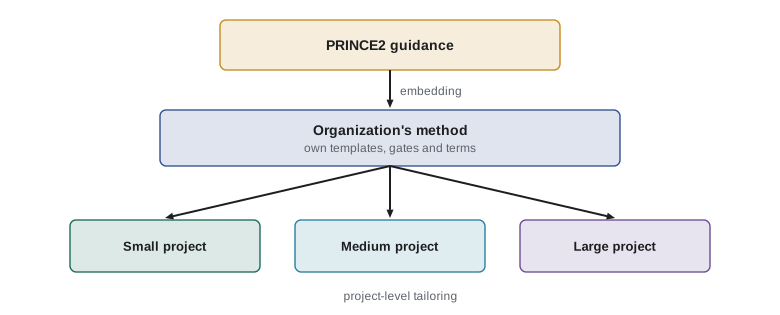
Tailoring happens at two levels. At the organizational level, a company or government department adopts PRINCE2 and adapts it into its own project management method: its own templates, terminology, gating process and thresholds. This is sometimes called embedding. At the project level, each project then tailors the organization's method to its own context, deciding how many stages it needs, which management products to use and how formal reporting will be. Both levels should be documented. Project-level tailoring is recorded in the project initiation documentation, so the board and assurance can see what was decided and why.
Factors that drive tailoring
The project context element of PRINCE2 7 lists many factors that influence tailoring. They can be grouped into a few questions.
- Scale: how large is the budget, team and duration?
- Complexity: how many interfaces, suppliers, technologies and stakeholders are involved?
- Risk and importance: what happens if the project fails? Is it safety-critical or highly visible?
- Delivery approach: is the work predictive, agile or a hybrid?
- Capability: how experienced are the project manager, board and teams?
- Organizational environment: what standards, gates, regulations and governance already apply?
- Commercial context: are suppliers external, and under what contracts?
- Sustainability and social context: what environmental and community expectations apply?
A tailoring decision matrix
Many organizations use a simple scoring matrix to suggest a tailoring level. Each factor is scored, the scores are weighted and the total points to a light, standard or full application of the method. The matrix does not replace judgment, but it makes tailoring decisions consistent and easier to explain to assurance.
Worked problem
Scoring a project for tailoring
An organization scores four factors from 1 (low) to 5 (high) with weights: budget size 30 %, risk 30 %, complexity 25 % and team inexperience 15 %. Scores of 2.0 or below suggest light tailoring, 2.1 to 3.5 standard and above 3.5 full. A project to replace meeting room booking software scores budget 2, risk 2, complexity 3 and team inexperience 1. Which level is suggested?
Show solution
- Budget: 2 × 0.30 = 0.60.
- Risk: 2 × 0.30 = 0.60.
- Complexity: 3 × 0.25 = 0.75.
- Team inexperience: 1 × 0.15 = 0.15.
- Weighted total: 0.60 + 0.60 + 0.75 + 0.15 = 2.10.
Answer: A score of 2.10 falls at the bottom of the standard band, so standard tailoring with some simplification is suggested. The project manager should explain any further lightening in the project initiation documentation.
Tailoring a small project
On a small, low-risk project, typical tailoring choices include:
- one person acting as executive and senior user;
- the project manager also acting as team manager;
- starting up and initiating combined into a short activity producing a single project initiation document;
- two management stages: initiation and one delivery stage;
- highlight reports as short emails, perhaps fortnightly;
- a combined register for risks, issues and lessons;
- product descriptions as a short table rather than separate documents.
Every principle is still visible. The business case is short but reviewed at the end of initiation. Lessons are sought from the previous similar project. Roles are defined, even if combined. There are two stages with a decision point. Tolerances are set. Products are described. The tailoring is written down. That is a small PRINCE2 project done properly.
Tailoring a large or high-risk project
On a large or high-risk project, tailoring usually adds formality rather than removing it: more management stages, independent assurance reviews, more detailed product descriptions, a dedicated project support office, formal configuration management, and perhaps several team managers and a change authority. Large projects may also align stage boundaries with external gates, such as government investment approvals or regulatory milestones. The principle cuts both ways: it is as much a failure to under-manage a complex project as to over-manage a simple one.
PINO: PRINCE2 in name only
The opposite of good tailoring is sometimes called PINO, PRINCE2 in name only. A PINO project claims to use PRINCE2 but has removed or ignored one or more principles. Common signs include a business case that was never updated, a board that never meets, stage boundaries that are skipped, no tolerances, and templates filled in after the event to satisfy auditors. PINO projects often produce more paperwork than well-tailored ones, because documents are produced for compliance rather than use.
| Legitimate tailoring | PINO |
|---|---|
| Business case shortened to two pages but reviewed at each stage end | Business case written for approval and never looked at again |
| Executive and senior user combined, with assurance from another manager | No executive; decisions made informally by whoever is available |
| Two management stages with a brief boundary decision | One stage; the board sees the project again at closure |
| Highlight reports by email with forecasts against tolerance | No tolerances; problems discovered at the end |
| Tailoring decisions recorded in the initiation documentation | Templates completed retrospectively for an audit |
Tailoring and agile delivery
When delivery is agile, tailoring typically maps PRINCE2 concepts onto agile ones. Work packages may be defined as sets of backlog items for a release. Team managers may be product owners or delivery leads. Quality criteria may be expressed in a definition of done. Highlight reports may use burn-up charts. Scope becomes the main tolerance, with time and cost fixed. PRINCE2 Agile provides detailed guidance on this blend. Whatever the mapping, the principles still apply: the board still checks business justification at stage boundaries, which may align with releases, and still manages by exception.
Documenting tailoring
Tailoring decisions belong in the project initiation documentation, usually in a short section that lists each significant decision and the reason for it. This record matters for three reasons. It lets the board approve the way the project will be managed. It lets assurance check that tailoring has not removed a principle. And it lets a future project manager understand why the project was run as it was, which feeds learn from experience.
Worked problem
Recording tailoring decisions
Write three short tailoring records for a six-month internal process improvement project with a budget of 150,000.
Show solution
- Decision 1: combine executive and senior user (operations director). Reason: the director owns both the budget and the process; independent assurance from the finance manager.
- Decision 2: three management stages (initiation, design and pilot, rollout). Reason: the pilot result is a natural go or stop decision before rollout costs are committed.
- Decision 3: single combined register for risks, issues and lessons, reviewed fortnightly. Reason: small team; volume of entries expected to be low.
Answer: Each record names the decision, the reason and, where relevant, how the principle is still honoured.
Tailoring the processes
Tailoring is not limited to documents. The seven processes can be adapted too. On a simple project, starting up and initiating a project can be combined into a short activity that produces a single initiation document. Controlling a stage and managing product delivery can be handled by the same person if the project manager is also the team manager. Managing a stage boundary can be a short meeting with a two-page end stage report. On a complex project, by contrast, each process may be supported by detailed procedures, a project office and formal approvals. What matters is that the purpose of each process is still achieved: the project is justified before significant resources are committed, it is planned before delivery starts, progress is controlled, boundaries are decision points and closure is orderly.
Tailoring terminology
Organizations often have their own vocabulary. They may call the executive the sponsor, the project board a steering committee, stage boundaries gates and the project initiation documentation a project charter. PRINCE2 allows terminology to be changed, as long as the meaning is preserved. The danger is that a renamed role quietly loses its responsibilities. A steering committee that only receives updates, rather than making decisions and holding tolerances, is not a project board in the PRINCE2 sense. When terminology is tailored, it is good practice to include a short mapping table in the tailoring record so that people trained in PRINCE2 can see how terms correspond.
| PRINCE2 term | Common organizational term | Check |
|---|---|---|
| Executive | Sponsor | Owns the business case and is accountable |
| Project board | Steering committee | Makes decisions and sets stage tolerances |
| Stage boundary | Gate | Includes a business case review and a go, change or stop decision |
| Project initiation documentation | Project charter | Contains plans, controls and tailoring decisions |
| Exception report | Escalation note | Triggered by a forecast breach of tolerance |
Reviewing tailoring as the project goes
Tailoring is not a one-off decision. As a project progresses, its context may change: the risk may grow, a new supplier may join, the team may become more experienced, or a program may take over some responsibilities. Stage boundaries are a good time to review whether the tailoring still fits. A project that started light may need more formality if problems emerge; a project that started heavy may simplify once processes are stable. Any change to tailoring should be recorded, with its reason, so that the board and assurance can see that every principle is still being applied.
Assurance reviewers often look at tailoring first, because it tells them where to expect evidence. If the tailoring record says highlight reports are monthly emails, the reviewer checks for those emails and for forecasts against tolerance in them. If it says the executive also acts as senior user, the reviewer checks that someone independent provides user assurance. Tailoring that is recorded clearly makes a project easier to review and easier to defend.
Common mistakes
MistakeTreating tailoring as permission to skip principles.
InsteadTailor practices, processes and products; keep every principle.
MistakeApplying the full method identically to every project.
InsteadScale the method to size, risk, complexity and context.
MistakeUnder-managing a complex, high-risk project in the name of tailoring.
InsteadAdd formality and assurance where risk demands it.
MistakeMaking tailoring decisions informally and not recording them.
InsteadRecord tailoring in the project initiation documentation.
MistakeFilling in templates afterwards to look compliant.
InsteadUse management products as tools for decisions, not for audits.
Summary and key terms
- PRINCE2 must be tailored to the project's context.
- Principles are never tailored away; everything else can be adapted.
- Tailoring happens at organizational and project levels.
- Scale, complexity, risk, approach, capability and environment drive tailoring.
- A weighted scoring matrix makes tailoring decisions consistent.
- PINO projects claim PRINCE2 but drop principles.
- Tailoring decisions and reasons belong in the project initiation documentation.
- Tailoring
- Adapting the method to suit the project's context.
- Embedding
- Adopting PRINCE2 into an organization's own project management method.
- Project context
- The internal and external setting that shapes how the method is applied.
- PINO
- PRINCE2 in name only: claiming to use PRINCE2 while ignoring principles.
- Project initiation documentation
- The documents that define how the project will be managed, including tailoring.
- Gate
- An organizational decision point, often aligned with a stage boundary.
- Weighted scoring
- Combining scores using weights to reflect relative importance.
- PRINCE2 Agile
- Guidance on combining PRINCE2 with agile delivery.
- Definition of done
- The agreed criteria for a backlog item to be considered complete.
- Formality
- The degree to which management products and controls are documented.
Practice problems
Work each problem on paper first, then reveal the answer to check.
Can principles be tailored away?
Show answer
No; only how they are applied can be adapted.
Name the two levels of tailoring.
Show answer
Organizational and project.
Scores 4, 3, 3, 2 with weights 30, 30, 25, 15 %. Weighted total?
Show answer
1.2 + 0.9 + 0.75 + 0.3 = 3.15.
Where are project tailoring decisions recorded?
Show answer
In the project initiation documentation.
Give one sign of PINO.
Show answer
A business case never updated, skipped stage boundaries or no tolerances.
Does tailoring always reduce formality?
Show answer
No; complex or risky projects may need more.
Which role combination is common on small projects?
Show answer
Executive and senior user.
In agile tailoring, which tolerance is often the main flexibility?
Show answer
Scope.
What guidance covers PRINCE2 with agile in detail?
Show answer
PRINCE2 Agile.
Why record the reason for each tailoring decision?
Show answer
So the board can approve it, assurance can check it and future projects can learn from it.
Lesson quiz · 5 questions
Score 60% or more to complete this lesson.
Create a free account to save your progress, take quizzes and earn a certificate.