
PRIN-110 · Lesson 2 of 12 · 26 min
Ensure continued business justification
The first principle states that a PRINCE2 project must have a justifiable reason to start, that the justification must remain valid throughout the life of the project, and that it must be documented and approved. The key word is continued. Many organizations write a business case to win funding and then never look at it again. PRINCE2 treats the business case as a living document that is checked, updated and used to make decisions at every stage boundary and whenever a significant change or exception occurs.
Why justification must be continued
Projects take time, and the world changes while they run. Costs rise, markets move, regulations change, a competitor launches first, a sponsoring executive leaves or a new technology makes the planned solution obsolete. A project that was clearly worthwhile at the start can become a poor use of money halfway through. Without a principle that forces regular re-examination, the momentum of a project tends to carry it forward: people have invested time and reputation, contracts are signed, and stopping feels like failure.
PRINCE2 reverses that instinct. Stopping a project whose justification has failed is a success of the method, not a failure. Money not spent on a doomed project can be spent on something worthwhile. The board that closes a project early because its benefits no longer outweigh its costs and risks is doing exactly what the principle requires.
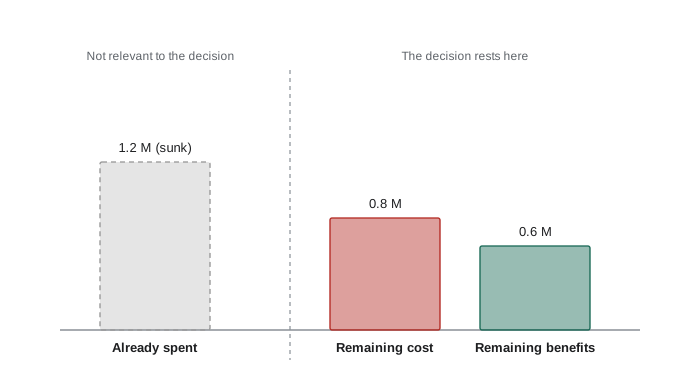
Economists call the opposite behaviour the sunk cost fallacy: continuing because of what has already been spent rather than because of what remains to be gained. The business case corrects this by asking a forward-looking question at each decision point. Given what we now know, are the remaining costs and risks worth the remaining expected benefits?
Where the principle lives in the method
Continued business justification is supported mainly by the business case practice, but it reaches across the processes:
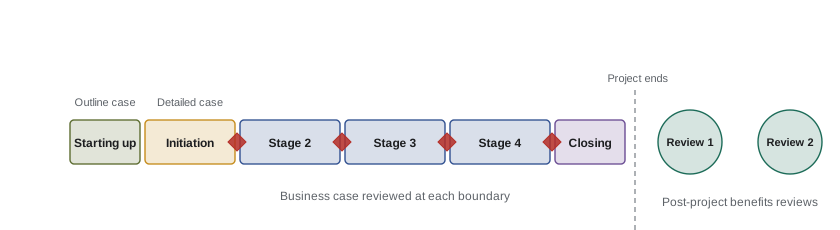
- In starting up a project, the executive is responsible for an outline business case, often building on a project mandate or brief that explains why the project is needed.
- In initiating a project, the outline business case is refined into a detailed business case, with costs, timescales, benefits, risks and investment appraisal drawn from the project plan.
- In managing a stage boundary, the project manager updates the business case with the latest forecasts, and the board reviews it before authorizing the next stage.
- In directing a project, the board can stop the project at any time if justification fails, not only at stage ends.
- In controlling a stage, issues and risks are assessed for their impact on the business case, so a significant change triggers a fresh look at justification.
- In closing a project, the business case is used to confirm what has been achieved and to plan post-project benefits reviews.
The executive owns the business case. The project manager prepares and maintains it, and senior users are accountable for specifying the benefits and, after the project, realizing them. Project assurance on behalf of the executive checks that the business case remains sound and that the figures in it are honest.
Compulsory projects still need a business case
Some projects must happen: a new privacy law, a safety regulation, a hardware platform reaching end of support. It is tempting to say these projects need no justification. PRINCE2 disagrees. There are almost always several ways to comply, with different costs, timescales and risks. The business case for a compulsory project compares those options and shows that the chosen one is the best value. It also guards against gold-plating, where a mandatory project becomes a vehicle for unrelated improvements.
For example, when Quebec's Law 25 brought in new privacy obligations in stages between 2022 and 2024, organizations had to comply, but they could choose between building new consent and records systems, buying a privacy management product or extending an existing platform. A business case comparing those options is still essential.
Measuring justification: the investment appraisal
A business case usually includes an investment appraisal that compares costs and benefits over time. Common measures include payback period, return on investment, benefit-cost ratio and net present value. None of them is perfect, and each answers a slightly different question. PRINCE2 does not prescribe a measure; the organization's own standards usually do. What PRINCE2 requires is that the measures are calculated honestly, updated as forecasts change and compared against tolerance.
Net present value discounts future cash flows to today's value using a discount rate that reflects the cost of capital and risk:
Here \(B_t\) and \(C_t\) are the benefits and costs in year \(t\) and \(r\) is the discount rate. A positive NPV means the project is expected to create value at that discount rate.
Worked problem
Rechecking NPV at a stage boundary
A project to automate invoice processing was approved with a one-time cost of 500,000 in year 0 and savings of 180,000 a year for years 1 to 4. The organization uses a discount rate of 8 %. At the end of stage 2, the forecast cost has risen to 560,000 and the savings estimate has fallen to 160,000 a year because one department has dropped out. Is the project still justified on NPV?
Show solution
- Discount factors at 8 %: year 1 = 0.926, year 2 = 0.857, year 3 = 0.794, year 4 = 0.735. Sum = 3.312.
- Original NPV: 180,000 × 3.312 − 500,000 = 596,160 − 500,000 = 96,160.
- Revised NPV, treating the whole revised cost as still to be spent for simplicity: 160,000 × 3.312 − 560,000 = 529,920 − 560,000 = −30,080.
- At the boundary, though, part of the cost has already been spent. Suppose 200,000 is spent; the remaining cost is 360,000.
- Forward-looking NPV: 529,920 − 360,000 = 169,920, which is positive.
Answer: Looking forward, the remaining investment of 360,000 is still expected to return 529,920 in today's money, so continuing is justified on NPV even though the whole-project NPV is now negative. The board should record that the original case has deteriorated and check whether tolerance on benefits has been breached.
This example shows why the principle is about continued justification. The whole-life figures tell you whether the project was a good idea; the forward-looking figures tell you whether finishing it is a good idea. Both belong in the updated business case, and the board needs both to make a sound decision.
Justification and tolerance
PRINCE2 7 recognizes seven performance targets for which tolerances can be set: time, cost, scope, quality, benefits, risk and sustainability. Benefits tolerance is directly tied to this principle. If the forecast benefits fall below the agreed tolerance, an exception exists and must be escalated. The board then decides whether the project remains justified. Payback period and benefit-cost ratio are often used as quick checks alongside NPV.
Worked problem
Testing payback and benefit-cost ratio against tolerance
A project board set benefits tolerance as follows: the payback period must not exceed 3.5 years and the benefit-cost ratio over five years must stay at or above 1.3. The current forecast is a cost of 420,000 and undiscounted benefits of 110,000 a year for five years. Is the project within benefits tolerance?
Show solution
- Payback: 420,000 ÷ 110,000 ≈ 3.82 years.
- Benefit-cost ratio: (110,000 × 5) ÷ 420,000 = 550,000 ÷ 420,000 ≈ 1.31.
- The ratio meets the 1.3 floor, but the payback exceeds 3.5 years.
- Because one benefits measure is outside tolerance, the project manager must raise an exception report to the board.
Answer: No: payback of about 3.8 years breaches the 3.5-year limit, so an exception must be escalated even though the ratio is just inside tolerance.
Failure modes
Projects neglect this principle in predictable ways. Recognizing them is the first step to preventing them.
| Failure mode | What it looks like | What the principle requires |
|---|---|---|
| Write once, file forever | Business case approved at the start and never updated | Update and review at every stage boundary and major change |
| Optimism bias | Benefits overstated and costs understated to win approval | Honest estimates, independent assurance and reference-class comparisons |
| Benefits without owners | Benefits listed with no one accountable for realizing them | Senior users accountable for benefits, with a benefits management approach |
| Sunk cost reasoning | Continuing because of what has been spent | Forward-looking review of remaining costs and benefits |
| Justification by mandate | "We were told to do it" treated as a business case | Compare options even for compulsory projects |
| Hidden deterioration | Forecasts slip but the case is not revisited | Benefits tolerance that triggers an exception |
Optimism bias deserves special mention. Research on large projects, including the work of Bent Flyvbjerg and others, has repeatedly found that projects tend to underestimate costs and overestimate benefits at approval. Some governments apply explicit optimism bias uplifts to early estimates. A PRINCE2 business case does not need to use a particular method, but it should show how estimates were made and how uncertainty was considered.
Benefits are realized after the project
Many benefits appear only after the project closes. A new booking system saves staff time only once clinics are using it routinely. PRINCE2 deals with this through a benefits management approach, created during initiation, which describes how and when benefits will be measured and who will measure them. Some benefits reviews happen during the project, if products are handed over in stages; many happen after closure, owned by corporate or business management. The project's duty is to make sure the benefits can be measured and that responsibility for doing so is clearly handed on.
Applying the principle on a small project
On a small project the business case can be short, perhaps a page or two, and stage boundary reviews can be brief conversations recorded in an email. What must not disappear is the question itself. Before each commitment of further money and effort, someone with authority must ask whether the project is still worth doing, using up-to-date figures, and must have the power to stop it. If that happens, the principle is being applied, however light the paperwork.
Questions a board should ask at every boundary
A short, standard set of questions helps a board apply this principle consistently. Are the expected benefits still realistic, and who has confirmed them? Have the costs to complete changed, and why? Have new options appeared, such as a cheaper product, a partner or a change in policy? Are the main risks to the business case still acceptable? Is the project still aligned with the organization's strategy and priorities? If the answer to any question raises doubt, the board should ask for analysis before authorizing the next stage, rather than approving now and hoping the doubt resolves itself.
Common mistakes
MistakeTreating the business case as a funding document that is never revisited.
InsteadReview and update it at every stage boundary and when significant issues arise.
MistakeContinuing a project because of the money already spent.
InsteadDecide on remaining costs, risks and benefits; treat spent money as sunk.
MistakeSkipping the business case for a compulsory project.
InsteadCompare the options for complying and justify the chosen one.
MistakeListing benefits with no named owner or measure.
InsteadMake senior users accountable and describe how each benefit will be measured.
MistakeViewing early closure as a project failure.
InsteadRecognize that stopping an unjustified project is the principle working.
Summary and key terms
- A PRINCE2 project needs a justifiable reason to start that remains valid throughout.
- The business case is reviewed at every stage boundary and whenever significant change occurs.
- The executive owns the business case; senior users are accountable for benefits.
- Compulsory projects still need a business case to choose the best way to comply.
- Forward-looking appraisal ignores sunk costs; whole-life figures show how the case has changed.
- Benefits tolerance turns a deteriorating case into an exception for the board.
- Stopping a project whose justification has failed is the method working as intended.
- Business case
- The justification for a project, setting out costs, benefits, risks and options.
- Outline business case
- The early version of the business case produced in starting up a project.
- Investment appraisal
- The comparison of costs and benefits over time, using measures such as NPV.
- Net present value (NPV)
- The sum of discounted future net cash flows.
- Payback period
- The time taken for cumulative benefits to equal the investment.
- Benefit-cost ratio
- Total benefits divided by total costs over a defined period.
- Sunk cost
- Money already spent that cannot be recovered and should not drive decisions.
- Optimism bias
- The tendency to underestimate costs and overestimate benefits.
- Benefits management approach
- The plan for how and when benefits will be measured and by whom.
- Benefits tolerance
- The permitted deviation in expected benefits before an exception occurs.
Practice problems
Work each problem on paper first, then reveal the answer to check.
Who owns the business case?
Show answer
The executive.
Cost 300,000; benefits 90,000 a year. Payback?
Show answer
300,000 ÷ 90,000 ≈ 3.33 years.
Benefits 500,000 over five years; cost 400,000. Benefit-cost ratio?
Show answer
1.25.
Discount factor for year 2 at 10 %?
Show answer
1 ÷ 1.1² ≈ 0.826.
Why does a compulsory project need a business case?
Show answer
To compare options for complying and choose the best value.
Which process produces the outline business case?
Show answer
Starting up a project.
When can the board stop a project?
Show answer
At any time, not only at stage boundaries.
What is the sunk cost fallacy?
Show answer
Continuing because of money already spent rather than remaining value.
Name the seven performance targets.
Show answer
Time, cost, scope, quality, benefits, risk and sustainability.
Who is accountable for realizing benefits after the project?
Show answer
Senior users, on behalf of business management.
Lesson quiz · 5 questions
Score 60% or more to complete this lesson.
Create a free account to save your progress, take quizzes and earn a certificate.