
PMP-160 · Lesson 5 of 12 · 29 min
Practising predictive Process questions
The Process domain is the largest on the exam, about 41 % or roughly 70 scored questions. Some of those questions are set in adaptive contexts, which lesson 6 covers; many are set on predictive projects, where scope, schedule and cost are planned in advance and controlled against baselines. PMP-130 taught planning and PMP-131 taught quality, risk, procurement and integration. This lesson practises the question patterns for predictive work and highlights where candidates most often go wrong.
Predictive questions reward a clear picture of the flow of work: from charter and plans, through execution and monitoring, to change control and closure. Many questions are really about where in that flow the project is, and what document or process applies at that point.
Integration and the project management plan
Integration questions test whether you see the project as a whole. The project charter authorizes the project and names the project manager; the project management plan brings the subsidiary plans and baselines together; the integrated change control process protects the baselines; and closure confirms acceptance, releases resources and records lessons learned. When a question describes a problem that crosses several areas, such as a scope change that also affects cost, risk and stakeholders, the best answer usually involves assessing the integrated impact before deciding.
| Situation in a question | Document or process that applies | Typical best action |
|---|---|---|
| Project manager has no authority to obtain resources | Project charter | Ask the sponsor to issue or clarify the charter |
| Stakeholder wants a new feature after scope is baselined | Integrated change control | Assess impact and submit a change request |
| Team unsure what is in or out of scope | Scope statement and WBS dictionary | Review and clarify scope with the team and customer |
| A deliverable passes inspection but the customer will not sign | Validate scope | Review acceptance criteria with the customer and resolve the gap |
| A risk occurs | Risk register and issue log | Implement the planned response and record the issue |
| Work is finished | Close project or phase | Confirm acceptance, release resources, archive records, capture lessons |
Scope questions
Scope questions often describe scope creep, gold plating or confusion about requirements. Scope creep is uncontrolled growth in scope without adjustments to time, cost and resources. Gold plating is the team adding extras the customer did not ask for. Both are wrong even when the additions seem valuable, because they bypass change control and add risk. The best answers stop the unauthorized work, assess the impact and route any genuine change through the change control process.
Worked problem
Gold plating on the fit-out
The Project Compass electrical contractor installs extra lighting in the children's area because the electrician thought it would look better. The work was not in the approved scope and has not been paid for. The customer has not complained. What should Priya do?
Show solution
- This is gold plating: work outside the approved scope, added without a change request.
- Priya should discuss it with the contractor, make clear that work must stay within the contract scope, and assess the impact: cost, schedule, quality and compliance with the electrical design.
- If the library wants to keep the lighting, a change request should record and approve it through the change control board; if not, the contractor bears the cost of removal under the contract.
- Updating the baseline without approval, ignoring the extra work because the customer is happy, or praising the electrician are all wrong.
Answer: Address the unauthorized work with the contractor, assess the impact and handle any decision to keep it through change control.
Schedule and cost questions
Schedule questions test the critical path, float, compression and the effect of delays. Crashing adds resources to critical-path activities to shorten them, at a cost; fast tracking overlaps activities that would normally be sequential, at a risk of rework. When asked how to recover a delay with no extra budget, fast tracking is usually the better answer; when asked how to recover it with the least risk and budget is available, crashing the cheapest critical activities first is better. Activities that are not on the critical path cannot shorten the project, however much they are accelerated.
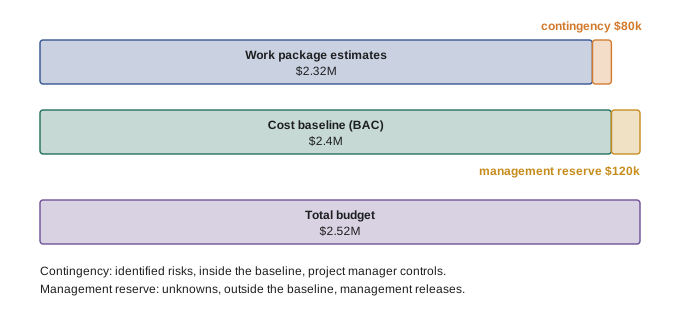
Cost questions test budgets, reserves and earned value. Contingency reserves cover identified risks and sit inside the cost baseline, controlled by the project manager. Management reserves cover unknown unknowns and sit outside the baseline, released by management. A question about using money for a risk that was in the register points to contingency; a question about an unforeseen event points to management reserve, with approval. Lesson 8 practises earned value calculations in detail.
Quality questions
Quality questions distinguish prevention from inspection, quality assurance from quality control, and the cost of conformance from the cost of nonconformance. The exam favours prevention: building quality into processes rather than inspecting defects out. It also favours using data, such as control charts and Pareto analysis, to find causes. On a control chart, a point outside the control limits or a run of seven points on one side of the mean signals that a process may be out of control and needs investigation; a single point inside the limits does not.
Procurement questions
Procurement questions test contract types, the procurement process and contract administration. The key idea is how risk is shared. In a firm fixed price contract the seller bears the cost risk; in cost-reimbursable contracts the buyer does; incentive contracts share it according to an agreed ratio. Time and materials contracts suit work whose scope is hard to define but carry a risk of open-ended cost unless a ceiling is set.
# Buyer's cost for the Project Compass kiosk contract under different contract types ($000).
# Fixed price incentive fee: target cost 300, target fee 30, ceiling price 345, share 70/30 (buyer/seller).
target_cost, target_fee, ceiling, buyer_share = 300, 30, 345, 0.70

def fpif(actual):
    fee = target_fee + (target_cost - actual) * (1 - buyer_share)   # seller keeps 30 % of under-run
    return min(actual + fee, ceiling)

def cpff(actual, fixed_fee=24):
    return actual + fixed_fee

def ffp(actual, price=335):
    return price

pta = (ceiling - (target_cost + target_fee)) / buyer_share + target_cost
print(f"Point of total assumption: {pta:.1f}")
print(f"{'Actual cost':>12}{'FFP':>8}{'FPIF':>8}{'CPFF':>8}")
for actual in (270, 300, 321.4, 340, 370):
print(f"{actual:>12}{ffp(actual):>8.1f}{fpif(actual):>8.1f}{cpff(actual):>8.1f}")Point of total assumption: 321.4
Actual cost FFP FPIF CPFF
270 335.0 309.0 294.0
300 335.0 330.0 324.0
321.4 335.0 345.0 345.4
340 335.0 345.0 364.0
370 335.0 345.0 394.0The program uses the Project Compass kiosk contract from PMP-131: a fixed price incentive fee with target cost $300,000, target fee $30,000, ceiling price $345,000 and a 70/30 buyer-seller share. The point of total assumption, about $321,400, is the cost above which the seller bears every additional dollar. Exam questions may ask for that figure, for the final price at a given actual cost, or for which contract type best suits a situation.
| Contract type | Who bears cost risk | Fits when |
|---|---|---|
| Firm fixed price | Seller | Scope is clear and stable |
| Fixed price incentive fee | Shared up to the ceiling, then seller | Scope is fairly clear and the buyer wants to reward efficiency |
| Fixed price with economic price adjustment | Seller, except for agreed index changes | Long contracts exposed to inflation or commodity prices |
| Cost plus fixed fee | Buyer | Scope is uncertain; fee does not reward overruns |
| Cost plus incentive fee | Shared by ratio | Uncertain scope with an incentive to control cost |
| Cost plus award fee | Buyer, with fee based on judged performance | Performance is hard to measure objectively |
| Time and materials | Mostly buyer, limited by any ceiling | Small or loosely defined work, staff augmentation |
Contract administration questions often involve a seller who is not meeting terms or a dispute. The best answer usually starts with reviewing the contract and communicating formally with the seller through the agreed channel, often the procurement or contracts officer. Claims follow the contract's dispute process, with negotiation preferred and litigation a last resort. A project manager should not direct a seller to do work outside the contract or promise changes without a contract change.
Closing questions
Closing questions test the order and content of closure. Before closing a project or phase, confirm that the work is complete and formally accepted, close any contracts, release resources, archive records and capture lessons learned. If a project is cancelled early, it still goes through closure, documenting what was completed and why it stopped. A question that asks what to do when the customer has accepted all deliverables usually points to the remaining closure steps, not to celebrating or reassigning the team immediately.
Worked problem
An early termination
Suppose the library board had cancelled Project Compass in month 3 because the province or state withdrew its grant. The fit-out contract had started and the app team had completed two sprints. What should the project manager do?
Show solution
- Treat the cancellation as a formal decision from governance and begin closure.
- Close or terminate contracts according to their termination clauses and settle amounts owed for work performed.
- Document what was completed, the reason for cancellation and the status of deliverables, including the working app increment.
- Release resources, archive records and hold a lessons-learned session; the lessons may help a future Eastgate project if funding returns.
Answer: Follow the closure process: settle contracts, document status, release resources, archive and capture lessons.
On Canadian public projects, closure often includes releasing statutory holdback once the lien period expires and confirming that subcontractors have been paid. Exam questions describe this in general terms as completing contract closure and final payments.
Quick patterns for predictive Process questions
- Baselines change only through approved change requests.
- Assess the integrated impact of a change before deciding or escalating.
- Only critical-path activities shorten the project; crash the cheapest first, fast track when budget is tight.
- Contingency is for known risks inside the baseline; management reserve is for unknowns outside it.
- Prevention beats inspection; find root causes with data.
- Review the contract before acting on a seller problem; communicate formally.
- Close every project, including cancelled ones.
One more predictive question worked through
Worked problem
A seller asks for an extension
The kiosk supplier tells Priya that installation will be ten days late because a component is back-ordered. The contract has a delivery date and a liquidated damages clause. The kiosks are not on the critical path but have only six days of float. What should Priya do first?
Show solution
- Assess the impact: a ten-day delay against six days of float would delay the opening by about four days unless the work is resequenced.
- Review the contract terms on delivery, notice, excusable delays and liquidated damages, and involve the procurement officer.
- Discuss options with the supplier, such as partial delivery, an alternative component or extra installers, and record the issue.
- Escalating to the sponsor, invoking damages immediately or quietly accepting the delay would each skip a step; any change to the contract dates would go through the agreed contract change process.
Answer: Assess the schedule impact, review the contract with the procurement officer and explore options with the supplier before deciding on changes or remedies.
Common mistakes
MistakeUpdating a baseline to match actual performance.
InsteadBaselines change only through approved changes.
MistakeAccepting gold plating because the customer is pleased.
InsteadStop unauthorized work and use change control.
MistakeCrashing a non-critical activity to finish sooner.
InsteadOnly critical-path activities affect the end date.
MistakeUsing management reserve for an identified risk without approval.
InsteadIdentified risks draw on contingency; management reserve needs management approval.
MistakeConfusing control quality with validate scope.
InsteadQuality checks correctness; scope validation is customer acceptance.
Summary and key terms
- Process is the largest domain, about 41 % of scored questions, and includes many predictive scenarios.
- The charter authorizes, the plan integrates, change control protects baselines, and closure confirms acceptance and records lessons.
- Scope creep and gold plating bypass change control and should be stopped and assessed.
- Crashing costs money; fast tracking adds risk; only the critical path matters for the end date.
- Contingency reserves sit inside the baseline; management reserves sit outside it.
- Contract types allocate cost risk differently; the point of total assumption marks where the seller bears all extra cost in a fixed price incentive contract.
- Scope creep
- Uncontrolled expansion of scope without adjustment to time, cost and resources.
- Gold plating
- Adding features or work the customer did not request.
- Crashing
- Shortening the schedule by adding resources to critical-path activities.
- Fast tracking
- Shortening the schedule by performing activities in parallel that would normally be sequential.
- Contingency reserve
- Budget or time within the baseline for identified risks.
- Management reserve
- Budget outside the baseline for unforeseen work, released by management.
- Point of total assumption
- In a fixed price incentive contract, the cost above which the seller bears all additional cost.
- Validate scope
- Formal acceptance of completed deliverables by the customer or sponsor.
Practice problems
Work each problem on paper first, then reveal the answer to check.
What document authorizes a project and the project manager?
Show answer
The project charter.
What is gold plating?
Show answer
Adding work the customer did not request.
Which compression technique adds risk of rework?
Show answer
Fast tracking.
Where does contingency reserve sit?
Show answer
Inside the cost baseline.
What signals an out-of-control process on a control chart?
Show answer
A point outside the control limits or seven consecutive points on one side of the mean.
Who bears cost risk in a firm fixed price contract?
Show answer
The seller.
What is the point of total assumption for the kiosk contract?
Show answer
About $321,400.
What is the difference between control quality and validate scope?
Show answer
Quality checks deliverables against requirements; scope validation is formal customer acceptance.
Does a cancelled project go through closure?
Show answer
Yes, including contract settlement, documentation and lessons learned.
What should a project manager do first when a seller misses contract terms?
Show answer
Review the contract and communicate formally through the agreed channel.
Lesson quiz · 5 questions
Score 60% or more to complete this lesson.
Create a free account to save your progress, take quizzes and earn a certificate.