
PMP-150 · Lesson 8 of 12 · 25 min
Impediments, issues and escalation
Every project runs into obstacles: a supplier is late, a key person is pulled onto other work, a decision is stuck, a test environment fails, a rule is unclear. The 2026 outline asks project leaders to remove impediments and manage issues: to assess and prioritize impediments, apply ways to resolve them, reassess them regularly, recognize when a risk has become an issue, and work with stakeholders to resolve issues. PMP-131 covered issues from the risk and change side. This lesson treats impediments and issues as a Business Environment task, focusing on triage, ownership, escalation and the organizational obstacles that only governance can remove.
Risks, issues and impediments
The three terms overlap but are not the same, and the exam expects you to tell them apart.
| Term | Meaning | Compass example | Main tool |
|---|---|---|---|
| Risk | An uncertain event or condition that, if it occurs, would affect objectives | The single electrician crew might not finish the kiosk circuits in time | Risk register and responses |
| Issue | A current condition or situation that is affecting, or will affect, objectives | The crew has been delayed by another job and the circuits are now behind schedule | Issue log |
| Impediment | Anything that blocks or slows a team's progress; agile teams use the term for obstacles to their work | The app team cannot test with the kiosks because the firmware fails the RFID handshake | Impediment board or list, daily scrum |
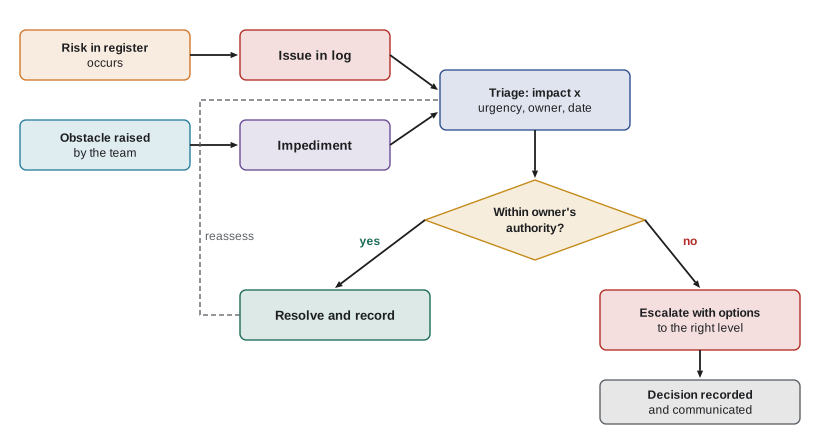
A risk becomes an issue when it occurs. At that point, the planned risk response, if one exists, is put into action, and the item moves from the risk register to the issue log, with a cross-reference. Recognizing that moment matters: a team that keeps describing a problem as a risk after it has happened is likely to under-react. In adaptive teams, issues and impediments are often handled through the same mechanism: impediments are raised in the daily scrum, the Scrum Master or team lead works to remove them, and those the team cannot remove are escalated.
Triage: what to work on first
When several impediments and issues are open at once, the project manager needs a quick, consistent way to decide where to spend effort. A common approach scores each item on impact (how much it affects objectives) and urgency (how soon it must be resolved before the damage grows), assigns an owner and a target date, and tracks how long each item has been open. Items that are both serious and old are the strongest candidates for escalation, because they have shown they will not resolve themselves at the current level.
# Rank open impediments and issues by impact x urgency, then flag any that are too old.
from datetime import date
today = date(2027, 7, 14)
items = [
    ("Kiosk firmware fails RFID gate handshake", 4, 5, date(2027, 7, 9),  "Technology lead"),
    ("Second electrician crew not yet booked",     4, 3, date(2027, 7, 2),  "Project manager"),
    ("Product owner pulled into budget meetings",  3, 4, date(2027, 6, 28), "Sponsor"),
    ("Test devices for screen reader checks late", 2, 3, date(2027, 7, 12), "Scrum Master"),
    ("Union question on new self-checkout duties", 4, 4, date(2027, 7, 6),  "HR lead"),
]
limit_days = 10
print("Score  Age  Owner            Item")
for name, impact, urgency, raised, owner in sorted(items, key=lambda i: i[1] * i[2], reverse=True):
    age = (today - raised).days
    flag = "  <- escalate" if age > limit_days and impact * urgency >= 12 else ""
print(f"{impact * urgency:>5} {age:>3} {owner:15} {name}{flag}")Score Age Owner Item
20 5 Technology lead Kiosk firmware fails RFID gate handshake
16 8 HR lead Union question on new self-checkout duties
12 12 Project manager Second electrician crew not yet booked <- escalate
12 16 Sponsor Product owner pulled into budget meetings <- escalate
6 2 Scrum Master Test devices for screen reader checks lateThe kiosk firmware problem scored highest, but it was only five days old and the technology lead was actively working with the vendor, so it stayed with its owner and was reviewed daily. Two items were flagged for escalation: the second electrician crew, which the project manager had been trying to book for 12 days, and the product owner being pulled into budget meetings, open for 16 days. The first needed a decision only the sponsor could make, to release management reserve for a premium-rate crew. The second was an organizational impediment: the director of finance kept scheduling Amara Osei into budget sessions, leaving the app team without a product owner for two days a week. The project manager could not fix that alone, because it involved competing priorities between two senior managers.
Ways to remove impediments
The outline speaks of applying intervention strategies. In practice the project manager or Scrum Master has a range of options, roughly in order of escalation.
- Remove it directly: fix the tool, book the room, find the information, clarify the requirement.
- Coach the team to remove it: many impediments are within the team's own power once someone points out the options.
- Negotiate: work with a functional manager, vendor or other team to free a person, a resource or a decision.
- Work around it: change the sequence of work, use a substitute, or adjust scope so the obstacle no longer blocks progress.
- Escalate: take it to the sponsor or governance body with an analysis of its impact and options, when it is beyond the project's authority or has resisted other approaches.
Servant leadership, covered in PMP-120 and PMP-140, puts removing impediments at the centre of the leader's job. The goal is not to solve every problem personally, but to make sure obstacles are seen early, owned clearly and removed at the lowest level that can remove them.
Escalating well
Escalation is not failure; it is how governance is supposed to work when a problem exceeds someone's authority or capability. But there is a difference between escalating well and simply passing a problem upward. A good escalation states the problem and its impact on objectives, what has been tried, the options available with their costs and consequences, a recommendation, and the decision needed and by when. It goes to the person or body with the authority to decide, through the agreed escalation path, not around it.
| Element | Compass escalation: product owner availability |
|---|---|
| Problem | The product owner is in budget meetings two days a week, so the app team waits up to a day for answers and refinement has slipped |
| Impact | Sprint 8 forecast down to about 16 points against an average velocity of 21.3; release 1 at risk for the soft opening |
| Already tried | Moved refinement to the product owner's free mornings; asked the finance director's assistant to avoid sprint review days |
| Options | Delegate budget sessions to a deputy; appoint a proxy product owner for day-to-day questions; accept a smaller release 1 |
| Recommendation | Finance assigns a deputy for routine budget sessions until the opening; the product owner keeps full authority |
| Decision needed | Sponsor to agree with the finance director by Friday, before sprint 8 planning |
The sponsor raised the issue with the finance director the same day, and a deputy took over routine budget sessions until the opening. The issue log recorded the decision and its date, and the team's sprint 8 forecast returned to about 20 points.
The issue log
An issue log (or issue register) records each issue with its description, date raised, who raised it, category, impact and priority, owner, actions, target resolution date, status and final resolution. It supports reporting to governance, helps make sure nothing is forgotten and becomes a source of lessons learned. Reviewing the log regularly, weekly on most projects and daily for critical issues, keeps attention on ageing items. Closed issues should record how they were resolved, so that similar problems later can be handled faster.
Organizational impediments
Some of the hardest impediments are not technical at all. They are conflicting priorities between departments, policies that slow work without adding value, approval chains that take weeks, shared resources everyone is fighting over, or cultural habits such as reluctance to share bad news. These are Business Environment problems: the project manager cannot solve them by working harder inside the project. The project manager can make them visible, quantify their cost, propose changes and bring them to the people with authority. Over time, recording organizational impediments and their effects is one of the most useful inputs to the organization's improvement efforts, which lesson 12 covers.
Worked problem
Risk or issue?
The risk register for a project lists "key vendor may go out of business" with a contingency plan to switch to an alternative supplier. This morning, the vendor announced it has entered receivership and will stop shipping at month end. What should the project manager do?
Show solution
- The risk has occurred, so it is now an issue; record it in the issue log and link it to the risk entry.
- Implement the planned contingency response: contact the alternative supplier and confirm availability, price and lead time.
- Assess the effect on schedule, cost and scope, and check whether it exceeds the project manager's authority.
- Communicate with stakeholders and escalate any decisions beyond delegated limits, such as using management reserve.
Answer: Log it as an issue, carry out the planned contingency response, assess its impact and escalate decisions beyond your authority.
Impediments on adaptive teams
Agile teams make impediments visible by design. Developers mention blockers in the daily scrum; many teams keep an impediment list or a column on their board; and the Scrum Guide makes the Scrum Master accountable for getting impediments to the team's progress removed. This visibility is valuable, but only if impediments are actually removed. A team that raises the same blocker in every daily scrum for a week, with no change, is learning that raising impediments is pointless.
A useful habit is to separate impediments the team can remove itself from those it cannot. The first group should be handled by the team, with the Scrum Master coaching rather than fixing everything. The second group, such as a missing test environment owned by another department or a policy that prevents deploying on Fridays, needs the Scrum Master or project manager to work with others in the organization. The Compass app team tracked both kinds on its board, with the date each was raised, so that ageing blockers were obvious at a glance.
Recurring impediments across teams are a strong signal for organizational improvement. When three projects in a year report waiting weeks for test devices, the right response is to change the procurement process, not to escalate the same problem three times.
Common mistakes
MistakeContinuing to treat an event that has happened as a risk.
InsteadMove it to the issue log and put the planned response into action.
MistakeEscalating every obstacle immediately.
InsteadTry to resolve it at the lowest level that can, then escalate with analysis if needed.
MistakeStruggling alone with an organizational impediment for weeks.
InsteadEscalate problems only governance can fix, with their cost and options.
MistakeEscalating without options or a recommendation.
InsteadState the problem, impact, attempts, options, recommendation and decision needed.
MistakeGoing around the agreed escalation path.
InsteadUse the path set in governance, so decisions are made by those with authority.
Summary and key terms
- A risk is uncertain; an issue is happening; an impediment blocks a team's progress.
- When a risk occurs it becomes an issue and the planned response is implemented.
- Triage issues and impediments by impact and urgency, with owners, target dates and age tracking.
- Intervention options range from fixing directly to negotiating, working around and escalating.
- Good escalation brings problem, impact, attempts, options, a recommendation and a deadline to the right decision maker.
- Organizational impediments need governance action and are valuable inputs to improvement.
- Issue
- A current condition affecting, or about to affect, project objectives.
- Impediment
- Anything that blocks or slows a team's progress.
- Issue log
- A record of issues with owners, actions, status and resolution.
- Triage
- Sorting problems by impact and urgency to decide what to address first.
- Escalation
- Raising a decision or problem to a higher authority through an agreed path.
- Workaround
- An unplanned response to an issue that has occurred, used when no planned response exists or it is insufficient.
- Organizational impediment
- An obstacle arising from the organization's structure, policies or culture rather than the project itself.
Practice problems
Work each problem on paper first, then reveal the answer to check.
What is the difference between a risk and an issue?
Show answer
A risk is uncertain and may happen; an issue is already happening.
What happens to a risk entry when the risk occurs?
Show answer
It becomes an issue, linked to the risk, and the planned response is carried out.
Which two Compass items were flagged for escalation?
Show answer
The second electrician crew and the product owner's availability.
Why did the kiosk firmware issue not escalate despite its high score?
Show answer
It was new and its owner was actively resolving it.
List the elements of a good escalation.
Show answer
Problem, impact, what was tried, options, recommendation, decision needed and deadline.
Give two intervention options short of escalation.
Show answer
For example, fixing it directly, coaching the team, negotiating or working around it.
Who removed the product owner impediment?
Show answer
The sponsor, with the finance director, by assigning a deputy for budget sessions.
How often should the issue log typically be reviewed?
Show answer
Weekly, and daily for critical issues.
Give an example of an organizational impediment.
Show answer
Conflicting departmental priorities, slow approval chains or shared resource conflicts.
What is a workaround?
Show answer
An unplanned response to an issue when no planned response exists or it is insufficient.
Lesson quiz · 5 questions
Score 60% or more to complete this lesson.
Create a free account to save your progress, take quizzes and earn a certificate.