
PMP-150 · Lesson 6 of 12 · 25 min
Compliance: finding and classifying requirements
Compliance means meeting the obligations that apply to a project and its products: laws and regulations, standards, contracts, and the organization's own policies. Failing to comply can mean fines, lawsuits, stop-work orders, failed inspections, lost funding, harm to people and lasting damage to reputation. The second Business Environment task in the 2026 outline is to plan and manage project compliance: confirming what the requirements are (the outline gives security, health and safety, sustainability and regulation as examples), classifying them, identifying threats to meeting them, applying ways to comply, analysing the consequences of noncompliance, choosing actions and measuring compliance. This lesson covers the first half of that work: finding and classifying the requirements. Lesson 7 covers meeting and measuring them.
Where compliance requirements come from
Compliance requirements rarely arrive in one neat list. They are scattered across laws, regulations, codes, standards, contracts, funding agreements, collective agreements and internal policies. Part of the project manager's job is to make sure someone has looked in all the right places, usually by involving the people who know each area: legal counsel, privacy and records officers, health and safety staff, procurement, finance, IT security and facilities.
| Source | Examples | Who usually knows |
|---|---|---|
| Laws and regulations | Privacy, accessibility, occupational health and safety, environmental, employment | Legal counsel, specialist officers |
| Codes and standards | Building and fire codes, electrical code, accessibility guidelines, security standards | Designers, inspectors, IT security |
| Contracts and funding agreements | Grant conditions, lease clauses, vendor contracts, insurance requirements | Procurement, finance, legal |
| Collective agreements | Job duties, scheduling, consultation on technological change | Human resources, union representatives |
| Internal policies | Purchasing, records retention, information security, sustainability, ethics | Policy owners, PMO |
| Industry or professional codes | PMI Code of Ethics, professional association standards | Practitioners, professional bodies |
Some requirements are mandatory and not negotiable, such as a building permit or a privacy law. Others are discretionary standards the organization has chosen to adopt, such as a green building rating or an internal design standard; the organization could change them, but the project normally may not. A few are voluntary good practices. Knowing which is which matters, because mandatory requirements are constraints the project must meet, while voluntary ones can be weighed against cost and benefit through governance.
The compliance landscape for Project Compass
When Priya Natarajan set up Project Compass, she held a compliance workshop with the library's privacy and records officer, the facilities manager, the IT security lead, the procurement officer, a human resources adviser and the digital services manager. Together they identified the main areas of obligation.
Privacy was first. Patron borrowing records are personal information, and public libraries are covered by provincial access-to-information and privacy laws for public bodies; in Ontario, for example, public library boards fall under the Municipal Freedom of Information and Protection of Privacy Act. The app vendor would handle patron data, so the contract had to require the vendor to protect it and to keep it in locations the library approved. Federal private-sector privacy law, or a substantially similar provincial law, generally applies to the vendor's commercial activities; in June 2026 the federal government tabled Bill C-36, which would replace the private-sector part of PIPEDA, so the team noted it as a development to watch rather than a requirement in force.
Accessibility came next. Several provinces have accessibility laws, and Ontario's Accessibility for Ontarians with Disabilities Act standards already require designated public sector organizations' websites and web content to meet the Web Content Accessibility Guidelines (WCAG) 2.0 at level AA. The library's own policy, adopted for all new digital services, set the higher bar of WCAG 2.1 level AA, and the branch itself had to meet the accessibility provisions of the building code.
Health and safety covered the construction work: permits, inspections, the fire code, asbestos and other hazardous materials in the old retail unit, and the contractor's safety program. Information security covered the app and kiosks: authentication, encryption, vendor access and, because patrons could pay fines in the app, the Payment Card Industry Data Security Standard (PCI DSS), which the card payment contract required. Records management required project records, including decisions and contracts, to be kept according to the library's retention schedule. Procurement rules set thresholds for quotes and tenders. Sustainability requirements came from the municipality's climate plan and the library's own green purchasing policy. Finally, the collective agreement required consultation with the union before introducing self-checkout, because it changed staff duties.
Classifying requirements
A long, unsorted list of obligations is hard to manage. Classifying requirements helps assign owners, choose methods and decide where to focus. Useful classifications include the category (privacy, accessibility, safety, security, records, procurement, sustainability, employment), the source (law, standard, contract, policy), whether it is mandatory or discretionary, which deliverables it affects, when in the life cycle it must be satisfied, who verifies it and how severe the consequences of failing would be. The outline asks project leaders to classify compliance categories, so expect questions that ask what kind of requirement something is or who should confirm it.
A practical next step is to rank requirements by exposure: how likely the project is to fall short, and how serious the consequences would be. This is the same logic as a risk score, applied to obligations. Compass's compliance register scored each requirement from 1 to 5 on both scales.
# Classify Project Compass compliance requirements and rank them by exposure
# (likelihood of a gap 1-5 times consequence of noncompliance 1-5).
reqs = [
    ("Patron borrowing records stay confidential",    "Privacy",        3, 5),
    ("App and website meet WCAG 2.1 level AA",        "Accessibility",  4, 4),
    ("Building permit and fire inspection passed",    "Safety",         2, 5),
    ("Asbestos survey before demolition",             "Safety",         2, 5),
    ("Records kept per the retention schedule",       "Records",        3, 3),
    ("Competitive quotes above the purchasing limit", "Procurement",    2, 4),
    ("Low-VOC finishes per the library's green policy", "Sustainability", 3, 2),
    ("App vendor stores data in approved locations",  "Security",       3, 4),
    ("Payment card data never touches library servers", "Security",     2, 4),
]
ranked = sorted(reqs, key=lambda r: r[2] * r[3], reverse=True)
for name, cat, like, cons in ranked:
    print(f"{like * cons:>2}  {cat:14} {name}")
by_cat = {}
for _, cat, _, _ in reqs:
    by_cat[cat] = by_cat.get(cat, 0) + 1
print("By category:", ", ".join(f"{c} {n}" for c, n in sorted(by_cat.items())))16 Accessibility App and website meet WCAG 2.1 level AA 15 Privacy Patron borrowing records stay confidential 12 Security App vendor stores data in approved locations 10 Safety Building permit and fire inspection passed 10 Safety Asbestos survey before demolition 9 Records Records kept per the retention schedule 8 Procurement Competitive quotes above the purchasing limit 8 Security Payment card data never touches library servers 6 Sustainability Low-VOC finishes per the library's green policy By category: Accessibility 1, Privacy 1, Procurement 1, Records 1, Safety 2, Security 2, Sustainability 1
Accessibility topped the list: the consequence of failing is serious and, because the app was new and built by a vendor, the likelihood of gaps was high. Patron privacy was close behind, with the highest possible consequence. The two safety items scored lower on likelihood, because permits and asbestos surveys are routine for the facilities team and the contractor, but their consequences were severe, so they still needed firm controls. The ranking did not mean low-scoring requirements could be ignored; every mandatory requirement must be met. It told the team where to put extra attention, early testing and senior oversight.
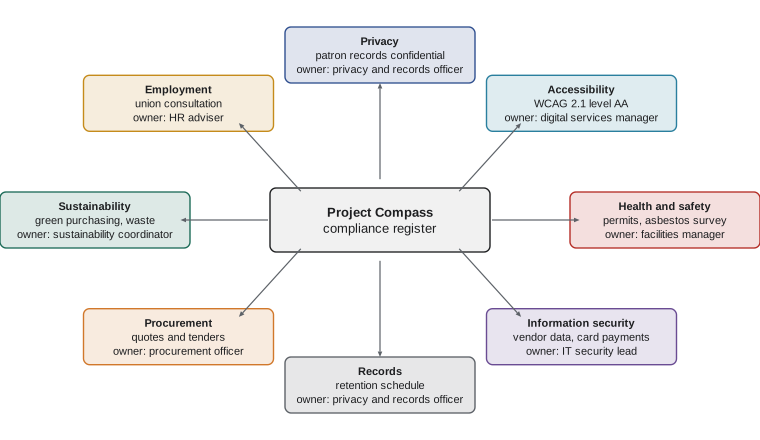
The compliance register
Many projects keep compliance requirements in a register, often combined with the requirements traceability matrix. Each entry records the requirement, its source, its category, whether it is mandatory, the deliverables it affects, the owner who interprets it, how it will be met, how it will be verified, the evidence needed and its status. Linking each requirement to the deliverables and tests that satisfy it gives a clear trail when an auditor, inspector or regulator asks how the project knows it complied.
| Requirement | Source | Owner | How met | How verified |
|---|---|---|---|---|
| Patron borrowing records confidential | Privacy law; library policy | Privacy and records officer | Data minimization in the app; vendor contract clauses; privacy impact assessment | Privacy officer review of the assessment and test results |
| App meets WCAG 2.1 level AA | Accessibility law or rule; library policy | Digital services manager | Criteria in the definition of done; accessible design system | Automated checks each sprint; expert audit before release |
| Asbestos survey before demolition | Occupational health and safety regulation | Facilities manager | Survey by a qualified consultant; abatement if found | Survey report on file before work starts |
| Quotes or tender above purchasing limit | Purchasing policy | Procurement officer | Procurement plan with thresholds | Procurement file reviewed at contract award |
Compliance in adaptive work
In adaptive projects, compliance requirements are best expressed in two places. Requirements that apply to everything, such as accessibility, security standards and privacy rules, belong in the definition of done, so every increment must meet them before it is considered complete. Requirements that apply to particular features belong in the acceptance criteria of the relevant backlog items. Compliance specialists can be invited to sprint reviews or refinement sessions so that problems surface early, when they are cheap to fix. The Compass app team included an accessibility check and a privacy check in its definition of done from the first sprint, which is why release 1 could be audited without a rush of last-minute fixes.
When requirements are unclear or conflicting
Requirements sometimes conflict: a records retention rule may require keeping information that a privacy principle says to minimize, or a sustainability preference for reused furniture may clash with a fire code requirement for certain materials. The project manager should not resolve such conflicts alone. The right step is to bring the conflict to the people who own each requirement, often with legal or specialist advice, and record the decision and its basis. Where a law is ambiguous, the organization's specialist or counsel interprets it; the project manager makes sure the question is asked early enough for the answer to shape the work.
Worked problem
Mandatory or discretionary?
The library's sustainability coordinator asks the team to source all furniture from suppliers with a recognized environmental certification. The certified furniture costs 9 % more than the budgeted furniture. The municipality's climate plan encourages, but does not require, such purchasing. What should the project manager do?
Show solution
- Classify the requirement: it is discretionary, coming from an encouraged practice rather than a law or binding policy.
- Because it is not mandatory, it can be weighed against cost and benefit, but the project manager should not dismiss it alone.
- Analyse the cost, schedule and benefit, including any reputational or strategic value given the library's climate goal.
- Bring the analysis to the change control board or sponsor, depending on the amount, and record the decision in the compliance register.
Answer: Treat it as a discretionary requirement, analyse its cost and value, and take it through governance for a decision.
Common mistakes
MistakeAssuming compliance is only about laws.
InsteadInclude standards, contracts, funding conditions, collective agreements and internal policies.
MistakeHaving the project manager interpret legal requirements alone.
InsteadInvolve legal and specialist owners to interpret; the project manager ensures questions are asked early.
MistakeTreating discretionary standards as non-negotiable or mandatory laws as negotiable.
InsteadClassify each requirement so mandatory ones are met and discretionary ones go through governance.
MistakeUsing an exposure ranking to drop low-scoring mandatory requirements.
InsteadUse ranking to focus attention; every mandatory requirement must still be met.
MistakeLeaving compliance checks until the end of an agile project.
InsteadPut shared requirements in the definition of done and feature-specific ones in acceptance criteria.
Summary and key terms
- Compliance requirements come from laws, codes, standards, contracts, funding agreements, collective agreements and policies.
- Classify requirements by category, source, mandatory status, affected deliverables, timing, verifier and consequence.
- Rank by likelihood of a gap and consequence of failure to focus attention, without dropping mandatory items.
- A compliance register links each requirement to its owner, method, verification and evidence.
- In adaptive work, shared requirements go in the definition of done and specific ones in acceptance criteria.
- Conflicting or unclear requirements are resolved by their owners with specialist advice, and the decision is recorded.
- Compliance
- Meeting the legal, regulatory, contractual and policy obligations that apply to a project.
- Compliance register
- A list of compliance requirements with sources, owners, methods, verification and status.
- Mandatory requirement
- An obligation the project must meet, such as a law or binding policy.
- Discretionary requirement
- A standard the organization has chosen or encourages, which can be weighed through governance.
- Privacy impact assessment
- A structured review of how a project collects, uses and protects personal information.
- WCAG
- The Web Content Accessibility Guidelines, the international standard for accessible web and app content.
- PCI DSS
- The Payment Card Industry Data Security Standard for organizations that handle card payments.
Practice problems
Work each problem on paper first, then reveal the answer to check.
Name four sources of compliance requirements.
Show answer
For example, laws, codes and standards, contracts and funding agreements, collective agreements, internal policies.
Which requirement topped the Compass exposure ranking?
Show answer
App and website accessibility at WCAG 2.1 level AA.
Why did the asbestos survey still need firm controls despite a lower score?
Show answer
Its consequences are severe and it is mandatory.
Why did the union need to be consulted?
Show answer
The collective agreement required consultation before self-checkout changed staff duties.
Why did PCI DSS apply to the app?
Show answer
Patrons could pay fines by card, and the card payment contract required it.
Where should an agile team put a requirement that applies to all features?
Show answer
In the definition of done.
Who interprets an ambiguous law for the project?
Show answer
Legal counsel or the specialist owner, not the project manager alone.
What makes the certified furniture request discretionary?
Show answer
It is encouraged by the climate plan, not required by law or binding policy.
What should each compliance register entry link to?
Show answer
The deliverables and tests that satisfy it, and the evidence of compliance.
What two scales does an exposure ranking combine?
Show answer
Likelihood of a gap and consequence of noncompliance.
Lesson quiz · 5 questions
Score 60% or more to complete this lesson.
Create a free account to save your progress, take quizzes and earn a certificate.