
PMP-150 · Lesson 7 of 12 · 25 min
Meeting and measuring compliance
Knowing the requirements is only the start. The project must then choose how to meet each one, build those methods into its plans and deliverables, check that they are working, measure the level of compliance and act when gaps appear. The second half of the compliance task in the 2026 outline covers exactly this: applying compliance methods, analysing the consequences of noncompliance, choosing the right actions and measuring compliance. This lesson follows Project Compass as it turns its compliance register into controls and evidence.
Choosing how to comply
For each requirement, the team chooses one or more methods. The choice depends on the requirement, the deliverable and the cost of each approach. Most methods fall into a few families.
| Method | What it means | Compass example |
|---|---|---|
| Design it in | Shape the deliverable so it complies by construction | App collects only the patron data it needs; accessible design system used for every screen |
| Contract it | Require a supplier to comply and to prove it | Vendor contract clauses on data location, breach notice and accessibility conformance |
| Check it | Inspect, test or audit to confirm compliance | Automated accessibility checks each sprint; fire inspection before occupancy |
| Train for it | Make sure people know and follow the rules | Privacy training for branch staff before opening |
| Document it | Keep the evidence regulators or auditors will ask for | Asbestos survey report, privacy impact assessment, procurement files |
| Consult on it | Involve the people whose agreement is required | Union consultation on self-checkout duties before the decision |
Designing compliance in is usually cheapest and most reliable, because it prevents gaps rather than finding them later. Checking is essential but finds problems after they exist; the later a gap is found, the more it costs to fix. This mirrors the quality principle from PMP-131: prevention over inspection.
Building compliance into the plan
Compliance work needs to appear in the schedule, budget and backlog like any other work, or it will be squeezed out. On Compass, the asbestos survey was a predecessor of demolition in the network diagram; the fire inspection was a milestone before the occupancy permit; the privacy impact assessment had to be approved before the app was connected to live patron data; the expert accessibility audit was scheduled two sprints before release 1 so that findings could be fixed; and union consultation had a fixed slot before the self-checkout configuration was finalized. Each of these had an owner and appeared in the integrated schedule, so slippage would be visible.
Measuring compliance
Compliance must be measured, not assumed. Measures can be simple, such as whether a required permit or approval has been obtained, or continuous, such as the share of app screens passing an accessibility audit, the number of open privacy findings or the percentage of staff who have completed required training. Good compliance measures are tied to specific requirements, collected regularly and reported to the people who need them.
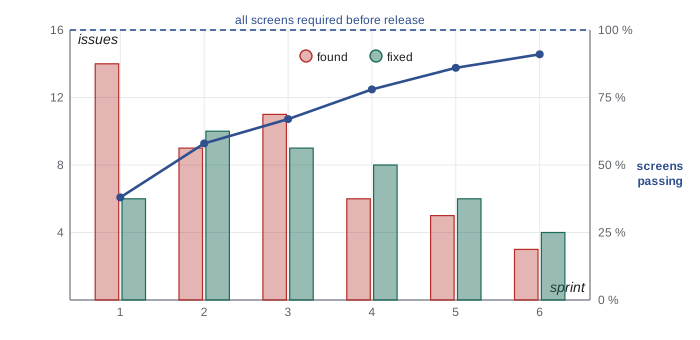
The Compass app team tracked accessibility closely. Each sprint, automated tools and a manual screen-reader check found issues, and the team fixed as many as it could within the sprint. The digital services manager reported the trend to the CCB each month.
# Accessibility issues found and fixed per sprint, and the share of screens passing audit.
found =  [14, 9, 11, 6, 5, 3]
fixed =  [6, 10, 9, 8, 6, 4]
screens_total = [8, 12, 15, 18, 21, 23]
screens_pass  = [3, 7, 10, 14, 18, 21]
open_issues = 0
print("Sprint  Found  Fixed  Open  Screens passing")
for s, (f, x, t, p) in enumerate(zip(found, fixed, screens_total, screens_pass), start=1):
    open_issues += f - x
    print(f"{s:>6}  {f:>5}  {x:>5}  {open_issues:>4}  {p}/{t} ({100 * p / t:.0f}%)")
# Expected cost of a privacy breach with and without the vendor data-location control
p_without, p_with, impact = 0.06, 0.015, 400_000
print(f"Expected exposure: ${p_without * impact:,.0f} without the control, ${p_with * impact:,.0f} with it")Sprint Found Fixed Open Screens passing
1 14 6 8 3/8 (38%)
2 9 10 7 7/12 (58%)
3 11 9 9 10/15 (67%)
4 6 8 7 14/18 (78%)
5 5 6 6 18/21 (86%)
6 3 4 5 21/23 (91%)
Expected exposure: $24,000 without the control, $6,000 with itIn the first sprint the team found 14 issues and fixed 6, leaving 8 open. By sprint 6, new issues found had fallen to 3 per sprint and 21 of 23 screens passed audit, but 5 issues remained open. That was a useful signal: the team was preventing more issues as the design system matured, yet still not closing the backlog of older ones fast enough to reach zero by release. The product owner moved the open accessibility issues to the top of the next sprint's backlog, which is where they belonged because the definition of done required level AA compliance before release.
Consequences of noncompliance
The outline asks project leaders to analyse the consequences of noncompliance. Consequences can be legal (fines, orders, lawsuits), financial (remediation costs, lost grants, contract penalties), operational (stop-work orders, failed inspections, delayed opening), reputational (loss of public trust, media coverage) and human (harm to people, exclusion of users with disabilities, exposure of personal information). Understanding them helps the project justify the cost of controls and choose the right level of effort.
One way to compare controls is expected exposure: the probability of a compliance failure multiplied by its consequence. The Compass team estimated that without a contract clause and verification of where the app vendor stored patron data, the chance of a reportable privacy breach over the app's first two years was about 6 %, with a consequence, including investigation, notification, remediation and reputational harm, of about $400,000. With the control, the probability fell to about 1.5 %. The expected exposure dropped from $24,000 to $6,000, which easily justified the modest cost of the clause and an annual verification. The figures were rough, but the comparison made the decision obvious.
| Consequence type | Compass example of what could happen | Main control |
|---|---|---|
| Legal | Order from a privacy regulator or a complaint under accessibility law | Privacy impact assessment; WCAG in the definition of done |
| Financial | Grant clawed back for failing grant conditions | Grant conditions in the compliance register with an owner |
| Operational | Occupancy permit refused, delaying opening | Fire inspection milestone with float before opening |
| Reputational | News story about patron data exposure | Vendor data controls and breach response plan |
| Human | Patrons using screen readers cannot place holds | Accessibility audit and user testing with disabled patrons |
Responding to a compliance gap
When a gap is found, the response depends on its seriousness and on who is accountable. The project manager's job is to make sure the gap is recorded, the right owner is informed, the consequences are assessed, options are developed and a decision is made at the right level. Serious gaps, such as a potential privacy breach or a safety violation, may require immediate action and notification under the organization's policies or the law; the project manager follows those procedures and involves the specialists at once rather than investigating quietly first.
In month 5 of the fit-out, the facilities manager discovered that the demolition subcontractor had started removing ceiling tiles in one area before the asbestos survey report had been formally accepted. The survey had in fact found no asbestos in that area, so no one was harmed, but the work had broken the project's own control. Priya stopped the work in that area, informed the sponsor and the health and safety lead, and the contractor was required to explain the breach. The team added a hold point to the subcontractor's work permits so that no demolition could start in any area without the survey sign-off, and the incident was recorded as a lesson learned.
Ethics and compliance
Compliance sometimes collides with pressure to deliver. A vendor may suggest skipping an audit because the product is "basically compliant"; a manager may hint that a failed test result should be reported as a pass; a deadline may tempt the team to open the branch before a final inspection. PMI's Code of Ethics asks project professionals to be honest in their reporting, to follow the law and the organization's policies, and to report unethical or illegal conduct to the appropriate people. On the exam, answers that hide, delay or misrepresent compliance problems are almost always wrong, however convenient they seem.
Sustainability as a compliance area
Sustainability now appears in the outline explicitly as a type of compliance requirement and as a source of risk. For many projects, sustainability obligations come from building or energy codes, environmental regulations, disclosure rules for larger companies, funding conditions and organizational policies. Measuring them may involve energy performance, waste diverted from landfill, embodied carbon in materials or the share of purchases meeting a green standard. For Compass, the library's green purchasing policy required low-emission finishes, and the municipality's climate plan asked capital projects to report waste diversion. The contractor tracked diversion weekly and reported 68 % of demolition waste diverted, above the 60 % target in the library's policy. Lesson 11 returns to sustainability as part of the external environment.
Worked problem
An audit the vendor wants to skip
Two sprints before release 1, the app vendor proposes skipping the planned expert accessibility audit because automated checks show only a few issues, and the audit would cost $6,500 and a week of calendar time. The release date is tight. What should the project manager do?
Show solution
- Accessibility at WCAG 2.1 level AA is a mandatory requirement for the app and part of the definition of done.
- Automated checks typically find only part of accessibility problems; many, such as screen-reader flow and meaningful labels, need expert and user testing.
- Skipping the audit would leave an unknown compliance gap with legal, reputational and human consequences.
- The project manager keeps the audit, explains the reasons to the vendor and, if the date is at risk, works with the product owner to adjust scope rather than drop the check.
Answer: Keep the audit, since it verifies a mandatory requirement, and protect the date by adjusting scope if needed.
Audits and inspections
Compliance is often confirmed by people outside the project: building inspectors, auditors, regulators, accessibility experts or the organization's internal audit team. Their findings carry weight because they are independent. The project manager's role is to prepare for these reviews, not to manage their outcome. Preparation means knowing which reviews are required and when, having evidence organized and easy to find, making sure the right people are available, and leaving time in the schedule to correct findings.
On Compass, the fire inspection was scheduled with ten working days of float before the planned opening, because the facilities manager knew from experience that minor findings are common and correcting them takes time. The inspection found two issues, a missing sign and an emergency light that failed its test, both corrected within three days. The internal auditor's review of the procurement files found one quote that had been obtained by phone rather than in writing; the procurement officer obtained written confirmation and the purchasing procedure was clarified for future projects.
When findings arrive, they are recorded, assigned to owners and tracked to closure like any other compliance gap. Disputing a finding is sometimes appropriate, if the reviewer has misunderstood the facts, but it should be done openly through the proper channel, not by pressuring the reviewer.
Common mistakes
MistakeRelying on inspection at the end to achieve compliance.
InsteadDesign compliance in and check it throughout; prevention is cheaper than correction.
MistakeLeaving compliance work out of the schedule and budget.
InsteadPlan compliance tasks, milestones and owners like any other work.
MistakeAssuming compliance without measuring it.
InsteadTrack specific measures tied to requirements and report them.
MistakeInvestigating a serious compliance breach quietly before informing anyone.
InsteadFollow the organization's procedures and involve specialists and the sponsor at once.
MistakeReporting a compliance problem as resolved to meet a deadline.
InsteadReport honestly; misrepresentation breaches ethics and creates bigger problems.
Summary and key terms
- Compliance methods include designing it in, contracting, checking, training, documenting and consulting.
- Compliance tasks, milestones and owners belong in the schedule, budget and backlog.
- Measure compliance with specific, regular measures and report trends.
- Analyse consequences of noncompliance and compare controls using expected exposure.
- Respond to gaps by recording, informing owners, assessing and deciding at the right level; serious gaps need immediate escalation.
- Honest reporting and sustainability obligations are part of managing compliance.
- Compliance control
- A measure that helps ensure a requirement is met, such as a design rule, contract clause or test.
- Hold point
- A point in a process where work cannot continue until a check is signed off.
- Expected exposure
- The probability of a failure multiplied by its consequence.
- Compliance measure
- A metric showing how well a requirement is being met.
- Remediation
- Action taken to correct a compliance gap and its effects.
- Waste diversion rate
- The share of waste kept out of landfill through reuse or recycling.
Practice problems
Work each problem on paper first, then reveal the answer to check.
Which compliance method is usually cheapest and most reliable?
Show answer
Designing compliance into the deliverable.
Why was the expert accessibility audit scheduled two sprints before release?
Show answer
So that findings could be fixed before release.
After sprint 6, how many accessibility issues were still open?
Show answer
5.
What was the expected exposure from the data-location risk with and without the control?
Show answer
$6,000 with it, $24,000 without.
Name three types of consequence of noncompliance.
Show answer
For example, legal, financial, operational, reputational and human.
What did Priya do when demolition started before survey sign-off?
Show answer
Stopped the work there, informed the sponsor and safety lead, and added a hold point.
What is a hold point?
Show answer
A step where work cannot continue until a check is signed off.
Why are answers that hide compliance problems usually wrong on the exam?
Show answer
They breach honesty and the duty to follow law and policy.
What waste diversion did the Compass contractor achieve?
Show answer
68 %, above the 60 % target.
Why can automated accessibility checks not replace an expert audit?
Show answer
They find only part of the problems; many need expert and user testing.
Lesson quiz · 5 questions
Score 60% or more to complete this lesson.
Create a free account to save your progress, take quizzes and earn a certificate.