
PMP-150 · Lesson 11 of 12 · 25 min
The external environment and sustainability
Projects are planned against assumptions about the world outside the organization: the laws that will apply, the prices of materials, the technology that will be available, what customers will want and how the economy will behave. Those assumptions rarely hold for long. The last Business Environment task in the 2026 outline asks project leaders to evaluate external business environment changes: to monitor changes such as regulatory, technological, geopolitical and market developments, assess their effect on scope or the backlog, prioritize responses and keep reviewing. This lesson covers how to scan the environment, judge what matters and respond, with particular attention to sustainability, which the outline names in both compliance and risk.
Scanning the environment
The first step is simply to notice changes early. Organizations use a mix of formal and informal sources: legal and regulatory updates from counsel or industry associations, supplier notices, market and economic reports, technology roadmaps from vendors, professional networks, news, and the knowledge of team members and stakeholders. For a project, scanning does not need to be elaborate, but it does need to be deliberate. On Compass, Priya Natarajan added a standing item to the monthly steering committee agenda, "what has changed outside?", and asked each member to bring anything relevant from their area.
A common framework for organizing what you find is PESTLE: political, economic, social, technological, legal and environmental factors. It is a prompt to look broadly, not a formula, and many factors fit more than one heading.
| Factor | Examples of changes | Possible project effect |
|---|---|---|
| Political | Change of government, new funding priorities, grant programs renewed or cut, trade disputes | Funding gaps or opportunities; sponsor priorities shift |
| Economic | Inflation, interest rates, tariffs, labour shortages, supplier failures | Cost increases, longer lead times, scarce skills |
| Social | Demographic change, shifting customer expectations, public attitudes, workforce trends | Different demand; new requirements; changed adoption |
| Technological | New platforms, end of support for old ones, AI tools, security threats | Rework, new options, new risks |
| Legal | New or amended laws, regulations, court decisions, standards | New compliance requirements, changed deadlines |
| Environmental | Climate policy, extreme weather, environmental regulation, sustainability expectations | New requirements, site risks, reporting duties |
Judging what matters
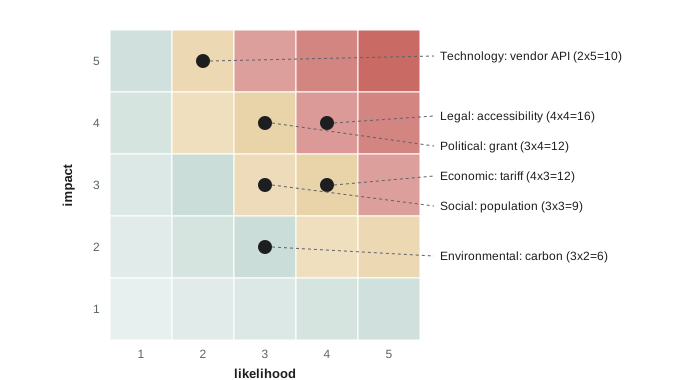
Not every external change deserves a response. The project needs a quick way to judge which changes matter most, so it can focus effort. A simple approach scores each change on how likely it is to affect the project and how much impact it would have, much like a risk score. Compass's steering committee reviewed six external developments in the spring before opening.
# Score external changes for Project Compass: likelihood (1-5) x impact (1-5),
# and test what a kiosk tariff increase does to the technology budget.
changes = [
    ("Political", "Senior-government library grant renewed or cut", 3, 4),
    ("Economic",  "Tariff increase on imported kiosks",             4, 3),
    ("Social",    "East-side population growing faster than forecast", 3, 3),
    ("Technology","Library system vendor ends support for old API",  2, 5),
    ("Legal",     "New accessibility deadline for public bodies",    4, 4),
    ("Environmental", "Council requires a carbon estimate for capital projects", 3, 2),
]
for cat, desc, l, i in sorted(changes, key=lambda c: c[2] * c[3], reverse=True):
    print(f"{l * i:>2}  {cat:13} {desc}")
kiosks, unit_price = 6, 18_500
for tariff in (0.0, 0.10, 0.25):
print(f"Tariff {tariff:.0%}: kiosk cost ${kiosks * unit_price * (1 + tariff):,.0f}")16 Legal New accessibility deadline for public bodies 12 Political Senior-government library grant renewed or cut 12 Economic Tariff increase on imported kiosks 10 Technology Library system vendor ends support for old API 9 Social East-side population growing faster than forecast 6 Environmental Council requires a carbon estimate for capital projects Tariff 0%: kiosk cost $111,000 Tariff 10%: kiosk cost $122,100 Tariff 25%: kiosk cost $138,750
The new accessibility requirement scored highest. The province had announced consultations on updating its accessibility standards for public sector digital services, and the library's policy already exceeded the existing standard, so the change was likely to be manageable, but the committee asked the privacy and records officer to track it and confirm that WCAG 2.1 level AA would still satisfy any new rule. The senior-government library grant and the kiosk tariff scored next. For the tariff, the code shows the sensitivity: a 10 % tariff on six kiosks adds about $11,100, and 25 % adds about $27,750. That range fell within the risk reserve, but only just at the top end, which is why the purchase was moved earlier and a price-adjustment clause agreed with the vendor. In the event, the tariff increase cost about $19,000, drawn from the reserve as recorded in PMP-131.
Responding to external change
Once a change is judged significant, the project has several kinds of response, often used together.
- Treat it as a risk: if the change is uncertain, add it to the risk register and plan a response, as the team did with the grant renewal.
- Treat it as an issue: if the change has happened and is affecting the project, log it and act, as with the tariff once it took effect.
- Change scope or the backlog: a new legal requirement may add work; in adaptive projects, new requirements go into the backlog for the product owner to order, while mandatory ones may need to go straight into the definition of done.
- Raise a change request: in predictive work, a change that affects baselines goes through change control.
- Revisit the business case: a large external change may alter the value of the project, which is a governance decision.
- Seize an opportunity: not all external change is bad. When the city announced a new bus route past Eastgate, the team updated the visit forecast and coordinated opening publicity with the transit agency.
Technology and the vendor ecosystem
Technology changes are often the most disruptive for projects with software or equipment. Vendors release new versions, end support for old ones, change pricing models or are acquired. The Compass app depended on the library system vendor's interface for holds and accounts. When the vendor signalled that its old interface would be retired within two years, the app team asked for access to the new interface early and built the app against it, avoiding a forced rework shortly after launch. Generative AI is another fast-moving area: organizations are adopting AI tools for drafting, analysis and customer service, while laws and policies on their use are still being written. Larkfield's policy allowed staff to use approved AI tools for drafting communications but not with patron personal information.
Regulatory timelines in technology move as well. Canada's earlier federal bill that included an artificial intelligence act died when Parliament was prorogued in January 2025, and in June 2026 the government tabled Bill C-36 to reform private-sector privacy law. Internationally, European lawmakers agreed in 2026 to push back key obligations of the EU AI Act for high-risk systems to late 2027 and 2028. The lesson for project managers is to track such developments through specialists rather than assume a rule will arrive, or not arrive, on its originally announced date.
Sustainability
Sustainability appears in the 2026 outline as a type of compliance requirement and as a category of risk, reflecting how much it has moved into the mainstream of project work. For projects, sustainability has several dimensions. Environmental sustainability covers energy use, emissions, materials, waste and effects on ecosystems. Social sustainability covers effects on communities, workers and users, including accessibility and fair labour practices. Economic sustainability asks whether the outputs can be operated and maintained affordably over their life. Many organizations frame these together as environmental, social and governance (ESG) considerations.
Sustainability obligations come from regulation (energy codes, environmental permits, disclosure rules for larger companies in some jurisdictions), funding conditions, customer and investor expectations, and organizational policies such as climate plans and green purchasing rules. They also create risks: extreme weather can delay construction or damage sites, carbon pricing can raise costs, and failing to meet stakeholder expectations can harm reputation.
| Dimension | Compass decision | Effect |
|---|---|---|
| Embodied carbon | Reused existing steel shelving from a closed branch for a third of the stacks | Lower material emissions and cost; slightly longer installation |
| Operational energy | LED lighting with occupancy sensors; heat pump replacing the old rooftop unit | Higher capital cost, lower operating cost and emissions |
| Waste | Demolition waste sorted on site | 68 % diverted from landfill (lesson 7) |
| Social | Accessible design beyond code minimum; local hiring encouraged in the construction tender | Wider access; community benefit |
| Economic | Life-cycle cost comparison for flooring and lighting | Options chosen on cost over 15 years, not purchase price alone |
The heat pump decision illustrates how sustainability interacts with the business case. It cost $46,000 more than replacing the old gas rooftop unit like for like, but the facilities manager estimated it would save about $5,500 a year in energy and maintenance and cut the branch's heating emissions substantially, aligning with the municipality's climate plan. The CCB approved it from the facilities contingency after the project manager showed that the life-cycle cost over 15 years was lower and that the decision supported a strategic goal.
Keeping the review continuous
External scanning is not a one-off exercise at the start. Conditions change throughout the project, and changes late in delivery can be the most expensive. Making external change a standing agenda item, keeping a short watch list of developments with owners, and revisiting the business case when something significant happens keep the project connected to its environment. In adaptive projects, the product owner and sponsor should bring relevant external changes to backlog refinement and release planning, so that priorities reflect the world as it is now.
Worked problem
A regulation announced mid-project
Halfway through a project to build a customer portal, the government announces new data protection rules that will take effect in nine months, after the planned launch. The rules may require changes to how consent is recorded. The product owner wants to wait until the rules take effect before doing anything. What should the project manager recommend?
Show solution
- Waiting risks launching a product that becomes noncompliant soon after launch and needs costly rework.
- Ask the privacy or legal specialist to assess what the rules require and how they affect the portal.
- Depending on the assessment, add the required changes to the backlog or the definition of done, adjust the release plan and update the risk register and business case if costs change materially.
- Inform stakeholders and the sponsor of the impact and plan.
Answer: Have the specialist assess the impact now, then update the backlog, plans and risk register, and inform the sponsor, rather than waiting for the rules to take effect.
The external environment in the risk register
Many external developments end up in the risk register, so it helps to link the two activities explicitly. Compass's risk register included a category for external risks, and each external watch-list item that crossed an agreed score threshold was added as a risk with an owner and response. When an external risk changed, for example when the grant program was confirmed for another three years, the register was updated and the contingency released or reassigned. This prevented a common gap in which external changes are discussed in steering meetings but never translated into actions.
Common mistakes
MistakeScanning the environment only at the start of the project.
InsteadMake external change a standing review item throughout.
MistakeReacting to every external change with a scope change.
InsteadAssess likelihood and impact first, then choose the response.
MistakeAssuming announced regulatory dates are fixed.
InsteadTrack developments through specialists and plan for timelines to move.
MistakeTreating sustainability as only environmental.
InsteadConsider environmental, social and economic dimensions.
MistakeComparing options on purchase price alone.
InsteadUse life-cycle cost and strategic fit, especially for sustainability decisions.
Summary and key terms
- External changes in regulation, markets, technology, society and the environment can alter a project's scope, risks and value.
- PESTLE helps scan broadly; likelihood and impact scoring helps focus on what matters.
- Responses include treating changes as risks or issues, changing scope or the backlog, raising change requests, revisiting the business case and seizing opportunities.
- Technology and regulatory timelines move; track them through vendors and specialists.
- Sustainability covers environmental, social and economic dimensions and is both a compliance area and a source of risk.
- External review should be continuous, built into governance and backlog refinement.
- PESTLE
- A framework for scanning political, economic, social, technological, legal and environmental factors.
- Environmental scanning
- Systematically watching for external developments that could affect the organization or project.
- Horizon scanning
- Looking further ahead for emerging changes that may matter in future.
- ESG
- Environmental, social and governance considerations used to judge sustainability and responsibility.
- Embodied carbon
- Greenhouse gas emissions from producing, transporting and installing materials.
- Life-cycle cost
- The total cost of owning an asset over its life, including purchase, operation, maintenance and disposal.
Practice problems
Work each problem on paper first, then reveal the answer to check.
What do the letters in PESTLE stand for?
Show answer
Political, economic, social, technological, legal, environmental.
Which external change scored highest for Compass?
Show answer
The new accessibility requirement or deadline.
What would a 25 % tariff add to the cost of six kiosks?
Show answer
About $27,750.
What did the team do to limit the tariff exposure?
Show answer
Moved the purchase earlier and agreed a price-adjustment clause.
Give an example of an external change that was an opportunity.
Show answer
The new bus route past Eastgate.
How did the app team handle the vendor's retiring interface?
Show answer
Built the app against the new interface early.
Name the three dimensions of sustainability.
Show answer
Environmental, social and economic.
Why did the CCB approve the more expensive heat pump?
Show answer
Lower life-cycle cost over 15 years and alignment with the climate plan.
What should happen when a new regulation is announced mid-project?
Show answer
Assess its impact with specialists, update plans, backlog and registers, and inform stakeholders.
How can external review be kept continuous?
Show answer
Standing agenda items, a watch list with owners and bringing changes to refinement and release planning.
Lesson quiz · 5 questions
Score 60% or more to complete this lesson.
Create a free account to save your progress, take quizzes and earn a certificate.