
PMP-150 · Lesson 10 of 12 · 25 min
Supporting adoption and transition
Lesson 9 showed how to understand culture, assess the impact of change and diagnose readiness. This lesson turns to action: helping people through the transition so that they adopt what the project delivers and keep using it after the project team leaves. It covers communication and involvement, training, the transition from project to operations, adoption measures and reinforcement. These activities sit where the Business Environment task of supporting organizational change meets the Process task of managing project closure, and they are where many benefits are won or lost.
Leaders, communication and involvement
People decide how to respond to change largely on the basis of what their own leaders say and do. Research by change practitioners consistently finds that a visible, active sponsor is one of the strongest predictors of successful adoption, and that employees prefer to hear about organizational changes from senior leaders and about how changes affect their own jobs from their direct managers. For Project Compass, the chief executive held a town hall explaining why Eastgate mattered and what it meant for staff, and each branch manager then met their own team to talk through the specific effects.
Good change communication is early, honest, two-way and repeated. It explains why the change is happening, what will change and what will not, how it affects each group, what support is available and how people can raise concerns. One announcement is never enough: people need to hear key messages several times, through different channels, before they absorb them. Involvement is even more powerful than communication. When Eastgate staff helped design the branch's service model, choosing where kiosks would sit and how roaming help would work, they became advocates rather than recipients of the change.
| Audience | Key message | Channel and messenger | Timing |
|---|---|---|---|
| All staff | Why Eastgate matters; what changes and what does not | Town hall, chief executive | Six months before opening |
| Circulation staff | Self-checkout frees time for help and programs; no layoffs planned | Team meetings with branch managers; union joint statement | After union consultation |
| Eastgate team | Your role, your training, how opening week will work | Workshops with the branch manager | Monthly from four months out |
| Patrons on the east side | A new branch is coming; how to use kiosks and the app | Community events, social media, flyers, councillor newsletters | From two months out |
| Board and council | Progress, readiness and benefits plan | Board report, sponsor | Monthly |
Training that builds ability
Training is the most familiar change activity and the one most often done badly. Effective training is tied to real tasks, timed close to when people will use the skills, practical rather than lecture-based, and followed by support on the job. The Compass training plan replaced slide presentations with a mock branch set up in the main library's meeting room, where Eastgate staff practised opening procedures, helped colleagues acting as patrons use the kiosks and app, and handled scenarios such as a kiosk failure or a patron unable to log in. Training happened in the three weeks before opening, and floor walkers from the vendor and the IT service desk supported staff for the first two weeks after opening.
Training should cover the people who support the change as well as those who use it. The IT service desk needed to know how to troubleshoot kiosks and when to call the vendor; the collections team needed procedures for tagging new items; supervisors needed to know how to coach staff and read the new transaction reports.
The diffusion of innovations
When a change affects customers or the public, adoption rarely happens all at once. Everett Rogers's diffusion of innovations describes how new ideas spread through a population over time: a small group of innovators and early adopters try something first, the early and late majorities follow once it is proven and convenient, and laggards adopt last, if ever. The cumulative share of adopters typically follows an S-shaped curve: slow at first, then rapid, then levelling off.
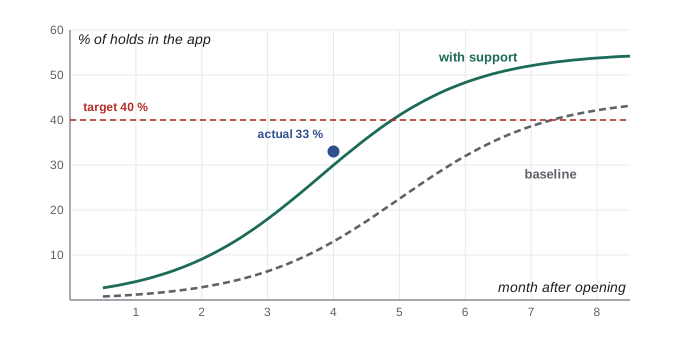
This pattern matters for benefits forecasting. The Compass business case set a target that 40 % of Eastgate holds would be placed through the app by month 6 after opening. Before opening, Amara Osei modelled two adoption curves: a baseline with no special effort, and a supported curve that assumed the adoption activities in the change plan, such as staff helping patrons install the app at the desk, a short sign-up in branch and reminders in hold notices.
# Forecast the share of Eastgate holds placed in the app using a simple S-curve,
# then check how far adoption support must move the curve to reach 40 % by month 6.
import math
def share(month, ceiling, midpoint, steepness=0.9):
    return ceiling / (1 + math.exp(-steepness * (month - midpoint)))
print("Month  Baseline  With support")
for m in range(1, 9):
    base = share(m, 0.45, 5.0)
    supported = share(m, 0.55, 3.8)
print(f"{m:>5} {100 * base:>7.0f}% {100 * supported:>11.0f}%")Month Baseline With support
1 1% 4%
2 3% 9%
3 6% 18%
4 13% 30%
5 22% 41%
6 32% 48%
7 39% 52%
8 42% 54%The baseline curve reached only about 32 % by month 6, short of the target. The supported curve reached about 41 % by month 5 and 48 % by month 6. The model was crude, but it made a clear case: the benefit would not appear on its own, and the adoption activities were worth funding. Four months after opening, the actual share was 33 %, slightly ahead of the supported curve's 30 % for that month, which is the evidence the sponsor saw in the quarterly review in lesson 5.
Transition to operations
Transition is the point where responsibility for the project's outputs passes from the project to the people who will run them. It is easy to treat transition as a single handover meeting at the end, but it needs planning from early in the project. A transition plan typically covers what is being handed over, to whom, when, the acceptance criteria for handover, training and documentation, support arrangements during an early-life support period, warranty and vendor contacts, and the transfer of benefits tracking.
| Handover item | From | To | Acceptance evidence |
|---|---|---|---|
| Fitted-out branch and building systems | Contractor via facilities project lead | Facilities operations | Occupancy permit, commissioning reports, operating manuals, warranties |
| Kiosks and RFID gates | Technology workstream | IT service desk and branch | Acceptance tests passed, support procedures, vendor support contract active |
| Mobile app | App team and vendor | Digital services team | Release accepted, accessibility audit closed, support and release process agreed |
| Opening collection | Collections workstream | Eastgate branch | Items tagged and shelved, catalogue records verified |
| Benefits register and reports | Project manager | Branch manager and digital services manager | Owners agreed, data sources and schedule set |
Operations must be ready to receive the change, not just told it is coming. Operational readiness checks ask whether the receiving teams have the people, skills, procedures, tools, budget and support contracts they need from the first day. On Compass, a readiness review two weeks before opening found that the IT service desk had no after-hours support for kiosk failures at weekends, when Eastgate would be busy. The project arranged weekend vendor coverage for the first three months while the library decided on a permanent solution.
Reinforcement and sustainment
The last element of ADKAR, reinforcement, is the one most often neglected, because by the time it is needed the project team is moving on. Without reinforcement, people drift back to old habits. Reinforcement includes recognizing people who adopt the change, sharing early successes, measuring and reporting adoption, fixing problems that make the new way harder than the old, and making the new way part of normal procedures, job descriptions and performance conversations. On Compass, the branch manager reviewed kiosk use and app adoption weekly for the first three months, the chief executive shared early successes in staff newsletters, and the new service model was written into the branch operating procedures.
Sustainment also depends on removing the old way where appropriate. If staff can always fall back on the old process, some will, especially under pressure. For Compass, this meant that self-checkout was the default at Eastgate, with staff assistance available, rather than a staffed checkout desk with kiosks as an optional extra.
Adaptive approaches and change
Adaptive delivery can make organizational change easier because change arrives in smaller steps and users are involved throughout. Frequent releases give people time to adjust and give the team feedback about what is and is not being adopted. They can also create change fatigue if every release brings new procedures with little warning. The Compass app team used its release notes, staff briefings and a short "what's new" screen in the app to help staff and patrons absorb each change, and the product owner held back non-urgent changes during opening month to avoid overloading staff.
Worked problem
Ready to hand over?
A new online booking system has passed all acceptance tests, and the project team plans to hand it to operations on Friday and close the project. The operations manager says her team has had no training on handling refunds and does not know how to escalate problems to the vendor. What should the project manager do?
Show solution
- Acceptance tests show the product works, but operational readiness covers people, procedures and support as well.
- Training on refunds and an escalation procedure with the vendor are clearly missing, so operations is not ready.
- Closing the project now would leave a gap that is likely to cause service failures and harm benefits.
- The project manager agrees a short plan with the operations manager to deliver the training and procedures, adjusts the handover date if needed and informs the sponsor.
Answer: Delay or condition the handover until operations is ready, delivering the missing training and procedures, and inform the sponsor.
Patrons as stakeholders in the change
Organizational change is not only about staff. When a change affects customers or the public, they also need information, support and alternatives. For Eastgate, patrons were about to meet self-checkout and a new app at a branch they had never visited. The communication plan reached them through community events, local councillors' newsletters and the library's social media, and floor staff in the first weeks were trained to approach patrons near the kiosks and offer help rather than wait to be asked.
Accessibility and inclusion mattered here too. Some patrons do not have smartphones, some find kiosks difficult, and some prefer a staffed service. Keeping a staffed desk and offering assistance at the kiosks meant that nobody was excluded by the change, which was both a value of the library and, for some patrons, a legal requirement under accessibility law. Feedback cards and a short survey in the first two months gave patrons a voice; their most common request, longer weekend hours, fed directly into the visits shortfall investigation in lesson 3.
Common mistakes
MistakeRelying on one announcement to communicate a change.
InsteadCommunicate early, honestly and repeatedly, through leaders and managers, with two-way channels.
MistakeDelivering training long before people use the skills.
InsteadTrain close to use, practically, with support on the job afterward.
MistakeAssuming adoption will reach targets without effort.
InsteadPlan and fund adoption activities; model the adoption curve.
MistakeHanding over when the project's work is done but operations is not ready.
InsteadConfirm operational readiness and acceptance by the receiving organization.
MistakeStopping change support at go-live.
InsteadReinforce and sustain the change, and remove the old way where appropriate.
Summary and key terms
- Visible sponsors and direct managers are the most influential messengers of change.
- Communication should be early, honest, two-way and repeated; involvement builds ownership.
- Effective training is practical, timed close to use and followed by on-the-job support.
- Adoption follows an S-curve; adoption activities can move it earlier and higher.
- Transition plans and operational readiness checks make sure operations can run the outputs from day one.
- Reinforcement and sustainment prevent people drifting back to old ways.
- Transition plan
- The plan for handing project outputs to the people who will operate them.
- Operational readiness
- The receiving organization's preparedness to run a new product or service.
- Early-life support
- Extra support provided for a period immediately after go-live.
- Diffusion of innovations
- A theory describing how new ideas spread through a population over time.
- Adoption curve
- The S-shaped curve of the cumulative share of people who adopt a change.
- Reinforcement
- Actions that help a change stick, such as recognition, measurement and updated procedures.
- Change fatigue
- Exhaustion and disengagement caused by too much change too quickly.
Practice problems
Work each problem on paper first, then reveal the answer to check.
Who are the most influential messengers of change for employees?
Show answer
Senior leaders for the reasons, direct managers for the effects on their jobs.
Why did Compass use a mock branch for training?
Show answer
So staff could practise real tasks and scenarios rather than watch presentations.
What share of holds did the baseline adoption curve reach by month 6?
Show answer
About 32 %.
What was the actual app share at month 4?
Show answer
33 %.
Name four items a transition plan typically covers.
Show answer
For example, what is handed over, to whom, when, acceptance criteria, training, support, warranties and benefits tracking.
What gap did the Compass readiness review find?
Show answer
No after-hours weekend support for kiosk failures.
Why is reinforcement often neglected?
Show answer
The project team has usually moved on by the time it is needed.
Why was self-checkout made the default at Eastgate?
Show answer
So staff and patrons would not drift back to the old way under pressure.
What is change fatigue?
Show answer
Exhaustion caused by too much change too quickly.
How did the app team limit change fatigue at opening?
Show answer
It held back non-urgent changes during opening month.
Lesson quiz · 5 questions
Score 60% or more to complete this lesson.
Create a free account to save your progress, take quizzes and earn a certificate.