
PMP-150 · Lesson 1 of 12 · 27 min
Projects in their business environment
A project never exists on its own. It is started because an organization wants something to change, it is paid for out of budgets that compete with other uses, it is overseen by people who answer to boards, regulators or the public, and it delivers into an organization that must absorb what it produces. The PMP exam groups the knowledge and judgement needed to handle all of this under the Business Environment domain. In the outline that took effect on 9 July 2026, that domain carries about 26 % of scored questions, up from about 8 % in the previous outline, so roughly one question in four now asks how a project fits the organization and the world around it.
This course covers that domain. PMP-120 and PMP-121 dealt with people, PMP-130 and PMP-131 with planning and controlling the work, and PMP-140 with agile and hybrid delivery. Here the focus moves outward: why the project exists, how its value is judged, who governs it, which rules it must obey, how the organization changes because of it, what is happening outside that could affect it, and how the organization learns from it. As before, the running example is Project Compass, the invented project to open the Eastgate branch of the invented Larkfield Regional Library.
The Business Environment domain at a glance
PMI lists eight Business Environment tasks in the 2026 outline. The names below are paraphrased, together with where this course teaches each one. Two of them, plan and manage risk and manage and control changes, were taught in depth in PMP-131, so this course revisits them only where they meet governance, compliance and the external environment.
| Business Environment task (paraphrased) | What it is about | Where it is taught |
|---|---|---|
| Define and establish project governance | Structures, decision rights, escalation paths and thresholds, success measures, reporting | Lessons 4 and 5 |
| Plan and manage project compliance | Identifying, classifying and meeting legal, security, safety, sustainability and policy requirements | Lessons 6 and 7 |
| Manage and control changes | Formal change control and communicating decisions | PMP-131; revisited in lessons 4 and 11 |
| Remove impediments and manage issues | Triage, intervention, escalation, recognizing when a risk has become an issue | Lesson 8 |
| Plan and manage risk | Risk planning, analysis, responses and reporting, including security and sustainability risks | PMP-131; revisited in lessons 7 and 11 |
| Continuous improvement | Lessons learned, improvement cycles, updating organizational process assets | Lesson 12 |
| Support organizational change | Culture, readiness and the effect of change on people and the project | Lessons 9 and 10 |
| Evaluate external business environment changes | Regulatory, market, technology, social and geopolitical changes and their effect on scope or the backlog | Lesson 11 |
Value and benefits are not a separate Business Environment task. The outline places value-based delivery in the Process domain, and the integrated plan task asks whether the project still offers business value. They belong in this course anyway, because nearly every governance, compliance or change question turns on the same test: what decision best protects the value the project was started to create? Lessons 2 and 3 build that foundation with business cases and benefits realization.
From strategy to projects
Organizations rarely start projects one at a time. They set a strategy, translate it into goals, and then choose a set of initiatives that together should move those goals. The usual vocabulary is worth knowing precisely, because exam questions often hinge on who decides what.
- A strategy states where the organization wants to go and how it intends to compete or serve. Larkfield Regional Library's strategic plan for 2026 to 2030 has five goals: every resident within about 15 minutes of a library service point, stronger digital services, deeper community partnerships, financial sustainability and action on climate.
- A portfolio is the full set of projects, programs and operations an organization manages to achieve its strategy. Portfolio management selects, prioritizes and balances that set against limited money, people and capacity for change.
- A program is a group of related projects and activities managed together because coordinating them produces benefits that managing them separately would not. The library runs a branch network renewal program; Eastgate is one project within it.
- A project is a temporary endeavour to create a unique product, service or result. It produces outputs, such as a fitted-out branch and a working app, which the organization then uses to achieve outcomes and benefits.
- Operations are the ongoing work that runs the organization and keeps delivering value after projects end, such as branch services, collections and the IT service desk.
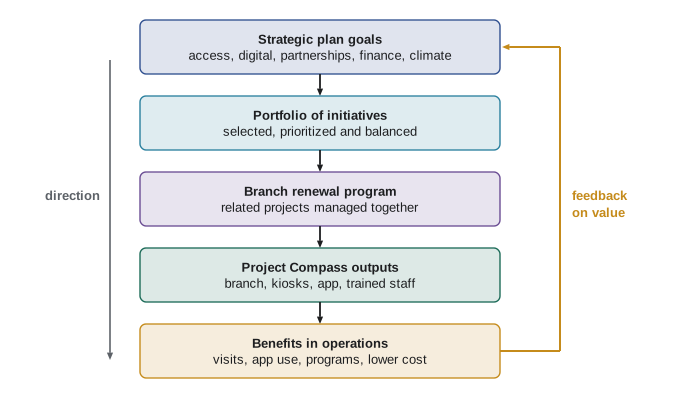
The cascade runs in both directions. Strategy sets direction downward, and evidence about what projects are actually achieving flows back up so that leaders can adjust the portfolio. A project manager who reports only schedule and cost, and never whether the project still serves its strategic purpose, is giving leaders half the picture.
Choosing which projects to do
When there are more good ideas than money, organizations compare candidates using a mix of financial measures and strategic scoring. Lesson 2 covers the financial side. A common strategic tool is weighted scoring: leaders agree weights for each strategic goal, score each candidate against each goal, and multiply. The library's portfolio committee scored five candidate projects for the 2027 capital budget.
# Weighted scoring of the library's candidate projects against its 2026-2030 strategic plan.
# Weights add to 100; each project is scored 1 (weak) to 5 (strong) on each goal.
weights = {"Access within 15 minutes": 35, "Digital services": 25,
           "Community partnerships": 15, "Financial sustainability": 15, "Climate action": 10}
projects = {
    "Eastgate branch (Project Compass)": [5, 4, 4, 3, 3],
    "Main library roof and HVAC renewal": [2, 1, 2, 4, 5],
    "Bookmobile replacement":            [4, 1, 3, 3, 2],
    "Library website rebuild":           [2, 5, 2, 3, 2],
    "Makerspace expansion":              [2, 3, 4, 2, 2],
}
def score(marks):
    return sum(w * m for w, m in zip(weights.values(), marks)) / 100
ranked = sorted(projects.items(), key=lambda kv: score(kv[1]), reverse=True)
print(f"{'Project':38} Score")
for name, marks in ranked:
print(f"{name:38} {score(marks):.2f}")Project Score Eastgate branch (Project Compass) 4.10 Library website rebuild 2.90 Bookmobile replacement 2.75 Makerspace expansion 2.55 Main library roof and HVAC renewal 2.35
Eastgate scores 4.10 out of 5, well ahead of the others, mainly because it serves the highest-weighted goal: closing the gap in library access on the fast-growing east side of the city. The roof and HVAC renewal scores lowest on strategy, yet it may still go ahead: some work is mandatory, because the building must be kept safe and weathertight, and portfolio committees usually fund mandatory and compliance work before discretionary projects. Scoring informs judgement; it does not replace it. A good committee also checks capacity (can the organization actually deliver and absorb all of the selected projects at once?) and balance (is the portfolio too risky, or too focused on one goal?).
Outputs, outcomes and benefits
PMP-110 introduced a distinction that the whole Business Environment domain depends on. An output is what the project produces: the fitted-out Eastgate branch, the self-service kiosks, the mobile app, trained staff. An outcome is the change that results when the output is used: east-side residents borrow more, patrons place holds from home, staff spend less time on routine checkouts. A benefit is a measurable improvement that a stakeholder values and that contributes to an organizational objective: more residents with access to library service, higher use of digital services, lower cost per transaction.
| Level | Project Compass example | Who usually owns it |
|---|---|---|
| Output | Eastgate branch open with 38,000 items, kiosks and app release 1 | Project manager and team |
| Outcome | East-side residents visit, borrow and place holds through the app | Branch manager and digital services manager |
| Benefit | About 140,000 visits a year by year 2; 40 % of Eastgate holds placed in the app | Business owners named in the benefits register |
| Strategic objective | Every resident within about 15 minutes of a service point; stronger digital services | Chief executive and board |
The distinction matters because a project can deliver every output on time and on budget and still fail to produce the benefits. If the branch opens but the bus route serving it is cancelled, visits will fall short of the business case even though the project team did everything asked of it. Equally, the most important benefits usually appear after the project has closed, which is why benefits must have owners in the business, not only in the project.
The project manager's place in the environment
In the Business Environment domain the project manager acts less as a scheduler and more as a link between the project and the organization. Typical responsibilities include keeping the business case current, raising early when the project no longer looks worthwhile, working within and helping to shape governance, making sure compliance obligations are known and met, preparing the organization to receive the change, watching the external environment for developments that affect the project, and capturing and sharing what was learned.
None of this means the project manager makes decisions that belong to others. The sponsor owns the business case, the board decides whether to fund extra scope, the privacy officer interprets privacy law, and operations managers own benefits after handover. The project manager's job is to make sure those people have the right information at the right time and that decisions are made at the right level. Many exam distractors offer the project manager taking a decision alone that belongs to the sponsor, a governance body or a specialist; others offer escalating something the project manager is clearly empowered to resolve.
Predictive, adaptive and hybrid settings
Business Environment tasks apply in every delivery approach, but they look different. In a predictive project, governance tends to be gated, with formal approval to move from one phase to the next, a change control board and documented compliance sign-offs. In an adaptive project, governance often sets boundaries and outcomes rather than approving each piece of scope: a product owner prioritizes within an agreed budget and goal, compliance requirements become part of the definition of done, and the organization reviews value at regular intervals. Hybrid projects such as Project Compass combine both, so the project manager must make sure the two styles meet cleanly at integration points.
| Task | Predictive emphasis | Adaptive emphasis |
|---|---|---|
| Governance | Phase gates, baselines, change control board | Guardrails, outcome reviews, product owner decision rights |
| Compliance | Requirements traced and signed off before acceptance | Built into the definition of done and checked every increment |
| Organizational change | Transition plan near the end | Users involved early; change absorbed in smaller steps |
| External changes | Assessed through change requests against the baseline | Reflected in backlog priorities at the next refinement |
| Continuous improvement | Lessons learned at phase ends and closure | Retrospectives every iteration, plus project-level reviews |
Project Compass in its environment
To ground the rest of the course, here is what surrounds Project Compass. The library is a public body governed by a board appointed by the municipality, which provides most of its funding. The chief executive, Gloria Mensah, is the project sponsor. The board approved a budget of $2.52 million: a $2.4 million cost baseline plus a $120,000 management reserve held by the sponsor. A change control board chaired by the sponsor's delegate handles mid-sized changes, and the project manager, Priya Natarajan, may approve small changes within workstream contingency. The branch manager for Eastgate, Owen Tran, will own most of the benefits once the branch opens, and the digital services manager, Amara Osei, is product owner for the app.
Outside the library, the environment includes provincial rules on access to information and privacy for public bodies, provincial accessibility standards and the building code, the municipality's purchasing bylaw and climate plan, a library services grant from the province, the landlord of the leased unit, a union representing library staff, and the library system vendor whose software the app depends on.
Each of these can generate requirements, constraints, risks or opportunities. Later lessons return to them one at a time.
Worked problem
Strategy or sunk cost?
Midway through Project Compass, a councillor proposes moving the money for Eastgate to a downtown renovation, arguing that a lot has already been spent on Eastgate but downtown is more visible. The sponsor asks the project manager for a recommendation for the board. What should the recommendation rest on?
Show solution
- Money already spent is a sunk cost and should not drive the decision either way.
- The relevant question is which use of the remaining money best serves the library's strategic goals, compared on value still to be gained and cost still to be spent.
- Eastgate scored highest on the strategic plan, mainly on the access goal; the downtown renovation would need to be scored the same way, along with the cost of stopping Eastgate (lease commitments, contracts, lost grant).
- The project manager prepares that comparison and an updated business case; the board, not the project manager, decides.
Answer: Base the recommendation on remaining costs and remaining value against the strategic plan, including the cost of stopping, and present it for the board to decide.
Common mistakes
MistakeTreating the Business Environment domain as a minor topic.
InsteadIt is about 26 % of the 2026 exam, roughly one question in four.
MistakeJudging a project only by schedule and cost.
InsteadAsk whether it still delivers the benefits and strategic value it was started for.
MistakeConfusing outputs with benefits.
InsteadOutputs are what the project makes; benefits are measurable improvements from using them.
MistakeUsing sunk cost to justify continuing or stopping.
InsteadDecide on remaining cost and remaining value.
MistakeHaving the project manager make decisions that belong to the sponsor, board or a specialist.
InsteadPrepare the information and route the decision to the right level.
Summary and key terms
- The Business Environment domain is about 26 % of the July 2026 PMP exam and has eight tasks.
- Strategy is turned into portfolios, programs and projects; evidence of value flows back up.
- Weighted scoring helps select projects but does not replace judgement about mandatory work, capacity and balance.
- Projects produce outputs; outcomes and benefits come from using them, often after the project ends.
- The project manager links the project to the organization and routes decisions to the right level.
- Governance, compliance and change look different in predictive and adaptive settings but serve the same purpose.
- Business environment
- The organizational and external context in which a project is started, governed and delivered.
- Strategic alignment
- The degree to which a project contributes to an organization's strategic goals.
- Portfolio
- The set of projects, programs and operations managed together to achieve strategic objectives.
- Program
- Related projects and activities managed together to obtain benefits not available from managing them separately.
- Output
- A product, service or result created by a project.
- Outcome
- The change that results from using a project's outputs.
- Benefit
- A measurable improvement, valued by a stakeholder, that contributes to an organizational objective.
- Sunk cost
- Money already spent that cannot be recovered and should not influence future decisions.
Practice problems
Work each problem on paper first, then reveal the answer to check.
About what share of the 2026 PMP exam is in the Business Environment domain?
Show answer
About 26 %.
Which two Business Environment tasks were taught mainly in PMP-131?
Show answer
Plan and manage risk, and manage and control changes.
What is the difference between a program and a portfolio?
Show answer
A program groups related work for shared benefits; a portfolio is the whole set of work managed to achieve strategy.
Why might the low-scoring roof renewal still be funded?
Show answer
It is mandatory work to keep the building safe and weathertight.
Give one output, one outcome and one benefit of Project Compass.
Show answer
The open branch; residents borrowing there; about 140,000 visits a year.
Who owns most Eastgate benefits after opening?
Show answer
The branch manager and, for the app, the digital services manager.
What should replace sunk cost in a continue-or-stop decision?
Show answer
Remaining cost compared with remaining value.
How does compliance typically appear in an adaptive project?
Show answer
Built into the definition of done and checked every increment.
Name two parts of the external environment that affect Project Compass.
Show answer
For example, privacy and accessibility rules, the purchasing bylaw or ordinance, the grant, the landlord, the union or the system vendor.
What does weighted scoring multiply?
Show answer
The weight of each goal by the project's score on that goal, summed over goals.
Lesson quiz · 5 questions
Score 60% or more to complete this lesson.
Create a free account to save your progress, take quizzes and earn a certificate.