
PMP-140 · Lesson 6 of 12 · 25 min
Lean, XP and scaling frameworks
Scrum and Kanban are the frameworks most often named in exam questions, but agile practice draws on a wider family of ideas. Lean thinking explains why agile teams obsess over flow and waste. Extreme Programming (XP) supplies the engineering practices that let software teams change direction cheaply. Scaling frameworks try to coordinate many agile teams working on one product. This lesson surveys them at the depth the PMP exam expects: what each is for, its signature practices and when it fits.
Lean thinking
Lean grew from the Toyota Production System and was described for Western audiences in the 1990s. Its central idea is to maximize customer value while minimizing waste, by improving the flow of work through the whole value stream. Mary and Tom Poppendieck later translated lean into software development with seven principles that remain a useful summary: eliminate waste, build quality in, create knowledge, defer commitment, deliver fast, respect people and optimize the whole.
| Lean principle (Poppendieck) | What it means in practice | Compass example |
|---|---|---|
| Eliminate waste | Remove anything that does not add value for the customer | Drop a monthly 20-page status report nobody reads; replace it with the dashboard |
| Build quality in | Prevent defects rather than inspect them out | Automated accessibility checks run on every change |
| Create knowledge | Learn through short cycles, experiments and shared understanding | Prototype two ways to show the holds queue and test both with patrons |
| Defer commitment | Decide at the last responsible moment, when the most is known | Choose the notification provider only after the library confirms its SMS budget |
| Deliver fast | Short cycle times reduce risk and speed feedback | Release small changes to a pilot group weekly |
| Respect people | Empower the people closest to the work to improve it | Front-line staff help design the kiosk help screens |
| Optimize the whole | Improve the end-to-end flow, not individual steps | Fix the slow release approval, not just the coding speed |
"Defer commitment" is often misunderstood. It does not mean avoiding decisions; it means not making irreversible decisions earlier than necessary, so that they can be made with better information. The last responsible moment is the point after which not deciding would eliminate an important option. For the fit-out, that moment came early, because long-lead items had to be ordered. For the app's notification provider, it came much later.
The wastes of knowledge work
Lean manufacturing identified types of waste, often remembered as transport, inventory, motion, waiting, overproduction, overprocessing and defects, with unused talent sometimes added as an eighth. The Poppendiecks mapped these to software and other knowledge work. The mapping helps you recognize waste in exam scenarios that never use the word.
| Manufacturing waste | Knowledge work equivalent | Example |
|---|---|---|
| Inventory | Partially done work | Designs approved but not built; code written but not released |
| Overproduction | Extra features | A reporting module nobody asked for (gold plating) |
| Overprocessing | Extra process and relearning | Three approval signatures for a minor text change; rediscovering a forgotten decision |
| Transport | Handoffs | Requirements passed from analyst to designer to developer to tester, losing context each time |
| Motion | Task switching | A developer split across four projects |
| Waiting | Delays | Waiting days for test data, decisions or environments |
| Defects | Defects | Bugs found by patrons after release |
| Unused talent | Not using people's knowledge | Branch staff ideas never reach the backlog |
Value stream mapping
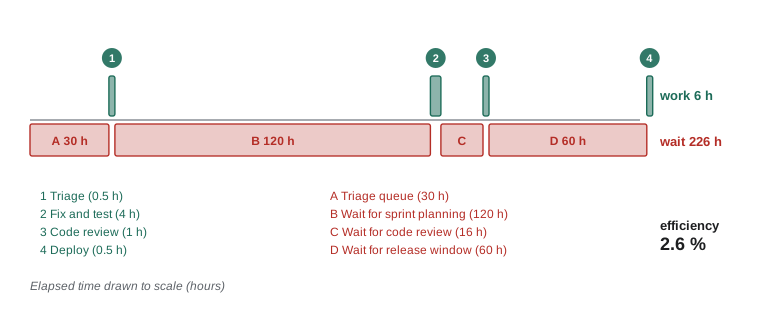
A value stream map traces a piece of work from request to delivery, recording the time spent actually working on it and the time spent waiting between steps. The ratio of working time to total elapsed time is called process cycle efficiency (sometimes flow efficiency). In knowledge work it is often shockingly low, under 15 %, because items spend most of their time in queues. The Compass team mapped what happened to a typical bug reported by a patron during the pilot, from report to fix in production.
# Value stream for a patron-reported app bug, from report to fix in production (hours).
steps = [("Triage queue", 0, 30), ("Triage", 0.5, 0), ("Wait for sprint planning", 0, 120),
         ("Fix and unit test", 4, 0), ("Wait for code review", 0, 16), ("Code review", 1, 0),
         ("Wait for release window", 0, 60), ("Deploy", 0.5, 0)]
work = sum(w for _, w, _ in steps)
wait = sum(q for _, _, q in steps)
print(f"Value-adding work: {work} h; waiting: {wait} h; lead time: {work + wait} h")
print(f"Process cycle efficiency: {work / (work + wait):.1%}")
biggest = max(steps, key=lambda s: s[2])
print("Largest wait:", biggest[0], f"({biggest[2]} h)")Value-adding work: 6.0 h; waiting: 226 h; lead time: 232.0 h Process cycle efficiency: 2.6% Largest wait: Wait for sprint planning (120 h)
Only six of 232 hours were spent working on the bug; the rest was waiting. The biggest wait was not in the team's coding at all but in holding the bug until the next sprint planning. Working faster would barely change the total. The team changed its policy: small defects found by patrons now go straight to the top of the sprint backlog if they take less than half a day, and releases move from a fixed fortnightly window to whenever the automated tests pass. Optimizing the whole meant fixing queues, not effort.
Extreme Programming (XP)
XP, developed by Kent Beck and colleagues in the late 1990s, takes good engineering practices and turns them up to the extreme: if code review is good, review all the time through pair programming; if testing is good, write tests first; if integration is good, integrate many times a day. XP's values are communication, simplicity, feedback, courage and respect. Many Scrum teams adopt XP's technical practices because Scrum itself says nothing about how to build software.
| XP practice | What it is | Why it matters |
|---|---|---|
| Pair programming | Two developers work at one workstation, swapping roles | Continuous review, shared knowledge, fewer defects |
| Test-driven development (TDD) | Write a failing automated test, write code to pass it, then refactor | Designs stay testable; regression safety net |
| Continuous integration | Merge and test changes many times a day | Integration problems surface early and small |
| Refactoring | Improve code structure without changing behaviour | Keeps the design simple and change cheap |
| Simple design | Build the simplest thing that works for today's needs | Avoids speculative complexity |
| Collective code ownership | Anyone can improve any part of the code | No single-person bottlenecks |
| Small releases | Release working software frequently | Fast feedback from real use |
| Whole team / on-site customer | A customer representative works with the team | Questions answered quickly |
| Sustainable pace | Avoid sustained overtime | Tired people make more mistakes |
| Coding standards | Shared conventions for code | Code is readable by everyone |
A related idea is technical debt: the future cost of shortcuts taken now, such as skipped tests or a quick-and-dirty design. Like financial debt, a little can be useful to hit a date, but unpaid debt accumulates interest in the form of slower and riskier change. XP practices keep debt low. In exam questions, a team whose velocity is steadily falling while defects rise often has a technical debt problem; the best answer usually involves making the debt visible to the product owner and allocating capacity to pay it down.
Other agile methods
Several other methods appear occasionally. The Dynamic Systems Development Method (DSDM), now maintained by the Agile Business Consortium, fixes time, cost and quality and varies features, and gave the world MoSCoW prioritization (must, should, could, won't have this time). Feature-Driven Development (FDD) organizes work around small client-valued features with a modelling phase and feature teams. Crystal is a family of methods scaled by team size and criticality, emphasizing people and communication. You need to recognize their names and signature ideas rather than know them in depth.
Scaling agile
A single Scrum Team of up to about ten people cannot build every product. When several teams work on one product, they need ways to coordinate backlogs, dependencies, integration and releases. Scaling frameworks offer different answers.
| Approach | Core idea | Signature elements |
|---|---|---|
| Scrum of Scrums | Representatives from each team meet regularly to coordinate | Short coordination meetings focused on dependencies and impediments |
| Nexus (Scrum.org) | Three to nine Scrum Teams on one product with an integration team | Nexus integration team, shared product backlog, integrated increment |
| LeSS (Large-Scale Scrum) | Scale Scrum with minimal extra structure | One product owner and one product backlog for many teams; shared sprint |
| SAFe (Scaled Agile Framework) | Comprehensive framework from team to portfolio level | Agile release trains, program increment (PI) planning, portfolio management |
| Disciplined Agile (PMI) | A toolkit for choosing your way of working at team and enterprise level | Context-sensitive choices, goal-based guidance; owned by PMI since 2019 |
Scaling frameworks differ greatly in how much structure they add. LeSS tries to keep Scrum's simplicity and reorganize around customer value; SAFe provides many defined roles and events that large enterprises find familiar. Neither is automatically right. Exam questions about scaling usually reward the basics: a single, clearly ordered backlog per product, coordination of dependencies across teams, an integrated increment at least every sprint, and avoiding extra layers that slow decisions. The Compass app is a single team, so none of these frameworks was needed, but the library's later program to build apps for all branches used a Scrum of Scrums across three teams.
Worked problem
Spotting the waste
The library's web team takes about six weeks to publish a new page. Writing the content takes a day, design half a day and coding half a day. The rest of the time the page waits: for a weekly content committee, for legal review that happens every second Friday, and for a monthly release window. The team asks for an extra developer to speed things up. What should the project manager suggest?
Show solution
- Map the value stream: about two days of work in roughly 30 working days means process cycle efficiency below 10 %.
- An extra developer would shave part of a day off the coding step and barely change the six weeks.
- The waste is waiting and overprocessing: batch approvals and infrequent releases.
- Options include delegating routine approvals, having legal review only pages that meet defined criteria, and releasing whenever a page is approved.
Answer: Do not add a developer; reduce the waits by changing approval policies and release frequency, guided by a value stream map.
Choosing among the family
In practice, few teams use one method in pure form. A common combination is Scrum for the team's framework, XP practices for engineering, Kanban-style WIP limits on the task board and lean thinking for improving the end-to-end process. Exam questions rarely ask which method a team "should" adopt in the abstract; they describe a problem and ask for the next step. Match the problem to the idea that addresses it: long lead times with little hands-on work point to lean value stream thinking; rising defects and slow change point to XP practices and technical debt; unpredictable incoming work points to Kanban; coordination trouble across several teams points to scaling practices; and a team unsure of its goals and roles points back to Scrum's accountabilities and events.
Common mistakes
MistakeSpeeding up the busiest people to cut lead time.
InsteadFind and reduce the queues; in knowledge work most time is spent waiting.
MistakeReading "defer commitment" as avoiding decisions.
InsteadDecide at the last responsible moment, before options disappear.
MistakeIgnoring technical debt because the product owner wants features.
InsteadMake the debt visible and reserve capacity to pay it down.
MistakeChoosing the heaviest scaling framework by default.
InsteadAdd only the coordination needed; keep one backlog per product and integrate often.
MistakeTreating XP as only for programmers.
InsteadIts ideas (fast feedback, simple design, sustainable pace) apply widely, though its practices are technical.
Summary and key terms
- Lean aims to maximize value and minimize waste by improving end-to-end flow.
- Poppendieck principles: eliminate waste, build quality in, create knowledge, defer commitment, deliver fast, respect people, optimize the whole.
- Knowledge work wastes include partially done work, extra features, handoffs, task switching, delays and defects.
- Value stream maps reveal low process cycle efficiency caused mainly by waiting.
- XP contributes pair programming, TDD, continuous integration, refactoring, simple design and sustainable pace.
- Technical debt is the growing cost of shortcuts; manage it visibly.
- Scaling approaches include Scrum of Scrums, Nexus, LeSS, SAFe and Disciplined Agile.
- Lean
- An approach that maximizes customer value and minimizes waste by improving flow.
- Value stream map
- A diagram of the steps and waits from request to delivery.
- Process cycle efficiency
- Working time divided by total elapsed time for a piece of work.
- Last responsible moment
- The latest point at which a decision can be made without losing important options.
- Extreme Programming (XP)
- An agile method built around intensive engineering practices and fast feedback.
- Test-driven development
- Writing an automated test before the code that makes it pass.
- Technical debt
- The future cost of rework caused by shortcuts in design or quality.
- Agile release train
- In SAFe, a long-lived team of agile teams that plans and delivers together.
Practice problems
Work each problem on paper first, then reveal the answer to check.
What is process cycle efficiency?
Show answer
Working time divided by total elapsed time.
Which waste corresponds to inventory in knowledge work?
Show answer
Partially done work.
Why did adding a developer not fix the web page delays?
Show answer
Most of the lead time was waiting for approvals and releases.
Name three XP practices.
Show answer
Any three of pair programming, TDD, continuous integration, refactoring, simple design, collective ownership, small releases, sustainable pace.
Which method introduced MoSCoW prioritization?
Show answer
DSDM.
What signs suggest a technical debt problem?
Show answer
Falling velocity with rising defects and slower changes.
What is PI planning?
Show answer
A SAFe event where the teams on a release train plan the next program increment together.
Which scaling framework does PMI own?
Show answer
Disciplined Agile.
What does "optimize the whole" mean?
Show answer
Improve end-to-end flow rather than individual steps.
In LeSS, how many product owners and backlogs serve many teams on one product?
Show answer
One product owner and one product backlog.
Lesson quiz · 5 questions
Score 60% or more to complete this lesson.
Create a free account to save your progress, take quizzes and earn a certificate.