
PMP-140 · Lesson 2 of 12 · 25 min
Choosing a delivery approach
Lesson 1 described why agile approaches exist. This lesson asks the practical question every project faces early: how should this work be delivered? The answer is rarely "all predictive" or "all agile". It is usually a deliberate mix, chosen part by part and revisited as the project learns. The PMBOK Guide, eighth edition, calls this tailoring, and the 2026 exam rewards answers that tailor thoughtfully instead of applying one method everywhere.
A spectrum of life cycles
It helps to think of delivery approaches as a spectrum defined by two questions: how often are requirements revisited, and how often is something usable delivered? A predictive life cycle defines requirements early and delivers once at the end. An iterative life cycle repeats cycles of building and refining a solution to improve it, but may still deliver once. An incremental life cycle delivers usable pieces in sequence, each adding to the last, while the overall scope may be fixed. An adaptive (agile) life cycle is both iterative and incremental: requirements are refined every cycle and usable increments are delivered frequently.
| Life cycle | Requirements | Delivery | Goal | Example |
|---|---|---|---|---|
| Predictive | Fixed early | Single delivery at the end | Manage cost and control change | Fit-out of the Eastgate branch |
| Iterative | Refined through prototypes and feedback | Often a single final delivery | Get the solution right | Shelving layout refined through three cardboard mock-ups before ordering |
| Incremental | Largely known; split into pieces | Frequent smaller deliveries | Speed and early use | RFID tagging rolled out collection by collection |
| Adaptive (agile) | Elaborated every iteration | Frequent usable increments | Customer value through feedback | Mobile app built in two-week sprints |
| Hybrid | Mixed by component or phase | Mixed | Fit each part to its conditions | Project Compass as a whole |
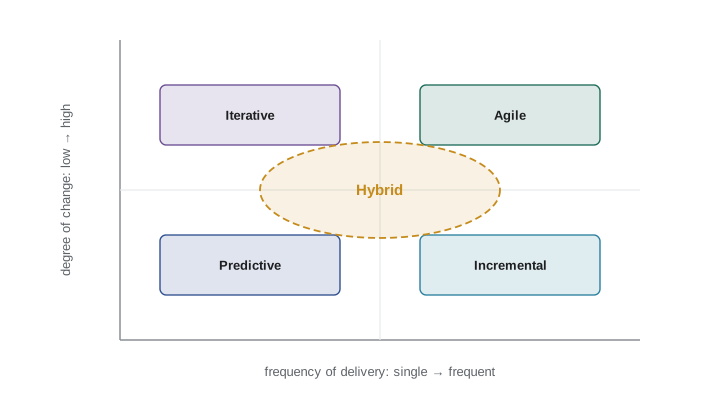
The second edition of PMI's Agile Practice Guide encourages thinking about this as a continuum rather than four boxes, and avoids treating "hybrid" as a single method. A team can be mostly predictive with a few adaptive practices, such as frequent stakeholder demonstrations, or mostly agile within a predictive governance frame, such as stage gates for funding. The exam often describes such mixtures and asks what to do next, so recognizing where on the spectrum a situation sits is a useful first step.
Factors that shape the choice
No single factor decides the approach. Several pull in different directions, and the project manager weighs them with the sponsor, the team and other stakeholders. The most important are the following.
| Factor | Favours predictive when... | Favours adaptive when... |
|---|---|---|
| Requirements certainty | Requirements are clear, stable and agreed | Requirements are unclear or likely to change |
| Cost and ease of change | Late change is expensive or impossible (concrete, regulatory filings) | Change is cheap (software, documents, campaigns) |
| Availability of feedback | Users can only judge the finished product | Users can try partial products early |
| Delivery options | The product only has value as a whole | Parts are useful on their own |
| Risk and safety | Rigorous upfront design and approval are required | Fast learning reduces the biggest risks |
| Organization and culture | Hierarchical approvals, fixed-price contracts, functional teams | Empowered, dedicated, cross-functional teams and supportive leaders |
| Stakeholder involvement | Stakeholders can only engage at milestones | A decision maker can engage frequently |
Regulation deserves a careful reading. Heavily regulated work is not automatically predictive. A medical device or a payroll system can be developed in iterations, provided the evidence that regulators require is produced along the way. What regulation does demand is traceability, documented verification and controlled releases, which agile teams can build into their definition of done. What makes something genuinely predictive is when a physical or legal step cannot be undone, such as pouring a slab or filing a permit application.
A simple suitability assessment
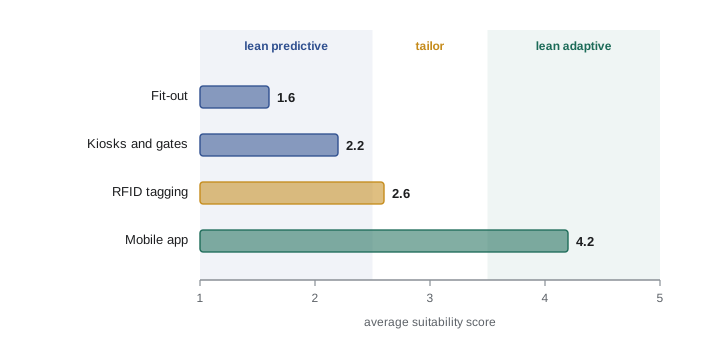
Many organizations use a short scored questionnaire, sometimes called a suitability filter, to start the conversation. Each component of the work is scored on a few criteria; low scores suggest predictive, high scores adaptive and middling scores a tailored mix. The scores are not a verdict. Their value lies in making assumptions visible so that the people involved can discuss them. The Project Compass team scored its four main components on five criteria, using 1 for conditions that favour predictive and 5 for conditions that favour adaptive.
# Suitability scores (1 = suits predictive, 5 = suits adaptive) for each Compass component.
criteria = ["Requirements clarity", "Cost of change late", "Feedback available early",
            "Regulatory and contract limits", "Team and stakeholder availability"]
scores = {
    "Fit-out":            [2, 1, 1, 1, 3],
    "RFID tagging":       [2, 2, 3, 3, 3],
    "Kiosks and gates":   [2, 2, 2, 2, 3],
    "Mobile app":         [5, 4, 5, 3, 4],
}
for part, s in scores.items():
    avg = sum(s) / len(s)
    lean = "adaptive" if avg >= 3.5 else "predictive" if avg <= 2.5 else "either; tailor"
print(f"{part:<18} average {avg:.1f} -> {lean}")Fit-out average 1.6 -> predictive RFID tagging average 2.6 -> either; tailor Kiosks and gates average 2.2 -> predictive Mobile app average 4.2 -> adaptive
The results match intuition but add nuance. The fit-out scores lowest: once walls are framed and conduit is run, changes are expensive, and nobody can use half a library. The app scores highest. RFID tagging lands in the middle: the work is well defined, but it can be delivered collection by collection with feedback after each, so the team tailored it as an incremental rollout with a predictive plan and short weekly reviews. Kiosks lean predictive because they are bought under a fixed-price incentive contract, with acceptance testing at delivery.
Complexity: why some work cannot be fully planned
A useful way to explain the choice to stakeholders uses two dimensions: how much agreement there is about what is needed, and how certain the technology or method is. When both are high, the work is simple and a plan works well. When both are low, the situation is chaotic and the first job is to stabilize it. In between lies complicated work, where experts can analyse the problem in advance, and complex work, where cause and effect are only clear in hindsight and the best strategy is to probe, sense and respond. Agile methods are designed for the complex zone.
The Cynefin framework, developed by Dave Snowden, uses similar categories (clear, complicated, complex, chaotic) and is often cited in agile literature. For the exam you do not need the details of any one model; you need the idea that the right approach depends on how predictable the work is, and that predictable and unpredictable parts can sit inside the same project.
Tailoring within a chosen approach
Choosing a life cycle is only the first tailoring decision. Within it, the team tailors processes, artifacts and ceremonies to the project's size, criticality and context. A small internal project might use a one-page charter and a simple Kanban board. A large, high-risk program might add architecture runways, formal risk reviews and integrated release planning across teams. The PMBOK Guide describes tailoring as selecting, adjusting and combining practices, and it expects the tailoring decisions themselves to be recorded and revisited.
| Element | Fit-out (predictive) | App (adaptive) | Shared |
|---|---|---|---|
| Scope | Scope statement, WBS, change control board | Product goal, product backlog, product owner orders | Release 1 must be live by the soft opening |
| Schedule | Critical path network, baseline | Two-week sprints, release burn-up | Integrated milestone plan |
| Cost | Bottom-up estimate, earned value | Team cost per sprint against the contract ceiling | One budget view for the board |
| Quality | Inspections and punch list | Definition of done, automated tests | Integration tests with the catalogue system |
| Reporting | Monthly EV report | Sprint review and burn-up | Monthly sponsor dashboard combining both |
The project manager's role in tailoring is to facilitate the decision, not to impose a favourite method. That means involving the team, which knows how the work actually gets done, the sponsor, who owns the risk appetite and funding model, and any governance bodies, such as a PMO that sets minimum reporting standards. Tailoring decisions are revisited at retrospectives and phase reviews; if the RFID rollout's weekly reviews add no value after the first two collections, the team can drop them.
Organizational readiness
An approach that suits the work may still fail if the organization is not ready for it. Agile approaches assume a product owner with real decision authority who is available to the team, team members dedicated to the work rather than spread across five projects, managers comfortable with teams planning their own work, and funding that can follow capacity rather than fixed scope. When these conditions are missing, the project manager can either adapt the approach, for example a hybrid with shorter planning horizons, or work with leaders to build readiness gradually, often starting with a pilot.
Project Compass faced exactly this. The library had never run an agile project, and its procurement rules assumed fixed-price contracts. The project manager worked with the sponsor and the purchasing office to justify a time and materials contract with a ceiling for the app (PMP-131, lesson 8), and arranged for the digital services manager, Amara Osei, to spend most of her week as product owner. Without those two changes, the app would probably have been forced into a fixed specification written before anyone had seen a prototype.
Transitioning between approaches
Delivery approaches can change during a project. A product might be explored iteratively through prototypes, then built incrementally, and finally moved into a stable, predictive maintenance phase. A project that started predictively may switch to iterations when it becomes clear that requirements are far less stable than assumed. Such changes should be explicit decisions, recorded with their reasons and communicated to stakeholders, because they change how progress is measured and how decisions are made.
Worked problem
Choosing for a new component
Midway through Project Compass, the board asks for a digital signage system in the branch to display events and wayfinding. The content will change often, the screens and mounting are standard products, and the branch manager has strong but vague ideas about what the screens should show. How should the project manager propose to deliver it?
Show solution
- Split the component: hardware (screens, mounts, wiring) and content (layouts, feeds, schedules).
- Hardware has clear requirements and depends on the fit-out's electrical work, so it fits the predictive plan, with a change request to add it to the fit-out scope and schedule.
- Content is uncertain, cheap to change and easy to test with staff and patrons, so it suits short iterations, perhaps with the app team or a small content team using a Kanban board.
- Define the interface: the content system must work with the chosen screens, so the screen specification is fixed early.
Answer: A hybrid: buy and install the hardware predictively through change control, and develop the content iteratively with frequent feedback, linked by an early interface decision.
Common mistakes
MistakeChoosing one approach for the whole project out of habit.
InsteadAssess each component and tailor; hybrids are normal.
MistakeAssuming regulated work must be predictive.
InsteadAdaptive work can meet regulation if evidence and traceability are built in.
MistakeTreating a suitability score as a decision.
InsteadUse the scores to surface assumptions and discuss them with stakeholders.
MistakeImposing a method without involving the team or sponsor.
InsteadFacilitate tailoring with the people who do the work and own the risk.
MistakeIgnoring organizational readiness.
InsteadCheck product owner availability, team dedication, contracts and funding before committing to agile.
Summary and key terms
- Life cycles range from predictive through iterative and incremental to adaptive; hybrids mix them.
- Requirements certainty, cost of change, feedback, delivery options, risk, culture and stakeholder availability shape the choice.
- Suitability assessments make assumptions visible; they do not decide by themselves.
- Complex work, where cause and effect appear only in hindsight, suits adaptive approaches.
- Tailoring continues within the chosen approach and is recorded and revisited.
- Organizational readiness (product owner, dedicated team, contracts, funding) can limit agile adoption.
- Approaches can change during a project, as an explicit decision.
- Predictive life cycle
- An approach in which scope, time and cost are determined early and changes are carefully managed.
- Iterative life cycle
- An approach that refines the product through repeated cycles of building and feedback.
- Incremental life cycle
- An approach that delivers the product in usable pieces that build on one another.
- Adaptive life cycle
- An approach that is both iterative and incremental, with requirements elaborated each iteration.
- Hybrid approach
- A combination of predictive and adaptive elements chosen to suit different parts or phases of the work.
- Tailoring
- Selecting, adjusting and combining approaches, processes and artifacts to fit the project.
- Suitability filter
- A scored assessment used to discuss whether work suits predictive, adaptive or hybrid delivery.
Practice problems
Work each problem on paper first, then reveal the answer to check.
What distinguishes an incremental life cycle from an iterative one?
Show answer
Incremental delivers usable pieces in sequence; iterative refines the solution through repeated cycles, possibly with one final delivery.
Why did the fit-out score low on suitability for agile?
Show answer
Late changes are expensive and the product has no value until complete.
Can regulated work be delivered adaptively?
Show answer
Yes, if required evidence, traceability and controlled releases are built in.
In which complexity zone do agile methods work best?
Show answer
The complex zone.
Who should be involved in tailoring decisions?
Show answer
The team, the sponsor and relevant governance bodies, facilitated by the project manager.
Name two signs of organizational readiness for agile.
Show answer
An available, empowered product owner and dedicated team members (also flexible contracts and funding).
How was RFID tagging tailored on Project Compass?
Show answer
As an incremental rollout under a predictive plan, with short weekly reviews.
What should happen when a project changes its delivery approach midway?
Show answer
Record the decision and reasons, and communicate how progress and decisions will now work.
What is the purpose of a suitability score?
Show answer
To make assumptions visible and support discussion.
How should a component with fixed hardware and uncertain content be delivered?
Show answer
Split it: hardware predictively, content iteratively, with an early interface decision.
Lesson quiz · 5 questions
Score 60% or more to complete this lesson.
Create a free account to save your progress, take quizzes and earn a certificate.