
PMP-140 · Lesson 3 of 12 · 26 min
Scrum: accountabilities and commitments
Scrum is the most widely used agile framework, and the PMP exam assumes you know it well. The definitive description is the Scrum Guide, written by Ken Schwaber and Jeff Sutherland. Its current version dates from November 2020 and is deliberately short. In June 2025, Jeff Sutherland and co-authors published a Scrum Guide Expansion Pack with optional guidance on product strategy, outcomes and AI; it supplements the 2020 guide rather than replacing it. This lesson explains who is accountable for what in Scrum and the three commitments that keep the work focused. Lesson 4 covers the events and artifacts.
Scrum calls itself a lightweight framework, not a method. It defines a small number of roles, events, artifacts and rules, and leaves the rest (how to write requirements, which engineering practices to use, how to estimate) to the team. That is why you will see Scrum teams that look quite different from one another, and why exam answers that add heavy process to Scrum are usually wrong.
The Scrum Team
A Scrum Team is a small, cohesive unit with one product owner, one Scrum Master and the developers. The Scrum Guide describes it as typically ten people or fewer, because smaller teams communicate better and are more productive. There are no sub-teams and no hierarchy inside the team; everyone focuses on the same objective, the product goal. The team is cross-functional, meaning it has all the skills needed to create a valuable increment each sprint, and self-managing, meaning it decides internally who does what, when and how.
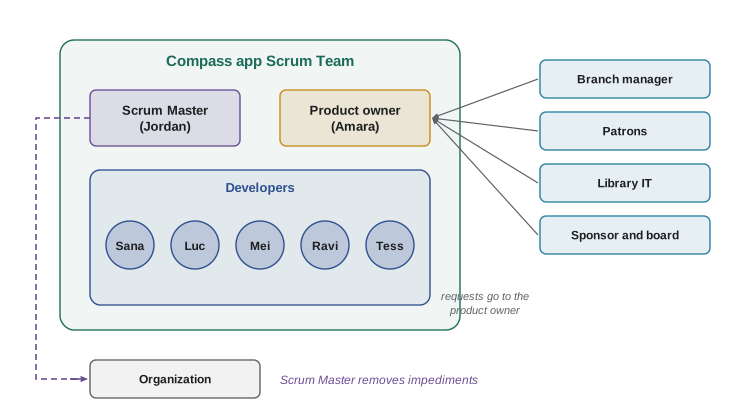
The Compass app Scrum Team has seven people. Amara Osei, the library's digital services manager, is the product owner. Jordan Reyes, an experienced agile lead from the library's IT department, is the Scrum Master. Five developers come from the development firm under contract: Sana and Luc build the app, Mei handles the connection to the library's catalogue system, Ravi focuses on testing and automation, and Tess on design and accessibility. Together they can take a story from idea to a tested, releasable feature without handing it to another group.
The product owner
The product owner is accountable for maximizing the value of the product resulting from the team's work. In practice that means developing and communicating the product goal, creating and clearly expressing product backlog items, ordering them, and making sure the backlog is transparent, visible and understood. The product owner may delegate some of this work, for example letting developers write stories, but remains accountable. The product owner is one person, not a committee, although that person represents the needs of many stakeholders.
For the product owner to succeed, the whole organization must respect their decisions. Those decisions show up in the content and order of the backlog and in the increment shown at the sprint review. If the branch manager wants a feature, she persuades Amara; she does not go directly to the developers. An exam scenario in which a senior stakeholder tells developers to drop their sprint work for an urgent request usually has the same answer: redirect the request to the product owner.
| Product owner does | Product owner does not |
|---|---|
| Owns and communicates the product goal | Tell developers how to build an item |
| Orders the product backlog by value, risk and dependencies | Assign tasks to individual developers |
| Clarifies items and acceptance criteria with developers | Change the sprint goal mid-sprint without the team |
| Accepts or rejects work against the definition of done and acceptance criteria | Hand off accountability to a committee of stakeholders |
| Engages stakeholders and decides what to build next | Act as a proxy with no real authority (an anti-pattern) |
The Scrum Master
The Scrum Master is accountable for establishing Scrum as the Scrum Guide defines it, by helping everyone understand Scrum theory and practice, both within the team and in the organization, and for the team's effectiveness. The Scrum Guide describes Scrum Masters as true leaders who serve the team and the larger organization. Their work has three directions: serving the team (coaching self-management and cross-functionality, helping it focus on high-value increments, causing impediments to be removed, making sure events take place and are productive), serving the product owner (techniques for backlog management and product goal definition, facilitating stakeholder collaboration) and serving the organization (leading and coaching Scrum adoption, removing barriers between stakeholders and teams).
Note what the Scrum Master is not: a project manager who assigns work, a team lead who approves designs, or a secretary who runs meetings for others. Jordan does not tell Sana which story to pick up. When Mei is blocked because the library's catalogue vendor has not issued test credentials, Jordan does not write the code around it; he chases the vendor contact, escalates to the library's IT manager when needed and keeps the team informed. When the daily scrum drifts into a design debate, he helps the team notice and move the discussion to a smaller group afterwards.
The PMP exam often uses the generic term "agile lead" or "team facilitator" for this servant-leader role, and sometimes describes a project manager acting in it. The behaviours it rewards are the same: facilitate, coach, protect the team from disruption, remove impediments and let the team decide how to do its work.
The developers
Developers are the people in the Scrum Team who are committed to creating any aspect of a usable increment each sprint. The word includes testers, designers, analysts and writers, not just programmers. Developers are accountable for creating a plan for the sprint (the sprint backlog), instilling quality by adhering to the definition of done, adapting their plan each day toward the sprint goal and holding each other accountable as professionals. Scrum recognizes no titles among developers, regardless of the work each person does, which encourages people to help one another across specialties.
Cross-functional teams often grow "T-shaped" people: deep skill in one area and enough breadth to help in others. When Ravi's test automation backlog grows, Luc pairs with him for a day; when Tess is away, Sana can make small layout changes using the design system. That flexibility reduces the waiting that occurs when every task needs one specialist.
Scrum and the project manager
The Scrum Guide does not mention a project manager. That does not mean project managers disappear in organizations that use Scrum. In a hybrid project like Compass, the project manager integrates the app with the fit-out, technology and transition work, manages the contract with the development firm, reports to the board, manages project-level risks and helps the product owner with stakeholders. Inside the Scrum Team, they respect the team's self-management and the product owner's authority over the backlog.
| Responsibility | Who holds it on the Compass app |
|---|---|
| What to build and in what order | Product owner (Amara) |
| How to build it and who does which task | Developers |
| Effective use of Scrum and removing impediments | Scrum Master (Jordan) |
| Integration with the rest of Compass, contract, budget reporting and project risk | Project manager |
| Funding, release date and overall priorities across the project | Sponsor and project board |
In smaller organizations, one person may hold both the Scrum Master and project manager roles. That can work, but the combination carries a risk: the habits of a project manager who assigns tasks and tracks individuals can undermine self-management. If you are in that position, be explicit about which hat you are wearing, and lean toward facilitation inside the team.
The three commitments
Each Scrum artifact has a commitment that gives it focus and makes progress measurable. The product backlog commits to the product goal; the sprint backlog commits to the sprint goal; the increment commits to the definition of done.
| Artifact | Commitment | What it is | Compass example |
|---|---|---|---|
| Product backlog | Product goal | A long-term objective for the product that the backlog works toward; the team pursues one product goal at a time | Patrons at Eastgate can find, reserve and pick up items from their phones by the soft opening |
| Sprint backlog | Sprint goal | The single objective for the sprint, chosen at sprint planning, giving flexibility in how it is met | Sprint 7: patrons can see their place in the holds queue and get notified when an item is ready |
| Increment | Definition of done | The formal description of the quality an increment must meet; work that does not meet it is not part of the increment | Code reviewed, automated tests pass, WCAG 2.1 AA checks pass, works against the catalogue test system, release notes updated |
The definition of done is shared by everyone who works on the product. If the organization has a standard for done, teams follow it at a minimum; if several teams work on one product, they share a definition of done. When a backlog item does not meet it, the item is not released or shown as complete at the sprint review; it goes back to the product backlog. Lesson 7 distinguishes the definition of done, which applies to all items, from acceptance criteria, which are specific to each item.
The Scrum values
Scrum's success depends on people living five values: commitment, focus, openness, respect and courage. Team members commit to achieving their goals and supporting one another; they focus on the sprint's work; they are open about the work and its challenges; they respect each other as capable, independent people; and they have the courage to do the right thing and work on tough problems. The values are not decorative. A team that hides problems (no openness) or never questions the product owner's priorities (no courage) loses the transparency that empiricism needs.
Worked problem
Who should act?
Three days into sprint 7, the library's head of IT, Martin, emails Sana directly asking her to stop sprint work and build a quick export of app usage data for a council presentation next week. Sana is unsure what to do and mentions it at the daily scrum.
Show solution
- Developers take work from the sprint backlog, not from individual stakeholders; Martin's request has bypassed the product owner.
- Jordan, as Scrum Master, should coach Sana and the team to route the request to the product owner, and may explain the process to Martin.
- Amara, as product owner, decides how valuable the export is compared with current work. If it is urgent and small, she may discuss with the developers whether it fits without endangering the sprint goal; otherwise it goes into the product backlog for a later sprint.
- If the request makes the sprint goal obsolete, only the product owner can cancel the sprint, which is rare.
Answer: Redirect Martin's request to the product owner, who weighs it against the sprint goal and the backlog; the Scrum Master coaches the team and helps Martin understand how requests flow.
Common Scrum anti-patterns
Exam scenarios often describe a team that uses Scrum's vocabulary while breaking its intent. Recognizing the pattern points to the answer. A proxy product owner who must check every decision with someone else slows the team and blurs accountability; the fix is to give the real decision maker the role or delegate genuine authority. A Scrum Master who acts as a task manager undermines self-management; the fix is coaching and stepping back. A "hardening sprint" at the end of every release, used to do the testing the team skipped, signals a weak definition of done; the fix is to build that work into every sprint. And a team that changes its members every few sprints loses the stability that makes forecasting and trust possible.
| Anti-pattern | Why it hurts | Better practice |
|---|---|---|
| Proxy product owner without authority | Decisions wait; accountability is unclear | Empower one real decision maker |
| Scrum Master as task assigner | Undermines self-management | Coach, facilitate and remove impediments |
| Regular hardening sprints | Hides undone work and technical debt | Strengthen the definition of done |
| Rotating team members every sprint | Velocity and trust never stabilize | Keep teams long-lived and stable |
Common mistakes
MistakeTreating the Scrum Master as the team boss who assigns tasks.
InsteadThe Scrum Master is a servant leader who coaches, facilitates and removes impediments.
MistakeLetting stakeholders give work directly to developers.
InsteadRequests go through the product owner, who orders the backlog.
MistakeHaving a committee act as product owner.
InsteadThe product owner is one accountable person who represents many stakeholders.
MistakeSplitting the Scrum Team into separate design, build and test sub-teams.
InsteadScrum teams are cross-functional with no sub-teams.
MistakeCounting work as done when it fails the definition of done.
InsteadUnfinished items go back to the product backlog and are not part of the increment.
Summary and key terms
- Scrum is a lightweight framework defined by the 2020 Scrum Guide; a 2025 expansion pack adds optional guidance.
- A Scrum Team has one product owner, one Scrum Master and developers, typically ten or fewer, cross-functional and self-managing.
- The product owner maximizes value and owns the product goal and the ordering of the backlog.
- The Scrum Master establishes Scrum, coaches and removes impediments as a servant leader.
- Developers plan the sprint, build quality in and hold each other accountable.
- Commitments: product goal for the product backlog, sprint goal for the sprint backlog, definition of done for the increment.
- Values: commitment, focus, openness, respect and courage.
- Scrum Team
- One product owner, one Scrum Master and developers working toward one product goal.
- Product owner
- The person accountable for maximizing product value and ordering the product backlog.
- Scrum Master
- The person accountable for establishing Scrum and for the team's effectiveness, acting as a servant leader.
- Developers
- Scrum Team members who create the usable increment each sprint.
- Product goal
- The long-term objective for the product, the commitment of the product backlog.
- Sprint goal
- The single objective for a sprint, the commitment of the sprint backlog.
- Definition of done
- The formal description of the quality required for an increment.
- Cross-functional
- Having all the skills needed to create value each sprint.
Practice problems
Work each problem on paper first, then reveal the answer to check.
Who orders the product backlog?
Show answer
The product owner.
Who decides how many items to pull into a sprint and how to build them?
Show answer
The developers.
What is the typical maximum size of a Scrum Team?
Show answer
Ten people or fewer.
Which commitment belongs to the increment?
Show answer
The definition of done.
A stakeholder asks a developer directly for new work. What should happen?
Show answer
Redirect the request to the product owner.
Name the five Scrum values.
Show answer
Commitment, focus, openness, respect and courage.
Does the Scrum Guide define a project manager role?
Show answer
No; in hybrid projects a project manager often integrates the Scrum Team with the wider project.
What happens to an item that does not meet the definition of done by the end of the sprint?
Show answer
It returns to the product backlog and is not part of the increment.
What does a Scrum Master do about an impediment outside the team?
Show answer
Causes it to be removed, for example by escalating or working with the organization.
Is the Scrum Guide Expansion Pack mandatory?
Show answer
No; it is optional guidance that supplements the 2020 Scrum Guide.
Lesson quiz · 5 questions
Score 60% or more to complete this lesson.
Create a free account to save your progress, take quizzes and earn a certificate.