
PMP-140 · Lesson 12 of 12 · 25 min
Hybrid delivery and agile exam questions
Project Compass was hybrid from the start: a predictive fit-out, predictive and incremental technology work, an adaptive app and a transition to operations. This last lesson pulls the course together by looking at how the parts were governed, contracted, reported and integrated, and how the app reached the soft opening. It ends with habits for answering the agile and hybrid questions that make up most of the 2026 PMP exam.
Common hybrid patterns
Hybrid projects come in several recurring shapes. In the first, a predictive project contains one or more adaptive components, as Compass does. In the second, adaptive teams work inside predictive governance: the organization funds work in stages with gates, while teams deliver in sprints between gates. In the third, the approach changes over time, for example iterative discovery and prototyping, then agile development, then a predictive rollout to many sites. In the fourth, agile practices are used selectively within a predictive project, such as daily stand-ups and visual boards on a construction site or iterative reviews of a design.
| Pattern | Description | Watch out for |
|---|---|---|
| Predictive project with adaptive components | Fixed parts planned with baselines; uncertain parts run in iterations | Interfaces and shared milestones between the parts |
| Agile teams inside stage-gate governance | Gates for funding and risk review; sprints between gates | Gate criteria that demand fixed detailed scope |
| Sequential change of approach | Discovery, then agile build, then predictive rollout | Explicit transition decisions and changing metrics |
| Selective agile practices | Stand-ups, boards or iterative reviews in predictive work | Using the ceremonies without the mindset |
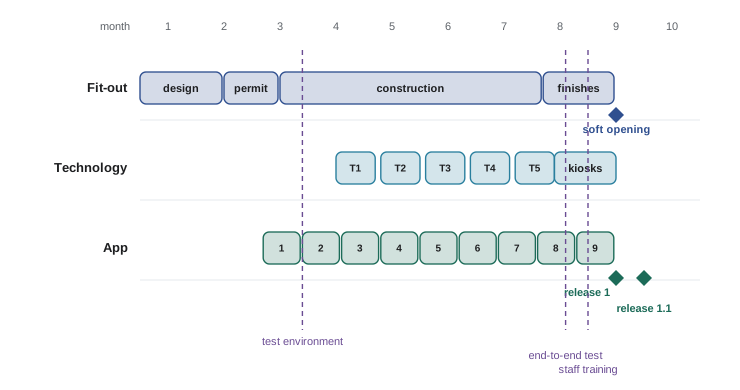
Integrating the parts
The hardest part of a hybrid project is usually the seams. The predictive and adaptive parts run at different rhythms and measure progress differently, yet they depend on each other. The Compass project manager identified three integration points early and put them on both plans: the catalogue test environment had to be ready before app sprint 3; the end-to-end test of kiosks, gates and app against the live catalogue had to happen after substantial completion and before the soft opening; and staff training needed a stable build of release 1 two weeks before opening. Each integration point had an owner, a date and acceptance criteria.
Integration also needs shared rhythms. The project manager attended app sprint reviews to see the product and hear stakeholder feedback, and invited the product owner to the fortnightly construction coordination meeting. A monthly integrated planning session, where leads from fit-out, technology and app looked at the next two months together, caught several dependencies, including the need for wireless access points to be live before app testing in the branch.
Governance and funding
Agile work challenges governance designed for predictive projects. Stage gates that require a fully detailed scope before funding, or change control boards that must approve every backlog change, fight against adaptive delivery. Useful adaptations include gates based on demonstrated increments and outcomes rather than documents, funding a team's capacity for a period rather than a fixed scope, and delegating backlog decisions to the product owner within agreed boundaries such as the product goal and budget.
On Compass, the board approved the app as a capacity budget: one team for up to ten sprints, within the time and materials ceiling of $210,000. The change control board continued to control changes to the project scope baseline, the overall budget, the opening date and the contract, but changes within the app backlog were the product owner's decisions. When the board later considered adding a second community room, a change to the fit-out, that went through change control (PMP-131, lesson 11); when Amara moved renewals to release 1.1, it did not.
| Change | Who decides on Compass | Mechanism |
|---|---|---|
| Reorder app stories or move a story between app releases | Product owner | Product backlog |
| Change the app's product goal or capacity budget | Sponsor and board | Change request |
| Change the fit-out scope or opening date | Change control board | Integrated change control |
| Change the app contract ceiling | Library purchasing and board | Contract change order |
Contracts for agile work
Fixed-price, fixed-scope contracts sit uneasily with adaptive delivery, because they assume scope can be defined in advance. Common alternatives include time and materials with a not-to-exceed ceiling, which Compass used; fixed price per sprint or per increment, with scope chosen sprint by sprint; capped time and materials with shared savings; and graduated fixed-price arrangements. Jeff Sutherland described two clauses sometimes added to agile contracts: "change for free", where the customer can swap backlog items of equal size without cost, and "money for nothing", where the customer can stop early once enough value has been delivered and pay a fraction of the remaining value.
Whatever the model, agile contracts work best when they focus on collaboration and transparency: frequent reviews, shared access to the backlog and burn-up, clear definitions of done and acceptance, and mechanisms for changing scope without renegotiating the whole contract. The Compass contract required the firm to provide sprint reports and attend reviews, and made the library's acceptance depend on the definition of done.
Risk in agile work
Agile approaches manage many risks through their structure: short iterations limit how far a team can go in the wrong direction, frequent reviews surface misunderstandings, and working increments reduce the risk of ending with nothing. Teams also manage risk explicitly. A risk-adjusted backlog places risk-reduction work, such as spikes and early integration, high in the order; the WSJF calculation in lesson 8 did this by scoring risk reduction. Risks that teams cannot handle themselves, such as vendor delays or funding, go to the project-level risk register, where the project manager manages them with the sponsor.
One status view
A hybrid project still needs a single, honest picture for the sponsor. The Compass monthly board pack combined earned value for the fit-out and technology with the release burn-up for the app, a risk summary and the integration milestones. The code reproduces the month 6 headline figures.
# One status view for a hybrid project: earned value for the predictive parts,
# release burn-up for the app. Money in thousands of dollars.
pv, ev, ac = 1440, 1290, 1400
print(f"Fit-out and technology: SPI {ev / pv:.2f}, CPI {ev / ac:.2f}")
done, scope, velocity, sprints_left = 128, 190, 21.3, 3
need = (scope - done) / sprints_left
print(f"App release 1: {scope - done} points left, needs {need:.1f} per sprint vs velocity {velocity}")
print("App release 1 on track" if velocity >= need else "App release 1 at risk")Fit-out and technology: SPI 0.90, CPI 0.92 App release 1: 62 points left, needs 20.7 per sprint vs velocity 21.3 App release 1 on track
The predictive parts were behind schedule and over cost (SPI 0.90, CPI 0.92, as PMP-130 and PMP-131 analysed), while the app looked on track on averages. Lesson 9 showed why the app's "on track" needed a closer look: with variability and scope growth, the chance of finishing all of release 1 in three sprints was only about one in five, which led the product owner to move renewals to release 1.1. A good status view shows both kinds of evidence side by side without forcing them into one misleading index.
How release 1 landed
Release 1 (search, holds with queue position and notifications by email, account management, accessibility to WCAG 2.1 AA) was deployed behind a feature flag a week before the soft opening, tested by staff in the branch and switched on for patrons on opening day. Renewals followed in release 1.1 two weeks later, as forecast. In the first two months, about a third of Eastgate holds were placed through the app, short of the 40 % target, and task completion for sign-in was low. The team's first post-launch sprint focused on simplifying sign-in, guided by those outcome measures. Release 2, room booking and event sign-up, moved into the library's ongoing product work after the project closed, with the app team funded from the operating budget.
Transition is part of hybrid delivery too. The project's closure (PMP-131, lesson 12) handed the app to a product team rather than to a maintenance group, with the product owner, backlog and definition of done carrying on. That choice reflected the app's nature: a product that would keep evolving, not a deliverable that would be finished.
Answering agile and hybrid exam questions
Because about 60 % of the exam draws on adaptive and hybrid approaches, it pays to have a set of habits for these questions. The PMP exam does not test one framework's rulebook; it tests judgement consistent with agile values and PMI's guidance. The patterns below summarize the course.
| When the question describes... | The best answer usually... |
|---|---|
| A stakeholder giving work directly to developers | Redirects the request to the product owner and the backlog |
| A team that seems slow or stuck | Looks for impediments and causes; coaches; does not micromanage |
| A new or changed requirement | Adds it to the backlog for the product owner to order; protects the current iteration |
| Conflict within the team | Lets the team resolve low-level conflict; facilitates when it escalates |
| A request for status | Points to working increments and information radiators |
| A request for a fixed date and scope | Explains trade-offs, gives probabilistic forecasts and lets scope flex |
| Pressure to skip retrospectives or reviews | Keeps them, perhaps shortened, and addresses the real constraint |
| A hybrid project | Tailors each part, defines integration points and gives one honest status view |
Two cautions complete the picture. First, watch the words "first" and "next": understanding the situation (talking to the product owner, reviewing the board, asking the team) often comes before acting. Second, the most agile-sounding option is not always right. If a project has a fixed regulatory deadline, a contract or safety constraints, the best answer respects them while applying agile practices where they fit. Tailoring, not ideology, is what PMI rewards.
Worked problem
An integration problem
Two weeks before the soft opening, the end-to-end test shows that the kiosks and the app disagree about whether some items are on hold, because the kiosks read hold status from a nightly file while the app reads it live. The fit-out team says it is an app problem; the app developers say it is a kiosk problem. What should the project manager do?
Show solution
- Treat it as an integration issue owned at project level, not as a dispute between teams; log it as an issue with an owner and a date.
- Bring the kiosk supplier, the app team and library IT together to agree the cause and options, such as moving the kiosks to the live interface or adding a refresh.
- Have the product owner judge the impact on patrons and, if an app change is needed, order it at the top of the backlog; any kiosk change goes through the kiosk contract and change control.
- Report the issue and the chosen fix in the board pack, and add a lesson about agreeing data interfaces earlier.
Answer: Own the issue at project level, bring the parties together to fix the interface, route changes through the backlog or change control as appropriate, and report transparently.
Common mistakes
MistakeRunning predictive and adaptive parts as unrelated projects.
InsteadDefine integration points with owners, dates and acceptance criteria, and share rhythms.
MistakeRequiring change control board approval for every backlog change.
InsteadDelegate backlog changes to the product owner within agreed boundaries.
MistakeUsing fixed-price, fixed-scope contracts for uncertain work.
InsteadUse time and materials with a ceiling, price per increment or similar collaborative models.
MistakeCombining all status into one index that hides differences.
InsteadShow earned value and burn-up side by side with risks and milestones.
MistakeChoosing the most agile-sounding answer automatically.
InsteadRespect real constraints and tailor.
Summary and key terms
- Hybrid patterns include adaptive components in predictive projects, agile teams in stage-gate governance, sequential approaches and selective practices.
- Integration points need owners, dates and acceptance criteria; shared rhythms catch dependencies.
- Governance can fund capacity and delegate backlog decisions while controlling baselines, budgets and contracts.
- Agile-friendly contracts include time and materials with a ceiling and price per increment.
- Risk-adjusted backlogs and short cycles manage much agile risk; project-level risks stay with the project manager.
- One status view shows earned value and burn-up side by side.
- Exam habits: product owner owns the backlog, servant leadership, protect iterations, transparency, probabilistic forecasts, tailoring.
- Integration point
- A planned point where predictive and adaptive parts of a project must come together.
- Capacity funding
- Funding a team for a period rather than for a fixed scope.
- Stage gate
- A decision point at which a project is reviewed before continuing.
- Risk-adjusted backlog
- A backlog that places risk-reduction work high in the order.
- Money for nothing
- A contract clause letting the customer stop early once enough value is delivered.
- Change for free
- A contract clause letting the customer swap backlog items of equal size without cost.
- Product team
- A long-lived team that continues to develop a product after a project ends.
Practice problems
Work each problem on paper first, then reveal the answer to check.
Name two common hybrid patterns.
Show answer
Any two: adaptive components in a predictive project; agile teams in stage-gate governance; sequential approaches; selective agile practices.
What should every integration point have?
Show answer
An owner, a date and acceptance criteria.
Who decided to move renewals to release 1.1, and why was no change request needed?
Show answer
The product owner; it was a backlog change within the app's goal and budget.
What was the app's contract model?
Show answer
Time and materials with a $210,000 ceiling.
What is a risk-adjusted backlog?
Show answer
A backlog that orders risk-reduction work high.
What did the month 6 board pack show for the predictive parts?
Show answer
SPI 0.90 and CPI 0.92.
How was release 1 deployed before opening?
Show answer
Behind a feature flag, tested by staff, then switched on at opening.
What share of Eastgate holds came through the app in the first two months?
Show answer
About a third, short of the 40 % target.
Who owns a cross-team integration issue in a hybrid project?
Show answer
The project manager, at project level.
Is the most agile-sounding answer always correct on the exam?
Show answer
No; the best answer tailors to real constraints.
Lesson quiz · 5 questions
Score 60% or more to complete this lesson.
Create a free account to save your progress, take quizzes and earn a certificate.