
PMP-120 · Lesson 12 of 12 · 33 min
Capstone: leading a troubled project team
This capstone brings the course together in an extended case. You take over a project team that is in trouble: missed dates, low morale, conflict and unclear roles. Working through the case, you will diagnose the team's problems, plan your first weeks, apply the tools from lessons 1 to 11, and then turn to exam strategy for People domain questions. The case and the organization are invented for teaching purposes; any resemblance to real organizations is coincidental.
The case: Project Beacon
Northvale Regional Health is a fictional Canadian health authority. Fourteen months ago it launched Project Beacon to replace its patient referral system with a new platform that lets family doctors send referrals electronically to specialists and track their status. The project has a budget of $6.8 million, a hybrid approach (predictive for infrastructure and integration, Scrum for the referral application) and a team of 16: nine Northvale employees in a matrix arrangement, five contractors from a systems integrator, and two staff from the software vendor, who work from Ireland.
The original project manager left suddenly last month. The sponsor, the vice-president of clinical operations, has asked you to take over. In your first conversations you learn the following:
- The go-live date has slipped twice. The last three sprints delivered on average 60 % of committed work.
- The Scrum team and the integration team blame each other for defects. The integration lead, Ruth, calls the developers "cowboys"; the lead developer, Sanjay, calls the integration team "the department of no".
- Two experienced Northvale analysts are spending more and more time on their regular jobs; their functional manager says the project "doesn't seem to be going anywhere".
- The vendor staff in Ireland say they are rarely invited to decisions and learn about changes from defect reports.
- There is no team charter. Daily stand-ups have become 40-minute status meetings run by the previous project manager, who assigned tasks to individuals.
- Status reports to the steering committee have been green for months.
- A clinical informatics nurse, Mei, who knows the referral workflow best, has told the sponsor she is thinking of leaving the project.
- The sponsor wants a new go-live date within a month and says, "I need this team to start acting like a team."
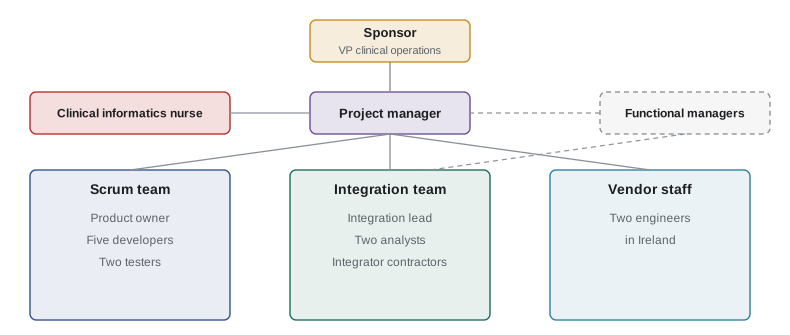
Step 1: Diagnose before acting
The temptation when taking over a troubled project is to act immediately: announce a new plan, reorganize the team, crack down on the conflict. Resist it. A new leader's first job is to understand, and the team will judge you by whether you listen. The ECO enablers "solve problems" and "break down situations to identify the root cause" apply here.
Worked problem
A diagnostic plan for the first two weeks
Plan how you will diagnose Project Beacon's team problems in your first two weeks.
Show solution
- One-to-one conversations with every team member, including vendor staff by video, asking: What is going well? What is getting in the way? What would you change? What do you need from me?
- Meetings with the sponsor, product owner and functional managers to understand expectations, constraints and priorities.
- A review of data: sprint history, defect trends, the risk and issue logs, and the actual allocation of each Northvale team member.
- Observation: attend stand-ups, reviews and integration meetings without changing anything yet, noting patterns.
- Synthesis: group findings by theme and test them with a few team members before acting.
Answer: Listen widely, check data, observe and synthesize before changing things. This builds trust and avoids fixing the wrong problem.
Suppose your diagnosis produces the following themes, mapped to the lessons in this course.
| Finding | Underlying issue | Relevant lessons |
|---|---|---|
| Blame between Scrum and integration teams | Task conflict escalated to relationship conflict (contest level); unclear interfaces and decision rights | Lessons 4 and 8 |
| Analysts drifting away | Unclear priorities with functional managers; low expectancy that the project will succeed | Lessons 3 and 6 |
| Vendor staff excluded | Distributed team practices missing; proximity bias | Lesson 10 |
| Stand-ups as status meetings with assigned tasks | Directive style imposed on a team meant to self-organize | Lesson 2 |
| Green status reports, then slips | Low psychological safety | Lesson 5 |
| Key expert considering leaving | Motivation, recognition and possibly overload; single point of failure | Lessons 3, 6 and 7 |
| No team charter; no shared vision | Missing foundation for collaboration | Lessons 1 and 4 |
Step 2: Rebuild the foundation
Several problems trace back to missing foundations: no shared vision, no team charter, no clear decision rights. Lencioni's model suggests starting with trust. A practical sequence is to reconnect the team to purpose, agree how it will work together, and then tackle specific conflicts and performance issues within that framework.
Worked problem
A team reset workshop
Design a one-day reset workshop for the whole Beacon team, including the vendor staff.
Show solution
- Logistics: bring the vendor staff on site for the day if budget allows; otherwise use a hybrid format with everyone on their own device and timing that fits Ireland.
- Purpose (morning): invite a family doctor and a specialist's office manager to describe how lost and delayed referrals affect patients. Draft a project vision together.
- Honest review: an anonymous "start, stop, continue" exercise about how the team works, presented without attribution.
- Team charter (late morning): values, communication agreements including response times across time zones, decision rights between the Scrum and integration teams (a delegation board), and a conflict process.
- Interfaces (afternoon): the Scrum and integration teams jointly map the hand-offs that cause defects and agree a definition of done that includes integration tests.
- Close: agree three priorities for the next month and how progress will be visible.
Answer: Reconnect with purpose, create safety for honest feedback, agree the team charter and decision rights, and fix the interface that drives the conflict.
Step 3: Address the conflict between leads
The Ruth and Sanjay conflict has reached Leas's contest level: generalizations, labels and win-lose language. At this level the project manager must step in. A useful approach is to meet each lead privately first, then together.
- Privately with each: listen to their perspective, acknowledge frustrations and ask what they need. Describe the impact of the labels on the team, using SBI.
- Together: set ground rules, define the problem jointly ("defects found late at integration are costing both teams time"), explore interests (Ruth needs stable, tested interfaces; Sanjay needs fast feedback and fewer approval delays) and generate options.
- Agree: for example, integration tests run automatically on every build; a joint interface review at sprint planning; a single shared defect triage meeting twice a week; both leads model respectful language and correct each other's teams if labels reappear.
- Follow up after two sprints and recognize progress publicly.
Step 4: Restore the team's operating rhythm
The stand-up has turned into a status meeting with tasks assigned by the project manager, which undermines self-organization and wastes time. A servant leadership approach returns ownership to the team.
| Before | After |
|---|---|
| 40-minute stand-up run by the project manager | 15-minute stand-up run by the team, focused on the sprint goal and impediments |
| Project manager assigns tasks | Team members pull work from the sprint backlog |
| Status reported to the project manager | Status visible on the shared board; written updates for the vendor time zone |
| Impediments mentioned but not tracked | Impediment list owned by the project manager, reviewed daily |
| Steering reports built from optimistic estimates | Reports drawn from board data, with candid risks |
Restoring psychological safety means changing how bad news is received. In your first steering committee meeting, you present an honest status, amber or red where appropriate, with a recovery plan. Telling the team you did this, and that you would rather hear bad news early, makes it safer for them to report problems.
Step 5: Secure resources and retain key people
The analysts' drift and Mei's possible departure threaten the project. Both call for direct action.
- With the functional manager: meet with data on the analysts' actual allocation and the impact on the critical path. Explain the recovery plan to raise their confidence that the project is now going somewhere. Agree allocations in writing and, if needed, ask the sponsor to help resolve competing priorities.
- With Mei: a private conversation to understand her concerns. Perhaps she is overloaded, her expertise is being ignored, or she sees no development path. Possible responses include reducing her load by pairing her with a junior analyst, which also reduces the single point of failure, giving her a formal role in design decisions, recognizing her contribution visibly and arranging a mentor in clinical informatics.
- With the vendor staff: include them in decisions within the time-zone overlap, add them to the team channel and decision log and arrange regular one-to-ones.
Worked problem
Checking the recovery plan with expectancy theory
Before your changes, you estimate the analysts' motivation as expectancy 0.3 (they doubt the project will succeed), instrumentality 0.6 (they are unsure their effort will be noticed) and valence 0.7 (they care about better referrals). After the reset, a credible replan and agreed recognition through their functional manager, you estimate expectancy 0.7 and instrumentality 0.9. Compare motivational force before and after.
Show solution
- Before: 0.3 × 0.6 × 0.7 = 0.126.
- After: 0.7 × 0.9 × 0.7 = 0.441.
- The change is 0.441 ÷ 0.126 = 3.5 times higher.
- Valence was not the problem; the analysts already cared about the outcome. Credibility and recognition were.
Answer: Motivational force rises from about 0.13 to about 0.44, roughly 3.5 times, mainly through higher expectancy and instrumentality.
Step 6: Communicate the reset
Finally, report the changes: to the sponsor, with a new date based on the team's replanning rather than a date imposed from above; to the steering committee, with an honest status and recovery plan; and to functional managers, with clear resource agreements. Stakeholder communication planning is covered in PMP-121; for this case, the key point is that the new date comes from the team, which raises its commitment and credibility.
Exam strategy for People questions
People questions make up about a third of the exam, and many Process and Business Environment questions also turn on people judgement. The following strategies help.
- Identify the stage of the situation: Has the problem just appeared? Has something already been tried? "What should the project manager do first" and "what should the project manager do next" have different answers.
- Look for the root cause: answers that address causes usually beat answers that treat symptoms.
- Prefer direct, private, respectful engagement with the person involved before escalation.
- Match leadership to the context: coaching and impediment removal for self-organizing teams; direction for emergencies, safety and ethics.
- Use the team: answers that involve the team in solving its own problems, through retrospectives, team charters and collaborative planning, are often best.
- Check for policy, legal or ethical issues: harassment, safety, fraud and discrimination require prompt action under policy, not informal fixes.
- Eliminate extremes: answers that ignore the problem, punish publicly, escalate immediately without trying anything, or change the entire plan unilaterally are usually wrong.
- Read every option: two options may both be reasonable; choose the one that is most proactive, collaborative and consistent with servant leadership and the PMI Code of Ethics.
| Question stem cue | Usually points toward |
|---|---|
| "A new team member…" | Onboarding, direction, training, buddy |
| "Team members disagree about…" | Facilitate collaboration; check decision rights |
| "An agile team…" | Self-organization; servant leadership; retrospectives |
| "A team member is underperforming…" | Private conversation; diagnose cause; support before escalation |
| "The team is distributed across…" | Overlap, asynchronous practices, inclusion |
| "A team member behaved inappropriately toward…" | Address promptly; follow policy; involve HR if serious |
| "Morale is low…" | Find the cause; recognition; purpose; remove impediments |
| "Status reports were green until…" | Psychological safety; transparency |
Worked problem
Working an exam-style question
An agile team's velocity has dropped for two sprints. The product owner suggests that the project manager assign specific stories to the strongest developers to speed things up. What should the project manager do? (A) Assign the stories as suggested. (B) Facilitate a discussion with the team, for example in the retrospective, to identify causes of the drop and agree improvements. (C) Report the drop to the sponsor and request more developers. (D) Ask each developer to report hours worked daily.
Show solution
- Cues: agile team, velocity drop, suggestion to assign work.
- A undermines self-organization and treats a symptom.
- C escalates and adds resources before understanding the cause.
- D adds control and reporting, which may lower morale and does not address the cause.
- B involves the team in diagnosing the root cause, consistent with servant leadership.
Answer: B. Involve the team in finding the root cause before taking other action.
A final note on preparation: People questions reward judgement built from experience. Reflect on teams you have worked on, good and bad, and ask what the leader did, what they could have done and what the lessons in this course suggest. PMP-160 provides full practice exams and timing strategy.
Common mistakes
MistakeTaking over a troubled team and announcing changes on day one.
InsteadListen, review data and observe first, then act on a tested diagnosis.
MistakeTreating every symptom separately.
InsteadLook for shared root causes, such as missing vision, charter and decision rights.
MistakeImposing a new date from above to satisfy the sponsor.
InsteadReplan with the team so the date is credible and owned.
MistakeContinuing optimistic reporting to protect the team.
InsteadReport honestly; it makes it safer for the team to raise problems.
MistakeChoosing the first plausible exam answer.
InsteadRead all options and pick the most proactive, root-cause, collaborative choice.
MistakeIgnoring policy or ethics cues in a question.
InsteadAct promptly under policy when harassment, safety or fraud is involved.
Summary and key terms
- Diagnose a troubled team through one-to-ones, data and observation before acting.
- Many symptoms share root causes: missing vision, charter, decision rights and psychological safety.
- A reset workshop can rebuild purpose, agreements and interfaces.
- Escalated conflict between leads needs private, then joint, interest-based resolution.
- Servant leadership returns ownership of daily work to the team.
- Secure resources and retain key people with direct conversations, recognition and reduced dependence.
- Exam strategy: find the stage and root cause, engage directly, use the team and act on ethics and safety.
- Team reset
- A deliberate session to re-establish a team's purpose, agreements and ways of working.
- Root cause
- The underlying reason for a problem, as opposed to its symptoms.
- Single point of failure
- A person or component whose loss would stop progress.
- Impediment list
- A record of obstacles to the team's progress and who is resolving them.
- Recovery plan
- A plan to bring a troubled project back toward its objectives.
- Replanning
- Revising a plan, ideally with the team, based on current information.
- Watermelon reporting
- Status reports that are green on the outside but red on the inside.
- Stem
- The part of an exam question that describes the scenario and asks the question.
- Distractor
- A plausible but incorrect answer option.
- First 90 days
- A common planning horizon for a leader taking on a new role or team.
Practice problems
Work each problem on paper first, then reveal the answer to check.
What should a new project manager of a troubled team do in the first two weeks?
Show answer
Listen through one-to-ones, review data, observe and synthesize findings before acting.
Which Leas level fits Ruth and Sanjay's conflict?
Show answer
Level 3, contest, given the labels and win-lose language.
Why invite a doctor and an office manager to the reset workshop?
Show answer
To reconnect the team with the purpose and the people who benefit.
Calculate motivational force for E = 0.5, I = 0.8, V = 0.9.
Show answer
0.5 × 0.8 × 0.9 = 0.36.
What does watermelon reporting indicate?
Show answer
Reports that look green but hide problems, often a sign of low psychological safety.
How can the project manager reduce dependence on Mei?
Show answer
Pair her with a junior analyst and document key workflow knowledge.
Where should Beacon's new go-live date come from?
Show answer
From replanning with the team, so it is credible and owned.
Name two exam answer patterns that are usually wrong.
Show answer
For example, ignoring the problem and escalating immediately without trying anything.
In an exam question, what does "first" signal?
Show answer
The initial action, often gathering information or talking directly to the person involved.
How should vendor staff in Ireland be included?
Show answer
Decisions in the overlap hours, shared channels and decision log, and regular one-to-ones.
Lesson quiz · 5 questions
Score 60% or more to complete this lesson.
Create a free account to save your progress, take quizzes and earn a certificate.