
PMP-110 · Lesson 9 of 12 · 28 min
Project initiation: business case, charter and stakeholders
Initiating is the first of the five focus areas, and it sets up everything that follows. Done well, it gives the project a clear purpose, an accountable sponsor, an authorized project manager, an initial understanding of who is affected and agreement on what success means. Done badly, it leaves the team arguing about scope and authority for months. This lesson covers the documents and activities of initiation at a foundations level: the business documents that justify the project, the project charter that authorizes it, the first identification of stakeholders, and how initiation looks in adaptive settings. PMP-121 and PMP-130 build on these topics in depth.
Before the project: business documents
Projects are usually justified before they are formally started. Two business documents, introduced in lesson 2, carry this justification. The business case documents the economic feasibility and strategic rationale for the project: the business need, the analysis of the situation, options considered, the recommended option, and the expected costs, benefits and risks. The benefits management plan explains how and when benefits will be delivered and measured. These documents are typically owned by the sponsor or a business unit, not by the project manager, though the project manager may help develop them and must understand them.
A good business case considers several options, including doing nothing. Options analysis forces the organization to compare alternatives honestly. For each option, the case typically states costs, benefits, risks, timing and fit with strategy, and then recommends one. Needs assessment, sometimes called business analysis, may come first: understanding the problem or opportunity, current-state gaps and the stakeholders affected.
Worked problem
Payback with uneven benefits
Option B costs $300,000 up front. Expected net benefits are $50,000 in year 1, $120,000 in year 2, $150,000 in year 3 and $150,000 in year 4. When does it pay back?
Show solution
- Cumulative after year 1: 50,000.
- After year 2: 170,000.
- After year 3: 320,000, which exceeds 300,000.
- During year 3, 130,000 was still needed out of 150,000: 130 / 150 ≈ 0.87 of the year.
Answer: Payback occurs after about 2.9 years. Uneven benefits need a cumulative calculation rather than simple division.
The project charter
The project charter is the document issued by the project initiator or sponsor that formally authorizes the existence of a project and provides the project manager with the authority to apply organizational resources to project activities. It links the project to the organization's strategic objectives and creates a shared understanding of the project at a high level. Ideally, the project manager is assigned before or while the charter is developed, so they can help shape it.
| Typical charter content | Why it matters |
|---|---|
| Project purpose and justification | Explains why the project exists, linked to the business case |
| Measurable objectives and success criteria | Defines what success looks like and how it will be judged |
| High-level requirements and description | Sets initial boundaries before detailed scope work |
| Overall risks | Flags major uncertainties early |
| Summary milestone schedule | Sets key dates and expectations |
| Pre-approved financial resources | Shows funding available |
| Key stakeholder list | Identifies main parties from the start |
| Project approval requirements | States who signs off and on what criteria |
| Exit criteria | Defines conditions to close or cancel |
| Assigned project manager, responsibility and authority level | Establishes who leads and what they can decide |
| Sponsor name and authority | Identifies who is accountable for enabling success |
The charter is deliberately high level. It is not the project management plan, which comes later and contains detailed baselines. Nor is it a contract, though on projects for external customers it may be supported by one. Once signed, the charter is changed only with the sponsor's approval. In exam scenarios, if team members are confused about the project manager's authority or the project's purpose, revisiting or creating the charter is often the right answer. If a project starts work without a charter, the project manager should work with the sponsor to create one.
Alongside the charter, the team starts an assumption log, recording high-level assumptions and constraints identified during initiation. Lesson 8 explained how these trace back to EEFs and OPAs. The assumption log continues throughout the project and is regularly reviewed.
Identifying stakeholders
A stakeholder is an individual, group or organization that may affect, be affected by, or perceive itself to be affected by a decision, activity or outcome of a project. Identifying stakeholders begins in initiation and continues throughout the project, because new stakeholders appear and existing ones change their interest or influence. The output is a stakeholder register, which records each stakeholder's identification information, assessment (such as requirements, expectations, influence and interest) and classification.
Stakeholders include the sponsor, customers and users, the project team, functional managers, the PMO, operations staff, suppliers, regulators, communities, and sometimes the public or the media. Stakeholders can be supportive, neutral or resistant, and some may never be satisfied. Missing a stakeholder early is a frequent cause of late surprises: a regulator who was not consulted, a union that was not informed, a community group that learns about a project from the news.
| Grid quadrant | Power | Interest | Typical strategy |
|---|---|---|---|
| Manage closely | High | High | Engage fully, consult on key decisions, keep closely aligned |
| Keep satisfied | High | Low | Keep needs met, avoid overloading with detail |
| Keep informed | Low | High | Share regular updates, use as a source of detail and support |
| Monitor | Low | Low | Watch for changes, minimal communication |
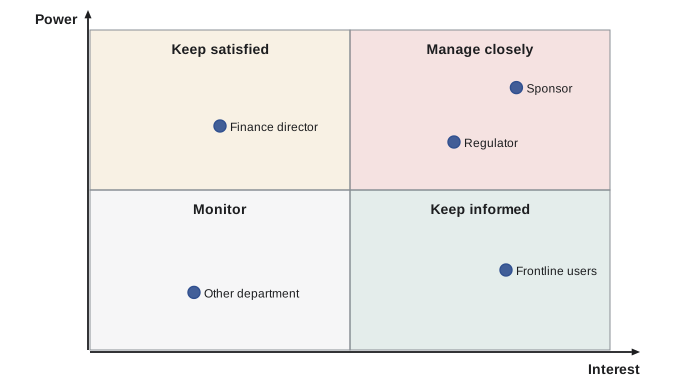
Other classification models add dimensions. A salience model considers power, urgency and legitimacy. A stakeholder cube adds attitude. Direction of influence describes whether a stakeholder is upward (senior management), downward (team), outward (suppliers, regulators) or sideward (peer project managers). For the exam, focus on the purpose of classification: to decide how much engagement each stakeholder needs and what kind.
Worked problem
Placing stakeholders on the grid
Rate four stakeholders for power and interest on a 1–10 scale, with 6 or more counting as high: finance director (power 9, interest 3), frontline users (power 3, interest 9), regulator (power 8, interest 7), neighbouring department (power 2, interest 2). Where does each go?
Show solution
- Finance director: high power, low interest: keep satisfied.
- Frontline users: low power, high interest: keep informed (and involve heavily in requirements).
- Regulator: high power, high interest: manage closely.
- Neighbouring department: low and low: monitor.
Answer: Keep satisfied, keep informed, manage closely and monitor respectively. Note that users' low formal power does not make their input less important for success.
Worked problem
Growth in communication channels
The stakeholder register lists 12 key people at initiation. During planning, 6 more are identified. How many more potential communication channels does that create?
Show solution
- At 12: \( 12 \times 11 / 2 = 66 \).
- At 18: \( 18 \times 17 / 2 = 153 \).
- Increase: \( 153 - 66 = 87 \).
Answer: 87 more channels, a reason to plan communication deliberately rather than relying on everyone talking to everyone.
Initiation in adaptive settings
Adaptive projects still need authorization, a purpose and known stakeholders, but the artifacts look different. Instead of, or alongside, a detailed charter, teams may use a product vision statement, a lean canvas or a team charter. A product vision states who the product is for, what problem it solves and how it differs from alternatives. Funding may be allocated to a product team for a period rather than to a fixed scope. The team charter, covered in PMP-120, sets working agreements such as values, communication norms and the definition of done. An initial product backlog captures high-level features or epics, to be refined later.
Hybrid projects often combine a formal charter for governance with a product vision for the adaptive team. What matters is that someone with authority has approved the project and its funding, the project manager or team lead knows the limits of their authority, and everyone shares an understanding of why the project exists and how success will be judged.
Canadian federal projects typically move through departmental gates during initiation. A business case and a Project Complexity and Risk Assessment are prepared, and for projects above a department's approved capacity or financial thresholds, Treasury Board approval is sought, often in two stages: preliminary project approval and effective project approval. Indigenous consultation, accessibility and official languages considerations may need to be identified as stakeholder and requirement issues at this stage.
Common initiation problems
Several patterns appear repeatedly in practice and on the exam. The project starts without a charter, so authority is disputed. Objectives are vague ("improve customer service") rather than measurable ("reduce average response time from 48 to 24 hours by June"). Key stakeholders are missed. The sponsor is absent or disengaged. The project manager is assigned after commitments have been made. Each has a typical remedy: create or revisit the charter with the sponsor, make objectives SMART (specific, measurable, achievable, relevant and time-bound), broaden stakeholder identification, secure the sponsor's engagement and clarify authority early.
Kickoff
Initiation usually ends, and planning begins, with a kickoff meeting, though some organizations hold one kickoff at the end of initiation and another when execution starts. A kickoff brings together the sponsor, the team and key stakeholders to share the project's purpose, objectives, scope boundaries, high-level schedule, roles, governance and ways of working. It is also a chance to build relationships and surface concerns early. A good kickoff ends with participants able to explain, in their own words, why the project matters and how they contribute.
| Kickoff agenda item | Purpose |
|---|---|
| Sponsor welcome and business context | Show commitment and link to strategy |
| Objectives and success criteria | Create a shared definition of success |
| Scope boundaries and high-level milestones | Set expectations about what is and is not included |
| Roles, responsibilities and governance | Clarify who decides what and how to escalate |
| Risks and assumptions | Surface concerns early |
| Ways of working and communication | Agree meetings, tools and norms |
| Questions and next steps | Confirm understanding and actions |
In adaptive projects the equivalent might be a chartering or inception workshop in which the team, product owner and key stakeholders agree the vision, high-level backlog, working agreements and first release goals. The format differs; the purpose of shared understanding is the same.
After the kickoff, the project manager confirms that actions are recorded, that the stakeholder register and assumption log reflect what was learned, and that any concerns raised are logged as risks or issues. Initiation is complete when the charter is approved, key stakeholders are identified and the team is ready to plan in detail. Moving into planning without these foundations usually costs more time later than it saves now.
One more point about the charter: it is valuable precisely because it is short. A two- or three-page charter that people actually read does more for alignment than a forty-page document nobody opens. If stakeholders want more detail, that detail belongs in the project management plan, the requirements documentation or the business case, which the charter can reference. Keep the charter focused on purpose, success, boundaries, authority and the few facts everyone must share.
Common mistakes
MistakeTreating the charter as the detailed project plan.
InsteadThe charter is high level; the plan comes later.
MistakeHaving the project manager sign their own charter.
InsteadThe sponsor or initiator issues it.
MistakeIdentifying stakeholders only once.
InsteadIdentification continues throughout the project.
MistakeIgnoring low-power stakeholders.
InsteadUsers and communities can make or break adoption.
MistakeWriting vague objectives.
InsteadSuccess criteria must be measurable.
Summary and key terms
- The business case and benefits management plan justify a project and are usually owned by the sponsor.
- Good business cases compare options, including doing nothing.
- The project charter formally authorizes the project and gives the project manager authority.
- The charter is high level and is issued by the sponsor or initiator.
- An assumption log starts during initiation.
- Stakeholder identification produces a register and continues throughout the project.
- Adaptive projects use product visions, team charters and initial backlogs alongside or instead of formal charters.
- Initiating
- The focus area that defines and authorizes a project or phase.
- Business case
- A documented justification for a project, including options and expected value.
- Project charter
- A document that formally authorizes a project and the project manager's authority.
- Stakeholder
- Anyone who may affect, be affected by or perceive themselves affected by the project.
- Stakeholder register
- A document recording stakeholder information, assessment and classification.
- Power-interest grid
- A tool that classifies stakeholders by their power and interest.
- Salience model
- A classification by power, urgency and legitimacy.
- Product vision
- A short statement of who a product is for, what it does and why it matters.
- SMART objective
- An objective that is specific, measurable, achievable, relevant and time-bound.
- Exit criteria
- Conditions that must be met to close or cancel a project or phase.
Practice problems
Work each problem on paper first, then reveal the answer to check.
Who issues the project charter?
Show answer
The sponsor or project initiator.
Name three items in a typical charter.
Show answer
Purpose, measurable objectives, high-level requirements, risks, milestones, budget, stakeholders, PM authority.
Cost $200,000; benefits $80,000, $80,000, $80,000. Payback?
Show answer
2.5 years.
High power, low interest stakeholder strategy?
Show answer
Keep satisfied.
What document records stakeholder information?
Show answer
The stakeholder register.
Which three attributes does the salience model use?
Show answer
Power, urgency and legitimacy.
Rewrite "improve response times" as a SMART objective.
Show answer
For example: reduce average response time from 48 to 24 hours by 30 June.
What artifact might an adaptive team use instead of a detailed charter?
Show answer
A product vision or team charter, with an initial backlog.
The team starts work with no charter. What should the PM do?
Show answer
Work with the sponsor to create one.
Who usually owns the business case?
Show answer
The sponsor or a business unit.
Lesson quiz · 5 questions
Score 60% or more to complete this lesson.
Create a free account to save your progress, take quizzes and earn a certificate.