
PMP-110 · Lesson 5 of 12 · 26 min
The performance domains and focus areas
If principles describe how to think, performance domains describe what to pay attention to. A performance domain is a group of related activities that are critical to delivering project outcomes. The PMBOK Guide 8th edition organizes its guidance into seven performance domains and reintroduces five focus areas that echo the familiar process groups, with 40 tailorable processes linking the two. This lesson gives an overview of that structure, explains how it differs from the 7th edition's eight domains and the 6th edition's ten knowledge areas, and shows how it relates to the three domains of the 2026 PMP exam content outline. Later courses in this series go deeper into each area.
Three structures you may meet
Project management guidance has been organized in several ways over the years, and you will meet all of them in books, workplaces and older practice questions. The 6th edition (2017) used five process groups and ten knowledge areas with 49 processes. The 7th edition (2021) replaced these with twelve principles and eight performance domains and moved processes out of the main guide. The 8th edition (November 2025) keeps a principles-and-domains structure but brings processes back in a flexible form, organized by focus areas. The exam is based on its own content outline rather than on any single edition, but PMI lists the PMBOK Guide among its references, so understanding the current structure is useful.
| Edition | Organizing structure | Processes |
|---|---|---|
| 6th (2017) | 5 process groups and 10 knowledge areas | 49 processes, presented in detail |
| 7th (2021) | 12 principles and 8 performance domains | No process list in the guide; models, methods and artifacts instead |
| 8th (2025) | 6 principles, 7 performance domains and 5 focus areas | 40 non-prescriptive, tailorable processes |
The seven performance domains
| Domain | Focus | Example questions it answers |
|---|---|---|
| Governance | Oversight, decision rights, compliance and alignment with organizational policy | Who decides? What approvals and controls apply? How are changes authorized? |
| Scope | Defining and managing what the project will and will not deliver, including quality expectations | What is in and out? How are requirements captured and validated? |
| Schedule | Planning, sequencing and coordinating work over time | When will work happen? What is the critical path or release cadence? |
| Finance | Budgeting, funding, cost performance and investment decisions | How much will it cost? Is spending on track? Is the investment still sound? |
| Stakeholders | Identifying and engaging the people and groups affected | Who cares about this project and how do we build shared understanding? |
| Resources | People, equipment, materials, facilities and tools | Who and what do we need, when, and how do we get and develop them? |
| Risk | Uncertainty: threats and opportunities | What could happen, and how will we respond? |
These names will look familiar to anyone who studied the older knowledge areas: scope, schedule, cost (now finance), stakeholders, resources and risk all appeared there. Governance is new as a domain and gathers ideas that were previously spread across integration management, change control and organizational context. Communication, quality and procurement are not separate domains in the 8th edition; they are addressed within the domains and processes, with procurement given expanded treatment as a topic of its own.
The five focus areas
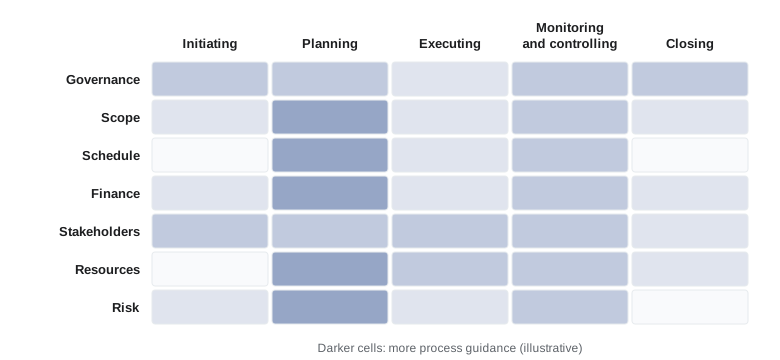
The 8th edition brings back initiating, planning, executing, monitoring and controlling, and closing, calling them focus areas rather than process groups. The change in name signals a change in emphasis: they describe kinds of work that happen throughout a project, often repeatedly and in overlapping cycles, rather than strict phases that follow one another. An adaptive team, for example, plans, executes and reviews in every iteration.
- Initiating: establish purpose, vision and strategic alignment, and authorize the work.
- Planning: define the approach, scope, estimates, risks and governance arrangements.
- Executing: do the work, lead the team, engage stakeholders and manage resources.
- Monitoring and controlling: track performance, manage changes and correct variances.
- Closing: finalize deliverables, transfer them, capture lessons and confirm value.
The 40 processes are described as non-prescriptive. They are a menu that a team tailors, not a checklist that every project must complete. Commentators reviewing the 8th edition report that planning contains the largest share of processes, close to half; treat exact counts as something to confirm in the guide itself.
Worked problem
Where does this activity belong?
Place each activity in a domain and a focus area: (a) a steering committee approves a change to the go-live date; (b) the team estimates the cost of each work package; (c) the project manager runs a stakeholder workshop to agree priorities; (d) the team records lessons and archives documents at the end.
Show solution
- (a) Decision rights and change authorization: Governance, monitoring and controlling.
- (b) Estimating costs: Finance, planning.
- (c) Engaging stakeholders to agree priorities: Stakeholders, planning or executing depending on timing.
- (d) Closing activities: mainly Governance (records and formal closure), closing.
Answer: Domains answer "what kind of work is this?" and focus areas answer "when in the cycle is it happening?". Some activities fit more than one domain, which is expected.
The 7th edition's eight domains
Many current study resources still use the 7th edition's eight performance domains: stakeholders, team, development approach and life cycle, planning, project work, delivery, measurement and uncertainty. These were defined around kinds of project activity rather than management disciplines. The 8th edition replaced them with discipline names, partly in response to practitioner feedback that the 7th edition was hard to apply. The ideas did not disappear. Team concerns now sit mainly under resources and the empowered culture principle; development approach and life cycle is treated as part of tailoring and planning; measurement is spread across the domains' monitoring guidance; uncertainty is covered by the risk domain.
| 7th edition domain | Where the ideas mainly live in the 8th edition |
|---|---|
| Stakeholders | Stakeholders domain |
| Team | Resources domain; build an empowered culture principle |
| Development approach and life cycle | Tailoring guidance; planning focus area |
| Planning | Planning focus area across all domains |
| Project work | Executing focus area; resources and governance domains |
| Delivery | Scope domain; focus on value principle |
| Measurement | Monitoring and controlling focus area within each domain |
| Uncertainty | Risk domain |
How this relates to the exam content outline
The PMP exam is not organized by PMBOK Guide domains. Its 2026 content outline has three domains: People (33 %), Process (41 %) and Business Environment (26 %), containing 8, 10 and 8 tasks respectively. About 40 % of questions reflect predictive approaches and about 60 % adaptive or hybrid approaches, spread across all three domains. The exam domains describe what a project professional does; the PMBOK Guide domains describe areas of project performance. They overlap heavily, and it helps to see the links.
| Exam domain (2026) | Example tasks | Closest PMBOK Guide 8th edition areas |
|---|---|---|
| People (33 %) | Develop a common vision; manage conflicts; lead the project team; engage stakeholders; plan and manage communication | Stakeholders, Resources; empowered culture and accountable leader principles |
| Process (41 %) | Develop an integrated plan; manage scope, schedule, finance, resources, procurement and quality; evaluate status; manage closure | Scope, Schedule, Finance, Resources; all five focus areas |
| Business Environment (26 %) | Establish governance; manage compliance; control changes; manage risk and issues; continuous improvement; support organizational change; evaluate external changes | Governance, Risk; holistic view, value and sustainability principles |
Worked problem
Allocating study time by exam weight
You plan 120 hours of study after this course. Allocate them in proportion to the 2026 domain weights, then split each domain's hours 40 % predictive and 60 % adaptive or hybrid.
Show solution
- People: 0.33 × 120 = 39.6 ≈ 40 hours (16 predictive, 24 adaptive or hybrid).
- Process: 0.41 × 120 = 49.2 ≈ 49 hours (about 20 and 29).
- Business Environment: 0.26 × 120 = 31.2 ≈ 31 hours (about 12 and 19).
- Check: 40 + 49 + 31 = 120.
Answer: About 40, 49 and 31 hours, with roughly three hours in every five on adaptive or hybrid scenarios.
Note how much the Business Environment domain grew. In the 2021 outline it carried only 8 % of the exam; in the 2026 outline it carries 26 %, with tasks on governance, compliance, change control, risk, issues, continuous improvement and organizational change. Those topics align with the governance and risk domains of the 8th edition and with this course's lessons on organizational context. Process remains the largest domain, and People remains substantial.
Using domains in practice
Domains are best seen as lenses. When planning, you look at the project through each lens in turn and ask what it needs: what governance applies, what the scope is, how the schedule will work, how it will be funded and controlled, who the stakeholders are, what resources are required and what risks exist. When something goes wrong, the lenses help diagnose it: a missed date might really be a resources problem, a stakeholder problem or a governance problem. Tailoring, covered in lesson 6, decides how much formality each lens needs on a given project.
Canadian federal guidance uses similar lenses. The Project Complexity and Risk Assessment tool asks departments to rate projects on factors such as project characteristics, strategic risk, procurement, human resources, business and change management, and the result helps decide the level of oversight and documentation required.
Reading questions through the domains
When you read a PMP scenario, it helps to ask which domain the question is really testing. A question about a team member who keeps missing stand-ups looks like a schedule problem but is usually a People question about engagement or conflict. A question about a vendor who delivered late may be about procurement (Process) or about contract compliance and governance (Business Environment). A question about a regulator changing a rule mid-project points to evaluating external business environment changes. Identifying the domain narrows down the kind of answer the question expects: People questions often favour conversation, coaching and collaboration; Process questions often favour following or updating the plan; Business Environment questions often favour governance, compliance and alignment with organizational strategy.
The same lens works in practice. When a project struggles, list the symptoms and ask which domains they touch. Repeated late approvals point to governance; constant rework points to scope or quality; unclear ownership points to resources and stakeholders. Treating the right domain saves time spent fixing symptoms.
| Scenario clue | Likely exam domain |
|---|---|
| Team conflict, motivation, coaching, communication | People |
| Scope, schedule, budget, procurement, quality, closure | Process |
| Governance, compliance, regulation, strategy, organizational change | Business Environment |
Finally, remember that the exam content outline is the authoritative guide to what the exam covers. The PMBOK Guide is one of several references PMI lists, alongside guides such as the Agile Practice Guide, so knowing the structure of the guide helps, but you should study from the outline's tasks.
Common mistakes
MistakeAssuming exam domains and PMBOK Guide domains are the same.
InsteadThe exam has three domains; the guide has seven.
MistakeMemorizing the 7th edition's eight domains as current.
InsteadThe 8th edition has seven, with new names.
MistakeTreating focus areas as strict sequential phases.
InsteadThey describe kinds of work that repeat and overlap.
MistakeThinking the 40 processes are mandatory.
InsteadThey are tailorable and non-prescriptive.
MistakeUnderestimating Business Environment.
InsteadIt rose from 8 % to 26 % of the exam in 2026.
Summary and key terms
- Performance domains are groups of related activities critical to delivering outcomes.
- The 8th edition has seven domains: governance, scope, schedule, finance, stakeholders, resources and risk.
- Five focus areas, initiating to closing, describe when work happens; 40 tailorable processes link them to domains.
- The 7th edition's eight domains map largely onto the new structure.
- The 2026 exam outline has three domains: People 33 %, Process 41 % and Business Environment 26 %.
- About 40 % of exam items are predictive and 60 % adaptive or hybrid.
- Domains are lenses for planning and diagnosis, tailored to each project.
- Performance domain
- A group of related activities critical to delivering project outcomes.
- Focus area
- A kind of project work, from initiating to closing, that recurs through the life cycle.
- Governance domain
- Oversight, decision rights, compliance and alignment with policy.
- Finance domain
- Budgeting, funding, cost performance and investment decisions.
- Process
- A set of activities that produces an outcome; in the 8th edition, tailorable.
- Knowledge area
- The 6th edition's grouping of processes by subject, such as cost or risk.
- Process group
- The 6th edition's grouping of processes by timing; now echoed by focus areas.
- Examination content outline
- PMI's specification of exam domains, tasks and weights.
- Business Environment
- The exam domain covering governance, compliance, change, risk and organizational change.
- Lens
- A way of examining a project from one domain's perspective.
Practice problems
Work each problem on paper first, then reveal the answer to check.
List the seven 8th edition performance domains.
Show answer
Governance, scope, schedule, finance, stakeholders, resources and risk.
List the five focus areas.
Show answer
Initiating, planning, executing, monitoring and controlling, and closing.
How many processes does the 8th edition describe?
Show answer
40.
Give the 2026 exam domain weights.
Show answer
People 33 %, Process 41 %, Business Environment 26 %.
Which 7th edition domain maps mainly to risk?
Show answer
Uncertainty.
Where does team development mainly sit in the 8th edition?
Show answer
Resources domain and the empowered culture principle.
Which domain is new as a domain in the 8th edition?
Show answer
Governance.
200 study hours: how many for Business Environment at 26 %?
Show answer
52 hours.
What share of exam items reflect predictive approaches?
Show answer
About 40 %.
How many tasks are in the 2026 Process domain?
Show answer
10.
Lesson quiz · 5 questions
Score 60% or more to complete this lesson.
Create a free account to save your progress, take quizzes and earn a certificate.