
PLB-320 · Lesson 9 of 12 · 20 min
Selecting the right device: premise, zone and fixture isolation
By the ninth week, Maya could name every device and explain how it worked. Luis gave her a harder test: a stack of six work orders from the building's tenants and owner, each needing a backflow decision. A new pottery studio wanted a utility sink with a hose. The dental clinic was adding a second treatment room. The café wanted a new coffee brewer and a carbonated water tap. The owner wanted a pressure washer hookup in the parking garage. The fire protection contractor proposed adding antifreeze to the garage sprinkler loop. And the city had written to say the building's premise isolation needed review. "Pick a device for each," Luis said, "and tell me why. That's the job." This lesson pulls the earlier lessons together into a method for choosing protection.
Three levels of protection
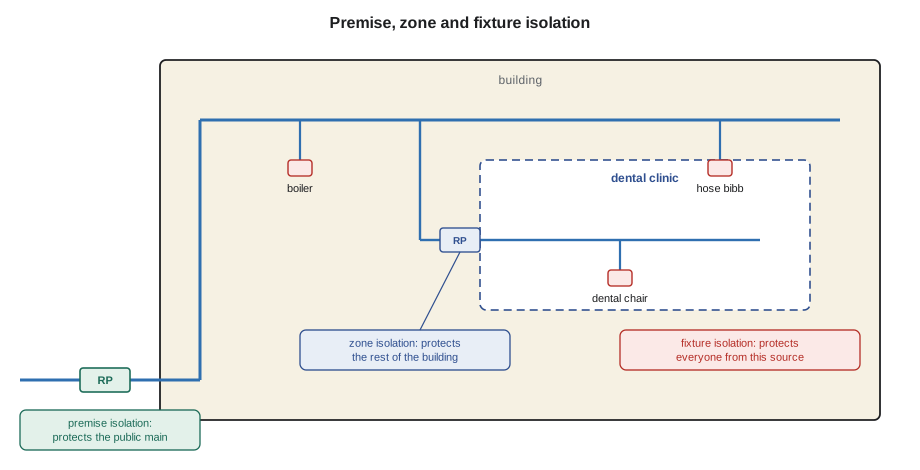
Backflow protection in a building is organized in three layers, and a good design uses all of them.
- Premise isolation, also called containment, is a device at the service connection, usually right after the water meter. Its job is to keep anything inside the building from reaching the public main. It protects the neighbours and the city, not the occupants. The utility decides whether it is required and what type, based on the building's overall hazard.
- Zone isolation, also called area isolation, is a device that protects a group of fixtures or a part of the building, such as a whole tenant space, a laboratory wing or a floor of a hospital. It keeps a hazardous area's water from reaching the rest of the building.
- Fixture isolation, also called point-of-use protection, is a device at an individual fixture or piece of equipment, such as a boiler fill, a dishwasher or a hose bibb. It protects everyone in the building from that one source. The plumbing code requires it wherever a cross-connection exists.
Premise isolation alone is never enough. It protects the city but does nothing for the office worker on the third floor who drinks from a fountain on the same branch as an unprotected chemical dispenser. Fixture isolation alone is rarely enough for the utility, because it depends on dozens of devices that the utility cannot see or track. The combination gives the utility a single device to rely on and gives occupants protection at every hazard.
A selection method
Experienced designers and inspectors follow roughly the same reasoning for every cross-connection. Maya wrote it on the back of her notebook.
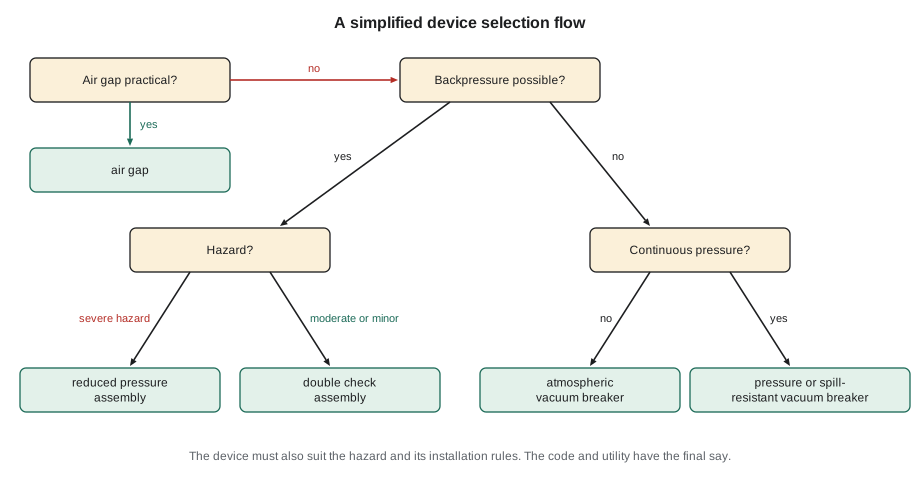
- Step 1. Identify what is on the other side and rate the hazard (Lesson 4).
- Step 2. Decide whether backpressure is possible: is there a pump, elevation, heat or a pressurized gas downstream? If yes, vacuum breakers are out.
- Step 3. Decide whether the connection is under continuous pressure and whether there are valves downstream. If yes, an atmospheric vacuum breaker is out.
- Step 4. Check whether an air gap is practical. If the equipment can be fed from an open tank or has a listed built-in gap, it is the most reliable choice.
- Step 5. Choose the least complex device that satisfies the hazard, the backflow type and the installation conditions, remembering that a more protective device is always acceptable.
- Step 6. Check the installation rules for the chosen device: height, orientation, drainage, freeze protection and access for testing. If the site cannot meet them, choose another device or change the site.
- Step 7. Check the utility's and manufacturer's requirements: approved models, listed equipment, and any special rules such as those for carbonated beverage dispensers or fire lines.
Working through the six orders
Maya's answers, after Luis's red pen, looked like this.
- Pottery studio sink with a hose: clay slip and glazes, some with metal oxides, could be siphoned. Backsiphonage only, intermittent. A hose connection vacuum breaker on the faucet at minimum; Luis preferred a faucet without hose threads plus a separate hose bibb with a vacuum breaker, so the hose would not be left in the sink. Hazard: moderate to severe depending on glaze materials.
- Dental clinic expansion: dental units connect to suction and can contain body fluids and disinfectants. Severe hazard with possible backpressure from the units' own pumps. The clinic already has a zone RP on its tenant supply; the new room connects downstream of it, and each new chair gets the manufacturer's specified fixture protection.
- Café coffee brewer and carbonated water tap: the brewer is listed with an internal air gap at its reservoir, so it needs only an approved connection. The carbonated water tap needs a device specifically listed for carbonated beverage machines, and no copper piping downstream of the device, because carbonated water that backflows dissolves copper. The old double check on the drink dispenser was replaced with a listed device for carbonators.
- Pressure washer in the garage: the washer has its own pump and can inject detergent. Backpressure and chemicals. A reduced pressure assembly on the dedicated supply, or a break tank built into the washer if the manufacturer offers one.
- Antifreeze in the garage sprinkler loop: antifreeze changes the hazard. The loop needs its own reduced pressure assembly where it branches off the wet system, or the whole fire service must be upgraded from a double check detector to a reduced pressure detector assembly, depending on the utility's rules and the fire code.
- Premise isolation review: the building contains high-hazard tenants and a boiler plant. The utility required a reduced pressure assembly at the service; the existing pair met the requirement once their test reports were brought up to date.
Fire protection systems
Fire sprinkler systems are a special case because they cannot tolerate much pressure loss, they are rarely tested by flowing water, and they are governed by the fire code and NFPA standards as well as the plumbing code. CSA B64.10 sorts fire systems into classes by their water source and contents: a system connected only to the city water with no chemicals and no fire department pumper connection is the lowest class, and systems with antifreeze, chemical additives, auxiliary water sources such as ponds, or connections to non-potable water are the highest. Ontario utilities use these classes to choose between a single check, a double check detector, and a reduced pressure detector assembly for the fire service.
Fire systems also raise a hydraulic issue. Every kilopascal lost through a backflow assembly is a kilopascal less at the highest sprinkler. When a backflow preventer is added to an existing fire service, a fire protection engineer must confirm the system still meets its design flow and pressure. Detector assemblies with low-loss check designs are made specifically for this.
Worked problem
Choosing for a new tenant
A veterinary clinic is leasing the second floor. It will have exam room sinks, a surgical scrub sink, an autoclave, a tub for bathing animals with a hand sprayer, and an X-ray processor (digital, with no chemicals). Choose zone and fixture protection.
Show solution
- Overall hazard: animal waste, disinfectants and surgical fluids make the clinic a severe hazard area.
- Zone isolation: a reduced pressure assembly on the clinic's tenant supply, so the rest of the building is protected from anything that gets past fixture devices.
- Fixture isolation: the bathing tub's hand sprayer can drop below the flood level rim, so it needs a vacuum breaker built into the sprayer hose connection or an approved deck-mounted device; the autoclave is fed through the manufacturer's specified device; sinks with spouts above their flood level rims have an air gap; the digital X-ray needs no water connection.
- Records: each testable device is added to the building's register and tested before the clinic opens.
Answer: Zone isolation lets the building owner protect the whole building from a hazardous tenant with one testable device, while the fixture devices protect the clinic's own staff and animals.
# Device selection following the step-by-step method (study aid only)
def select(hazard, backpressure, continuous_or_valves, air_gap_ok):
    if air_gap_ok:
        return "air gap"
    if backpressure:
        return "reduced pressure assembly" if hazard == "severe" else "double check assembly (or RP)"
    if continuous_or_valves:
        return "pressure or spill-resistant vacuum breaker"
    return "atmospheric vacuum breaker"

jobs = [("pottery sink hose", "severe", False, False, False),
        ("pressure washer", "severe", True, True, False),
        ("irrigation main", "moderate", False, True, False),
        ("single irrigation zone", "moderate", False, False, False),
        ("coffee brewer, built-in gap", "minor", False, True, True),
        ("plain-water fire line", "moderate", True, True, False)]
for name, hz, bp, cont, gap in jobs:
print(f"{name:28s} -> {select(hz, bp, cont, gap)}")pottery sink hose -> atmospheric vacuum breaker pressure washer -> reduced pressure assembly irrigation main -> pressure or spill-resistant vacuum breaker single irrigation zone -> atmospheric vacuum breaker coffee brewer, built-in gap -> air gap plain-water fire line -> double check assembly (or RP)
The function captures the reasoning, but it leaves out many real rules: hose threads always need at least a hose connection vacuum breaker, carbonators need a listed device, some utilities require testable devices for premise isolation regardless of hazard, and installation conditions can rule out a device that the logic would choose. Treat it as a way to check your reasoning, not a substitute for the code.
Cost, maintenance and the life of the building
Selection is not only a code question. A reduced pressure assembly needs a drain, takes more pressure and costs more to test and repair. A double check costs less but must be upgraded if the hazard changes. An air gap may need a tank and a booster pump. Owners often ask for the cheapest compliant device; good designers explain the long-term picture. In a building like Kingsway Tower, where tenants change every few years, choosing reduced pressure assemblies for tenant zone isolation saves the cost of upgrading devices each time a tenant with a higher hazard moves in.
Maintenance access is part of the choice too. A device that cannot be reached for testing will not be tested, and a device in a ceiling space that discharges water will cause damage. Sometimes the right answer is to move the connection rather than to squeeze a device into a bad location.
A selection checklist
By the end of the six work orders, Maya had turned the selection method into a short checklist she could use on any job. First, identify what could contaminate the water and rate the hazard. Second, decide whether backsiphonage, backpressure or both are possible, by looking for pumps, pressurized vessels, elevated piping and connections to other sources. Third, decide whether the device will be under continuous pressure, which rules out atmospheric vacuum breakers. Fourth, decide whether the protection is for a single fixture, a zone of the building or the whole premises. Fifth, choose the least complex device that meets all four answers, then check whether the utility or code requires something stricter.
The last step matters because codes and programs often set a minimum device for specific uses regardless of the general rules. A dental vacuum system, a mortuary table, a chemical dispenser or a fire sprinkler system with antifreeze may each have a device named in the rules. When Maya worked through the veterinary clinic case, her checklist pointed to an RP at the clinic branch, and the local rules agreed. Where the checklist and the rules disagree, the rules win.
The checklist also helps explain choices to owners. An owner who sees a reduced pressure assembly on a quote may ask why a cheaper double check will not do. A clear answer, such as "the boiler can push treated water back into the supply, and the treatment is toxic, so only an RP or an air gap is approved", is easier to accept than a reference to a code section.
Maya kept the checklist on a card in her toolbag and used it on every job for the rest of her apprenticeship.
Common mistakes
MistakeRelying on premise isolation to protect occupants.
InsteadPremise devices protect the public main; occupants need fixture and zone protection.
MistakeChoosing a device before checking for backpressure.
InsteadBackpressure rules out every vacuum breaker; check it first.
MistakeForgetting carbonated beverage machine rules.
InsteadUse a device listed for carbonators and no copper downstream.
MistakeAdding antifreeze or chemicals to a fire system without reviewing its backflow device.
InsteadAdditives raise the hazard and may require a reduced pressure detector assembly.
Summary and key terms
- Premise isolation protects the public main; zone isolation protects the rest of a building; fixture isolation protects everyone from one source.
- Select by rating the hazard, checking for backpressure, checking continuous pressure and downstream valves, and considering an air gap first.
- Choose the simplest device that meets the hazard, backflow type and installation rules; a more protective device is always acceptable.
- Fire systems are classed by water source and additives, and the class decides the detector assembly type.
- Carbonated beverage machines need a listed device and no copper downstream.
- Long-term cost, tenant changes and maintenance access belong in the decision.
- Containment
- Another name for premise isolation at the service connection.
- Zone isolation
- Protection of a group of fixtures or an area of a building by a single device.
- Point-of-use protection
- Another name for fixture isolation at a single fixture or piece of equipment.
- Listed device
- A device tested and certified to a recognized standard for a specific use.
- Fire service class
- A category that sorts fire protection systems by water source and contents to choose their backflow protection.
Practice problems
Work each problem on paper first, then reveal the answer to check.
What does premise isolation protect?
Show answer
The public water main and the neighbours.
Why is backpressure checked before anything else?
Show answer
If backpressure is possible, no vacuum breaker can be used.
A tenant space contains a severe hazard. What zone device is usual?
Show answer
A reduced pressure assembly on the tenant supply.
What two rules apply to carbonated water dispensers?
Show answer
Use a device listed for carbonators and no copper piping downstream.
Why would a designer use RPs for tenant zones even where a double check would do?
Show answer
Tenants change, and an RP avoids upgrades when a higher-hazard tenant moves in.
Lesson quiz · 5 questions
Score 60% or more to complete this lesson.
Create a free account to save your progress, take quizzes and earn a certificate.