
PLB-320 · Lesson 7 of 12 · 21 min
Double check valve assemblies
The fire line at Kingsway Tower enters the building through its own pipe, separate from the domestic water service, and runs up a riser in the parking garage to the sprinkler valves on each floor. Just inside the wall sits a long assembly with two big gate valves, two cast bodies in the middle and a small loop of pipe with a water meter running alongside. Luis called it the DCDA. "Double check detector assembly," he said. "Two check valves to keep the sprinkler water out of the city main, and a little meter on a bypass so the city can tell if anyone is stealing water from the fire line." This lesson covers the double check valve assembly and its relatives: how they work, what hazards they suit, how they fail, and how they are sized.
How a double check valve assembly works
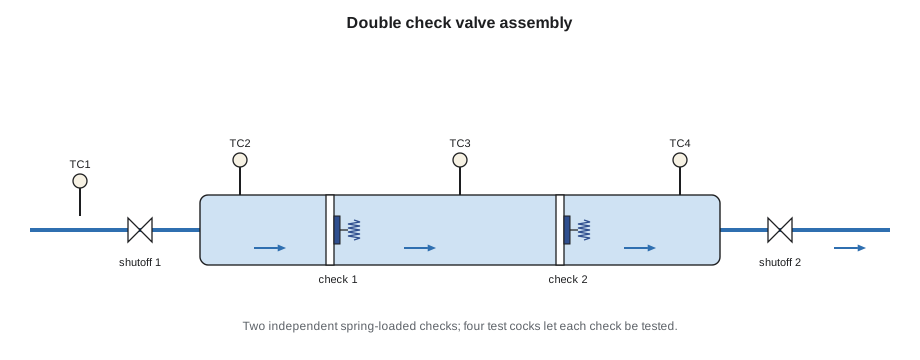
A double check valve assembly, usually called a DCVA or simply a double check, is two independently acting check valves in series, built into one unit with a resilient-seated shutoff valve at each end and four test cocks. Each check is held closed by a spring, so it opens only when the pressure upstream exceeds the pressure downstream by the spring's loading, typically a few kilopascals. When flow stops, both checks close. When the downstream pressure rises above the upstream pressure, both checks are pushed tighter onto their seats.
The idea behind having two checks is redundancy. A single check valve can be held open by a piece of debris, a chip of scale or a worn seat, and a single check is not accepted as backflow protection for that reason. With two independent checks, both must fail at the same time for backflow to occur. Each check is made to close on its own, so a failure in one does not affect the other.
The four test cocks are placed so a tester can measure the pressure at each point: test cock 1 upstream of the first shutoff valve, test cock 2 between the first shutoff and the first check, test cock 3 between the two checks, and test cock 4 between the second check and the second shutoff. With the shutoffs closed in turn and a differential pressure gauge on the test cocks, the tester can verify that each check holds tight against a backward pressure difference. Lesson 11 describes the procedure.
What hazards a double check suits
A double check valve assembly protects against both backsiphonage and backpressure, but it is accepted only for minor and moderate hazards. The reason is that its failure is silent. If both checks foul, water flows backward and nothing outside the device shows it until the next test, which may be a year away. For severe hazards, codes and CSA B64.10 require the stronger protection of a reduced pressure principle assembly or an air gap, whose failure is visible.
Typical uses include fire sprinkler systems without chemical additives, premise isolation for many apartment buildings, offices and stores, food-grade equipment feeds, and connections to plain-water process systems. Double checks have two practical advantages over reduced pressure assemblies: they never discharge water during normal operation, so they need no drain, and they can usually be installed in more places, including some below-grade vaults where the utility allows it.
The double check detector assembly
Fire sprinkler systems use a special version called a double check detector assembly, often written DCDA. It is a full-size double check on the main line with a small bypass around it. The bypass contains its own small double check and a water meter. Because the main checks need a slightly higher pressure difference to open than the bypass checks, small flows such as a leak or an unauthorized connection pass through the bypass and register on the meter. Large flows during a fire open the main checks and pass straight through.
The detector meter matters to utilities because fire lines are usually not metered for billing. Without a detector, a building could connect a hose or a process to the fire line and draw water for free, and leaks in the sprinkler piping would go unnoticed. Kingsway Tower's DCDA meter is read each month; a steady rise once revealed a cracked sprinkler pipe in the garage before it failed.
Where a sprinkler system contains antifreeze or other additives, or where the utility rates the fire system as a higher hazard, a reduced pressure detector assembly is used instead. Lesson 9 returns to fire line protection.
Dual check valves
A dual check valve looks like a double check in principle, two independent checks in series, but it is a small, non-testable device without shutoff valves or test cocks. Dual checks made to CSA B64.6 are commonly installed at the water meter of houses and small buildings, and Ontario's code calls for dual check protection at the service of houses that have an auxiliary water supply, such as a well, without a direct connection to the drinking water. They give reasonable protection against minor hazards and help utilities protect their mains from household cross-connections, but because they cannot be tested in place, they are replaced on a schedule rather than tested.
A dual check at the meter has a side effect that affects water heaters. Once the service has a check valve, the building's plumbing becomes a closed system: water that expands as a water heater warms can no longer push back into the main. Without a thermal expansion tank, the pressure in the building rises with every heating cycle until the water heater's temperature and pressure relief valve drips. Many utilities and codes now require an expansion tank whenever a check device is installed on a service. The same is true for any building with a double check or reduced pressure assembly at the service.
Pressure loss through a double check
Every backflow assembly takes some pressure to push water through its checks. The springs alone need perhaps 7 to 14 kPa to open each check, and at higher flows the friction and turbulence add more. Manufacturers publish flow curves showing pressure loss against flow for each size and model. A typical double check loses between 20 and 70 kPa at its rated flow, with the loss rising quickly near the top of its range.
That loss matters in tall buildings and on long services. When Maya's crew upgraded the café's drink dispenser feed, Luis made her check whether adding a device would leave enough pressure at the dispenser. When a premise device is added to an existing building, designers check that the top floor still has adequate pressure at peak demand; on some older buildings the answer requires a booster pump or a larger device with a flatter curve.
Worked problem
Will the café still have enough pressure?
The café's supply branch has 310 kPa at the riser during peak flow. The branch loses 25 kPa in pipe and fittings before the dispenser, and the dispenser needs at least 200 kPa to operate. The proposed device loses 55 kPa at the café's peak flow of 0.4 L/s. Is there enough pressure?
Show solution
- Pressure after pipe losses: 310 − 25 = 285 kPa.
- Pressure after the device: 285 − 55 = 230 kPa.
- Required: 200 kPa. Margin: 230 − 200 = 30 kPa.
Answer: There is enough pressure, but not much margin. Luis asked Maya to look up whether a larger device with a lower loss at the same flow would fit, because filters and scale build up over time and every kilopascal of margin helps.
# Pressure left after a backflow assembly, using a simple flow curve (illustrative)
import bisect
# (flow L/s, pressure loss kPa) for an illustrative 20 mm assembly
CURVE = [(0.0, 10), (0.1, 28), (0.2, 38), (0.3, 46), (0.4, 55), (0.5, 66), (0.6, 80)]

def loss_kpa(q):
    flows = [f for f, _ in CURVE]
    i = max(1, min(bisect.bisect_left(flows, q), len(CURVE) - 1))
    (q0, p0), (q1, p1) = CURVE[i - 1], CURVE[i]
    return p0 + (p1 - p0) * (q - q0) / (q1 - q0)

for q in (0.1, 0.25, 0.4, 0.55):
    left = 310 - 25 - loss_kpa(q)
print(f"flow {q:.2f} L/s: device loss {loss_kpa(q):4.1f} kPa, pressure left {left:5.1f} kPa")flow 0.10 L/s: device loss 28.0 kPa, pressure left 257.0 kPa flow 0.25 L/s: device loss 42.0 kPa, pressure left 243.0 kPa flow 0.40 L/s: device loss 55.0 kPa, pressure left 230.0 kPa flow 0.55 L/s: device loss 73.0 kPa, pressure left 212.0 kPa
The curve in the script is illustrative, not a real product. On a real job, use the manufacturer's published curve for the exact model and size, and check the loss at the design peak flow, not at an average.
How double checks fail
Double checks fail in a small number of predictable ways. Debris such as pipe dope, solder, sand or scale lodges on a check seat and holds it partly open. The rubber facing on a check disc hardens, cracks or takes a set and no longer seals. A spring weakens or breaks. A shutoff valve does not close fully, which makes the device impossible to test properly. In hard water, scale builds on guides and stems until the check sticks. Freezing cracks bodies and covers.
Because both checks must fail together for backflow to occur, a single fouled check is caught at the annual test and repaired before it becomes dangerous. That is the whole logic of testing: a double check is reliable only if someone verifies each check every year. A double check that has not been tested in five years should be treated as an unknown.
Repairs use the manufacturer's repair kit: new check discs, springs, seat rings and O-rings. After any repair, the assembly must be retested before it is put back in service, and the test report must record the repair. Lesson 11 covers repair and retest.
Installing a double check
Installation rules for double checks are less demanding than for reduced pressure assemblies, but they still matter. The assembly must be installed in the orientation it is listed for, usually horizontal. It must be accessible for testing and repair, which generally means a clear space around it, test cocks that face outward, and a height that a tester can reach, commonly between about 300 mm and 1.5 m above the floor unless the utility allows otherwise. It should be protected from freezing. A strainer upstream is sometimes recommended to keep debris off the checks, but on fire lines strainers are generally not allowed because they can clog.
Before a new assembly goes into service, the line upstream should be flushed so construction debris does not lodge in the new checks. Luis had Maya flush the café branch for two minutes at full flow before she installed the device, which caught a fistful of cutting chips and a strip of thread tape that would otherwise have ended up on the first check.
Fouling and maintenance
A double check depends on two small rubber discs sealing against two seats, and anything that gets between them makes the check leak. Sand, pipe scale, solder, thread sealant and pieces of gasket are the usual culprits, especially in a new installation where the piping was not flushed. Hard water can leave scale on the seats, and chloramine in the supply can harden or swell rubber parts over the years. Most double check failures found in annual tests come from one of these causes rather than broken parts.
The fix is usually simple: isolate the device, remove the check covers, clean the seats and discs, and replace worn rubber parts with the maker's repair kit. Springs rarely fail, but they can weaken or corrode. After repair, the device must be retested. At Kingsway Tower, Raj insisted on flushing the café's new branch thoroughly before installing its double check, and the first test passed with high readings on both checks.
Owners can help by reporting changes in water quality or pressure, which often point to a fouled or failing check long before the annual test finds it.
Common mistakes
MistakeUsing a double check for a severe hazard.
InsteadDouble checks fail silently; severe hazards need a reduced pressure assembly or an air gap.
MistakeInstalling a check device at the service without thermal expansion control.
InsteadAdd an expansion tank so water heater expansion does not lift the relief valve.
MistakeAssuming a double check needs no testing because it never discharges.
InsteadIts failure is silent, so annual testing is the only way to know it works.
MistakeInstalling a new assembly without flushing the line.
InsteadFlush the upstream piping first so debris does not foul the new checks.
Summary and key terms
- A double check valve assembly has two independent spring-loaded checks, two shutoff valves and four test cocks.
- It protects against backsiphonage and backpressure for minor and moderate hazards.
- Its failure is silent, so annual testing is essential.
- A double check detector assembly adds a metered bypass to reveal small flows on fire lines.
- Dual check valves are small non-testable devices, common at residential meters.
- Any check device on a service creates a closed system that needs thermal expansion control.
- Double check valve assembly
- A testable assembly of two independent spring-loaded check valves with shutoff valves and test cocks.
- Double check detector assembly
- A double check for fire lines with a metered bypass that records small flows.
- Dual check valve
- A small non-testable device with two checks, commonly used at residential water meters.
- Closed system
- A plumbing system with a check device at the service, so expanding water cannot flow back to the main.
- Flow curve
- A manufacturer's graph of pressure loss against flow for a backflow assembly.
Practice problems
Work each problem on paper first, then reveal the answer to check.
Why does a double check have two checks?
Show answer
So both must fail together for backflow to occur.
Why is a double check not accepted for severe hazards?
Show answer
Its failure is silent and could go unnoticed until the next test.
What does the bypass meter on a DCDA reveal?
Show answer
Small flows such as leaks or unauthorized connections on the fire line.
What happens to a water heater when a check device is added at the service?
Show answer
Expansion water cannot go back to the main, so pressure rises unless an expansion tank is installed.
A branch has 290 kPa after pipe losses and a device loses 60 kPa. Equipment needs 220 kPa. Is it enough?
Show answer
290 − 60 = 230 kPa, which is just enough with 10 kPa margin.
Lesson quiz · 5 questions
Score 60% or more to complete this lesson.
Create a free account to save your progress, take quizzes and earn a certificate.