
PLB-320 · Lesson 2 of 12 · 24 min
The hydraulics of backflow: backpressure and backsiphonage
Raj likes to explain things with a drinking straw. On Maya's first day of the backflow unit he set a glass of water on the lunch table, put a straw in it, and held his thumb over the top. "The water stays in the straw," he said, "because the air pushing on the glass is the same as the air my thumb holds back. Now watch." He sucked on the straw and the water rose. "I didn't pull the water. I lowered the pressure in the straw, and the atmosphere pushed the water up. That's backsiphonage. Every time a water main loses pressure, the whole city becomes a straw." This lesson puts numbers on Raj's straw: how pressure and head relate, how far the atmosphere can push water, and how backpressure develops from pumps, heat and elevation.
Pressure, head and the atmosphere
Pressure in a liquid can be expressed as a height of that liquid, called head. A column of water 1 metre tall exerts about 9.81 kPa at its base. Turned around, every 9.81 kPa of pressure can hold up or push a 1 metre column of water. A plumber who knows this one relationship can move between pressures and heights in either direction: 400 kPa at the bottom of a riser can lift water about 41 metres, and a fixture 30 metres above the gauge sees about 294 kPa less pressure than the gauge reads.
Gauges read gauge pressure, which is pressure above the surrounding atmosphere. The atmosphere itself presses on everything with about 101 kPa at sea level, a little less at higher elevations. Absolute pressure is gauge pressure plus atmospheric pressure. When a gauge reads zero, the absolute pressure is about 101 kPa. When a gauge on a water main reads below zero, the main is under a partial vacuum, and the atmosphere is pushing harder on the outside world than the water is pushing inside the pipe.
A perfect vacuum is the most the atmosphere can do. With the pressure in a pipe dropped all the way to zero absolute, the atmosphere could push water up that pipe about 10.3 metres. In practice no water main reaches a perfect vacuum, and dissolved air and water vapour limit the lift, but partial vacuums of 30 to 70 kPa below atmospheric have been measured in mains during breaks and surges. Even a modest vacuum can lift contaminated water several metres, more than enough to pull a bucket's contents up a hose and into a basement fixture.
Backsiphonage
Backsiphonage happens when the pressure at some point in the drinking water system drops below atmospheric pressure while an open or submerged outlet downstream is exposed to a non-potable liquid at atmospheric pressure. The liquid is pushed backward into the drinking water by the atmosphere, exactly as in Raj's straw. Three conditions must line up: a connection or submerged outlet, a source of non-potable liquid open to the air, and a drop in supply pressure below atmospheric at a point higher than or near the source.
The drop can come from outside the building or inside it. Outside, a water main break or a large firefighting draw pulls the main's pressure down, and the low pressure spreads into connected service lines. Inside, high velocity in an undersized pipe can lower the pressure locally, the way air moving over an airplane wing lowers the pressure on top. A fixture on a lower floor drawing heavily can lower the pressure in a riser enough to siphon from an upper-floor fixture. Draining the system for repairs also creates siphonage: when a plumber opens a drain valve at the bottom of a building's riser, every fixture above becomes a potential inlet as the water falls away.
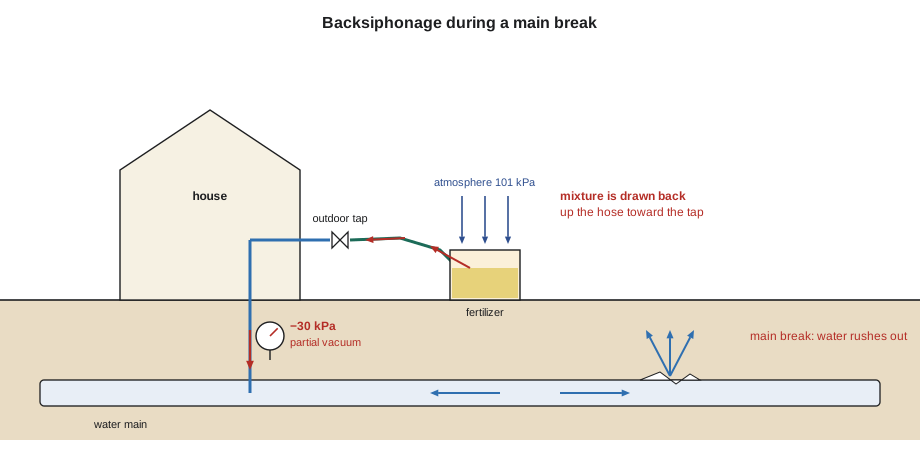
An important detail: backsiphonage needs the contaminant to be open to the atmosphere, or at least at a pressure near atmospheric. A pressurized system cannot be siphoned in the ordinary sense, but it can push water back by backpressure, which is the second mechanism.
Backpressure
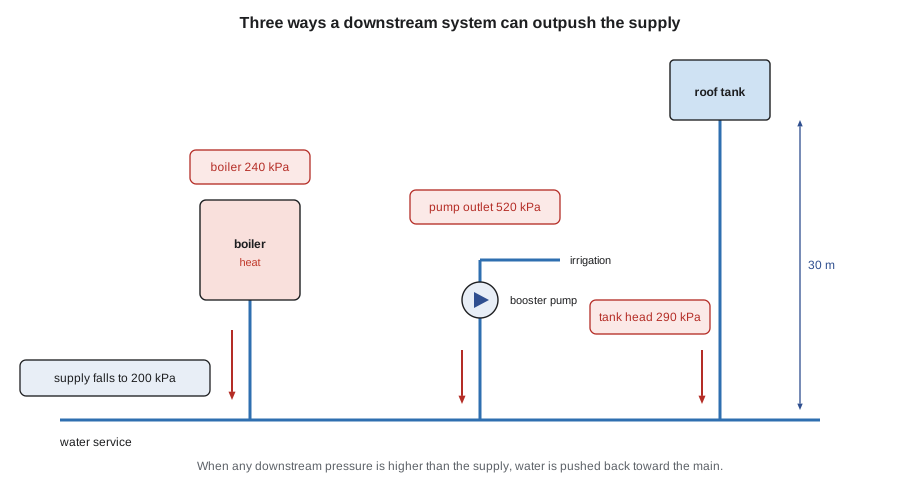
Backpressure happens when the pressure on the non-potable side of a connection becomes higher than the supply pressure. The supply pressure does not have to drop below atmospheric for this to happen; it only has to fall below whatever the downstream system is holding. There are four common sources of backpressure in buildings.
- Pumps. A booster pump, a circulating pump or a chemical feed pump on a downstream system can produce pressure above the supply. An irrigation booster, a fire pump on a sprinkler system or a process water pump can all push back.
- Elevation. Water stored or piped above the connection exerts head. A rooftop tank, a tall sprinkler riser or an upper-floor process system pushes down on everything below it, so a connection at the base of the building sees that head as backpressure.
Heat. Water expands when heated. A boiler, a water heater or a heat exchanger with its supply valve open pushes pressure back toward the supply as it heats. A hydronic system filled at 100 kPa can reach 200 kPa when hot, which can exceed a weak supply on an upper floor.
- Thermal and compressed gas systems. Carbon dioxide in a drink dispenser, compressed air in a process line, or steam can all exceed the water supply pressure.
Worked problem
Can the rooftop tank push back?
Kingsway Tower's podium irrigation system takes water from a small storage tank on the seventh-floor roof deck, 24 m above the ground-floor connection where it meets the drinking water supply. The building's supply pressure at that connection is normally 450 kPa, but during a city main break it can fall to 150 kPa. Can the tank create backpressure during the break?
Show solution
- Head from the tank at the connection: 9.81 × 24 ≈ 235 kPa.
- Normal supply: 450 kPa is higher than 235 kPa, so flow stays forward.
- During the break: 150 kPa is lower than 235 kPa, so the tank would push water back into the drinking water.
Answer: Yes. Elevation alone is enough to cause backpressure backflow whenever the supply drops. The connection needs a device rated for backpressure, not just a vacuum breaker.
# Compare supply pressure with downstream pressure from head, pumps or heat
KPA_PER_M = 9.81

def downstream_kpa(head_m=0, pump_kpa=0, system_kpa=0):
    return head_m * KPA_PER_M + pump_kpa + system_kpa

cases = [("rooftop tank", downstream_kpa(head_m=24)),
         ("irrigation booster", downstream_kpa(pump_kpa=350)),
         ("hot boiler loop", downstream_kpa(system_kpa=200))]
for supply in (450, 300, 150, -30):
    flows = [name for name, p in cases if p > supply]
print(f"supply {supply:4d} kPa: backflow risk from {', '.join(flows) if flows else 'none'}")supply 450 kPa: backflow risk from none supply 300 kPa: backflow risk from irrigation booster supply 150 kPa: backflow risk from rooftop tank, irrigation booster, hot boiler loop supply -30 kPa: backflow risk from rooftop tank, irrigation booster, hot boiler loop
The script makes the key point plain. At normal supply pressure nothing flows backward. As the supply weakens, the systems with the highest downstream pressure start to push back first, and at a negative supply pressure every connected source is a risk, including open containers that only backsiphonage can reach.
Why the difference matters for device choice
Backsiphonage and backpressure are not just two ways of saying the same thing. They determine which devices work. Some devices, such as atmospheric and pressure vacuum breakers, protect only against backsiphonage. They let air into the line when the supply pressure drops, breaking the siphon, but they cannot hold back water that is pushed against them under pressure. Other devices, such as double check valve assemblies and reduced pressure principle assemblies, protect against both backsiphonage and backpressure. An air gap protects against both because there is no physical connection at all.
| Device | Backsiphonage | Backpressure |
|---|---|---|
| Air gap | Yes | Yes |
| Atmospheric vacuum breaker | Yes | No |
| Pressure vacuum breaker or spill-resistant vacuum breaker | Yes | No |
| Double check valve assembly | Yes | Yes |
| Reduced pressure principle assembly | Yes | Yes |
When Maya looked again at the rooftop tank example, she could see the logic. A vacuum breaker on the irrigation connection would admit air during a siphon, but it could not stop water from the tank pushing back under 24 metres of head. The connection needs either an air gap at the tank fill or a testable assembly rated for backpressure.
Water hammer and pressure transients
Pressure changes in pipes are not always slow. When a valve closes quickly or a pump stops suddenly, a pressure wave travels through the system at roughly the speed of sound in water confined by the pipe, often around a kilometre per second in metal pipe. The wave creates a short spike of high pressure followed by a dip that can fall below atmospheric. These transients last only fractions of a second, but they can be enough to open a check valve, siphon from a submerged outlet or lift a seat off a worn valve. Utilities have recorded negative pressure transients in mains after power failures at pumping stations. For plumbers, transients are a reminder that "the pressure never drops here" is a dangerous assumption, and that devices must work in fast events, not only slow ones.
Where low supply pressure comes from
Backsiphonage needs the supply pressure to fall, and in a real distribution system there are many ways that can happen. A water main break is the most dramatic: water rushes out of the broken pipe, and every building on that section of main sees its pressure fall, sometimes below atmospheric on higher ground. Fire fighting is another common cause. When a pumper truck draws heavily from a hydrant, the flow in the local main can be many times its normal value, and the friction loss pulls the pressure down for every customer nearby. Planned work can do the same thing: a utility crew that shuts and drains a main to replace a valve leaves the buildings on it with no pressure at all, and any fixture with a submerged outlet can start to siphon as the main drains.
Inside a building, high demand on one floor can lower the pressure on another. When several flush valves operate at once on a lower floor, or a large fill valve opens, the pressure in an undersized riser drops, and an upper floor fixture can see a brief vacuum. Undersized piping, partly closed valves and long horizontal runs make this worse. Booster pump failures are a special risk in tall buildings: if the pumps stop, the upper floors lose pressure while the water in the riser drains down toward the lower floors, pulling on every outlet above.
Even a modest drop matters. Water can be lifted by a vacuum to a height of about 10.3 m at sea level if the pressure falls all the way to zero absolute, but backsiphonage does not need a perfect vacuum. A partial vacuum of only 10 kPa below atmospheric can lift water about 1 m, which is more than enough to pull a mop sink's contents up a submerged hose and into the piping.
Worked problem
How high can a partial vacuum lift water?
During a main break, the pressure at a Kingsway Tower riser falls to 30 kPa below atmospheric. How high above the water surface in a mop sink can the vacuum lift the water?
Show solution
- Each 9.81 kPa of pressure difference supports about 1 m of water.
- 30 ÷ 9.81 ≈ 3.1 m.
- The hose outlet in the sink is well within that height of the riser, so the water can be drawn into the piping.
Answer: The vacuum can lift water about 3.1 m, far more than the distance from the sink to the nearest branch.
Backpressure sources in a building
Backpressure needs something downstream that can push harder than the supply. The most common sources are pumps, pressurized vessels and elevation. A booster pump that feeds a process, a chemical injection pump on a cooling tower, or a fire pump can all raise the downstream pressure above the street's. Boilers and hot water heating systems run at a set pressure, and if the supply falls below it, water can be pushed back unless a device prevents it. Elevated storage tanks and the static head of water in tall buildings can do the same: the water in a full riser above a point exerts pressure on that point whether or not the supply is still pushing.
Thermal expansion is a quieter source. When water is heated in a closed system, it expands, and its pressure rises. If a containment device or a check valve stops the water from expanding back into the main, the pressure climbs until a relief valve opens or something fails. That is why thermal expansion control appears in the installation lesson: a device that prevents backflow also prevents expansion, and the plumber must provide somewhere for that extra volume to go.
When Maya mapped Kingsway Tower, she marked every pump, vessel and tank on the drawings with a small arrow showing which way it could push water if the supply failed. By the end, there were more arrows than she expected: the domestic booster pumps, the boiler, the cooling tower chemical pump, the café's carbonator pump and the fire pump. Each one became a question for the device selection lesson.
Common mistakes
MistakeUsing a vacuum breaker where the downstream system can build pressure.
InsteadVacuum breakers stop backsiphonage only; use an assembly rated for backpressure or an air gap.
MistakeForgetting that elevation creates backpressure.
InsteadEvery metre of water above a connection adds pressure that can push back when the supply weakens.
MistakeAssuming backsiphonage needs a broken main.
InsteadHigh velocity, draining for repairs and transients can all create local vacuums.
MistakeReading a gauge at zero as no pressure.
InsteadGauge zero is atmospheric pressure; below zero means a partial vacuum.
Summary and key terms
- Pressure and head are interchangeable: 1 m of water is about 9.81 kPa.
- The atmosphere can push water up about 10.3 m against a perfect vacuum.
- Backsiphonage occurs when supply pressure drops below atmospheric and an open source is connected.
- Backpressure occurs when a downstream system's pressure rises above the supply, from pumps, elevation, heat or gas.
- Vacuum breakers handle backsiphonage only; air gaps and testable check assemblies handle both.
- Fast transients can create brief vacuums even in systems that normally hold good pressure.
- Head
- Pressure expressed as the height of a column of liquid it can support.
- Gauge pressure
- Pressure measured above the surrounding atmospheric pressure.
- Absolute pressure
- Gauge pressure plus atmospheric pressure.
- Partial vacuum
- A pressure below atmospheric but above zero absolute.
- Pressure transient
- A brief pressure spike or dip caused by sudden changes in flow, such as a valve closing quickly.
Practice problems
Work each problem on paper first, then reveal the answer to check.
What head does 300 kPa represent?
Show answer
300 ÷ 9.81 ≈ 30.6 m.
A tank 18 m above a connection produces how much pressure there?
Show answer
18 × 9.81 ≈ 177 kPa.
Why can a vacuum breaker not protect against a booster pump?
Show answer
The pump creates backpressure, which a vacuum breaker cannot hold back.
Name four sources of backpressure.
Show answer
Pumps, elevation, heat and compressed gases.
What three conditions must line up for backsiphonage?
Show answer
A connection or submerged outlet, a non-potable source open to the air, and supply pressure below atmospheric.
Lesson quiz · 5 questions
Score 60% or more to complete this lesson.
Create a free account to save your progress, take quizzes and earn a certificate.