
PLB-320 · Lesson 3 of 12 · 21 min
Cross-connections in buildings
Maya's first survey of Kingsway Tower had found a dozen cross-connections. When Grace Lin reviewed it, she found eleven more. "You listed the obvious ones," Grace said, "the boiler, the sprinklers, the dental chairs. You missed the ones people add after the plumbers leave." She pointed to a trigger sprayer screwed onto a mop sink faucet, a hose left coiled in a planter, a water line teed into the café's ice machine drain to feed a misting fan, and an aquarium on the forty-first floor filled from a kitchen faucet with a length of tubing. This lesson is about finding cross-connections: where they hide, how a survey is done, and how to record what you find so the right device can be chosen.
Direct and indirect cross-connections
A direct cross-connection is a permanent pipe connection between the drinking water and a non-potable system. The boiler fill line, the sprinkler connection and the process water line to a factory machine are direct cross-connections. They are usually shown on drawings, they usually have a device installed, and they are the easiest to find.
An indirect cross-connection is a link that exists only some of the time, or through an air path that can be bridged. A hose that can be submerged, a faucet outlet below the flood level rim of a sink, a fill valve inside a tank without the required air gap, or a drain line that can back up into an open water supply are all indirect. They are harder to find because they depend on how people use the fixtures, and they change every time a tenant moves in or a worker improvises.
Codes and utilities care about both. A building can pass its premise isolation test every year and still have dozens of unprotected indirect cross-connections inside that threaten the occupants.
Where cross-connections hide
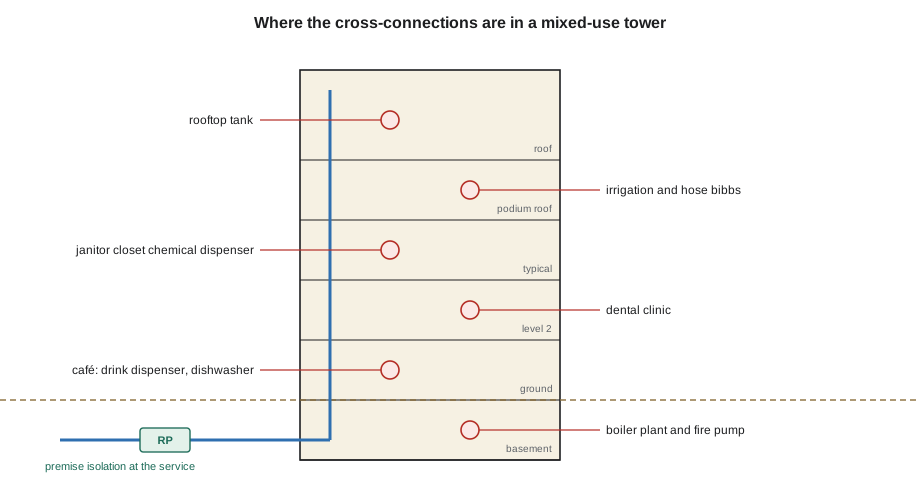
Experienced surveyors use a mental checklist built from years of finding the same problems. Grace gave Maya hers.
- Mechanical rooms: boiler and chilled water fill lines, cooling tower makeup, water treatment equipment, chemical feeders, glycol systems, heat exchangers and pump seal water.
- Fire protection: sprinkler systems, standpipes, fire pumps, antifreeze loops and dry or pre-action systems.
- Kitchens and food service: dishwashers, glass washers, espresso machines, carbonated drink dispensers, ice machines, steam kettles, combination ovens and garbage disposals.
- Health care and labs: dental chairs and vacuum systems, aspirators, sterilizers, lab sinks with hose outlets, X-ray film processors in older clinics, eyewash stations and dialysis water.
- Custodial and laundry: chemical dispensing stations, mop sinks with hose threads, washing machines with chemical injection and floor scrubber fill points.
- Outdoors: hose bibbs, irrigation, pools and hot tubs, fountains, car washes and decorative water features.
- Tenant improvements: aquariums, coffee makers plumbed into lines, misting systems, water-cooled equipment and anything a tenant connected without a permit.
How a cross-connection survey is done
A survey is a systematic walk through a building to find every cross-connection, classify its hazard and record whether it is protected. Utilities often require a survey by a qualified person when a building first enters the backflow program and again when it changes use or is renovated. Building owners also benefit from surveys because they reveal hazards inside the building that the utility's premise device will not catch.
A good survey has four steps.
- Prepare. Get the drawings, the list of tenants, the record of existing devices and their test reports. Ask the building operator about equipment that has been added. Know which code edition and utility rules apply.
- Trace. Start at the water service and follow the piping through the building. Open every mechanical room, kitchen, janitor closet and tenant space. Look at every outlet: where does the water go, and what could come back?
- Classify. For each cross-connection, note what is on the non-potable side, whether backsiphonage, backpressure or both are possible, and the degree of hazard. Lesson 4 covers hazard ratings.
- Record. Write down the location, the equipment, the existing protection if any, its make and size, whether it is testable, and what is needed. Photograph it. Give each item a number that will follow it through the test records.
Surveys are not inspections in the legal sense, and the surveyor does not usually have authority to order changes. But a survey report sent to the utility can trigger an order, and a careful survey protects the person who wrote it as well as the people who drink the water.
Common findings and why they happen
| Finding | Why it is a problem | Usual fix |
|---|---|---|
| Hose on a hose bibb left in a bucket or pool | Backsiphonage of whatever the hose sits in | Hose connection vacuum breaker; keep hose ends above liquid |
| Faucet spout below the sink's flood level rim | Sink contents can be siphoned if the sink fills and the supply drops | Raise the spout or replace with a faucet that has the required air gap |
| Chemical dispenser without an air gap or listed device | Concentrated chemical can be siphoned | Dispenser with a built-in air gap or a listed backflow device |
| Boiler fill without a testable assembly | Treated, heated water can push back | Reduced pressure principle assembly on the fill line |
| Carbonated drink dispenser with copper downstream of the device | Carbonated water dissolves copper | Listed device for carbonators and no copper after it |
| Irrigation tied directly to the supply | Soil, fertilizer and standing water | Pressure vacuum breaker or a testable assembly, depending on hazard and backpressure |
Many findings come from good intentions. A tenant adds a coffee maker and has a handyman tee into the nearest water line. A janitor buys a chemical dispenser that hangs on the mop sink faucet. A landscaper connects an irrigation timer to a hose bibb. Each person solves a practical problem without thinking about the reverse flow that might never happen in their time there.
Worked problem
Counting the testable assemblies at Kingsway Tower
After Grace's review, Maya's survey had 23 cross-connections. Seven were protected by testable assemblies: the premise reduced pressure assembly at the water service, the double check detector assembly on the fire line, the reduced pressure assembly on the boiler fill, another on the chilled water fill, a pressure vacuum breaker on the irrigation, a reduced pressure assembly on the dental clinic's supply, and a double check on the café's drink dispenser feed that Grace said needed to be upgraded. Eleven were protected by non-testable devices such as hose connection vacuum breakers and air gaps. Five were unprotected. How many items need action, and how many test reports will the building send to the city each year once the work is done?
Show solution
- Unprotected items: 5, all need a device.
- Upgrade: 1 (the café's double check becomes a device listed for carbonators, which may or may not be testable depending on the type chosen).
- Testable assemblies after the work: the six that stay, plus any new testable devices for the five unprotected items. Maya's design called for two new reduced pressure assemblies (the misting fan and the aquarium feed were removed instead) and three hose connection vacuum breakers.
- Test reports each year: 6 + 2 = 8, plus the café device if a testable type is installed.
Answer: Six items need action, and the building will send at least eight test reports a year. The non-testable devices still need inspection, even though they do not get annual test reports.
# Summarize a cross-connection survey: what needs action and what gets tested
survey = [
    ("water service", "RP", "ok"), ("fire line", "DCDA", "ok"), ("boiler fill", "RP", "ok"),
    ("chilled water fill", "RP", "ok"), ("irrigation", "PVB", "ok"), ("dental clinic", "RP", "ok"),
    ("cafe drink dispenser", "DC", "upgrade"), ("janitor station 12", "none", "unprotected"),
    ("janitor station 27", "none", "unprotected"), ("terrace hose bibb", "HBVB", "ok"),
    ("aquarium tubing", "none", "remove"), ("misting fan tee", "none", "remove"),
    ("mop sink 3", "none", "unprotected"),
]
TESTABLE = {"RP", "DC", "DCDA", "PVB", "SVB"}
action = [s for s in survey if s[2] != "ok"]
tested = [s for s in survey if s[1] in TESTABLE and s[2] == "ok"]
print(f"items surveyed: {len(survey)}")
print(f"need action: {len(action)} -> " + ", ".join(f"{n} ({a})" for n, _, a in action))
print(f"testable assemblies in service: {len(tested)}")items surveyed: 13 need action: 6 -> cafe drink dispenser (upgrade), janitor station 12 (unprotected), janitor station 27 (unprotected), aquarium tubing (remove), misting fan tee (remove), mop sink 3 (unprotected) testable assemblies in service: 6
A short list like this is the start of the building's cross-connection record. In practice the record lives in a spreadsheet or the utility's online portal, with each device's serial number, size, location, installation date and test history. Lesson 12 covers records in detail.
Interviewing the people who use the water
Drawings show what was designed, not what was added. The most useful survey tool is often a conversation. Ask the building operator what equipment has been installed in the last few years. Ask the café manager how the espresso machine and drink dispenser are fed. Ask the dental office manager whether the chairs have their own bottled water systems or draw from the building. Ask the custodial supervisor which chemical dispensers are used and where. Each answer can reveal a cross-connection that would take an hour to find by tracing pipe.
Grace's habit is to end every conversation with the same question: "Is there anything connected to the water that you're not sure about?" She says it finds something about one time in five.
When the survey finds an immediate danger
Occasionally a survey finds a cross-connection that is an immediate threat: a chemical line connected directly to the drinking water with no protection, or a sewage ejector discharge piped into a water line. The surveyor's first duty is to make sure nobody drinks the water from the affected branch, which may mean closing a valve and posting a notice, and to tell the building owner and the utility at once. Utilities can shut off service to a building with a serious uncorrected hazard. A plumber who finds such a connection during other work should treat it the same way: isolate, warn and report.
Recording the survey so others can use it
A survey is only useful if someone else can read it and act on it. Grace's survey forms for Kingsway Tower had one line for each finding, with the location written so a stranger could walk to it: floor, room or unit number, and a short description such as "mechanical room 2, east wall, boiler fill line". Each line recorded the type of connection, whether it was direct or indirect, what the water could be contaminated with, whether the condition was backsiphonage, backpressure or both, and what protection was present. Where a device was present, she wrote down its type, size and serial number and whether it was testable. Where protection was missing or wrong, she wrote what was needed.
Photographs make the survey far more useful. A photo of a hose in a mop sink, a carbonator with no device, or an RP installed in a pit shows the owner and the utility exactly what was found and removes any argument about what the surveyor saw. Grace took a wide photo to show the location and a close one to show the detail, and numbered each photo to match the line on the form.
The survey ends with a summary for the owner. It lists the findings in order of hazard, with the most serious first, and recommends the protection for each. It also recommends premise isolation if the building has hazards that cannot be reliably controlled inside, which is why a single serious hazard can lead a utility to require an RP at the service entrance for the whole building. A good summary is short enough for the owner to read, and complete enough for a contractor to price the work.
Maya noticed that the survey summary for Kingsway Tower read almost like a scope of work. Each line could be turned into a task: install an HBVB on the mop sink, add a dedicated device for the carbonator, raise the irrigation PVB, replace the pit-mounted RP with an above-ground assembly. The survey is where the plumber's work begins.
Common mistakes
MistakeSurveying only from drawings.
InsteadWalk every space and talk to the people who use the water; additions rarely appear on drawings.
MistakeRecording a device without its size, type and serial number.
InsteadRecords must identify each device so tests and repairs can be tracked.
MistakeIgnoring hose threads on mop sinks and hose bibbs.
InsteadHose threads invite submerged connections; protect them.
MistakeAssuming tenant spaces are the tenant's problem.
InsteadThe building's drinking water is shared; every tenant connection affects everyone.
Summary and key terms
- Direct cross-connections are permanent piping links; indirect ones depend on how fixtures are used.
- Mechanical rooms, fire protection, food service, health care, custodial areas and outdoor outlets all hide cross-connections.
- A survey prepares, traces, classifies and records every cross-connection in a building.
- Records should include location, equipment, protection, device type, size, serial number and what is needed.
- Conversations with operators and tenants find connections that drawings miss.
- An immediate hazard calls for isolating the branch, warning users and reporting to the owner and utility.
- Direct cross-connection
- A permanent piping connection between drinking water and a non-potable system.
- Indirect cross-connection
- A link that exists only at times or through an air path that can be bridged, such as a submerged hose.
- Cross-connection survey
- A systematic inspection of a building to find, classify and record every cross-connection.
- Flood level rim
- The edge of a fixture over which water would overflow.
- Testable assembly
- A backflow preventer with shutoff valves and test cocks that allow its performance to be checked in the field.
Practice problems
Work each problem on paper first, then reveal the answer to check.
Give two examples of indirect cross-connections.
Show answer
A hose submerged in a bucket, a faucet spout below a sink's flood level rim, or a tank fill without an air gap.
What are the four steps of a survey?
Show answer
Prepare, trace, classify and record.
Why is talking to the building operator useful?
Show answer
They know what equipment has been added since the drawings were made.
What should you do if you find a chemical line tied directly into the drinking water?
Show answer
Isolate the branch, warn users and report to the owner and the utility.
Why do carbonated drink dispensers need special protection?
Show answer
Carbonated water that backflows can dissolve copper from the supply piping.
Lesson quiz · 5 questions
Score 60% or more to complete this lesson.
Create a free account to save your progress, take quizzes and earn a certificate.