
PLB-320 · Lesson 10 of 12 · 20 min
Installation requirements for backflow preventers
The first reduced pressure assembly Maya installed by herself looked perfect to her: square, level, every joint clean. Luis looked at it for three seconds and asked her to hand him a test kit. She did, and he tried to connect the hose to the second test cock. It faced the wall, three centimetres from the drywall. "Nobody can test this," he said. "So nobody will. A device that can't be tested is a device that doesn't count." Maya reinstalled it rotated a quarter turn, with the test cocks facing out. This lesson covers the installation rules that make backflow preventers work and keep working: orientation, height and clearance, drainage, freeze and flood protection, supports, strainers, thermal expansion and commissioning.
Install the device the way it was approved
Every testable backflow assembly is approved for specific orientations. Most are approved for horizontal installation only. Some are approved for vertical installation with flow up, and a few for vertical with flow down. An assembly installed in an orientation it was not approved for may not seat its checks properly, may drain its relief valve incorrectly and may fail its test. The orientation is shown in the listing and on the manufacturer's installation sheet, and inspectors check it.
The same applies to the parts. A device must be installed complete, with its own shutoff valves and test cocks as supplied; substituting a different valve or removing a test cock voids the approval. Repair kits must come from the manufacturer for that model. A device modified in the field is no longer an approved backflow preventer, no matter how good the workmanship.
Height, clearance and access
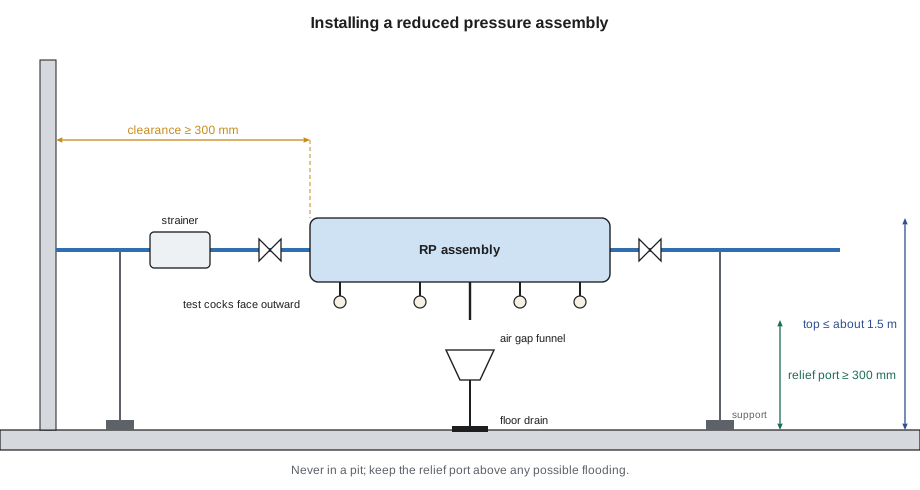
Assemblies must be installed where they can be tested and repaired. Codes, product standards and utility rules set limits that are broadly similar across jurisdictions. A reduced pressure assembly's relief port must be at least 300 mm above the floor or grade, so the port stays above any water that pools there. The assembly should not be more than about 1.5 m above the floor unless a permanent platform or other safe access is provided. There must be enough clearance around the device for the tester to connect hoses to every test cock and for the repairer to remove covers and checks, typically at least 300 mm on the test cock side and above.
Vacuum breakers have their own height rules, covered in Lessons 5 and 6, measured to their critical level above the highest downstream outlet. Double checks generally follow the same access rules as reduced pressure assemblies, though some utilities allow them in vaults or below grade when the vault is drained and accessible.
Drainage and discharge
Reduced pressure assemblies must have a place for their relief discharge to go. Lesson 8 covered the air gap at the relief port and the need to size the drain for the device's full discharge. In practice that means checking three things before installation: that a floor drain, receptor or indirect waste is close enough for the discharge to reach it without splashing equipment; that the drain can carry the full published discharge; and that the area is not finished space where a discharge would cause damage. Installing an RP above a ceiling, over electrical equipment or in a closet without a drain is asking for flooding.
Some installations need a dedicated drain line sized for large discharges. A 100 mm or larger RP can dump water fast enough to overwhelm a small floor drain and flood a room. In those cases designers provide a trench drain, a large floor sink or an indirect waste line sized from the manufacturer's discharge curve at the maximum expected inlet pressure.
Freeze and flood protection
Water inside a backflow assembly freezes like water anywhere else, and the bodies and covers crack. Outdoor assemblies need protection. In Hamilton that usually means one of three approaches: install the device indoors, in a heated mechanical room or service room; install it in an insulated and heated above-ground enclosure designed for backflow assemblies, with drain openings sized for relief discharge; or, for seasonal systems such as irrigation, drain the device each fall.
Enclosures must be large enough for testing and repair, must not block the air inlet of a vacuum breaker, and must have drain ports that can carry an RP's full discharge so water does not fill the box. Heat cables and lamps in enclosures must be installed and protected to the electrical code.
Flood protection is just as important. A reduced pressure assembly must never be installed in a pit, vault or other location where floodwater could rise above the relief port, because floodwater would then enter the device through the port. Utilities in both countries generally prohibit RPs below grade for this reason. If a service enters a building below grade, the RP goes up into the building, or the service rises into an above-grade enclosure.
Supports, strainers and flushing
Backflow assemblies are heavy, especially in larger sizes, and their weight must not hang on the piping or the valves. Pipe supports on both sides of the assembly, and for large assemblies under the body itself, keep the device aligned so its checks seat properly and its joints do not leak. Flanged and grooved assemblies need support so that the mechanical joints are not stressed.
Strainers protect check seats from debris. Many manufacturers and utilities recommend a strainer upstream of reduced pressure and double check assemblies on domestic lines, especially on new services and in areas with older mains that shed scale. Strainers are generally not allowed upstream of fire line assemblies, because a clogged strainer could starve the sprinklers during a fire. Where a strainer is used, it must be accessible for cleaning and should have a blowdown valve.
New piping must be flushed before the device is installed or before its checks are put into service. Construction debris, cutting chips, solder balls and thread sealant are the leading cause of new devices failing their first test. Some installers flush through a spool piece and install the device afterward; others install the device with its checks removed, flush, and then reinstall the checks.
Thermal expansion and water hammer
Lesson 7 explained that any check device on a service turns the building into a closed system. Installing a premise isolation device without providing for thermal expansion is a common and costly mistake. The code generally requires a means of controlling thermal expansion, usually a properly sized expansion tank on the cold supply to the water heaters, whenever a check valve, backflow preventer or pressure-reducing valve prevents expanded water from flowing back to the main.
Water hammer and pressure surges can make RPs spit and can damage check discs. Fast-closing valves downstream, such as solenoid valves on equipment, can create surges that reach the device. Water hammer arresters near the fast-closing valves, slow-closing valve choices and, where supply pressure fluctuates, a pressure-reducing valve upstream of the assembly reduce nuisance discharge.
Worked problem
Checking an installation plan
A designer has shown a 50 mm RP for a new commercial kitchen in a ceiling space 2.7 m above the floor, with its relief port piped directly into a 50 mm drain line. Identify the problems.
Show solution
- Height: 2.7 m is well above the usual maximum of about 1.5 m, and there is no platform, so the device cannot be safely tested or repaired.
- Discharge location: a ceiling space over a kitchen means any discharge would soak the ceiling and possibly electrical equipment.
- Drain connection: the relief port is hard-piped, with no air gap, so a blocked drain could back up into the zone.
- Drain size: a 50 mm line may not carry the device's full discharge; it must be checked against the manufacturer's curve.
Answer: Luis sent the drawing back with a note proposing to move the RP down to the kitchen's mechanical alcove, at a testable height, discharging through an air gap funnel to a floor sink sized for its full flow.
# Check an RP installation plan against common access and drainage rules (illustrative limits)
RULES = {"min_relief_mm": 300, "max_top_mm": 1500, "min_clear_mm": 300}

def check_rp(relief_mm, top_mm, clear_mm, air_gap, drain_lps, discharge_lps, below_grade):
    issues = []
    if relief_mm < RULES["min_relief_mm"]: issues.append("relief port too low")
    if top_mm > RULES["max_top_mm"]: issues.append("too high to test without a platform")
    if clear_mm < RULES["min_clear_mm"]: issues.append("not enough clearance at test cocks")
    if not air_gap: issues.append("relief must discharge through an air gap")
    if drain_lps < discharge_lps: issues.append("drain too small for full discharge")
    if below_grade: issues.append("cannot be installed where it could flood")
    return issues or ["meets these checks"]

print("ceiling plan :", check_rp(2400, 2700, 200, False, 1.5, 3.2, False))
print("revised plan :", check_rp(450, 1200, 400, True, 4.0, 3.2, False))ceiling plan : ['too high to test without a platform', 'not enough clearance at test cocks', 'relief must discharge through an air gap', 'drain too small for full discharge'] revised plan : ['meets these checks']
The limits in the script are typical values used for illustration. Each utility publishes its own installation requirements, sometimes with drawings, and those govern.
Labelling, permits and commissioning
Most jurisdictions require a plumbing permit to install or replace a testable backflow assembly, and many utilities require notice of installation. Every testable device must be tested by a qualified tester when it is installed, before it is put into service, and the test report sent to the utility. Many utilities also want the device tagged with its serial number, the date of installation and the tester's identification.
Commissioning is more than the test. Open the valves slowly to avoid slamming the checks, bleed air from the device and the downstream piping, check for leaks at every joint and test cock, confirm the relief port is clear and discharging to the right place, and make sure the owner knows where the device is and that it must be tested every year. Maya's crew leaves a laminated card beside each new assembly with the device information and the building operator's instructions: what normal looks like, what a discharge means, and who to call.
Installing in tight mechanical rooms
Mechanical rooms rarely have enough space, and backflow preventers are often the last thing to be fitted. Planning ahead avoids most problems. The device's position should be on the drawings early, with its clearances, drain and test access shown, so that other trades do not fill the space with ductwork or conduit. Large RPs and double checks are heavy, and their supports must be planned with the structure. Where a device must be installed vertically to fit, it must be a model approved for vertical installation in the flow direction used.
At Kingsway Tower, the service entrance RP sat in a room shared with the fire pump and the electrical service. Raj had the electrical contractor move a panel 600 mm to keep clear of any relief discharge, and arranged the floor drain and an air gap drain fitting so that the full relief flow could be carried away without flooding the room. The device sat at a comfortable working height, with the test cocks facing the open side of the room. When Grace tested it, she could reach everything without a ladder.
Access for future work matters as much as fit on the first day. A device that has to be tested every year for the life of the building should be reachable without moving other equipment, removing ceiling panels in an occupied space, or working from a ladder over live electrical gear. Planning that access costs little at the design stage and saves the owner money at every test and repair for decades.
Common mistakes
MistakeInstalling an assembly in an orientation it is not approved for.
InsteadCheck the listing and install only in an approved orientation.
MistakeFacing test cocks toward a wall.
InsteadTest cocks must be reachable; rotate the assembly or move it.
MistakePutting an RP in a pit or below grade.
InsteadInstall RPs above grade and above any possible flood level.
MistakeInstalling a premise device without thermal expansion control.
InsteadProvide an expansion tank so water heaters do not over-pressurize the building.
Summary and key terms
- Install each assembly complete and only in an orientation its approval allows.
- Keep RP relief ports at least 300 mm above the floor and assemblies reachable, commonly no more than about 1.5 m up.
- Provide clearance for testing and repair, with test cocks facing out.
- Discharge RP relief through an air gap to a drain sized for full discharge, away from finished spaces and equipment.
- Protect devices from freezing without blocking air inlets, and never install RPs where they could flood.
- Support assemblies, flush new piping, provide thermal expansion control, and test every device before it goes into service.
- Approved orientation
- The installation positions, such as horizontal or vertical flow up, in which a device has been tested and listed.
- Backflow enclosure
- An above-ground, often insulated and heated housing designed to protect an assembly while allowing testing and drainage.
- Blowdown valve
- A valve on a strainer used to flush collected debris out of it.
- Commissioning
- The steps to put a new device into service, including flushing, testing, leak checks and owner instruction.
- Thermal expansion control
- A device, usually an expansion tank, that absorbs water expansion in a closed system.
Practice problems
Work each problem on paper first, then reveal the answer to check.
Why must test cocks face outward?
Show answer
So a tester can connect hoses to every test cock.
What is the minimum height for an RP relief port?
Show answer
Generally at least 300 mm above the floor or grade.
Why can an RP not be installed in a pit?
Show answer
Floodwater could rise above the relief port and enter the device.
Why are strainers generally not allowed on fire line assemblies?
Show answer
A clogged strainer could starve the sprinklers during a fire.
What must be checked about the drain under an RP?
Show answer
That it can carry the device's full published discharge.
Lesson quiz · 5 questions
Score 60% or more to complete this lesson.
Create a free account to save your progress, take quizzes and earn a certificate.