
PLB-230 · Lesson 8 of 12 · 21 min
Combustion air, ventilation air and building pressure
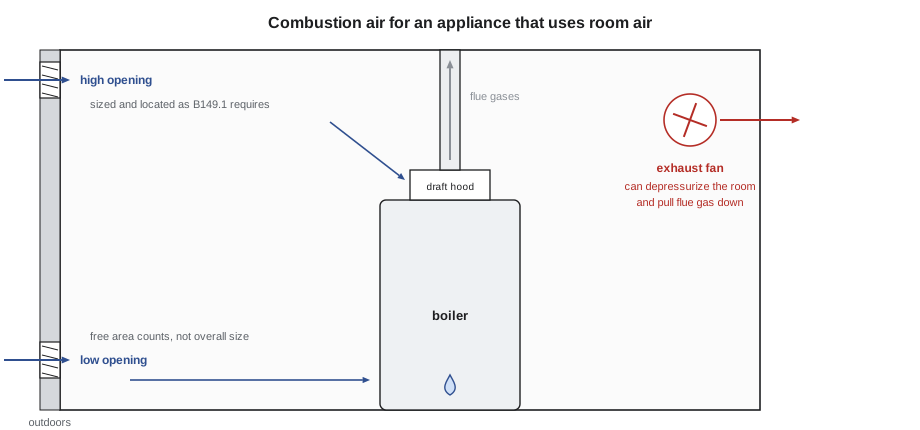
Kingsway's mechanical room once held an old atmospheric boiler that served the building next door through a shared tunnel, and the owner wanted to keep it as a backup until the neighbouring building was renovated. When Dana checked it, she found a problem that had nothing to do with the boiler itself. A new exhaust fan had been added to cool the room, the combustion air louver had been partly blocked by a storage shelf, and on a windy day the boiler's draft hood spilled flue gases into the room. "An appliance can be perfect and still kill people if the room it sits in is wrong," she said. "Air in and gases out. Both, every time."
This lesson covers the air that gas appliances need: combustion air, dilution air and ventilation of the appliance space, how the codes determine whether a space has enough air, how outdoor air is supplied through openings and ducts, and how exhaust fans and building tightness can turn a safe installation into a dangerous one.
What the air is for
An appliance that takes air from the room around it uses that air in three ways. Combustion air is the air that mixes with the gas at the burner, including the excess air described in lesson 1. Dilution air is room air drawn into a draft hood or barometric damper, which mixes with and cools the flue gases and stabilizes the draft in the vent. Ventilation air keeps the appliance space from overheating and carries away small amounts of heat and any minor leakage. Together they are often called the air supply, and the codes require it to be adequate for every appliance in the space.
Appliances fall into three groups for air supply. Direct-vent, sealed-combustion appliances, such as Kingsway's condensing water heaters, take all their combustion air from outdoors through a pipe and are not affected by the room. Fan-assisted and power-vented appliances take combustion air from the room but use a fan to push or draw it through, making them less sensitive than natural-draft appliances but still dependent on the room having enough air. Natural-draft appliances with draft hoods, like the old boiler, depend completely on the room supplying combustion and dilution air and on the vent drawing by buoyancy alone.
Is there enough air indoors?
CSA B149.1 sets out how the air supply for appliances that use room air is determined. The method depends on the total input of the appliances in the space, whether they have draft control devices, and whether the building or space is of ordinary or tight construction. Where the space alone cannot supply enough air, the code requires openings to the outdoors or to other parts of the building, or a duct bringing outdoor air to the space, sized from tables by the total input. Because the details are specific to B149.1, Maya studies them from the code itself in her G3 course; the principle she must grasp now is that the air supply is calculated, not guessed, for every installation.
The idea behind the volume rules is simple: a room contains a certain amount of air, and air leaks into a building through its envelope at some rate. A large room in a leaky building has plenty of air for a small appliance. A small room, or a tight modern building, may not. That is why replacing old windows and sealing a house, without thinking about the furnace and water heater in the basement, can create a carbon monoxide problem in a house that was safe for decades.
Closets and small mechanical rooms are the classic trouble spot. A water heater in a closet with a solid door has only the air in the closet, which is soon used up. The fix is to provide openings, often louvered doors or grilles, to a larger space, or to bring air from outdoors, or to replace the appliance with a direct-vent model.
Bringing in outdoor air
When outdoor air is needed, it can be brought in through openings in an exterior wall, through ducts from the outdoors, or by a mechanical air supply. The code tables size openings and ducts by the total input of the appliances, and the free area of any louver or grille counts, not its overall size, because the blades block part of the opening. The air openings must be located so that they cannot be blocked by snow or debris, must be protected with screens of a mesh large enough not to clog, and must not be located where they could draw in contaminated air, such as near vents or exhaust outlets. Where the air enters a heated space in a cold climate, the design must stop it from freezing nearby water piping, which in practice means locating the opening thoughtfully and sometimes ducting the air to near the appliance.
A mechanical air supply, using a fan to bring outdoor air into the appliance space, is another option. It must deliver enough air and be interlocked with the appliances, so that the burners cannot fire unless the fan is proven to be running. Kingsway's mechanical room now has a motorized outdoor air louver interlocked with the boiler, which the controls contractor programmed and the gas technician tested.
# Mechanical room air: check whether exhaust is balanced by make-up air
# and compare the room volume with the US indoor-air rule as a sanity check.
# B149.1 sets its own air supply method, which the gas technician uses on the job.
exhaust_ls = {"room exhaust fan": 140, "condensate pump vent": 0}
makeup_ls = {"motorized louver (outdoor air)": 120}
net = sum(makeup_ls.values()) - sum(exhaust_ls.values())
print(f"net air into room {net} L/s ->", "room slightly negative: check spillage" if net < 0 else "balanced or positive")
room_m3 = 6.0 * 4.5 * 3.2
room_appliances_kw = {"old atmospheric boiler (draft hood)": 58.6}   # uses room air
comparison_m3 = 4.8 * sum(room_appliances_kw.values())              # about 50 cu ft per 1,000 Btu/h
print(f"room {room_m3:.0f} m3 vs comparison volume {comparison_m3:.0f} m3")
print("room air alone not enough: outdoor air openings or ducts needed" if room_m3 < comparison_m3 else "volume adequate by comparison")net air into room -20 L/s -> room slightly negative: check spillage room 86 m3 vs comparison volume 281 m3 room air alone not enough: outdoor air openings or ducts needed
In this check, the room exhaust fan removes more air than the louver supplies, so the room runs slightly negative, and the room is far smaller than the comparison volume for an appliance that uses room air. Both point to the same answer: an interlocked outdoor air supply sized by the gas technician under B149.1, and an exhaust fan that does not outrun it. That is what Northbridge installed.
Exhaust fans, tight buildings and depressurization
All the air an exhaust fan pushes out of a building must be replaced from somewhere. If the building is tight and there is no dedicated make-up air, the replacement air may come down the easiest path available, which can be the chimney or vent of a natural-draft appliance. When that happens, the flue gases reverse direction and spill out of the draft hood into the building. Kitchen range hoods, bathroom fans, clothes dryers, central vacuum systems and fireplaces can all depressurize a house; in commercial buildings, kitchen exhaust hoods and large ventilation fans can do the same.
Building codes therefore require make-up air for large exhaust systems. Commercial kitchen hoods have dedicated make-up air units, which is exactly what Kingsway's rooftop gas-fired make-up air unit does: it heats and delivers outdoor air to replace what the café hood and corridor exhaust remove. Residential codes increasingly require make-up air for large kitchen range hoods too. When a fitter installs or services a natural-draft appliance, a worst-case depressurization test, with all exhaust appliances running and interior doors set to the worst position, shows whether the appliance can vent safely under the conditions it will really face.
The surest solution in a tight building is an appliance that does not depend on room air at all: a direct-vent, sealed-combustion appliance. That is one reason why new construction has moved almost entirely to direct-vent equipment, and why replacing an orphaned natural-draft water heater with a direct-vent model is often the best fix for a spillage problem.
Keeping the air supply working
Air openings that are blocked do not work. Homeowners close louvered doors, stack boxes in front of grilles, stuff insulation into ducts that let in cold air, and tape over openings to save energy. Service technicians check the air supply on every call: are the openings still there, still open and still the size they were? Labelling the openings, for example with a plate reading that the opening supplies combustion air and must not be blocked, helps.
Air supply ducts and openings must also be kept clean and their screens clear. In winter, intake openings can be blocked by snow, and in some areas by frost. Where outdoor air is brought into a space, the code often requires the air to be introduced in a way that does not freeze pipes or cause discomfort, which sometimes means ducting it to near the burner or the floor.
Combustion air must also be clean. Air contaminated with chlorine, fluorine or other halogen compounds, from laundry products, pool chemicals, refrigerants or solvents, forms acids in the flame that corrode heat exchangers and vents. Appliances near laundry rooms, pool equipment or workshops may need outdoor combustion air or a direct-vent design for that reason, and manufacturers list the contaminants their appliances must be protected from.
Worked problem
A closet water heater in a renovated suite
During a later service call, Maya finds a 40,000 Btu/h natural-draft gas water heater in a closet of about 2.2 m³ in an older condominium, with a new solid door. The owner recently installed new windows and a large range hood. What should she do?
Show solution
- Recognize the risk: the closet is tiny, the door is solid, the building is now tighter, and the range hood can depressurize the suite.
- Explain the carbon monoxide risk to the owner and check that a working carbon monoxide alarm is installed.
- Do not adjust or alter the gas appliance or vent herself unless she is certified or licensed for gas work and authorized to do so.
- Report to her supervisor so that a gas fitter can test for spillage under worst-case conditions and calculate the air supply.
- Likely solutions include openings to a larger space or to outdoors, make-up air for the hood, or replacing the heater with a direct-vent model.
Answer: The appliance probably needs a proper air supply or replacement; a qualified gas fitter decides and documents it.
Large equipment and rooftop units
Rooftop units such as Kingsway's make-up air unit sit outdoors and draw combustion air directly from the outside, so their air supply is built in, but the location still matters. The unit's air intake must be kept clear of its own flue outlet and of other exhausts, plumbing vents and cooling tower drift, with the separation distances set by the code and the manufacturer, so that it does not draw in flue gases or contaminants. Snow drifts against the intake, or a nearby wall that traps exhaust in the wind, can cause poor combustion even on a roof.
Large boilers and process equipment indoors need large air supplies, often a large louver area or a dedicated fan. The design engineer usually calculates the air supply for these rooms, and the gas technician confirms on site that the openings, dampers and interlocks match the design and work. A boiler room damper that fails closed, or a fan whose interlock has been bypassed, can stop the combustion air to equipment rated in the millions of Btu per hour, so the interlock test is part of every start-up and annual service.
Common mistakes
MistakeAssuming a room has enough air because it always had.
InsteadRecheck the air supply after windows, doors or exhaust fans change.
MistakeSizing a louver by its overall size.
InsteadUse the free area of the louver or grille.
MistakeAdding an exhaust fan to an appliance room without make-up air.
InsteadBalance exhaust with make-up air and test for spillage.
MistakeBlocking or taping combustion air openings to stop drafts.
InsteadKeep openings clear and labelled.
MistakeIgnoring contaminated combustion air near laundry or pool chemicals.
InsteadUse outdoor air or a direct-vent appliance where contaminants are present.
Summary and key terms
- Appliances that use room air need combustion air, dilution air and ventilation air.
- Direct-vent appliances take outdoor air through sealed pipes and are not affected by the room.
- B149.1 sizes the air supply from the total input, the appliance types and the construction.
- Outdoor air openings and ducts are sized from the B149.1 tables using free area.
- Mechanical air supplies must be interlocked with the appliances.
- Exhaust fans and tight construction can reverse vents; large exhausts need make-up air.
- Openings must stay clear, clean and uncontaminated.
- Combustion air
- Air that mixes with the gas at the burner.
- Dilution air
- Room air drawn into a draft hood to mix with and cool flue gases.
- Free area
- The open area of a louver or grille through which air can pass.
- Make-up air
- Outdoor air supplied to replace air removed by exhaust systems.
- Depressurization
- A building pressure lower than outdoors, caused by exhaust exceeding supply.
- Worst-case test
- A spillage test with all exhaust appliances running and doors set to the worst position.
Practice problems
Work each problem on paper first, then reveal the answer to check.
Name the three uses of air by a natural-draft appliance.
Show answer
Combustion air, dilution air and ventilation air.
Which appliances are unaffected by room air?
Show answer
Direct-vent, sealed-combustion appliances.
What does a mechanical air supply need?
Show answer
An interlock so the burners fire only when the fan is proven.
Why can new windows create a gas safety problem?
Show answer
A tighter building may not supply enough air or may depressurize.
What counts when sizing a louver?
Show answer
Its free area.
What do large kitchen hoods need?
Show answer
Make-up air.
Lesson quiz · 5 questions
Score 60% or more to complete this lesson.
Create a free account to save your progress, take quizzes and earn a certificate.