
PLB-230 · Lesson 12 of 12 · 22 min
Appliance start-up, combustion analysis and carbon monoxide safety
Start-up day for the Kingsway water heaters was a joint event. Maya had filled both heaters, bled the air, checked the relief valves and the condensate drains, and confirmed the water side was ready. Dana, as the G2, would light them. The manufacturer's start-up sheet lay on the floor between them, two pages of checks that both would sign. "First light is when you find out whether all the work was right," Dana said. "Gas pressure, air, venting, controls, combustion. If any one of them is wrong, this is the moment it shows. And if it's wrong, the heater stays off."
This final lesson brings the course together at the appliance: the checks before first light, the lighting sequence and safety controls, measuring gas pressure and input, combustion analysis, carbon monoxide and its effects, carbon monoxide alarms, and the records and customer instructions that finish the job. Initial activation is a certified task; this lesson explains what the certified technician does so that the plumber who works alongside understands and supports it.
Before first light
Before any appliance is lit for the first time, the technician confirms that it is the right appliance for the gas and location and that everything around it is ready. The rating plate is read: the gas type, the input, the required inlet pressure range and the manifold or offset pressure. The installation is checked against the instructions: clearances to combustibles, service clearances, the gas piping size, the shutoff valve, sediment trap and union, the venting materials, slope, joints and termination, the combustion air supply, the condensate trap and drain, and the electrical supply, polarity and grounding.
The gas piping must have passed its test and leak check, and the purge must be complete. The appliance's own gas valve is checked closed until the sequence calls for it. Water heaters and boilers must be full of water before they fire; firing a dry heat exchanger destroys it. Any controls, such as thermostats, flow switches and building automation interlocks, are set so that the appliance will call for heat when the technician is ready, and not before.
Finally, the technician reads the manufacturer's lighting and start-up instructions, every time, even for a familiar model. Instructions change with each design revision, and condensing appliances in particular have specific procedures for setting combustion.
Ignition sequences and safety controls
Most modern appliances light automatically under the control of an ignition module or burner management system. A typical sequence begins with a call for heat, then a check that the safety circuits are closed, then a pre-purge in which the combustion fan runs to clear the combustion chamber of any gas, then ignition by a hot surface igniter or spark, then the gas valve opening for a short trial for ignition, then flame proving by a flame sensor. If the flame is not proven within the trial time, the gas valve closes, and after a set number of tries the control locks out and waits for a manual reset.
Each step protects against a hazard. Pre-purge prevents delayed ignition of gas left in the chamber. The trial for ignition limits how much unburned gas can enter the chamber. Flame proving ensures gas flows only while it is burning. Pressure switches prove that the combustion fan is moving air and that the vent is not blocked. High-limit controls shut the burner off if the water or air gets too hot. Spill switches on natural-draft appliances detect venting failure. These are safety controls, and they are never bypassed, jumped, disabled or adjusted beyond their settings. A control that trips is reporting a problem; the technician finds and fixes the problem.
Older appliances with standing pilots use a thermocouple or thermopile that proves the pilot flame before the main valve can open. Lighting them follows the instructions on the appliance: gas off for the waiting period stated to let any gas clear, pilot lit with the control held, then released only when the pilot is proven. A pilot that will not stay lit is diagnosed, not wedged.
Gas pressure and input
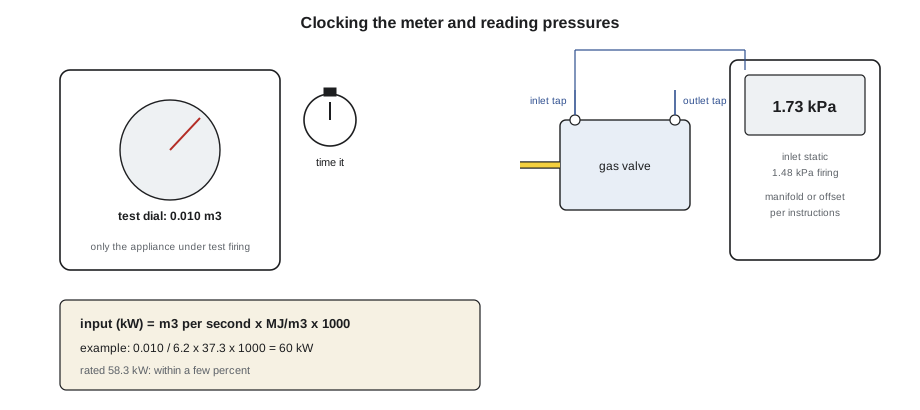
With the appliance firing, the technician checks the inlet pressure at the appliance's inlet test port, static and dynamic, against the rating plate range, as described in lesson 3. Then the manifold pressure, or on negative-pressure gas valves the offset pressure, is checked and, only if the instructions allow, adjusted to the specified value. Natural gas appliances commonly run at about 0.87 kPa (3.5 in. w.c.) manifold pressure, but the instructions give the exact figure, and some appliances are adjusted by combustion readings rather than by pressure.
The appliance's actual input can be checked by clocking the meter: with every other appliance off, the technician times how long the meter's test dial takes to pass a known volume, then calculates the gas flow and multiplies by the heating value. The result should be close to the rated input, usually within a few percent. An appliance that clocks high is overfiring, which can overheat the heat exchanger and produce carbon monoxide; one that clocks low is underfiring, which can cause condensation and poor performance. High-altitude installations are derated as the instructions require, because the air is thinner.
# Start-up numbers for one Kingsway water heater
# 1. Clock the meter: input = volume per second x heating value
HV = 37.3                          # MJ/m3, from the utility
volume_m3, seconds = 0.010, 6.2    # test dial passes 0.010 m3 in 6.2 s, only this heater firing
input_kw = volume_m3 / seconds * HV * 1000       # m3/s x MJ/m3 = MJ/s; x 1000 = kW
rated_kw = 58.3
print(f"clocked input {input_kw:.1f} kW, rated {rated_kw} kW ({100 * input_kw / rated_kw:.0f} percent)")
# 2. Air-free carbon monoxide from the analyzer readings
co_ppm, o2_pct = 42, 4.8
co_af = co_ppm * 20.9 / (20.9 - o2_pct)
print(f"flue CO {co_ppm} ppm at {o2_pct} percent O2 -> {co_af:.0f} ppm air-free")
limit = 150                         # this manufacturer's start-up limit, for illustration
print("within the manufacturer's limit" if co_af <= limit else "too high: stop, find the cause")clocked input 60.2 kW, rated 58.3 kW (103 percent) flue CO 42 ppm at 4.8 percent O2 -> 55 ppm air-free within the manufacturer's limit
In this example, the heater clocks within a few percent of its rating and the air-free carbon monoxide is well under the manufacturer's limit. Both numbers go on the start-up sheet. If the input had been well above the rating, Dana would have stopped and checked the gas valve setting, the orifice or the gas type before going any further.
Combustion analysis
A combustion analyzer samples the flue gases through a probe inserted into a test port in the vent, close to the appliance, and measures oxygen, carbon monoxide and flue gas temperature, calculating carbon dioxide, excess air and efficiency from them. Combustion analysis is the only way to know how well an appliance is actually burning. A blue flame and a quiet burner are encouraging, but carbon monoxide is invisible, and a burner can produce dangerous amounts while looking normal.
Carbon monoxide in the flue is usually reported as air-free carbon monoxide: the measured value corrected to what it would be with no excess air, so that readings from different appliances and different excess air levels can be compared fairly. The correction multiplies the measured value by 20.9 divided by 20.9 minus the measured oxygen percentage. Appliance standards set a maximum air-free carbon monoxide for certification, and manufacturers give their own start-up limits, often much lower. A reading above the limit means the appliance is not burning properly: too little air, too much gas, a dirty burner, a blocked heat exchanger, the wrong gas, or flue gas recirculating into the intake.
On condensing appliances, the manufacturer usually specifies a target range for carbon dioxide or oxygen at high fire and at low fire, and the technician adjusts the gas valve's throttle and offset screws to bring the readings into range, in the order the instructions set. Adjusting a condensing appliance without an analyzer is guesswork, and it is the cause of many nuisance lockouts and carbon monoxide calls. The analyzer is calibrated as its maker requires, and its readings are printed or saved for the job file.
The technician also checks the space around the appliance with the analyzer or a separate carbon monoxide meter: the ambient air near the appliance, at the draft hood on natural-draft appliances, and in the occupied space. Any carbon monoxide in the room air where none should be is investigated before the job is signed off.
Carbon monoxide and people
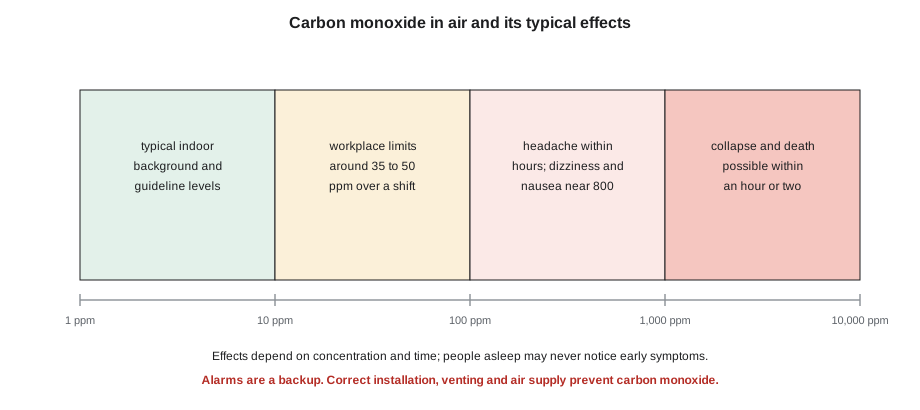
Carbon monoxide poisons by displacing oxygen in the blood. Low exposures cause headaches, dizziness, tiredness and nausea, symptoms easily mistaken for flu, and they often improve when the person leaves the building, which is an important clue. Higher exposures cause confusion, loss of consciousness and death, and people asleep may never notice the early symptoms. Infants, older adults, pregnant people and people with heart disease are especially vulnerable. Health Canada's residential indoor air quality guideline sets exposure limits of 10 parts per million averaged over 24 hours and 25 ppm over one hour, far below the levels that cause acute symptoms, while workplace exposure limits under provincial occupational health rules are higher and apply to healthy adult workers for a work shift.
Carbon monoxide alarms are the last line of defence. In Ontario, the Fire Code, amended after the Hawkins-Gignac Act was passed in 2013, requires carbon monoxide alarms near sleeping areas in homes with fuel-burning appliances, fireplaces or attached garages, and the building codes require them in new homes. Alarms are certified to CSA 6.19 and are replaced at the end of their stated life. A gas technician who finds a missing or expired alarm recommends one, and where the rules require alarms, notes their absence.
Finishing the job
When the appliance is running correctly, the technician completes the start-up record: the appliance model and serial number, gas type, inlet pressures static and firing, manifold or offset setting, clocked input, combustion readings at each firing rate, venting and air supply checks, safety control tests and the date and signature. The test tag or inspection record for the piping is confirmed in place. The appliance is labelled as the code and instructions require, and the instructions are left with the owner.
The owner or the building operator is shown how to shut off the appliance and its gas supply in an emergency, what the controls do, how to keep the air openings and terminations clear, what maintenance is needed, and the signs of a problem, including the symptoms of carbon monoxide exposure and what to do if an alarm sounds: get everyone out to fresh air, call the emergency number and the gas utility, and do not go back in until it is safe.
If anything is wrong and cannot be fixed on the spot, the appliance is not left running. The gas is shut off at the appliance valve, the appliance is tagged as unsafe, the owner is told in writing what is wrong and why, and, where the rules require, the utility or the regulator is notified. That written notice protects the occupants and the technician alike.
Worked problem
A high carbon monoxide reading at start-up
On the second Kingsway water heater, the analyzer shows 380 ppm carbon monoxide at 3.0 percent oxygen at high fire, and the clocked input is 6 percent above the rating. What should happen next?
Show solution
- Calculate air-free carbon monoxide: 380 × 20.9 ÷ (20.9 − 3.0) = 444 ppm, far above the manufacturer's start-up limit.
- Low oxygen and high input point to too much gas for the air available.
- Shut the heater down. Do not leave it running while investigating.
- Check the inlet pressure, the gas valve throttle setting, the gas type and the vent and intake for restrictions or recirculation, following the instructions.
- Adjust only as the instructions allow, restart, and repeat the analysis at high and low fire until the readings are within range.
- Record the initial readings, the correction made and the final readings on the start-up sheet.
Answer: The heater is overfiring; it stays off until the cause is corrected and the combustion readings are within the manufacturer's range.
Common mistakes
MistakeLighting an appliance without reading the current instructions.
InsteadRead the manufacturer's start-up instructions every time.
MistakeBypassing a pressure switch or flame sensor to get an appliance running.
InsteadNever bypass safety controls; find what tripped them.
MistakeJudging combustion by flame colour alone.
InsteadMeasure with a calibrated combustion analyzer.
MistakeFiring a water heater or boiler before it is full of water.
InsteadFill and purge the water side first.
MistakeLeaving an unsafe appliance running because the owner needs heat.
InsteadShut it off, tag it and give written notice.
Summary and key terms
- Before first light, check the rating plate, the installation, the piping test, the water side and the instructions.
- Ignition sequences pre-purge, ignite, prove flame and lock out on failure; safety controls are never bypassed.
- Check inlet pressure static and dynamic, then manifold or offset pressure as the instructions specify.
- Clocking the meter confirms the actual input against the rating.
- Combustion analysis measures oxygen, carbon monoxide and temperature; air-free CO = CO × 20.9 ÷ (20.9 − O₂).
- Carbon monoxide harms at low concentrations; alarms certified to CSA 6.19 are required in Ontario homes with fuel-burning appliances.
- Finish with a signed start-up record, owner instruction, and written notice for anything unsafe.
- Pre-purge
- Running the combustion fan before ignition to clear gas from the combustion chamber.
- Flame proving
- Confirming a flame is present before gas is allowed to keep flowing.
- Lockout
- A control state that stops the appliance after repeated failures until it is reset.
- Clocking the meter
- Timing the meter to calculate an appliance's actual input.
- Air-free carbon monoxide
- Carbon monoxide corrected to zero excess air for fair comparison.
- Combustion analyzer
- An instrument that measures flue gas oxygen, carbon monoxide and temperature.
Practice problems
Work each problem on paper first, then reveal the answer to check.
Why does an ignition sequence include a pre-purge?
Show answer
To clear any gas from the combustion chamber before ignition.
What does a pressure switch prove?
Show answer
That the combustion fan is moving air and the vent is not blocked.
A meter test dial passes 0.010 m³ in 9 s on natural gas at 37.3 MJ/m³. What is the input?
Show answer
About 41 kW.
Calculate air-free CO for 60 ppm at 6.9 percent oxygen.
Show answer
About 90 ppm.
Why do CO symptoms improving outdoors matter?
Show answer
They point to a source inside the building.
What standard certifies CO alarms in Canada?
Show answer
CSA 6.19.
Lesson quiz · 5 questions
Score 60% or more to complete this lesson.
Create a free account to save your progress, take quizzes and earn a certificate.