
PLB-230 · Lesson 7 of 12 · 22 min
Valves, sediment traps and appliance connections
The last few feet of gas piping before an appliance carry more rules than the rest of the system put together. In the café, Dana showed Maya the drop to the range: a shutoff valve on the wall within easy reach, a tee with a capped nipple hanging below it, a union, and a heavy-duty connector with a quick-disconnect and a cable fastening the range to the wall. "Every one of those parts is there because something went wrong somewhere once," she said. "Learn what each one is for, and you'll never leave one out."
This lesson covers the valves that let gas be shut off where and when it is needed, the sediment trap that protects the appliance's controls, unions and connectors, emergency shutoff systems for commercial kitchens, and how gas outlets are left when no appliance is connected.
Shutoff valves throughout the system
A gas system needs valves at several levels. The utility's service valve, ahead of the meter, lets the utility shut off the whole building. A building shutoff valve at the meter outlet or where the piping enters the building lets the owner or the fire department shut off the customer piping. Branch valves isolate parts of the system, such as the roof or a tenant space, so that one area can be worked on without shutting down the rest. Each appliance has its own shutoff valve.
Gas valves must be listed or certified for fuel gas, rated for the pressure at their location, and suited to the size of pipe. Quarter-turn ball valves and plug valves are the most common. The handle position shows at a glance whether the valve is open or closed: in line with the pipe means open, across the pipe means closed. Valves that are not designed for gas, such as water gate valves, are never used.
Valves must be accessible. A valve that cannot be reached quickly in an emergency is not a shutoff. Valves in ceiling spaces need access panels, valves in mechanical rooms must be within reach or have extension handles or chain operators, and valves are never buried in walls, behind equipment or in locked tenant spaces that the owner cannot reach. Every valve is tagged to show what it isolates.
Multi-tenant buildings have particular needs. Each tenant's supply must be shut off without affecting the others, and the valve for each tenant must be accessible to that tenant or to the building owner. At Kingsway, the café has its own meter and its own shutoff inside the café, and the house system has a building shutoff in the meter room and branch valves at the roof and in the mechanical room.
Appliance shutoff valves
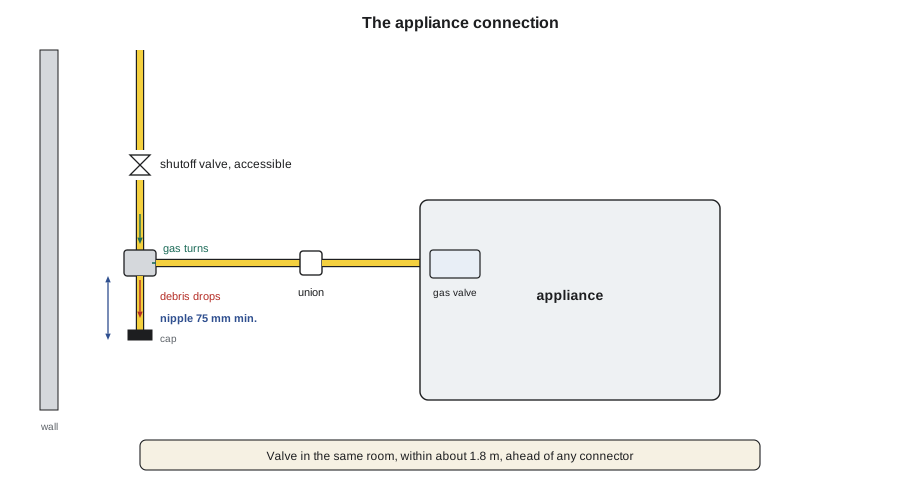
Every appliance needs an accessible manual shutoff valve ahead of it, so that the appliance can be serviced or removed without shutting off the rest of the system. The codes require it to be close to the appliance: in the same room and within a short distance, commonly 1.8 m (6 ft), of the appliance it serves, where it can be reached without moving the appliance. For an appliance with a connector, the valve is ahead of the connector. Where a manufacturer's instructions call for a particular valve position, such as outside a cabinet, the instructions govern.
Some appliances have a shutoff inside their own cabinet, but that does not replace the required valve in the piping. Fireplaces and decorative appliances often allow the valve to be in an adjacent space or under the unit where reachable, as the code and listing permit, because the appliance itself blocks access. The principle is always the same: anyone servicing the appliance, or responding to a problem with it, must be able to shut off its gas quickly without tools.
Sediment traps and drip legs
A sediment trap, also called a dirt pocket, is a tee installed immediately ahead of the appliance, arranged so that the gas changes direction at the tee, with a capped nipple hanging from the bottom outlet. Debris, scale and moisture carried along by the gas fall into the nipple instead of reaching the appliance's gas valve. The nipple is at least about 75 mm (3 inches) long. The codes require a sediment trap ahead of most appliances; some appliances, such as illuminating appliances, ranges, clothes dryers and outdoor grills, are exempt in some codes, but many fitters install one anyway.
The arrangement matters. If the gas flows straight through the bottom of the tee and on to the appliance, debris travels with it. The gas must enter the tee and turn, so that heavier particles continue straight down into the pocket. A tee installed with the nipple on the side, or a trap placed far upstream of the appliance with more piping after it, does not do the job.
A drip leg is similar but serves a different purpose: it is installed at a low point in piping that carries wet gas, or where condensation may occur, to collect liquid that can then be drained. Most utility natural gas is dry, so drip legs are needed only where the gas supplier or the code requires them, for example on some propane systems or where piping runs through cold spaces where liquids can condense.
Unions and connectors
A union, or a flange on larger pipe, is installed downstream of the shutoff valve so that the appliance can be disconnected without turning pipe. Unions are installed only where they are accessible, never in concealed locations. A ground joint union is the usual type; the seat is kept clean and the nut tightened without sealant on the seat.
Fixed appliances such as water heaters, furnaces and boilers are normally connected with rigid pipe or a listed connector as the manufacturer allows. Movable appliances, such as ranges, dryers and commercial cooking equipment on casters, use listed appliance connectors as described in lesson 4. Commercial cooking appliances on casters need a connector listed for commercial use, often with a quick-disconnect device that shuts off the gas automatically when it is separated, and a restraining device, usually a cable fastened to the wall, that is shorter than the connector so that pulling the appliance out for cleaning cannot strain the connector. The connector, valve and restraint must all be in place before the appliance is put into service.
A connector is sized for the appliance's input and its length; long or small connectors restrict flow. The manufacturer's capacity tables apply. Connectors are installed without kinks or sharp bends, are not concealed, and are not run through walls, floors or cabinets except as their listing permits for appliances designed for it.
Emergency shutoff in commercial kitchens
Commercial cooking operations that produce grease-laden vapours are protected by a kitchen hood with a fire suppression system. When the suppression system discharges, it must shut off fuel to all the cooking appliances under the hood, usually through a mechanical or electrically operated gas valve in the supply to the cooking line. That valve must be reset manually, and only after the fire is out and the system has been restored. The gas fitter installs the valve; the suppression contractor connects it to the suppression system; and the two test the interlock together.
At Kingsway, the café's gas supply to the cooking line passes through such a valve, located in the café where staff can reach it, with a sign showing what it does. During commissioning, the fire suppression contractor tripped the system and confirmed that every burner on the line went out and that the valve stayed closed until it was manually reset.
Some kitchens also have a manual emergency gas shutoff button at the exit, or interlocks with the exhaust fan so that appliances cannot run unless the hood is operating. Where these are required by the fire code or the design, the gas fitter installs the gas valves and the electrician and controls contractor wire them.
Capping outlets and leaving the system safe
An outlet that does not yet have an appliance connected, or from which an appliance has been removed, must be closed off gas-tight. A closed valve alone is not enough, because valves can be opened by accident or leak by. The outlet is closed with a threaded plug or cap of the same material, after the valve is closed. Leaving an open gas valve or uncapped pipe end, even for a moment, has caused explosions, and every code requires outlets to be capped.
When an appliance is removed permanently, the branch that served it should be removed back to the main or capped as close to the main as practical, so that no dead leg is left in the system. Unused branches collect debris, and in a future renovation someone may assume an old capped pipe is not gas.
# Check the cafe appliance connections against the job checklist
# Values are the job's rules of thumb taken from the code and instructions.
MAX_VALVE_M = 1.8          # shutoff valve within this distance, same room, accessible
MIN_TRAP_MM = 75           # sediment trap nipple length
appliances = [
    {"name": "range", "valve_m": 0.9, "same_room": True, "trap_mm": 100, "restraint": True, "casters": True},
    {"name": "fryer", "valve_m": 1.2, "same_room": True, "trap_mm": 75, "restraint": False, "casters": True},
    {"name": "oven", "valve_m": 2.6, "same_room": True, "trap_mm": 50, "restraint": None, "casters": False},
]
for a in appliances:
    issues = []
    if a["valve_m"] > MAX_VALVE_M or not a["same_room"]:
        issues.append("move shutoff valve closer")
    if a["trap_mm"] < MIN_TRAP_MM:
        issues.append("lengthen sediment trap")
    if a["casters"] and not a["restraint"]:
        issues.append("add restraint cable")
print(f"{a['name']:6s}", "OK" if not issues else "; ".join(issues))range OK fryer add restraint cable oven move shutoff valve closer; lengthen sediment trap
The checklist script finds three problems in the café: the oven's shutoff valve is too far away, its sediment trap is too short, and the fryer on casters has no restraint. All three were fixed before the inspector's visit. Writing the job's rules as a simple checklist, on paper or in a script, makes it much harder to miss an item on a crowded commercial kitchen line.
Worked problem
Connecting the water heaters
In the mechanical room, Maya and Dana connect the two condensing water heaters to the gas branch. The heaters' instructions require a gas valve outside the cabinet, a sediment trap, a union and a minimum pipe size to the inlet. What goes on each drop, and in what order from the branch to the heater?
Show solution
- A branch outlet from the top or side of the gas header.
- A listed quarter-turn shutoff valve, accessible and in the same room, outside the heater cabinet as the instructions require.
- A tee with a capped nipple as a sediment trap, arranged so the gas turns at the tee.
- A union so the heater can be removed without turning pipe.
- Rigid pipe at the size the instructions require to the heater's gas inlet, supported so its weight does not rest on the gas valve.
- A test port, often the plugged tee on the gas valve, for checking inlet pressure at start-up.
Answer: Branch outlet, shutoff valve, sediment trap, union, rigid connection, all accessible and supported.
Automatic valves on the service
Some valves close automatically. Many utilities now install an excess flow valve in new residential and small commercial services: a device in the service line that closes when the flow rises far above the expected load, as it would if the service were broken by an excavator or a vehicle. In areas with earthquake risk, some codes and owners require seismic gas shutoff valves that close when shaking exceeds a set level. These devices belong to the utility or are installed under specific rules, and a fitter who finds one should know that a building that has lost its gas supply suddenly may have a closed automatic valve rather than a broken pipe.
When any automatic or emergency valve has closed, gas is restored only after the cause is found and corrected, the piping is checked for leaks, and every appliance pilot and burner downstream is relit and checked. Opening a main valve while appliance valves or pilot valves are open can release gas into the building, so the relighting follows the same careful procedure as a new start-up, covered in lesson 12.
Common mistakes
MistakeRelying on the appliance's internal shutoff instead of a valve in the piping.
InsteadInstall an accessible manual shutoff valve ahead of every appliance.
MistakeInstalling the sediment trap tee so the gas flows straight through.
InsteadArrange the tee so the gas turns and debris falls into the nipple.
MistakeLeaving a removed appliance's outlet with only the valve closed.
InsteadClose the valve and cap or plug the outlet.
MistakeOmitting the restraint on a commercial appliance on casters.
InsteadInstall a restraint shorter than the connector.
MistakeBurying a union in a wall.
InsteadInstall unions only where accessible.
Summary and key terms
- Gas systems need service, building, branch and appliance shutoff valves, all listed for gas and accessible.
- Appliance valves are in the same room and within about 1.8 m of the appliance, ahead of any connector.
- A sediment trap is a tee with a capped nipple at least about 75 mm long, where the gas turns.
- Unions go downstream of the shutoff valve and only where accessible.
- Commercial appliances on casters need a listed connector, quick-disconnect where used, and a restraint.
- Kitchen hood suppression systems shut off gas to the cooking line through a manually reset valve.
- Unused outlets are capped, not just valved off.
- Sediment trap
- A tee with a capped nipple ahead of an appliance that collects debris.
- Drip leg
- A capped pipe at a low point that collects liquid from wet gas.
- Union
- A fitting that lets pipe be separated without turning it.
- Quick-disconnect device
- A fitting that shuts off gas automatically when a connector is separated.
- Restraint
- A cable or chain that limits how far a movable appliance can be pulled.
- Dead leg
- An unused branch left connected to a gas system.
Practice problems
Work each problem on paper first, then reveal the answer to check.
Where must an appliance shutoff valve be?
Show answer
Accessible, in the same room and within about 1.8 m of the appliance.
How long is a sediment trap nipple?
Show answer
At least about 75 mm.
Why must the gas turn at a sediment trap tee?
Show answer
So that debris falls into the nipple instead of flowing to the appliance.
What shuts off gas when a kitchen hood suppression system discharges?
Show answer
A manually reset gas valve interlocked with the suppression system.
How is an unused outlet left?
Show answer
Valve closed and the outlet capped or plugged.
Where are unions installed?
Show answer
Downstream of the shutoff valve, in accessible locations only.
Lesson quiz · 5 questions
Score 60% or more to complete this lesson.
Create a free account to save your progress, take quizzes and earn a certificate.