
PLB-230 · Lesson 2 of 12 · 22 min
Gas codes, TSSA certificates and who may do the work
On her first morning in the gas meter room, Maya reached for a pipe wrench to tighten a union on the test assembly Dana had set up. Dana stopped her. "Not yet. Until you hold a G3 and I sign off your skills, you watch, hand me tools and do exactly what I tell you, with me standing right here. That isn't me being fussy. It's the regulation, and it exists because people have died from gas work done by someone who thought it looked easy."
Gas work is regulated more tightly than almost any other part of a building. This lesson explains where the rules come from, which documents a gas fitter uses, who may install and service gas piping and appliances, and how permits, inspections and the gas utility fit together. The details differ between provinces, states and cities, so the lesson describes the system on the Kingsway job and the questions to ask anywhere else.
The installation code
In Canada, the technical rules for installing natural gas and propane piping, appliances and venting are in CSA B149.1, the Natural Gas and Propane Installation Code, published by the CSA Group. A companion standard, CSA B149.2, covers the storage and handling of propane. B149.1 is revised every few years. Its 2025 edition was published in 2025 and, among other changes, brings blends of hydrogen and natural gas into the code. Each province adopts the code by regulation, often with its own amendments. Manitoba adopted the 2025 edition in March 2026. In Ontario, the Technical Standards and Safety Authority, TSSA, consulted from November 2025 to January 2026 on a code adoption document that adopts the 2025 edition with Ontario amendments, including making one annex mandatory and dropping several older Ontario changes.
The adopted code is the law on the job, and the edition matters. A rule that changed between editions applies only once the province has adopted the new edition, and an amendment can replace a clause entirely. Ontario's code adoption document is therefore as important as the CSA book itself: a gas technician working in Ontario needs both. When a manufacturer's certified installation instructions are more restrictive than the code, the code requires the instructions to be followed too.
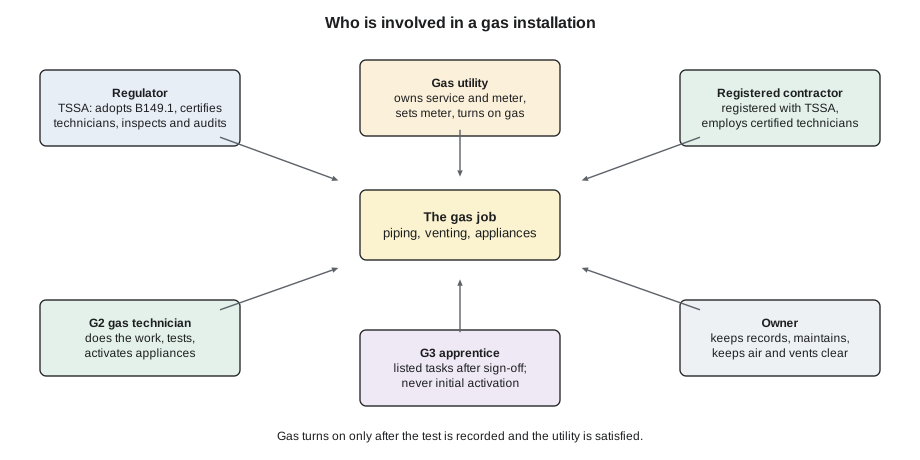
Who may do gas work
In Ontario, gas work is regulated under the Technical Standards and Safety Act and its regulation on certification of gas technicians, O. Reg. 215/01, administered by TSSA. Anyone who installs, inspects, alters, purges, activates, repairs, services or removes gas piping, appliances or venting must hold a gas technician certificate of the right class, and the work must be done for a contractor registered with TSSA. There are three classes. A Gas Technician 1, G1, may work on appliances of any input. A Gas Technician 2, G2, may do the same work on appliances up to 400,000 Btu/h. A Gas Technician 3, G3, is the entry certificate and works only under the supervision of a G1 or G2.
The G3 is limited on purpose. After a documented skills sign-off on TSSA's form, a G3 may work under general supervision on a short list of tasks: installing, testing, activating and purging piping smaller than 2-1/2 inches between the meter or propane service valve and the appliance control valve; reactivating an appliance that was previously installed; cleaning and lubricating an appliance; and cleaning, removing or replacing a vent connector, venting or draft control device. Everything else within the supervisor's scope requires direct supervision, with the supervisor on site and close by, and a G3 may never perform the initial activation of a new or newly converted appliance. A G3 who wants to become a G2 needs either an accredited G3 program or documented work hours under a G3 certificate, then the G2 training and examination. A G1 needs two years as a G2, including hours on large systems under a G1.
A plumbing certificate of qualification does not authorize gas work in Ontario, and a gas certificate does not authorize plumbing. That is why Maya is taking the G3 course alongside her plumbing apprenticeship, as many plumbers do: the two certificates together let a plumber install a complete water heater, both sides. On Kingsway, the rooftop make-up air unit is rated 750,000 Btu/h, above the G2 limit, so its start-up belongs to a G1 from Northbridge's service department.
| Class | May work on | Supervision |
|---|---|---|
| G3 | Listed tasks on piping and appliances, within the supervisor's scope | General supervision for listed tasks after sign-off; direct supervision otherwise |
| G2 | Appliances up to 400,000 Btu/h, with piping and venting | Works independently; may do G1 work under a G1's direct supervision |
| G1 | Appliances of any input, with piping and venting | Works independently |
| Registered contractor | Employs certified technicians; holds the registration | TSSA |
Permits, inspections and the gas utility
In Ontario, new gas installations and many alterations must be inspected. TSSA inspects some work directly and audits other work, and the utility will not supply gas to a new piping system until the contractor shows that it has been tested and the paperwork is in order. Every pressure test is recorded on a tag attached near the meter or the appliance, showing the address, the contractor's name and registration number, the date, the test pressure and duration, the pipe length and size, and the technician's name and certificate number, with a statement that the tag must not be removed. The tag is the record that follows the piping for its life.
The gas utility owns the service line from the main to the meter, the meter and usually the service regulator. Its staff set and seal the meter, and only they may turn on gas at the meter for the first time or after a shutoff for safety reasons. The customer's piping starts at the outlet of the meter. That boundary matters: a gas fitter does not tamper with the utility's meter, regulator or service valve, and the utility does not install or repair the customer's piping.
The utility also responds to emergencies. Every gas fitter keeps the utility's emergency number in their phone, and every customer should have it posted near the meter. When a fitter finds a hazardous condition, such as a leak, a cracked heat exchanger or a vent that spills, the codes and utility procedures require the appliance to be shut off and tagged and the customer warned in writing. In some cases the utility must be notified and will shut off the meter.
Professional responsibility
Gas codes rely on the judgment of trained people more than most codes do. The code cannot list every building, appliance and situation, so it sets objectives and minimum requirements and leaves the technician to apply them. A fitter who is unsure stops and asks. A fitter who finds that an installation cannot be made safe under the code does not make it work anyway; they explain the problem to the customer and the supervisor and decline to activate it.
Gas fitters are also responsible for what they leave behind. The person who last worked on an appliance is often the one questioned after a carbon monoxide incident. Clear records, tags on unsafe appliances, written notices to customers, and test tags on new piping protect the public and the technician. Dana's rule for Maya was simple: if it is not written down, it did not happen.
Finally, gas work changes with technology. Hydrogen blends, new piping materials, high-efficiency equipment, smart controls and electrification are changing what fitters install. Certificates and licences are renewed, codes are revised, and manufacturers update their instructions. A good gas fitter keeps learning, takes the refresher courses the regulator or employer requires and reads the code changes when a new edition is adopted.
Worked problem
Can Maya do this task?
Maya holds her G3 and Dana has signed her skills sign-off. Dana is on the roof. Maya is asked to (a) pressure test a new 3/4 inch branch to a café range and attach the test tag, and (b) perform the first light-off of the new café range. Which may she do?
Show solution
- Task (a): piping under 2-1/2 inches between the meter and the appliance control valve, including the test tag, is on the G3 general-supervision list after a sign-off. Dana must be readily available, which she is.
- Task (b): initial activation of a new appliance is never permitted for a G3.
- Maya does the test and tag, records them, and waits for Dana to activate the range.
Answer: She may test and tag the branch under general supervision but may not perform the initial activation.
Training, records and renewal
Maya's G3 course combines classroom units on gas properties, safety, codes, piping, venting and appliances with a TSSA examination. Passing gives her the G3 certificate, but the certificate alone is not enough to work without direct supervision: the skills sign-off, in which a G1 or G2 watches her perform each listed task and records it on TSSA's form, is what opens up general supervision for those tasks. Her logbook records the dates, tasks and supervisors. If she later applies for the G2, the hours she worked under her G3 count toward the work requirement, which is why Dana insists the logbook is kept up to date at the end of every week rather than reconstructed from memory.
Certificates are not permanent licences to work without further learning. TSSA certificates must be renewed, and fees and procedures change from time to time; a fee change took effect in May 2026, for example. When a new code edition is adopted, technicians are expected to learn the changes, and employers and training providers offer update courses. Contractors must keep their registration current and keep records of the technicians they employ and the work they do.
Supervision is also a two-way responsibility. The supervisor must actually supervise: be present or available as the rules require, check the apprentice's work before it is covered or tested, and refuse to sign for work they did not see. The apprentice must ask before doing anything new, stop when unsure, and report mistakes at once rather than hiding them. A joint that was cross-threaded and then forced, or a test gauge that was read wrongly, is easy to fix the day it happens and dangerous to discover years later. Dana told Maya that the apprentices she trusts most are the ones who tell her about their mistakes before she finds them.
On a large job, the paperwork matters as much as the piping. Kingsway's gas file contains the permit or job registration, the drawings showing pipe sizes and lengths, the load schedule, the material approvals, the CSST training cards of everyone who installed CSST, the test records and tags, the start-up and combustion reports for every appliance, and the manufacturer's instructions. The file is handed over to the building owner at the end of the job, and Northbridge keeps a copy.
# Who may do a task? A simple check of the G3 general-supervision list
G3_LIST = {"test piping under 2-1/2 in", "reactivate appliance", "clean appliance", "replace vent connector"}
def allowed(task, cert, signed_off, supervisor_on_site):
    if cert in ("G1", "G2"):
        return "yes, within the certificate's input limit"
    if task == "initial activation":
        return "no: a G3 may never perform initial activation"
    if task in G3_LIST and signed_off:
        return "yes, under general supervision"
    return "only under direct supervision" if supervisor_on_site else "no: supervisor must be on site"
for task in ["test piping under 2-1/2 in", "initial activation", "adjust burner on new boiler"]:
print(f"{task:30s} G3 -> {allowed(task, 'G3', True, False)}")test piping under 2-1/2 in G3 -> yes, under general supervision initial activation G3 -> no: a G3 may never perform initial activation adjust burner on new boiler G3 -> no: supervisor must be on site
The script is a teaching aid for the decision Dana made at the start of the lesson; the regulation and TSSA's policies are the authority. Its main point is the order of the questions: first the certificate, then whether the task is one a G3 may never do, then whether it is on the sign-off list, and only then the supervision available.
Common mistakes
MistakeAssuming a plumbing certificate covers gas work.
InsteadCheck the gas licensing rules; they are separate in most places.
MistakeUsing an old edition of the code from the truck.
InsteadConfirm which edition and amendments are adopted where the job is.
MistakeIgnoring the manufacturer's instructions because the code allows something else.
InsteadFollow both; the stricter requirement governs.
MistakeTurning on gas at a utility meter.
InsteadLeave the meter, regulator and service valve to the utility.
MistakeLeaving an unsafe appliance running because the customer insists.
InsteadShut it off, tag it and give the customer a written notice.
Summary and key terms
- CSA B149.1 is the gas installation code in Canada; its 2025 edition is being adopted province by province.
- Ontario adopts B149.1 through TSSA's code adoption document, which adds Ontario amendments.
- G1, G2 and G3 certificates under O. Reg. 215/01 define who may do gas work; G2 is limited to 400,000 Btu/h.
- A G3 may never perform initial activation of a new appliance.
- The utility owns the meter and service and is the only party that sets and turns on the meter.
- Every pressure test in Ontario is recorded on a test tag left on the system.
- Unsafe appliances are shut off, tagged and reported in writing.
- Authority having jurisdiction
- The body that adopts and enforces the code where the work is done.
- Code adoption document
- The Ontario regulation document that adopts B149.1 with Ontario amendments.
- Registered contractor
- A business registered with TSSA to employ gas technicians.
- Direct supervision
- Supervision with the supervisor on site, close by and available to help.
- Initial activation
- The first lighting of a new or newly converted appliance.
- Test tag
- A durable record of a pressure test left on the piping system.
Practice problems
Work each problem on paper first, then reveal the answer to check.
Which CSA standard is the Canadian gas installation code?
Show answer
CSA B149.1.
What input limit applies to a G2?
Show answer
400,000 Btu/h.
Name one task a G3 may do under general supervision after sign-off.
Show answer
Pressure test and tag piping under 2-1/2 inches, among others.
Who may set and turn on a new gas meter?
Show answer
The gas utility.
What must be shown on an Ontario test tag?
Show answer
Address, contractor and registration, date, test pressure and duration, pipe length and size, technician and certificate.
Does a plumbing certificate authorize gas work in Ontario?
Show answer
No.
Lesson quiz · 5 questions
Score 60% or more to complete this lesson.
Create a free account to save your progress, take quizzes and earn a certificate.