
PLB-210 · Lesson 3 of 12 · 22 min
Definitions and how to read a requirement
Midway through the week, Maya and Luis had an argument with a drywall foreman about a trap arm. The foreman wanted to move a bathroom sink so that its drain ran farther from the stack. Maya said the code limited the length. The foreman said the code limited the length of the vent, not the drain. Luis listened, then opened the code to the definitions and read out the meaning of trap arm. The foreman was wrong, but so, in a smaller way, was Maya: the limit was measured in a particular way that she had not understood. "Half of every code argument," Luis said, "is about what a word means."
This lesson covers two skills that go together: using the code's definitions, and reading a requirement word by word so that you know exactly what it demands. Both sound dull. Both save more arguments, failed inspections and torn-out work than any other code skill.
Why codes define words
Ordinary words have loose meanings. In everyday speech, a drain, a waste pipe, a soil pipe and a sewer are all roughly the same thing. In the code, they are not. Each is defined, and each definition carries consequences: different sizes, materials, slopes and venting rules. When a word is defined in the code, the definition overrides the everyday meaning wherever that word appears.
In the NPC and Ontario's code, defined terms are printed in italics in the text. When you see a word in italics, its meaning is fixed by the definitions in Division A, not by a dictionary. Words that are not defined have their ordinary dictionary meaning in the context of the trade.
A good habit is to read the definition of every key word in a rule the first time you use that rule. After a while the common ones become second nature, but the uncommon ones still catch experienced plumbers.
Definitions that matter most
Maya started a list of defined terms that came up again and again on the job. These are paraphrased; the exact wording is in the code.
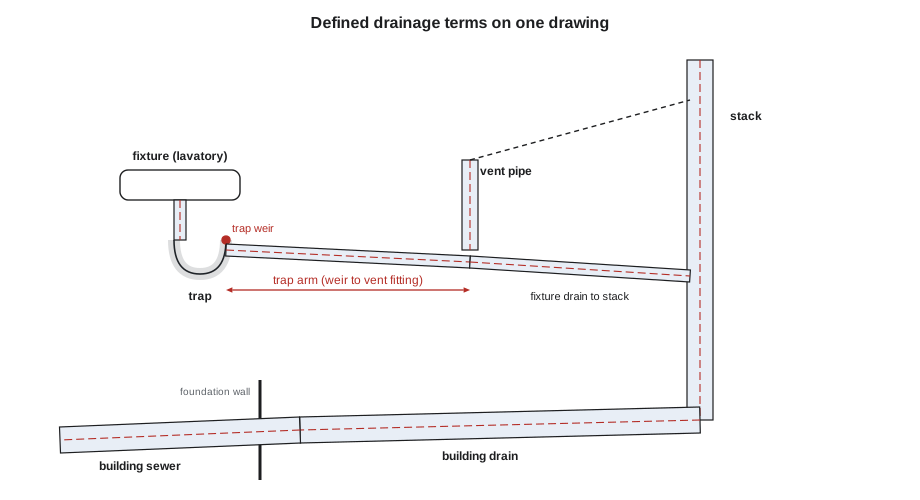
- Fixture: a receptacle or device that receives water or waste and discharges it into the drainage system, such as a toilet, sink, bathtub or floor drain.
- Trap: a fitting or device that holds a seal of water to stop sewer gas passing through it without stopping the flow of waste.
- Trap arm: the part of a fixture drain between the trap weir and the vent pipe fitting. Its length and slope are limited so that the trap is not siphoned.
- Fixture drain: the pipe from the trap of a fixture to where it joins another drain.
- Branch: a drainage pipe that carries waste from fixtures to a stack or building drain, generally running horizontally.
- Stack: a vertical drainage pipe extending through one or more storeys. A soil stack carries toilet waste; a waste stack carries other waste.
- Building drain: the lowest horizontal piping inside the building that receives drainage from stacks and branches and carries it to the building sewer.
- Building sewer: the pipe from the building drain outside the foundation wall to the public sewer or private disposal system.
- Vent pipe: a pipe that admits or removes air to protect trap seals; specific kinds of vent, such as a stack vent, vent stack, continuous vent, wet vent and circuit vent, each have their own definitions.
- Potable water and non-potable water: water fit for drinking and water that is not.
- Cross-connection: any connection through which non-potable water or other substances could enter the potable water system.
- Developed length: the length of a pipe measured along its centreline, including fittings, as opposed to the straight-line distance between its ends.
Several of these words are used loosely on job sites. The foreman in the opening story used trap arm to mean the whole drain from the sink to the stack. The code means only the piece between the trap weir and the vent. That difference decides whether a long drain needs its own vent.
Measuring things the way the code means
Many code arguments come down to how something is measured. The code usually says, either in a definition or in the rule itself, where a measurement starts and stops. Common examples include:
- Developed length is measured along the centreline of the pipe through every fitting. A trap arm that turns two corners is longer than the straight-line distance.
- The length of a trap arm is measured from the trap weir, not from the fixture outlet, to the vent fitting.
- Slope is measured as fall per unit of length, such as 1 in 50 or a quarter inch per foot, not as an angle.
- Heights may be measured from the finished floor, from the flood level rim of a fixture or from the centre of a pipe, depending on the rule.
- Pipe sizes in code tables are nominal sizes, not measured outside or inside diameters.
Worked problem
Measuring a trap arm
A lavatory trap's weir is 40 mm in from the wall. The trap arm runs 600 mm along the wall, turns 90 degrees and runs 900 mm to a sanitary tee where the vent rises. Each fitting adds about 50 mm of centreline length. What is the developed length of the trap arm, and how does it compare with the straight-line distance of about 1100 mm?
Show solution
- Straight runs: \(40 + 600 + 900 = 1540\) mm.
- Fittings: an elbow at the corner and the tee add about \(2 \times 50 = 100\) mm.
- Developed length: \(1540 + 100 = 1640\) mm, or about 1.6 m.
- The straight-line distance from weir to tee is only about 1100 mm, so measuring it that way would understate the length by about half a metre.
Answer: About 1.6 m measured along the pipe. The code limit on trap arm length is applied to the developed length, so measure along the pipe, not across the room.
The program below adds up developed length from a list of straight runs and fittings, the way Maya now does it on a takeoff sheet.
# Developed length = sum of straight runs + centreline allowance for each fitting (mm)
runs = [40, 600, 900]               # straight pieces along the centreline
fittings = {"elbow": 1, "tee": 1}   # fittings on the path
allowance = {"elbow": 50, "tee": 50, "wye": 75}

developed = sum(runs) + sum(allowance[f] * n for f, n in fittings.items())
straight_line = round((40 + 600) ** 2 + 900 ** 2) ** 0.5
print(f"developed length: {developed} mm ({developed / 1000:.2f} m)")
print(f"straight-line distance: {straight_line:.0f} mm")developed length: 1640 mm (1.64 m) straight-line distance: 1104 mm
Fitting allowances vary with fitting type and size; the values in the program are rough figures for teaching. On a real takeoff, measure the actual layout or use the manufacturer's laying lengths.
Reading a requirement word by word
Code requirements are written in a careful legal style. Each word is chosen to mean something specific, and small words matter. Luis taught Maya to slow down and read a requirement the way a lawyer reads a contract.
- "Shall" means the requirement is mandatory. "May" means something is permitted but not required.
- "Not less than" sets a minimum; "not more than" sets a maximum. A rule that says not less than 38 mm means 38 mm is acceptable and 37 mm is not.
- "And" means every condition must be met; "or" means any one of them is enough. A list of conditions joined by "and" is much harder to meet than the same list joined by "or".
- "Except" and "unless" introduce exceptions; read them carefully, because they change the main rule.
- "Where" and "when" set the conditions under which the rule applies. If the condition is not met, the rule does not apply.
- Numbers include units, and a rule may give both metric and imperial values. Use the one the adopted code makes official.
Ontario's code is written in metric units, and the metric values are the official ones. Imperial figures, where shown, are for convenience. When a metric value is converted to imperial, the result is often rounded, so the imperial number in a rule of thumb may be slightly different from the official metric limit.
| Word or phrase | What it means in a requirement |
|---|---|
| shall | Mandatory |
| may | Permitted, not required |
| not less than | Minimum; the value itself is acceptable |
| not more than | Maximum; the value itself is acceptable |
| and | Every listed condition must be met |
| or | Any one listed condition is enough |
| except, unless | Introduces a case where the main rule does not apply |
| where, when | Sets the condition under which the rule applies |
| approved | Accepted by the authority having jurisdiction |
Breaking a requirement into parts
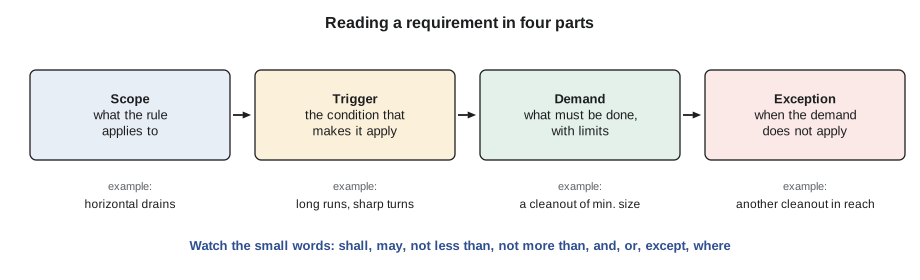
When a requirement is long, it helps to break it into parts: what it applies to, the condition that triggers it, what it demands, and any exceptions. Maya practised on a rule about cleanouts. Written in plain language, the rule she looked up said roughly this: cleanouts shall be provided in horizontal drainage pipes at certain intervals and at changes of direction, except where the pipe can be cleaned from another cleanout within a stated distance.
- Applies to: horizontal drainage pipes inside the building.
- Trigger: length of run and changes of direction greater than a stated angle.
- Demand: a cleanout of a minimum size, accessible for use.
- Exception: where another cleanout already allows the pipe to be rodded within the limit.
Once the rule was broken apart, the questions about it became easy to answer. Was the pipe horizontal? Yes. Was the run longer than the interval? Yes. Was there another cleanout within reach? No. So a cleanout was required, and its size and access had to meet the rule.
When a definition changes the answer
Back on the trap arm question, Luis showed Maya why the definition mattered. The code limits the length of a trap arm to protect the trap from being siphoned: if the drain falls too far below the trap weir before it reaches a vent, flowing water can pull the seal out of the trap. Because the limit applies to the trap arm, measured from the weir to the vent fitting, moving the sink farther from the stack is allowed as long as a vent is added close enough to the trap. The foreman's sink move was possible, but it needed a new vent, which meant opening the wall again. Knowing the definition turned an argument into a solution.
Maya also learned that the same word can be defined slightly differently in different codes. A term that means one thing in the NPC can mean something a little different in the IPC or the UPC. A plumber who moves between jurisdictions should read the definitions again, even for familiar words.
Interpreting unclear wording
Codes are written carefully, but no code covers every situation clearly. When the wording is unclear, a plumber has a few tools.
- Read the requirement in context: headings, neighbouring requirements and the scope of the section often clarify it.
Read the objectives and functional statements attached to the requirement in Division A, which say what the rule is meant to achieve. Lesson 4 covers these in detail.
- Read the explanatory notes or commentary, keeping in mind that they are guidance, not requirements.
- Ask the authority having jurisdiction for an interpretation, preferably in writing, before the work is installed.
For difficult questions, the province offers interpretation help to building officials, and Ontario has a body that can issue binding rulings on disputes about code requirements between an owner and a building official.
What a plumber should not do is pick the interpretation that is easiest or cheapest and hope the inspector agrees. If an interpretation is reasonable, it will survive being written down and sent to the inspector before the work is done.
Common mistakes
MistakeUsing everyday meanings for words the code defines.
InsteadCheck the definition whenever a word decides the answer.
MistakeMeasuring straight across instead of along the pipe.
InsteadUse developed length when the code says so, measured along the centreline through fittings.
MistakeReading "or" as "and", or the reverse.
InsteadCount the conditions and check whether all or any must be met.
MistakeTreating "not less than 38 mm" as "more than 38 mm".
InsteadThe stated value itself is acceptable for not less than and not more than.
MistakeChoosing the cheapest interpretation of unclear wording without asking.
InsteadGet an interpretation from the authority before the work goes in.
Summary and key terms
- Defined terms in the code override everyday meanings wherever they appear.
- Key drainage terms such as trap arm, fixture drain, branch, stack, building drain and building sewer each carry their own rules.
- The code says how things are measured; developed length is measured along the centreline through fittings.
- Small words such as shall, may, not less than, and, or and except decide what a requirement demands.
- Break long requirements into scope, trigger, demand and exceptions.
- When wording is unclear, read context and intent, then ask the authority having jurisdiction.
- Trap arm
- The part of a fixture drain from the trap weir to the vent fitting.
- Developed length
- The length measured along the centreline of a pipe, including fittings.
- Trap weir
- The lowest point of the trap outlet, which sets the level of the trap seal.
- Shall
- Word that makes a requirement mandatory.
- Approved
- Accepted by the authority having jurisdiction.
- Nominal size
- The standard trade size of a pipe, used in code tables, which is not exactly its inside or outside diameter.
Practice problems
Work each problem on paper first, then reveal the answer to check.
What does it mean when a word in the code is defined?
Show answer
Its definition overrides the everyday meaning wherever it appears in the code.
From where to where is a trap arm measured?
Show answer
From the trap weir to the vent fitting, along the pipe.
A rule says a seal of not less than 38 mm. Is 38 mm acceptable?
Show answer
Yes. Not less than means the value itself is the minimum and is acceptable.
A rule lists three conditions joined by "or". How many must be met?
Show answer
Any one of them.
What are the four parts to look for when breaking down a requirement?
Show answer
Scope, trigger, demand and exceptions.
What should you do when a requirement is genuinely unclear?
Show answer
Read context and intent, then ask the authority having jurisdiction, preferably in writing, before installing.
Lesson quiz · 5 questions
Score 60% or more to complete this lesson.
Create a free account to save your progress, take quizzes and earn a certificate.