
PLB-210 · Lesson 2 of 12 · 21 min
How the code is organized and how to find a requirement
On Maya's second day, Luis handed her a question instead of a task. "The engineer shows a 75 millimetre stack serving six suites of kitchen sinks on the east side. The inspector asked whether that is big enough. Find me the rule." Maya opened the code book and stared at the table of contents. She knew the answer was in there somewhere, but the book had hundreds of pages, and she did not know where to start. By the end of the day she had found it, but it took her three hours. Luis said that with practice it would take three minutes.
This lesson is about those three minutes. Finding a requirement quickly and correctly is a skill, and like any skill it depends on knowing the layout of the tool. A plumber who knows how the code is organized can go straight to the right section, find the right table and check whether there are exceptions or notes that change the answer.
The big picture: what is in a plumbing code
Every plumbing code, whatever its origin, covers roughly the same ground. It starts with administration and definitions, then sets general rules that apply everywhere, then works through the systems one at a time: fixtures, water heaters, water supply, drainage, venting, traps and interceptors, storm water and special systems. At the back are lists of referenced standards and appendices with explanatory material. Once you know that order, you can guess where a rule lives before you open the book.
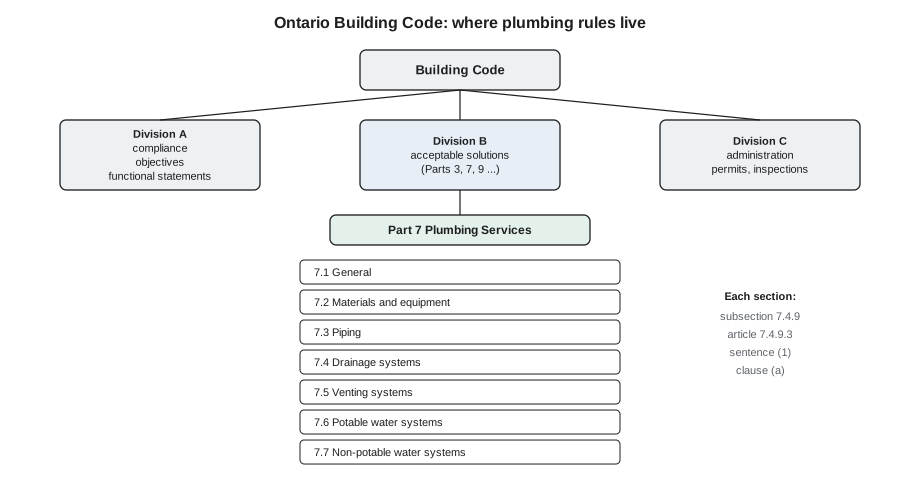
The National Plumbing Code of Canada is divided into three divisions. Division A sets out compliance, objectives and functional statements: what the code applies to, how compliance is achieved, and what each rule is trying to accomplish. Division B contains the acceptable solutions, which are the technical rules most plumbers think of as the code. Division C covers administrative provisions. Ontario's Building Code uses the same three divisions for the whole building code, and plumbing is Part 7 of Division B.
Within Division B of the NPC, plumbing systems are covered in one part divided into sections in a predictable order: general requirements, materials and equipment, piping, drainage systems, venting systems, potable water systems and non-potable water systems. Ontario's Part 7 follows the same order in Sections 7.1 to 7.7. Each section is divided into subsections, articles, sentences and clauses, and every requirement has a number that shows exactly where it sits.
Reading a code reference
Every requirement in the NPC and Ontario's code has a reference number that works like an address. The number 7.4.9.3.(1) in Ontario's code means Part 7, Section 7.4, Subsection 7.4.9, Article 7.4.9.3, Sentence (1). Below sentences there can be clauses, written as (a), (b), (c), and subclauses, written as (i), (ii), (iii). When an inspector cites a rule, the number tells you exactly where to look. When you write a note or an email about a code question, always give the full reference so the reader can check it.
The structure also tells you something about how the rule relates to its neighbours. A requirement deep inside a subsection usually depends on the general statement above it. If the general statement says it applies only to certain buildings or certain piping, so does everything under it. Reading only the detailed line and skipping its parent is one of the most common ways to get a code question wrong.
Worked problem
Decoding a reference
An inspector's note on a drainage question says: "See 7.4.9.3.(1)." What does each part of the number tell Maya?
Show solution
- 7: Part 7, Plumbing Services, of Division B.
- 7.4: Section 7.4, Drainage Systems.
- 7.4.9: the ninth subsection of that section; its heading tells her which drainage topic it covers.
- 7.4.9.3: the third article within that subsection.
- (1): the first sentence of the article. Maya should read the whole article, and the subsection heading above it, to see the context.
Answer: The reference is an address: part or chapter, then section, then smaller divisions. Always read the requirement in its context, with its headings.
The article and section numbers in this course are given to show how references work and where kinds of rules live. Numbers can move between editions, so always check the edition that applies to your job before quoting one.
Three ways into the code
There are three main ways to find a rule, and experienced plumbers use all three.
- The table of contents. Use it when you know which system the question is about. A question about stack sizing belongs in drainage; a question about vent pipe size belongs in venting. Go to the right section and scan its headings.
- The index. Use it when you know the topic but not where the code puts it. Look up a specific word, such as cleanout, interceptor or hose bibb, and follow the references. If the first word does not work, try a synonym.
- Search in an electronic copy. Many plumbers now use digital codes. Search is fast, but it finds words, not meaning. A search for "stack" returns hundreds of hits; a search for the exact phrase used in a heading is better. Search results also pull lines out of context, so always read the surrounding requirement.
Luis's advice was to start with the table of contents, because it forces you to think about which system the question belongs to. Many wrong answers come from finding a rule that sounds right but sits in the wrong section, such as a water supply sizing table used for a drain.
Tables, notes and footnotes
Much of the technical content of a plumbing code is in tables: fixture unit values, pipe sizes, slopes, vent lengths, minimum fixture counts and so on. Tables pack a lot of information into a small space, and they are easy to misread. Before using a table, read its title and any notes under it. The notes often limit when the table applies or change values for particular cases.
- Check the units. A table may give sizes in millimetres, inches or both, and lengths in metres or feet.
- Check what the numbers mean. A fixture unit value for drainage is not the same as a fixture unit value for water supply.
- Check the columns and rows carefully. Run a ruler or finger along the row, especially in wide tables.
- Read every note. Notes can say that a value applies only to horizontal pipes, only to certain fixtures or only above a certain height.
- Look for the requirement that sends you to the table. The table is part of a rule, and the rule may add conditions.
The NPC and Ontario's code also contain explanatory notes in an appendix, marked in the text with a small note reference. These notes explain the intent and give examples, but they are not part of the requirements. They are very useful for understanding a rule, but an inspector enforces the requirement itself, not the note.
| Kind of content | What it does | Enforceable? |
|---|---|---|
| Requirement (article, section) | States what must be done | Yes |
| Table referred to by a requirement | Gives values the requirement uses | Yes |
| Note under a table | Limits or modifies the table values | Yes, as part of the table |
| Explanatory note in the appendix | Explains intent and gives examples | No |
| Appendix not part of Division B | Optional or guidance material | No |
Finding Maya's stack rule
Luis made Maya walk through her stack question again so she could see the path an experienced plumber would take.
First, decide the system: a stack carrying kitchen sink waste is part of the drainage system, so the answer is in Section 7.4, Drainage Systems. Second, find the subsection on sizing: the table of contents lists a subsection on the size of drainage pipes. Third, read the general requirement, which says how to determine the hydraulic load on a stack, in fixture units, and refers to a table of maximum loads for stacks. Fourth, read the table and its notes. Fifth, check for special rules: Ontario's code has limits on how much load may enter a stack from a single branch and on connections near offsets, and those could change the answer.
Doing it in that order took Maya about ten minutes the second time. The answer was that the stack was big enough for the load the engineer had shown, but only because the kitchen sinks entered through branches that met the code's rules. If a branch had been undersized, the stack size alone would not have saved it.
The program below shows the logic of looking up a size in a table: find the smallest size whose capacity is at least the load. It uses a simplified practice table, not the code's values, so that the method is clear.
# Look up the smallest stack size that carries a given load (practice table only)
practice_table = [   # (size in mm, maximum fixture units on the stack)
    (50, 10), (75, 30), (100, 240), (125, 540), (150, 960)]

def smallest_size(load, table):
    for size, capacity in table:
        if load <= capacity:
            return size
    return None

for load in (8, 18, 30, 31, 200, 1000):
    size = smallest_size(load, practice_table)
print(f"load {load:5d} fixture units -> {size if size else 'beyond table'} mm")load 8 fixture units -> 50 mm load 18 fixture units -> 75 mm load 30 fixture units -> 75 mm load 31 fixture units -> 100 mm load 200 fixture units -> 100 mm load 1000 fixture units -> beyond table mm
The numbers in the practice table are made up for teaching. Always take values from the adopted code for the job.
Exceptions and the word "except"
Many requirements contain exceptions, often introduced by the words "except as provided in" followed by another reference. An exception can say that a rule does not apply in a certain case, or that a different rule applies instead. When a requirement sends you elsewhere, follow the reference and read it before deciding. A plumber who reads only the first half of a sentence can install something the code allows only in a narrow case, or miss a relaxation that would have saved money.
Maya started keeping a small notebook of rules she had looked up, with the reference and a one-line summary in her own words. Luis approved. Writing the summary forced her to understand the rule, and the notebook became a quick index to the parts of the code she used most.
Other documents that act like code
The plumbing code is not the only document that controls plumbing work on a building. A plumber also has to know when to look elsewhere.
The rest of the building code: Part 3 and Part 9 of Ontario's code contain the minimum numbers of fixtures, accessibility rules for washrooms and rules for fire separations that plumbing pipes pass through. The fire code and the electrical code also affect plumbing work, such as fire stopping and the bonding of water piping.
- Referenced standards: when the code says a backflow preventer must be tested, or a water heater installed, to a particular standard, that standard's requirements apply.
- Manufacturers' installation instructions: codes usually require products to be installed according to the manufacturer's instructions, which makes those instructions enforceable.
- Local rules: sewer-use and water utility rules, and the engineer's specification for the project.
Luis summed it up: the plumbing code is the centre, but not the whole picture. When a question touches fire separations, accessibility, electrical bonding or the city's sewer, check whether another document governs.
Common mistakes
MistakeStarting with a search for one word and taking the first hit.
InsteadDecide which system the question belongs to, then use the table of contents or index and read the rule in context.
MistakeReading a table without its title and notes.
InsteadRead the title, units and every note before using a value.
MistakeTreating explanatory notes or commentary as requirements.
InsteadNotes explain intent; the requirement itself is what is enforced.
MistakeQuoting a reference number without the code edition.
InsteadGive the code and edition, because numbers move between editions.
MistakeIgnoring an exception or a reference to another rule.
InsteadFollow every reference and read the exception before deciding.
Summary and key terms
- Plumbing codes follow a predictable order: administration and definitions, general rules, then each system, then referenced standards and appendices.
- The NPC has three divisions: A (compliance and objectives), B (acceptable solutions) and C (administration); Ontario's plumbing rules are Part 7 of Division B.
- A reference number is an address; read each requirement together with the headings above it.
- Use the table of contents, the index and electronic search together, and always read results in context.
- Tables carry most of the numbers; check units, meaning and notes.
- Explanatory notes and commentary explain intent but are not requirements.
- Other codes, standards, manufacturers' instructions and local rules also govern plumbing work.
- Acceptable solution
- A technical requirement in the code that is deemed to meet the code objectives.
- Requirement
- A rule in the code that must be met; it is enforceable.
- Explanatory note
- Material that explains the intent of a requirement but is not itself enforceable.
- Exception
- A provision that limits where a rule applies or substitutes a different rule.
- Index
- An alphabetical list of topics at the back of the code with references to where each is covered.
- Code edition
- The year version of a code, which determines which rules and numbers apply.
Practice problems
Work each problem on paper first, then reveal the answer to check.
What do Divisions A, B and C of the NPC each contain?
Show answer
A: compliance, objectives and functional statements; B: acceptable solutions; C: administrative provisions.
Which section of Ontario's Part 7 covers venting systems?
Show answer
Section 7.5.
What does the (1) in 7.4.9.3.(1) refer to?
Show answer
Sentence (1) of Article 7.4.9.3.
Why is it risky to rely on a single search hit in a digital code?
Show answer
Search finds words, not meaning, and pulls lines out of context.
Are explanatory notes in the appendix enforceable?
Show answer
No; they explain intent, but the requirement is what is enforced.
Where would you look for the minimum number of toilets required in an office?
Show answer
In the building code's rules on fixture counts, not only the plumbing part.
Lesson quiz · 5 questions
Score 60% or more to complete this lesson.
Create a free account to save your progress, take quizzes and earn a certificate.