
PLB-210 · Lesson 10 of 12 · 21 min
Hot water, backflow protection and special systems in the code
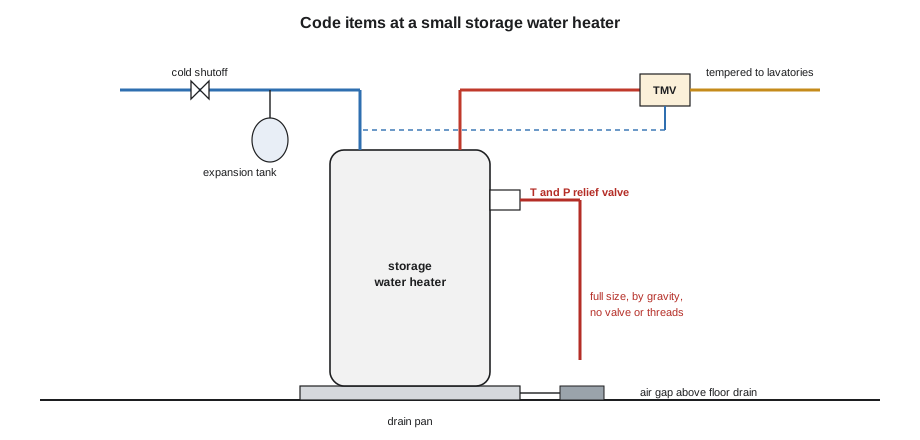
The café's under-counter water heater was small, but Maya found that it carried almost as many code rules as Kingsway's central hot water plant. It needed a temperature and pressure relief valve with a discharge pipe ending in the right place, a shutoff on the cold supply, protection against thermal expansion, a drain pan if leakage could damage the floor, and a mixing valve to keep the hand sinks from scalding. On the same drawing, the coffee machine, ice machine, dishwasher and chemical dispenser each needed backflow protection matched to their hazard. Luis called it a good lesson in how many rules hang on small pieces of equipment.
This lesson covers three groups of code rules that sit between the main water supply and drainage systems: water heaters and hot water temperature limits, backflow protection matched to hazard, and special systems such as non-potable water, medical gas and interceptors that the code treats separately.
Where these rules live
In Ontario's code, the hot water temperature limits, water heater connections, relief valves and backflow prevention rules are in Section 7.6, together with references to the standards for water heaters and backflow preventers. Non-potable water systems, including rainwater and greywater, are in Section 7.7. Interceptors and indirect waste are in the drainage section. The installation of gas-fired water heaters is also governed by the gas code, and electric heaters by the electrical code.
A plumber working on a water heater or a piece of food service equipment usually needs rules from more than one place. The habit of checking all of them before installing saves trips back.
Water heater rules
Water heaters store energy as well as water. A heater whose controls fail can overheat and build pressure until the tank ruptures with explosive force. Most of the code's water heater rules exist to prevent that, or to prevent the water damage and scalds that follow smaller failures.
- Temperature and pressure relief valve: every storage water heater needs a listed relief valve that opens on excess temperature or pressure. It must be the right size and rating for the heater and installed where the heater's manufacturer says.
- Relief valve discharge: the discharge pipe must be full size, run by gravity to a safe place where people will not be scalded and the discharge can be seen, end a short distance above the floor or into an indirect receptor with an air gap, and have no valve, trap or threaded end.
- Cold supply valve: a shutoff valve is required on the cold water supply to the heater.
- Drain pans: where a leak would damage the building, a pan with a drain to a suitable place is required.
- Location and access: heaters must be accessible for service and replacement, protected from damage, and, for gas-fired heaters, installed with the clearances and combustion air the gas code requires.
- Thermal expansion: where a check valve, backflow preventer or pressure-reducing valve makes the system closed, expansion must be controlled, usually with an expansion tank.
Worked problem
Checking a relief valve discharge
The café heater's relief valve has a 20 mm outlet. The installer ran a 15 mm copper pipe from it, through a trap formed by a dip under the counter, to a threaded cap behind the base cabinet. List the code problems.
Show solution
- The discharge pipe is smaller than the valve outlet; it must be at least full size.
- The dip forms a trap, where water would stand and could freeze or restrict flow; the pipe must drain by gravity.
- The end is capped and threaded; it must be open and not threaded so nobody can plug it.
- The discharge cannot be seen; it must end where a discharge will be noticed and not scald anyone, such as above a floor drain or an indirect receptor.
Answer: Four problems: undersized, trapped, threaded and capped, and hidden. The discharge pipe must be full size, drain by gravity and end open in a safe, visible place.
Hot water temperature limits
Hot water causes two hazards at opposite ends of the temperature range. Water stored too cool lets Legionella bacteria grow. Water delivered too hot scalds, especially young children and older people. The code handles this by allowing, and in practice requiring, hot water to be stored hot, then limiting the temperature delivered at fixtures where people bathe and wash.
Ontario's code limits the hot water temperature delivered at showers and bathtubs in dwellings to 49°C, through pressure-balancing or thermostatic valves or a mixing device, and sets limits for other fixtures and occupancies. Water heaters are commonly set to store water at about 60°C to control Legionella. PLB-130 described how Kingsway's central plant stores water hot and tempers it with a master mixing valve.
For the café, the hand sinks used by the public in the washrooms needed tempered water, so the under-counter heater fed a small thermostatic mixing valve set to the code limit. The three-compartment sink, used for washing dishes, could receive hotter water, because the health unit requires hot water there for sanitizing.
The program below shows why mixing valves and storage temperatures work together. It estimates the share of hot water needed to reach a target temperature at the tap from a given storage temperature and cold water temperature.
# Share of hot water needed to mix to a target temperature (simple energy balance, deg C)
def hot_fraction(t_hot, t_cold, t_target):
    return (t_target - t_cold) / (t_hot - t_cold)

t_cold = 8          # winter cold water
for t_hot in (49, 55, 60, 65):
    f = hot_fraction(t_hot, t_cold, 43)   # 43 C at the lavatory
print(f"stored at {t_hot} C -> {f:.0%} hot, {1 - f:.0%} cold for 43 C at the tap")stored at 49 C -> 85% hot, 15% cold for 43 C at the tap stored at 55 C -> 74% hot, 26% cold for 43 C at the tap stored at 60 C -> 67% hot, 33% cold for 43 C at the tap stored at 65 C -> 61% hot, 39% cold for 43 C at the tap
The hotter the stored water, the less of it is needed for each use, so storing water hot also stretches the heater's capacity. That is one more reason codes and designers favour hot storage with mixing at the point of use.
Backflow protection matched to hazard
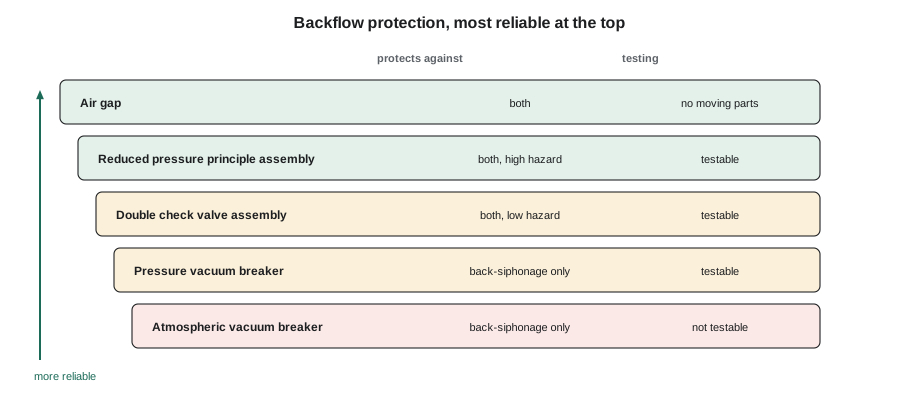
Lesson 9 introduced the kinds of backflow protection. The code goes further: it says which device is acceptable for which kind of connection, based on the degree of hazard and on whether the connection is exposed to back-siphonage only or to backpressure too.
- High hazard: a substance that could cause illness or death, such as chemicals, sewage or boiler treatment. Requires an air gap or a reduced pressure principle assembly.
- Low hazard: a substance that would make the water unpleasant but not harmful. A double check valve assembly or other lower-level device may be accepted.
- Back-siphonage only: vacuum breakers may be acceptable where there is no possibility of backpressure and no continuous pressure downstream.
- Backpressure possible: where a pump, boiler or elevated piping could push water back, vacuum breakers are not enough; a check-type assembly or air gap is required.
Ontario's code requires backflow preventers to be selected, installed and tested in accordance with the referenced CSA standard for selection and installation, which classifies hazards and lists acceptable devices. Hamilton's backflow program also requires premise isolation for many buildings and annual testing by a certified tester, with reports to the city.
| Connection | Hazard | Typical protection |
|---|---|---|
| Chemical dispenser at a mop sink | High | Air gap or reduced pressure principle assembly; dispenser's built-in air gap if listed |
| Boiler with treatment chemicals | High | Reduced pressure principle assembly |
| Hose bibb | Back-siphonage | Vacuum breaker |
| Ice machine, coffee machine | Low to moderate | Device listed for beverage equipment, as required |
| Carbonated beverage dispenser | Moderate | Device listed for carbonated beverage use, with no copper downstream |
| Premise isolation at the meter | Depends on use | Double check or reduced pressure assembly, as the utility requires |
Non-potable water systems
More buildings now reuse water: rainwater collected from roofs for toilet flushing and irrigation, greywater from showers and lavatories treated and reused, and condensate or other clear water. The code allows these systems under strict rules, because the biggest risk is that someone connects them to the drinking water by mistake, or drinks from them.
- Separate piping, clearly marked and coloured, with warning signs at outlets and in mechanical rooms.
- Treatment appropriate to the use, such as filtration and disinfection, to the standard the code references.
- Make-up water from the potable system only through an air gap or an approved backflow assembly.
- Testing at installation to prove there is no cross-connection, and often periodic retesting.
Ontario's code includes rules for rainwater and greywater systems in Section 7.7, referencing CSA standards for their design and installation.
Other special systems
The code also covers a range of special systems that a plumber may meet less often.
- Medical gas and vacuum systems in health care facilities, which are installed to a separate standard by specially certified installers.
- Interceptors and separators for grease, oil, sand, hair, lint and other materials, sized to the code and the city's sewer rules, with access for cleaning.
- Chemical and acid waste systems in laboratories and some industries, which need resistant materials and neutralization before discharge.
- Swimming pools, spas and decorative fountains, with backflow protection on fill lines and rules on discharge to drains.
- Fire sprinkler connections, which are mostly governed by the fire codes and standards but need backflow protection where they connect to the potable supply.
- Emergency fixtures such as eyewash and emergency showers, which need tempered water and are governed partly by workplace safety rules.
The café's grease interceptor was the one special system on Maya's drawing. She checked its size against the code and the city's sewer rules, its location for access, its vent and its sampling point. Luis reminded her that interceptors are useful only if they are cleaned, so access for the pump-out truck mattered as much as the size.
Checking a water heater installation
Before calling the final inspection on the café, Maya walked the heater with a short list: the heater's rating plate matched the drawing; the relief valve was rated for the heater's input and pressure and its discharge was full size, unthreaded, sloped and visible; the cold valve was accessible; the expansion tank was charged to the building pressure; the pan drained to the floor drain through an air gap; the mixing valve was set and its outlet temperature measured at the nearest lavatory; and the electrical disconnect was within sight of the heater, as the electrical code requires. Writing the measured temperature on the inspection sheet answered the inspector's first question before he asked it.
Common mistakes
MistakeRunning a relief valve discharge smaller than the valve outlet, or trapping or capping it.
InsteadUse a full-size pipe that drains by gravity and ends open in a safe, visible place.
MistakeSetting a water heater low to prevent scalds.
InsteadStore hot to control Legionella and use mixing valves to limit delivery temperature.
MistakeUsing a vacuum breaker where backpressure is possible.
InsteadUse an assembly or air gap that protects against backpressure.
MistakeChoosing a backflow device by price instead of hazard.
InsteadMatch the device to the degree of hazard and the type of backflow.
MistakeConnecting a rainwater system's make-up directly to potable water.
InsteadProvide make-up through an air gap or approved assembly.
Summary and key terms
- Water heater, hot water and backflow rules are in Section 7.6 of Ontario's code; non-potable systems are in Section 7.7.
- Storage water heaters need a relief valve with a full-size, gravity-draining, open, visible discharge; a cold supply valve; pans where leaks would cause damage; and expansion control in closed systems.
- Shower and bathtub temperatures in dwellings are limited to 49°C; water is stored hotter to control Legionella.
- Backflow protection is chosen by degree of hazard and by whether backpressure is possible; testable assemblies are tested at installation and yearly.
- Non-potable systems need separate marked piping, treatment, protected make-up and cross-connection testing.
- Special systems such as medical gas, interceptors, chemical waste and pools have their own rules and standards.
- Temperature and pressure relief valve
- A valve on a water heater that opens on excess temperature or pressure.
- Thermostatic mixing valve
- A valve that blends hot and cold water to a set outlet temperature.
- Degree of hazard
- How harmful a contaminant at a cross-connection would be, used to choose backflow protection.
- Reduced pressure principle assembly
- A testable backflow assembly with two checks and a relief valve for high-hazard connections.
- Premise isolation
- Backflow protection at the service entrance that isolates a whole building from the public supply.
- Rainwater harvesting system
- A non-potable system that collects and stores rainwater for uses such as flushing and irrigation.
Practice problems
Work each problem on paper first, then reveal the answer to check.
Name four requirements for a relief valve discharge pipe.
Show answer
Full size, drains by gravity with no traps, no valve and no threaded end, and ends in a safe, visible place.
What is the maximum hot water temperature at showers in dwellings under Ontario's code?
Show answer
49°C.
Why are water heaters set to store hotter water than people can safely use?
Show answer
To control Legionella; mixing valves then limit the delivery temperature.
Which backflow protection suits a boiler with chemical treatment?
Show answer
A reduced pressure principle assembly.
Why is a vacuum breaker not acceptable where backpressure is possible?
Show answer
It only protects against back-siphonage.
In which section of Ontario's code are rainwater and greywater systems covered?
Show answer
Section 7.7.
Lesson quiz · 5 questions
Score 60% or more to complete this lesson.
Create a free account to save your progress, take quizzes and earn a certificate.