
PLB-210 · Lesson 1 of 12 · 24 min
How plumbing codes are written, adopted and amended
Maya Chen started the second level of her plumbing apprenticeship in the same place she finished the first: Kingsway Tower, the 12-storey residential building over two parking levels in Hamilton where Northbridge Mechanical holds the plumbing contract. The rough-in was done on most floors, the risers were tested, and the finishing crews were setting fixtures on the lower floors. On her first morning back, Luis Ferreira put a thick binder on the gang box in front of her and opened it to a page covered in small print and numbers. "Up to now you learned how to install things," he said. "This level is about why. Every pipe size, slope, vent and valve you put in this building is there because a code says so. You need to be able to find the rule yourself, read it properly, and show an inspector where it is."
This course is the first of two on the plumbing code. PLB-110, PLB-120 and PLB-130 taught the materials, the drainage and venting system and the water supply system, and they mentioned code rules as they went. PLB-210 turns the code itself into the subject: where it comes from, how it is organized, how to read a requirement, and how its main parts apply to real work. The examples use the National Plumbing Code of Canada and the Ontario Building Code, Part 7, because Kingsway Tower is in Ontario. The skills carry over to any province.
The first lesson answers a question many apprentices never ask: where does the code come from, and who decides what it says? Knowing the answer explains why the book in Luis's binder is not quite the same as the one a plumber uses two provinces or states away, why the rules change every few years, and why an inspector sometimes asks for something the national book does not mention.
Why plumbing has a code at all
Plumbing codes exist because bad plumbing makes people sick. In the nineteenth century, cities in Europe and North America grew faster than their water and sewer systems, and outbreaks of cholera and typhoid spread through contaminated water. Engineers and public health officials learned that clean water, proper drainage, trap seals, venting and the separation of drinking water from waste were the difference between a healthy city and an epidemic. The first plumbing regulations were written by cities to stop the worst practices: wells next to cesspools, drains without traps, and drinking water pipes cross-connected to sewers.
Over time, cities found that writing and updating their own plumbing rules was expensive and led to confusion. A plumber working in two neighbouring towns could face two different rule books. Manufacturers had to make products to many local standards. That pressure led to model codes: a single, carefully written code that many governments could adopt as their own, with local changes where needed.
Every rule in a modern plumbing code still traces back to one of a small number of purposes. Luis put it simply for Maya: protect health, protect safety, protect the building and its neighbours, and make sure the system can be used and maintained. When a rule seems fussy, asking which of those purposes it serves usually explains it.
- Health: keep drinking water safe, carry waste away completely, and keep sewer gases out of the building.
- Safety: prevent scalds, explosions of water heaters, injuries from broken fixtures and falls caused by leaks.
- Protection of the building: prevent water damage, freezing, structural damage from cutting and notching, and fires spread through openings.
- Function and access: make sure fixtures work, systems can be cleaned out and tested, and people with disabilities can use the facilities.
Model codes and the codes that are law
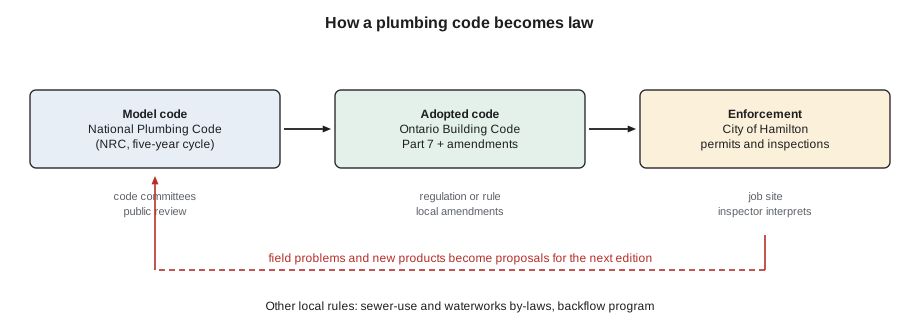
A model code is a document written by a code body so that governments can adopt it. On its own, a model code is not law. It becomes law only when a government with authority over construction adopts it, usually by referencing it in a regulation or by-law, sometimes with amendments. The version that is actually enforced on a job site is the adopted code, not the model.
In Canada, the model plumbing code is the National Plumbing Code of Canada, often shortened to the NPC. It is developed by standing committees of volunteers from industry, governments and the public, working under the Canadian Board for Harmonized Construction Codes, which replaced the older Canadian Commission on Building and Fire Codes. The National Research Council of Canada publishes it. Construction is a provincial and territorial responsibility under the Constitution, so the NPC becomes law only when a province or territory adopts it, either directly or as the basis of its own code.
Ontario does not adopt the NPC word for word. Instead, it writes its own Building Code, a regulation under the Building Code Act, 1992, and Part 7 of that code covers plumbing. Ontario's Part 7 follows the structure and most of the technical content of the NPC, with Ontario changes. The current edition took effect on January 1, 2025, and is based on the 2020 national codes. Other provinces take different approaches: some adopt the NPC by reference with a short list of amendments, and some publish their own edition with provincial changes built in.
Who writes the code
The NPC is written by consensus. Anyone can propose a change: a plumber, an inspector, a manufacturer, an engineer or a member of the public. Proposals go to a standing committee on plumbing, made up of volunteers chosen to balance the interests of regulators, industry and the general public. The committee studies each proposal, often with the help of task groups, and decides whether to recommend it. Recommended changes are published for public review, comments are considered, and only then are the changes approved for the next edition. The process is slow on purpose, because a code change affects every building built afterward.
This matters to an apprentice for a practical reason. When something in the code does not make sense, or a new product does not fit the rules, there is a way to change it. Many code changes start with an experienced plumber or inspector who noticed a problem in the field and wrote a proposal. Luis had once helped his union's code committee prepare a proposal on cleanout access, and he still remembered how long it took.
Editions and code cycles
The national codes are updated on a five-year cycle. Recent editions are 2010, 2015, 2020 and 2025. The 2025 National Plumbing Code was released in late December 2025. A new national edition does not automatically change the law in any province. Each province decides when to adopt it, and adoption can lag by a year or more. Alberta, for example, has announced that it will adopt the 2025 NPC in January 2027. Ontario's current code is based on the 2020 national codes, so the 2025 NPC is not yet the law in Ontario.
Because of the lag, a plumber has to know which edition applies to a given job. The rule is that a building is normally built to the code in force when the permit was applied for, even if a newer code takes effect while the building is under construction. A large project like Kingsway Tower can take three years to build, and the code edition is fixed by the permit date. Transition periods are common: a government announces a new code, sets an effective date, and allows permits applied for within a set time to use either the old or the new code.
Worked problem
Which code applies?
Kingsway Tower's plumbing permit was applied for in February 2025, after the current Ontario Building Code took effect on January 1, 2025. A change order in 2026 adds a ground-floor café. Which code governs the original plumbing, and what should Maya check for the café?
Show solution
- The permit was applied for under the current Ontario Building Code, so the original plumbing is built to that code, Part 7.
- The café is new work that may need its own permit or a permit revision. Ask the building department which code applies to the revision.
- Had the permit been applied for in 2024, the older code could have applied under the province's transition rules, so dates always matter.
- Record the answer in the job file so that everyone works to the same code.
Answer: The code in force at the permit application date governs, and changes may need to be checked against the code in force when they are permitted. When in doubt, ask the building department and write down the answer.
Amendments: why local codes differ
Governments that adopt a model code often change parts of it. These changes are called amendments, and they are why the code in force in one place can differ from the model and from the code next door. Amendments usually fall into a few groups.
- Climate and geography: deeper frost protection in cold regions, different rules for areas with expansive soils or earthquakes.
- Local practice and history: a city that has always required cast iron in tall buildings, or that bans a material after failures.
- Water supply conditions: rules for high city pressure, hard water or private wells.
- Administrative matters: who issues permits, who may do plumbing work, what licences are required and how inspections are booked.
- Policy goals: water conservation, energy efficiency, accessibility or lead reduction that go beyond the model.
Ontario's Part 7 differs from the NPC in a number of places, including some fixture and venting rules and provisions for things such as greywater and rainwater systems. Hamilton itself does not rewrite the plumbing code, because Ontario's Building Code applies across the province and municipalities may not change its technical requirements, but the city has its own sewer-use and waterworks by-laws that affect plumbing, such as rules on backflow prevention, grease interceptors and what may be discharged to the sewer.
Luis gave Maya a rule she would hear many times: the code is the minimum. An engineer's specification can require more than the code, a city by-law can add rules, and the owner can ask for better materials. What nobody can do is build to less than the code without an approved alternative. When the drawings, the specification and the code disagree, the stricter requirement usually governs, and the question goes to the engineer or the inspector before the work goes in.
Codes, standards and listings
The plumbing code does not try to describe every product. Instead, it refers to standards: documents that describe how a pipe, fitting, valve or fixture must be made and tested. When the code says a material must conform to a particular standard, it brings that standard into the code. The code tells you what to use and where; the standard tells the manufacturer how to make it.
Most plumbing product standards referenced by the NPC and Ontario's code are published by the CSA Group, with others from ASTM International, NSF International and other bodies. For example, plastic drainage pipe, copper tube, backflow preventers and water heaters each have their own standards. A product is shown to meet a standard by certification: an accredited certification body tests the product, and the product carries the body's mark. The inspector looks for the mark.
Maya had already seen these marks printed along PVC drain pipe and stamped on copper fittings. Now she understood why Luis rejected a box of cheap fittings from an online seller: they had no certification mark, so there was no proof they met the referenced standard, and the inspector would have been right to fail them.
The program below is the kind of quick check a foreman might run on a materials list: it compares each item's certification marks against what the job requires and flags anything missing.
# Check a materials list for the certification marks the job requires
required = {"pvc dwv pipe": "CSA B181.2", "copper tube type l": "ASTM B88",
            "rp backflow preventer": "CSA B64", "pex tubing": "CSA B137.5"}
delivered = [("pvc dwv pipe", ["CSA B181.2"]), ("copper tube type l", ["ASTM B88"]),
             ("rp backflow preventer", []), ("pex tubing", ["CSA B137.5", "NSF 61"])]

for item, marks in delivered:
    need = required[item]
    status = "ok" if need in marks else "REJECT: no " + need + " mark"
print(f"{item:24s} {status}")pvc dwv pipe ok copper tube type l ok rp backflow preventer REJECT: no CSA B64 mark pex tubing ok
The example standard numbers in the program are typical of what appears on a specification, but always take the actual standard from the code and the project specification, not from memory.
Who enforces the code
In Ontario, municipalities enforce the Building Code through their chief building officials and inspectors. A plumbing permit is issued by the municipality, and the municipal inspector checks the work at set stages. In Hamilton, the city's building division issues permits and books inspections. The province sets the code, trains and qualifies building officials, and provides interpretation help, but day-to-day enforcement is local.
The official who interprets and enforces the code is often called the authority having jurisdiction. When the code is unclear, that person's interpretation governs on their jobs. Interpretations can differ between jurisdictions, which is one more reason to ask early rather than guess. A good working relationship with inspectors, based on knowing the code and building neatly, saves time on every job. Lesson 11 covers permits and inspections in detail.
Licensing and who may do plumbing work
Codes set the technical rules; other laws set who may do the work. In Ontario, plumber is a compulsory trade: only a certified plumber or a registered apprentice working under one may do plumbing work for pay. Maya's apprenticeship is registered with Skilled Trades Ontario, and her work is supervised by Luis, who holds his Certificate of Qualification. Many municipalities also licence plumbing contractors. Designers of plumbing systems in large buildings are usually professional engineers.
Doing plumbing work without the right qualifications can bring fines, stop-work orders and insurance problems, and work done by unqualified people may have to be torn out and redone. For an apprentice, the rule is to work within the scope your supervisor assigns and to keep your logbook current.
Common mistakes
MistakeAssuming the national or model code is the law on every job.
InsteadFind out which adopted code and edition applies where the work is, and to which permit.
MistakeUsing the newest edition of the code for a job permitted under an older one.
InsteadBuild to the code in force when the permit was applied for, unless the authority says otherwise.
MistakeIgnoring local amendments and by-laws.
InsteadCheck the adopted code's amendments and the city's sewer, water and backflow rules.
MistakeTreating the code as the best way to build.
InsteadThe code is a minimum. Specifications and good practice may require more.
MistakeInstalling products without certification marks.
InsteadUse products that carry the mark showing they meet the referenced standard.
Summary and key terms
- Plumbing codes exist to protect health, safety and buildings and to make systems usable and serviceable.
- The National Plumbing Code of Canada is a model code; it becomes law only when a province or territory adopts it, directly or as the basis of its own code.
- Ontario's Building Code Part 7 follows the NPC with Ontario changes; the current edition took effect on January 1, 2025, based on the 2020 national codes.
- National codes follow a five-year cycle (2015, 2020, 2025); provinces adopt them on their own schedule.
- A building is normally built to the code in force when its permit was applied for.
- The code refers to product standards, and certification marks show that products meet them.
- Enforcement is usually local, through building departments and inspectors.
- Model code
- A code written by a code body for governments to adopt; not law until adopted.
- Adopted code
- The code a government has made law, including its amendments.
- Amendment
- A change a government makes to a model code when adopting it.
- Code cycle
- The regular interval at which a model code is revised and republished.
- Referenced standard
- A product or installation standard that the code brings in by naming it.
- Authority having jurisdiction
- The official or agency responsible for interpreting and enforcing the code on a project.
Practice problems
Work each problem on paper first, then reveal the answer to check.
What makes the NPC law in a province?
Show answer
The province must adopt it, directly or as the basis of its own code.
On what national edition is Ontario's current Building Code based?
Show answer
The 2020 national codes.
How often are the national codes revised?
Show answer
Every five years.
Which code applies to a building whose permit was applied for before a new code took effect?
Show answer
Normally the code in force at the permit application date, subject to transition rules.
What does a certification mark on a fitting tell the inspector?
Show answer
That the product has been tested and shown to meet the referenced standard.
Name two kinds of rules a city may add that affect plumbing even though it cannot change Ontario's code.
Show answer
Sewer-use rules, such as grease interceptor requirements, and waterworks rules, such as backflow prevention.
Lesson quiz · 5 questions
Score 60% or more to complete this lesson.
Create a free account to save your progress, take quizzes and earn a certificate.