
PLB-120 · Lesson 7 of 12 · 22 min
Traps and trap seals
On a site walk with the inspector, Maya watched him stop at a floor drain in the parking level, kneel down and sniff. He was checking the trap. A floor drain that smells of sewer, he said, is a floor drain whose trap has dried out, and a dry trap is an open pipe from the sewer into the building. Later Luis told her that the humble trap, a bend of pipe holding a few centimetres of water, is the single most important safety device in the drainage system. Everything else in the DWV system, the venting especially, exists to keep that water in place.
This lesson covers how a trap works, the parts and dimensions of a trap, which traps are allowed and which are banned, how trap seals are lost, and how codes and designers protect them, including trap seal primers for drains that are rarely used.
How a trap works
A trap is a fitting or part of a fixture that holds a body of water between the fixture and the drainage system. When the fixture drains, water flows over the trap and down the drain, and when the flow stops, enough water stays behind in the trap to fill the bend and block air from passing. Sewer air cannot push through the water, so it stays in the drain.
The water left behind is called the trap seal. Its depth is measured vertically from the top of the dip, the highest point of the inside bottom of the bend where the water can no longer pass under, up to the crown weir, the lowest point of the outlet where water spills over into the trap arm. As long as the water level stays above the dip, the seal holds.
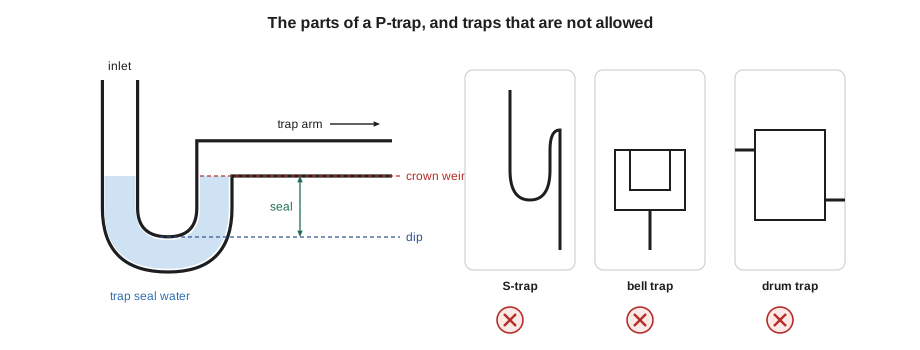
Codes set a minimum trap seal depth so that small pressure changes and some evaporation do not break the seal. The Ontario Building Code and the National Plumbing Code generally require a trap seal of at least 38 mm, and deep-seal traps are used where conditions call for more.
A trap should be self-scouring: the flow from the fixture should wash solids and debris through it rather than letting them settle in the bend. That is one reason traps are the same size as or slightly smaller than the fixture drain, have smooth interiors and have no internal partitions or pockets.
The parts of a trap
- Inlet: the vertical leg that receives water from the fixture's tailpiece or outlet.
- Seal: the body of water held in the bend.
- Dip: the highest point of the inside bottom of the bend.
- Crown weir: the lowest point of the outlet where water spills over; the top of the seal.
- Crown: the top of the bend just downstream of the weir.
- Trap arm: the section of fixture drain between the weir and the vent connection. Its length and slope are limited, as lesson 8 explains.
A P-trap, shaped like a sideways P, is the standard trap for sinks, lavatories, tubs, showers and floor drains. Water closets, urinals and some other fixtures have the trap built into the fixture itself. Either way, the code treats each fixture as needing exactly one trap.
Traps that are not allowed
Over the years many trap designs have been tried, and codes now ban the ones that fail to hold their seal, collect solids or cannot be cleaned:
- S-traps: a trap whose outlet turns straight down instead of running horizontally to a vent. The falling water siphons the seal out of an S-trap almost every time the fixture drains. Older houses often have them; new work never does.
- Bell traps: an old floor drain design with a bell-shaped cover sitting in a water cup. The seal is shallow and easily lost, and the bell is often removed and never replaced.
- Drum traps: a large canister trap once used for bathtubs. They collect hair and sludge, are hard to clean and are generally prohibited except for special uses that the code lists.
- Crown-vented traps: traps with the vent connected at the crown, right at the top of the bend. Solids and grease build up and block the vent.
- Traps with moving parts or internal partitions: they can stick, wear out or trap solids; codes generally prohibit them unless a specific device is listed and allowed.
- Double trapping: two traps in series on the same fixture drain. The air trapped between them blocks the flow and makes the fixture drain slowly or not at all.
Older Ontario houses sometimes have a running trap, also called a building trap or house trap, in the building drain near the foundation wall. Current codes generally do not require or allow building traps in new work except where a code or municipality calls for one, because they collect solids and interfere with venting of the public sewer.
How trap seals are lost
A trap seal can be lost in several ways. Recognizing them is the key to understanding venting, and it helps a service plumber diagnose a smelly drain:
- Self-siphonage: when a fixture drains, the slug of water flowing down a long or steep trap arm can pull the water out of its own trap behind it, like a siphon. Lavatories with long, steep fixture drains are the classic example. The gurgle at the end of draining is the sound of the seal being pulled down.
- Induced siphonage: when water flows down a stack or branch past the point where another fixture's drain connects, it lowers the air pressure in that drain and pulls water out of the other fixture's trap. Upper floors of a poorly vented stack are prone to this.
- Back-pressure, or blowout: when a slug of water or a hydraulic jump compresses the air in the drain below a trap, the pressure can push the seal up and out into the fixture. Lower floors near the base of a tall stack are prone to this, and detergent suds make it worse.
- Evaporation: water slowly evaporates from a trap that is never used, such as a floor drain in a mechanical room or a fixture in an empty suite. In a warm, dry space the seal can be gone in weeks.
- Capillary action: a string, hair or rag hanging over the weir can wick water out of the trap and down the drain.
- Wind and momentum: strong wind across a vent terminal can rock the seal back and forth, and a sudden large discharge into a trap can carry the seal out with it.
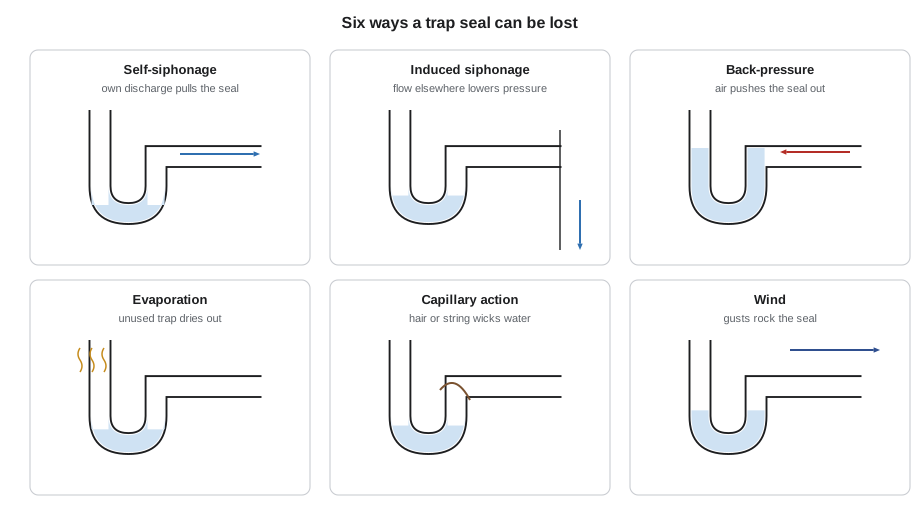
The first three are pressure problems, and venting solves them, as lessons 8 and 9 explain. Evaporation is a use problem, and trap primers or design solve it. Capillary loss is a maintenance problem. A good diagnosis starts with the question: did this trap lose its seal because of pressure, because nobody used it, or because something is hanging in it?
Evaporation and trap seal primers
Floor drains are the traps most likely to dry out. A floor drain in a parking level, a mechanical room or a storage room may go months without water, and in a heated space the seal evaporates. When it does, sewer gas enters the room, and in a parking garage that can be noticed throughout the building.
Codes require some floor drains, and other traps that are rarely used, to be protected against evaporation. The usual method is a trap seal primer: a device that adds a small amount of water to the trap automatically. Primers come in several types: pressure-drop primers on a water line that release a little water whenever pressure in the line changes, electronic primers on a timer, and drainage-type primers that take water from the tailpiece of a nearby fixture each time it is used.
The 2024 Ontario Building Code added that a floor drain connected to a storm system must be trapped, that one trap may serve the floor drains in the same room, and that the trap must have a trap seal primer. Floor drains on Kingsway's parking levels are on the sanitary system through the oil interceptor, but the same thinking applies: every one of them has a primer.
Some codes also allow listed trap seal protection devices, such as inserts with a flexible sleeve or a float that closes when the water level drops. These devices have their own standards and installation instructions, and they must be accessible for maintenance. Where the adopted code allows them, they are an alternative to a primer for some floor drains.
Worked problem
Estimating how long a floor drain trap will hold its seal
A floor drain trap in a heated storage room holds a seal of 50 mm. If water evaporates from it at an assumed 3 mm per week, how long until the seal is lost?
Show solution
- The seal is lost when the water falls below the dip, so the whole seal depth can evaporate.
- Time: \(50 \div 3 \approx 16.7\) weeks.
- That is about four months; a room left unused over a winter could lose its seal.
Answer: Roughly four months at the assumed rate, which is why rarely used floor drains need a primer or other protection.
# Weeks until a trap seal evaporates, for some assumed evaporation rates
seal_mm = 50
for place, rate_mm_per_week in (("cool damp parking level", 1.0),
                                ("heated storage room", 3.0),
                                ("hot dry mechanical room", 6.0)):
    weeks = seal_mm / rate_mm_per_week
print(f"{place:26s} {rate_mm_per_week:3.1f} mm/week -> about {weeks:5.1f} weeks")cool damp parking level 1.0 mm/week -> about 50.0 weeks heated storage room 3.0 mm/week -> about 16.7 weeks hot dry mechanical room 6.0 mm/week -> about 8.3 weeks
The evaporation rates in the program are assumptions for illustration; real rates depend on temperature, humidity and air movement. The point is the pattern: a dry, warm, ventilated space empties a trap much faster than a cool, damp one.
One trap per fixture, and trap size
Every fixture must have its own trap, except where the code allows a group of fixtures to share one, such as two or three adjacent compartments of a sink or a laundry tray and sink next to each other, within set distances. The trap is placed as close to the fixture outlet as the code allows, because the pipe between the fixture and the trap is not protected by a seal and can hold odours.
Codes list a minimum trap size for each type of fixture. A lavatory trap is small; a bathtub, shower or kitchen sink trap is larger; a floor drain trap is larger again. The trap must never be larger than the fixture drain it connects to, and the fixture drain must never be smaller than the trap.
| Fixture | Typical minimum trap size |
|---|---|
| Lavatory | 32 mm (1-1/4 in) |
| Kitchen sink, domestic | 38 mm (1-1/2 in) |
| Bathtub | 38 mm (1-1/2 in) |
| Shower | 50 mm (2 in) |
| Clothes washer standpipe | 50 mm (2 in) |
| Floor drain | 75 mm (3 in) |
Installing and checking traps
On a rough-in, the trap is not installed yet for most fixtures, but its position is fixed by the trap arm stub out of the wall. The height and location of that stub decide whether the trap will fit under the fixture, whether the trap arm will slope correctly, and whether the weir will be above the vent connection. At finish, the plumber installs the trap level, with the right size and seal depth, with slip-joint nuts and washers properly seated, and tests it by running water and checking for leaks and slow drainage.
Trap installation errors that inspectors and service plumbers see most often include S-traps made by connecting a P-trap straight down into a drain, traps set too low so that the trap arm slopes up to the wall, two traps in series under double sinks, and slip joints in the wrong place, such as on the outlet side of the trap where the code requires a solid joint.
Common mistakes
MistakeConnecting a P-trap so its outlet drops straight down into the drain, making an S-trap.
InsteadRun the trap arm horizontally at the proper slope to a vented drain.
MistakeInstalling two traps in series on one fixture drain.
InsteadUse one trap per fixture, or one shared trap only where the code allows it.
MistakeLeaving rarely used floor drains without seal protection.
InsteadInstall a trap seal primer or an approved trap seal protection device.
MistakeSetting a trap so low that the trap arm slopes up to the wall.
InsteadSet the trap arm stub height so the arm falls toward the drain.
MistakeUsing a trap larger than the fixture drain.
InsteadKeep the trap the same size as or smaller than the fixture drain, and never smaller than the code minimum.
Summary and key terms
- A trap holds a water seal between a fixture and the drain to block sewer air.
- Seal depth is measured from the dip to the crown weir; codes set minimum seal depths.
- S-traps, bell traps, drum traps, crown-vented traps, traps with moving parts and double trapping are generally not allowed.
- Seals are lost by self-siphonage, induced siphonage, back-pressure, evaporation, capillary action and wind.
- Pressure problems are solved by venting; evaporation is solved by trap seal primers or approved protection devices.
- Each fixture needs its own trap of at least the minimum size, placed close to the fixture outlet.
- Trap
- A fitting or part of a fixture that holds a water seal to block sewer air.
- Trap seal
- The depth of water held in a trap, measured from the dip to the crown weir.
- Crown weir
- The lowest point of a trap outlet, where water spills over into the trap arm.
- Self-siphonage
- Loss of a trap seal caused by the fixture's own discharge pulling the water out behind it.
- Induced siphonage
- Loss of a trap seal caused by flow elsewhere in the system lowering the pressure in the fixture drain.
- Trap seal primer
- A device that adds water to a trap automatically to replace water lost by evaporation.
Practice problems
Work each problem on paper first, then reveal the answer to check.
Between which two points is trap seal depth measured?
Show answer
From the dip up to the crown weir.
Why are S-traps not allowed?
Show answer
The falling water siphons the seal out almost every time the fixture drains.
Which ways of losing a trap seal are solved by venting?
Show answer
Self-siphonage, induced siphonage and back-pressure.
A trap holds 40 mm of seal and loses 2 mm per week to evaporation. How long will it last?
Show answer
About 20 weeks.
Why are two traps in series on one fixture prohibited?
Show answer
The air trapped between them blocks the flow and makes the fixture drain slowly.
What device protects a rarely used floor drain from losing its seal?
Show answer
A trap seal primer, or an approved trap seal protection device where the code allows.
Lesson quiz · 5 questions
Score 60% or more to complete this lesson.
Create a free account to save your progress, take quizzes and earn a certificate.