
PHYS-130 · Lesson 5 of 5 · 40 min
Rotational motion
So far every object has been treated as a particle, a point with mass. Real machines are full of things that spin: shafts, gears, pulleys, flywheels, turbine rotors, wheels, drill bits and hard-drive platters. To design them you need the rotational versions of the ideas from the last four chapters: angular position, velocity and acceleration; torque in place of force; moment of inertia in place of mass; and rotational kinetic energy and angular momentum.
The good news is that every rotational idea has a direct linear analogue, and the equations look the same once you swap the symbols. This chapter builds that dictionary and uses it on fans, wind turbines, flywheels, pulleys, rolling wheels and shafts.
Angular quantities
Consider a rigid body turning about a fixed axis. Every point moves in a circle, and every point turns through the same angle in the same time. So we describe the motion of the whole body with one angle \(\theta\), measured in radians.
A radian is the angle at which the arc length equals the radius, so an arc of length \(s\) on a circle of radius \(r\) subtends \(\theta = s/r\). One full turn is \(2\pi\) rad = 360°, so 1 rad ≈ 57.3°. Radians are not optional here: the formulas below are only true in radians.
The angular velocity is the rate of turning, and angular acceleration is its rate of change:
Machinery speeds are usually quoted in revolutions per minute (rpm). Convert with \(\omega = \text{rpm} \times 2\pi/60\). A motor at 1800 rpm turns at 188.5 rad/s.
Linking angular and linear motion
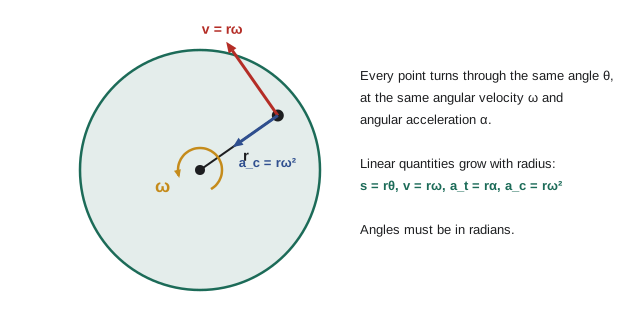
A point at distance \(r\) from the axis travels a distance \(s = r\theta\), so its speed and tangential acceleration are
where \(a_c\) is the centripetal acceleration from Lesson 2, directed toward the axis. All points share the same \(\omega\), but points farther out move faster and accelerate more.
Worked problem
Wind turbine blade tip
A wind turbine with 40 m blades turns at 15 rpm. Find the blade tip speed and its centripetal acceleration.
Show solution
- \(\omega = 15 \times 2\pi/60 = 1.571\) rad/s.
- Tip speed: \(v = r\omega = 40 \times 1.571 = 62.8\) m/s (226 km/h).
- Centripetal acceleration: \(a_c = r\omega^2 = 40 \times 1.571^2 = 98.7\) m/s², about 10 g.
Answer: 62.8 m/s; 98.7 m/s². Tip speed limits rotor design: faster tips are noisier and erode their leading edges
Constant angular acceleration
If \(\alpha\) is constant, the angular equations are exactly the constant-acceleration equations from Lesson 1 with \(x \to \theta\), \(v \to \omega\), \(a \to \alpha\):
Worked problem
Spinning up a fan
An industrial fan starts from rest and reaches 1200 rpm in 4.0 s with constant angular acceleration. Find \(\alpha\) and the number of revolutions it makes while speeding up.
Show solution
- Final speed: \(\omega = 1200 \times 2\pi/60 = 125.7\) rad/s.
- \(\alpha = 125.7/4.0 = 31.4\) rad/s².
- Angle: \(\theta = \tfrac12\alpha t^2 = \tfrac12(31.4)(16) = 251.3\) rad.
- Revolutions: \(251.3/2\pi = 40\).
Answer: α = 31.4 rad/s²; 40 revolutions
Torque
Force causes linear acceleration; torque causes angular acceleration. You met torque in Linear Algebra as the moment of a force, \(\boldsymbol{\tau} = \mathbf{r}\times\mathbf{F}\). For rotation about a fixed axis its size is
where \(\phi\) is the angle between \(\mathbf{r}\) and \(\mathbf{F}\), and \(d\) is the perpendicular distance from the axis to the force's line of action (the moment arm). Torque has units of N·m. By convention, counterclockwise torques are positive.
The same force produces more torque farther from the axis: this is why door handles are on the side away from the hinges and why a longer wrench loosens a stuck bolt. A force aimed straight through the axis produces no torque at all.
Moment of inertia and the rotational second law
Apply Newton's second law to each small piece of a rotating body. A piece of mass \(m_i\) at radius \(r_i\) has tangential acceleration \(r_i\alpha\), which needs a tangential force \(m_i r_i\alpha\) and hence a torque \(m_i r_i^2\alpha\). Adding over the body:
The moment of inertia \(I\) (units kg·m²) is the rotational counterpart of mass. It depends not just on how much mass there is but on how far it sits from the axis, and because of the \(r^2\) the outer mass dominates. You computed moments of inertia by integration in Calculus II. Some standard results, for total mass \(M\):
- Thin hoop or ring about its centre: \(I = MR^2\).
- Solid disc or cylinder about its axis: \(I = \tfrac12 MR^2\).
- Solid sphere about a diameter: \(I = \tfrac25 MR^2\).
- Thin rod of length \(L\) about its centre: \(I = \tfrac{1}{12}ML^2\); about one end: \(I = \tfrac13 ML^2\).
The parallel-axis theorem gives the moment of inertia about any axis parallel to one through the centre of mass: \(I = I_{\text{cm}} + Md^2\). For instance, the rod about its end is \(\tfrac{1}{12}ML^2 + M(L/2)^2 = \tfrac13 ML^2\).
Worked problem
Accelerating a flywheel
A flywheel is a solid steel disc of mass 50 kg and radius 0.40 m. A motor applies a constant torque of 20 N·m. Find the angular acceleration and the time to reach 300 rpm from rest.
Show solution
- \(I = \tfrac12 MR^2 = \tfrac12(50)(0.40)^2 = 4.0\) kg·m².
- \(\alpha = \tau/I = 20/4.0 = 5.0\) rad/s².
- 300 rpm \(= 31.4\) rad/s, so \(t = 31.4/5.0 = 6.3\) s.
Answer: α = 5.0 rad/s²; 6.3 s
Combining linear and rotational motion
Many machines have parts that translate and parts that rotate, connected by cords or gears. Write \(\sum F = ma\) for each translating part, \(\sum\tau = I\alpha\) for each rotating part, and link them with a constraint such as \(a = R\alpha\) for a cord that does not slip.
Worked problem
A block on a heavy pulley
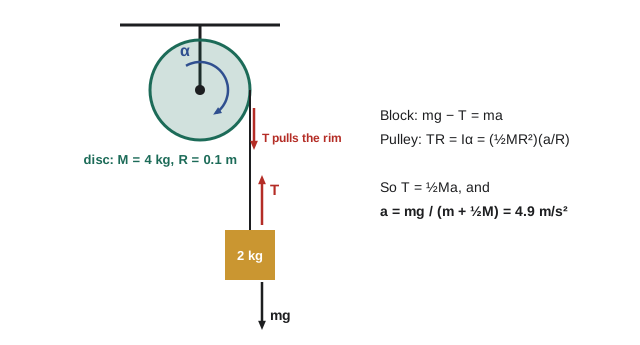
A 2.0 kg block hangs from a light cord wrapped around a solid disc pulley of mass 4.0 kg and radius 0.10 m, free to turn on a frictionless axle. Find the block's acceleration and the cord tension.
Show solution
- Block (down positive): \(mg - T = ma\).
- Pulley: \(TR = I\alpha = \tfrac12 MR^2 \cdot (a/R)\), so \(T = \tfrac12 Ma = 2.0\,a\).
- Substitute: \(2.0(9.81) - 2.0a = 2.0a\), so \(a = 19.62/4.0 = 4.91\) m/s².
- \(T = 2.0 \times 4.91 = 9.81\) N. The pulley's angular acceleration is \(a/R = 49\) rad/s².
Answer: a = 4.91 m/s² (half of g); T = 9.81 N. With a massless pulley the block would fall at g and the tension would be zero
Rotational kinetic energy and power
Each piece of a rotating body has kinetic energy \(\tfrac12 m_i(r_i\omega)^2\). Adding them:
Again \(I\) replaces \(m\) and \(\omega\) replaces \(v\). The work done by a torque turning through an angle is \(W = \int\tau\,d\theta\), and the power delivered to a rotating shaft is
This is the relation used to rate every motor, engine and gearbox.
Worked problem
Flywheel energy storage
The flywheel above (\(I = 4.0\) kg·m²) is spun to 3000 rpm. How much energy does it store?
Show solution
- \(\omega = 3000 \times 2\pi/60 = 314.2\) rad/s.
- \(K = \tfrac12(4.0)(314.2)^2 = 197\,000\) J ≈ 197 kJ.
- That is 0.055 kWh, enough to supply 10 kW for about 20 s.
Answer: About 197 kJ. Energy grows with ω², so doubling the speed stores four times as much, limited by the stress the spinning rim can withstand
Worked problem
Motor shaft power
An electric motor delivers 50 N·m of torque at 1750 rpm. What is its output power?
Show solution
- \(\omega = 1750 \times 2\pi/60 = 183.3\) rad/s.
- \(P = \tau\omega = 50 \times 183.3 = 9160\) W.
Answer: 9.2 kW (about 12.3 hp). A gearbox can trade speed for torque, but cannot increase the power
That last remark is the key to gear design. A 3:1 reduction gearbox turns this motor's output into about 150 N·m at 583 rpm, minus a few percent lost in the gears. Power in equals power out plus losses.
Rolling motion
A wheel rolling without slipping both translates and rotates, and the two are locked together: the centre moves at \(v = R\omega\). Its total kinetic energy is the sum of the translational energy of the centre of mass and the rotational energy about it:
Static friction at the contact point makes the wheel roll rather than skid, but does no work, because the contact point is momentarily at rest. So mechanical energy is conserved for an object rolling down a slope. From height \(h\):
Worked problem
A rolling race
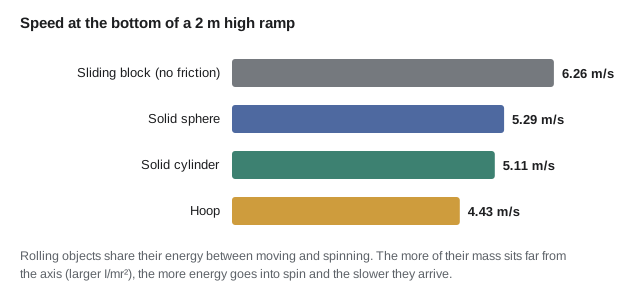
A solid cylinder and a hoop are released from rest at the top of a ramp 2.0 m high and roll without slipping. Find each one's speed at the bottom and compare with a frictionless sliding block.
Show solution
- Cylinder: \(I/MR^2 = \tfrac12\), so \(v = \sqrt{2(9.81)(2.0)/1.5} = 5.11\) m/s.
- Hoop: \(I/MR^2 = 1\), so \(v = \sqrt{2(9.81)(2.0)/2} = 4.43\) m/s.
- Sliding block (no rotation): \(v = \sqrt{2(9.81)(2.0)} = 6.26\) m/s.
Answer: Cylinder 5.11 m/s, hoop 4.43 m/s, block 6.26 m/s. Neither mass nor radius appears, only the shape factor I/MR²
Angular momentum
The rotational counterpart of momentum is angular momentum, \(L = I\omega\) for a body spinning about a fixed axis (units kg·m²/s). The rotational second law in its general form is \(\sum\tau = dL/dt\), and it gives another conservation law: if the net external torque on a system is zero, its angular momentum is constant.
If a spinning system pulls mass inward, \(I\) falls and \(\omega\) rises to compensate. A figure skater spins faster by pulling in her arms; a diver tucks to rotate quickly and straightens to slow down before entering the water.
Worked problem
Changing the moment of inertia
A rotating platform with \(I = 4.0\) kg·m² spins freely at 10 rad/s. Sliding weights move inward, reducing \(I\) to 1.6 kg·m². Find the new angular velocity and the change in kinetic energy.
Show solution
- No external torque: \(4.0 \times 10 = 1.6\,\omega_2\), so \(\omega_2 = 25\) rad/s.
- KE before: \(\tfrac12(4.0)(10^2) = 200\) J. After: \(\tfrac12(1.6)(25^2) = 500\) J.
Answer: 25 rad/s; kinetic energy rises by 300 J, supplied by whatever pulled the weights inward against the centrifugal tendency
Angular momentum conservation also explains why gyroscopes hold their orientation (used in aircraft instruments and satellite attitude control), why a helicopter needs a tail rotor (to cancel the torque reaction of the main rotor), and why a spinning bicycle wheel resists being tilted.
The linear–rotational dictionary
- Position \(x\) ↔ angle \(\theta\); velocity \(v\) ↔ angular velocity \(\omega\); acceleration \(a\) ↔ angular acceleration \(\alpha\).
- Mass \(m\) ↔ moment of inertia \(I\); force \(F\) ↔ torque \(\tau\).
- \(F = ma\) ↔ \(\tau = I\alpha\); \(K = \tfrac12 mv^2\) ↔ \(K = \tfrac12 I\omega^2\); \(P = Fv\) ↔ \(P = \tau\omega\); \(p = mv\) ↔ \(L = I\omega\).
Common mistakes
MistakeUsing rpm or degrees in v = rω, K = ½Iω² or P = τω.
InsteadConvert to radians and rad/s first: ω = rpm × 2π/60.
MistakeTreating moment of inertia as a fixed property like mass.
InsteadI depends on the axis. Use the parallel-axis theorem to move between axes.
MistakeUsing I = MR² for every round object.
InsteadMR² is for a thin hoop. A solid disc is ½MR², a sphere ⅖MR².
MistakeAssuming the cord tension equals the hanging weight when the pulley has mass.
InsteadWrite separate equations for the block (F = ma) and the pulley (τ = Iα), linked by a = Rα.
MistakeForgetting rotational energy for a rolling object.
InsteadK = ½Mv² + ½Iω². Rolling objects arrive slower than sliding ones.
MistakeExpecting a gearbox to increase power.
InsteadGears trade torque for speed. Power out = power in minus losses.
Summary and key terms
- A rigid body's rotation is described by θ (rad), ω = dθ/dt and α = dω/dt. Convert rpm with ω = rpm × 2π/60.
- A point at radius r has v = rω, a_t = rα and a_c = rω².
- For constant α, the angular equations mirror the linear constant-acceleration equations.
- Torque τ = rF sin φ = Fd causes angular acceleration: Στ = Iα.
- Moment of inertia I = Σmr² depends on mass and its distance from the axis. I = I_cm + Md² for parallel axes.
- Rotational KE is ½Iω²; shaft power is τω. Rolling objects share energy between translation and rotation.
- Angular momentum L = Iω is conserved when no external torque acts.
- Radian
- The angle subtended by an arc equal in length to the radius; 2π rad = 360°.
- Angular velocity
- Rate of change of angle, ω, in rad/s.
- Angular acceleration
- Rate of change of angular velocity, α, in rad/s².
- Torque
- The turning effect of a force about an axis, τ = Fd.
- Moment of inertia
- Resistance to angular acceleration, I = Σmr².
- Parallel-axis theorem
- I = I_cm + Md² for an axis a distance d from a parallel axis through the centre of mass.
- Rotational kinetic energy
- Energy of spinning, ½Iω².
- Angular momentum
- L = Iω, conserved without external torque.
- Rolling without slipping
- Rolling with v = Rω, so the contact point is momentarily at rest.
Practice problems
Work each problem on paper first, then reveal the answer to check.
Convert 3600 rpm to rad/s, and find the speed of a point 0.12 m from the axis.
Show answer
ω = 3600 × 2π/60 = 377 rad/s. v = 0.12 × 377 = 45.2 m/s.
A grinding wheel at 2400 rpm is switched off and stops in 20 s with constant deceleration. How many revolutions does it make while stopping?
Show answer
Average speed is 1200 rpm = 20 rev/s, for 20 s: 400 revolutions.
A 60 N force is applied at the end of a 0.30 m wrench at 90° and then at 45°. Find the torque in each case.
Show answer
18 N·m and 18 sin 45° = 12.7 N·m.
Find the moment of inertia of a 2 kg, 1.2 m thin rod about one end, using the parallel-axis theorem.
Show answer
I_cm = (1/12)(2)(1.44) = 0.24 kg·m². I = 0.24 + 2(0.6)² = 0.96 kg·m² = (1/3)ML².
A 10 N·m torque acts on a solid cylinder of mass 8 kg and radius 0.25 m. Find its angular acceleration.
Show answer
I = ½(8)(0.0625) = 0.25 kg·m². α = 10/0.25 = 40 rad/s².
Repeat the heavy-pulley example with a hanging mass of 3 kg and a disc pulley of 2 kg.
Show answer
a = mg/(m + M/2) = 29.43/4 = 7.36 m/s². T = ½Ma = 7.36 N.
A car engine produces 300 N·m at 4000 rpm. What power is that, in kW and hp?
Show answer
ω = 418.9 rad/s. P = 125.7 kW ≈ 168 hp.
A solid sphere rolls without slipping down a ramp 1.5 m high. Find its speed at the bottom.
Show answer
v = √(2gh/1.4) = √(29.43/1.4) = 4.58 m/s.
What fraction of a rolling solid cylinder's kinetic energy is rotational?
Show answer
K_rot/K_total = (½)/(1 + ½) = 1/3.
A skater spinning at 2 rev/s with \(I = 3.5\) kg·m² pulls her arms in to \(I = 1.4\) kg·m². What is her new spin rate?
Show answer
ω₂ = 2 × 3.5/1.4 = 5 rev/s.
Lesson quiz · 5 questions
Score 60% or more to complete this lesson.
Create a free account to save your progress, take quizzes and earn a certificate.