
PHYS-130 · Lesson 2 of 5 · 39 min
Newton's laws of motion
Kinematics describes motion. Dynamics explains it. Three laws published by Isaac Newton in 1687 connect the forces on an object to the way it moves, and they remain the working foundation of mechanical, civil and aerospace engineering. Every crane rating, elevator cable, vehicle suspension and conveyor drive is designed with them.
This chapter states the three laws, introduces the forces you will meet most often (weight, normal force, tension, friction), and develops the single most important skill in mechanics: drawing a free-body diagram and turning it into equations. You will then apply the method to inclines, connected bodies, elevators and vehicles on curves.
Force and the first law
A force is a push or pull exerted on an object by something else. It is a vector, measured in newtons (N). One newton is the force that gives a 1 kg mass an acceleration of 1 m/s². For a sense of scale, a typical apple weighs about 1 N and an adult about 700 N.
Newton's first law: an object stays at rest, or keeps moving in a straight line at constant speed, unless a net force acts on it. Motion does not need a force to keep it going; change of motion does. A hockey puck slows down not because "its force runs out" but because friction acts on it.
The first law also defines what we mean by an inertial reference frame: one in which the law holds. The ground is inertial to a very good approximation for engineering purposes. An accelerating car is not, which is why a coffee cup on the dashboard appears to slide backward "by itself" when you accelerate.
A body is in equilibrium when the net force on it is zero. It may be at rest (statics) or moving at constant velocity, such as an aircraft in steady level flight, where thrust balances drag and lift balances weight.
The second law
When the net force is not zero, the object accelerates in the direction of the net force, by an amount inversely proportional to its mass:
This is a vector equation, so in practice it is two (or three) scalar equations, one per axis: \(\sum F_x = ma_x\) and \(\sum F_y = ma_y\). Mass \(m\), in kilograms, measures inertia: how hard it is to change an object's motion. Pushing a loaded cart is harder than an empty one because its mass is larger, not because it is heavier (the push is horizontal and weight is vertical).
Weight and mass
The weight of an object is the gravitational force the Earth exerts on it: \(W = mg\), directed downward, with \(g = 9.81\) m/s². A 1000 kg car weighs 9810 N. Mass is the same everywhere; weight depends on the local gravity. On the Moon (\(g = 1.62\) m/s²) the same car weighs 1620 N.
The third law
Newton's third law: when object A exerts a force on object B, B exerts a force on A of equal size and opposite direction. Forces always come in pairs.
The two forces in a pair act on different objects, so they never cancel each other in the equation for a single object. When a tow truck pulls a car, the cable pulls the car forward and the car pulls the cable backward with an equal force. The truck still accelerates because it also has a large forward friction force from the road on its driven wheels. Whether something accelerates depends only on the forces acting on it.
A common trap: the weight of a book on a table and the normal force from the table are equal and opposite, but they are not a third-law pair. They act on the same object (the book). The third-law partner of the book's weight is the book's gravitational pull on the Earth.
Common forces
- Weight \(mg\): always present near the Earth, straight down.
- Normal force \(N\): the push of a surface, perpendicular to it. It is whatever size it needs to be to stop the object passing through the surface, which is not always \(mg\).
- Tension \(T\): the pull of a rope, cable or chain, along it, away from the object. An ideal (light) rope has the same tension throughout, and an ideal pulley changes its direction without changing its size.
- Friction: the force a surface exerts parallel to itself, opposing sliding (or attempted sliding).
- Spring force: \(F = kx\), opposing the stretch or compression \(x\) (Hooke's law).
Friction
Friction is surprisingly well described by two simple rules. Static friction acts when surfaces are not sliding; it adjusts to whatever is needed to prevent motion, up to a maximum:
Once sliding starts, kinetic friction takes over, with a roughly constant value \(\mu_k N\), and \(\mu_k\) is usually smaller than \(\mu_s\). That is why it takes more force to start a heavy crate moving than to keep it moving, and why anti-lock brakes, which keep tires just short of skidding, stop a car faster than locked wheels. Typical values: rubber on dry concrete \(\mu_s \approx 1.0\), \(\mu_k \approx 0.8\); steel on steel (dry) \(\mu_s \approx 0.7\), \(\mu_k \approx 0.5\); greased steel \(\mu \approx 0.1\).
Free-body diagrams: the method
Almost every dynamics problem is solved with the same five steps:
- Choose the object (or system) and isolate it in a sketch.
- Draw every force acting on it, and only those: weight, then one force at every point where something touches it.
- Choose axes. Align one axis with the acceleration if you know its direction; on an incline, use axes along and perpendicular to the slope.
- Write \(\sum F_x = ma_x\) and \(\sum F_y = ma_y\).
- Solve, then check units, signs and limiting cases.
Worked problem
Apparent weight in an elevator
A 70 kg person stands on a scale in an elevator. What does the scale read when the elevator (a) moves at constant speed, (b) accelerates upward at 1.5 m/s², (c) accelerates downward at 1.5 m/s²?
Show solution
- The scale reads the normal force \(N\) it exerts on the person. Forces on the person: \(N\) up, \(mg = 686.7\) N down. Take up as positive: \(N - mg = ma\).
- (a) \(a = 0\): \(N = 686.7\) N.
- (b) \(a = +1.5\): \(N = 70(9.81 + 1.5) = 791.7\) N.
- (c) \(a = -1.5\): \(N = 70(9.81 - 1.5) = 581.7\) N.
Answer: 687 N, 792 N, 582 N. The person feels heavier when accelerating up (including when slowing on the way down) and lighter when accelerating down. If the cable broke, N would drop to zero
Elevator cables are sized for the peak tension during acceleration, plus large safety factors. The same reasoning applies to crane hoists and mine cages.
Inclined planes
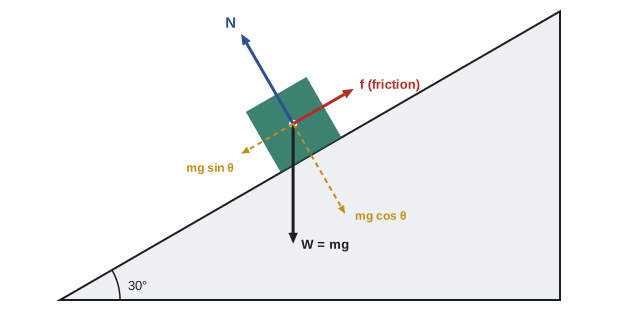
With axes along the slope (\(x\), downhill positive) and perpendicular to it (\(y\)), the weight splits into \(mg\sin\theta\) along the slope and \(mg\cos\theta\) into it. The block does not accelerate perpendicular to the slope, so \(N = mg\cos\theta\).
Worked problem
Sliding down a ramp
A crate slides down a 30° ramp. Find its acceleration (a) with no friction, (b) with \(\mu_k = 0.20\).
Show solution
- Perpendicular: \(N = mg\cos 30^\circ\).
- (a) Along the slope: \(mg\sin 30^\circ = ma\), so \(a = g\sin 30^\circ = 4.91\) m/s².
- (b) Friction \(\mu_k N = 0.20\,mg\cos 30^\circ\) acts up the slope: \(ma = mg\sin 30^\circ - 0.20\,mg\cos 30^\circ\).
- \[a = 9.81(0.500 - 0.20 \times 0.866) = 3.21 \text{ m/s}^2\]
Answer: (a) 4.91 m/s²; (b) 3.21 m/s². The mass cancels: a heavy crate and a light one slide the same way
Worked problem
Will it slide?
A 10 kg box rests on a plank tilted at 20°, with \(\mu_s = 0.40\). Does it slide? If not, what friction force holds it?
Show solution
- Friction needed to hold it: \(mg\sin 20^\circ = 98.1 \times 0.342 = 33.6\) N.
- Maximum available: \(\mu_s mg\cos 20^\circ = 0.40 \times 98.1 \times 0.940 = 36.9\) N.
- Needed is less than available, so it stays put, with a friction force of 33.6 N (not 36.9 N).
Answer: It does not slide; friction is 33.6 N. In general a block slips when tan θ exceeds μs. Here tan 20° = 0.364 < 0.40
That last result gives a quick way to measure \(\mu_s\): tilt a surface until the object just begins to slide and take the tangent of the angle. It is also the idea behind the angle of repose of gravel and soil stockpiles in geotechnical design.
Forces at an angle
Worked problem
Pulling a crate with a rope
A worker drags a 50 kg crate across a floor by pulling a rope with 200 N at 30° above horizontal. If \(\mu_k = 0.30\), find the crate's acceleration.
Show solution
- Forces: weight 490.5 N down, \(N\) up, 200 N along the rope, friction \(\mu_k N\) backward.
- Vertical (no acceleration): \(N + 200\sin 30^\circ - 490.5 = 0\), so \(N = 390.5\) N. The upward pull reduces the normal force.
- Friction: \(0.30 \times 390.5 = 117.2\) N.
- Horizontal: \(200\cos 30^\circ - 117.2 = 50a\), so \(173.2 - 117.2 = 50a\) and \(a = 1.12\) m/s².
Answer: 1.12 m/s². Pulling at an angle reduces friction, at the cost of a smaller forward component
Connected bodies
When objects are linked by ropes or in contact, draw a separate free-body diagram for each, then solve the equations together. The link gives a constraint: for an inextensible rope, the connected objects have the same magnitude of acceleration.
Worked problem
Block and hanging mass
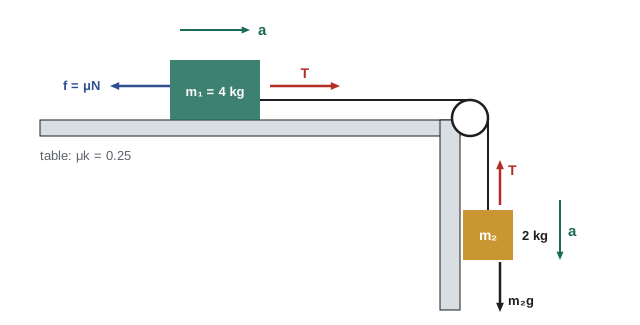
A 4.0 kg block on a table (\(\mu_k = 0.25\)) is connected over a light, frictionless pulley to a hanging 2.0 kg mass. Find the acceleration and the rope tension.
Show solution
- Table block (\(m_1\)), positive toward the pulley: \(T - \mu_k m_1 g = m_1 a\), that is \(T - 9.81 = 4a\).
- Hanging block (\(m_2\)), positive downward: \(m_2 g - T = m_2 a\), that is \(19.62 - T = 2a\).
- Add the equations so \(T\) cancels: \(19.62 - 9.81 = 6a\), so \(a = 1.64\) m/s².
- Tension: \(T = 19.62 - 2(1.635) = 16.35\) N.
Answer: a = 1.64 m/s², T = 16.4 N. The tension is less than the hanging weight (19.6 N), as it must be for that mass to accelerate downward
Circular motion
An object moving in a circle at constant speed is accelerating, because its direction keeps changing. The acceleration points toward the centre (it is centripetal) and has magnitude
By the second law, a net inward force \(mv^2/r\) is needed to keep it on the circle. That force is not a new kind of force: it is provided by friction, tension, a normal force, gravity, or a combination. Draw the real forces and set their inward sum equal to \(mv^2/r\).
Worked problem
Cornering on a flat road
What is the maximum speed at which a car can take a flat curve of radius 50 m if \(\mu_s = 0.80\) between tires and road?
Show solution
- Friction provides the centripetal force: \(f = mv^2/r\). Vertically, \(N = mg\).
- At the limit, \(\mu_s mg = mv^2/r\), so \(v = \sqrt{\mu_s g r}\).
- \(v = \sqrt{0.80 \times 9.81 \times 50} = 19.8\) m/s \(= 71\) km/h.
Answer: 19.8 m/s (71 km/h). On a wet road with μs = 0.4 it drops to 14 m/s (50 km/h)
Worked problem
Designing a banked curve
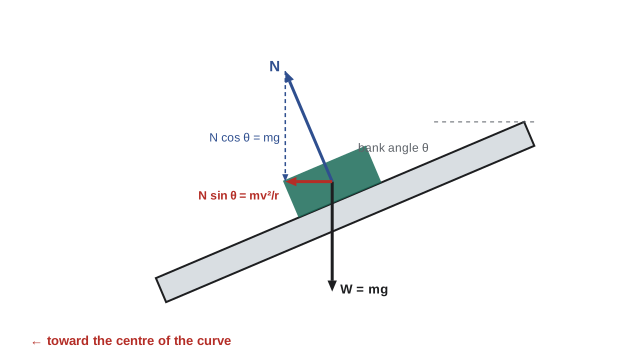
A highway ramp of radius 150 m is to be banked so that cars at 25 m/s (90 km/h) need no friction at all. What bank angle is needed?
Show solution
- Vertical: \(N\cos\theta = mg\). Horizontal (toward centre): \(N\sin\theta = mv^2/r\).
- Divide: \(\tan\theta = \dfrac{v^2}{rg} = \dfrac{625}{150 \times 9.81} = 0.425\).
- \(\theta = 23.0^\circ\).
Answer: 23°. In practice highway banking is limited to about 6–10° so stopped vehicles do not slide down in ice, and friction does the rest
Common mistakes
MistakeDrawing ma, or a "centripetal force", as an extra force on the free-body diagram.
InsteadDraw only real forces from real contacts and gravity. Their sum equals ma, or mv²/r toward the centre.
MistakeAssuming the normal force always equals mg.
InsteadFind N from the perpendicular equation. It differs on slopes, when other forces have vertical parts, and in accelerating elevators.
MistakeUsing f = μsN as the static friction force in every case.
InsteadμsN is the maximum. Static friction is only as large as needed to prevent sliding.
MistakeCancelling third-law pairs in one object's equation.
InsteadThe two forces of a pair act on different objects. Only forces on the chosen object go in its equation.
MistakeSetting the rope tension equal to the hanging weight when the system accelerates.
InsteadT = mg only in equilibrium. Write a separate equation for the hanging mass.
MistakeSplitting the weight on an incline as mg cos θ along the slope.
InsteadAlong the slope is mg sin θ, into the slope mg cos θ. Check with θ = 0: a flat surface has no downhill component.
Summary and key terms
- First law: without a net force, velocity stays constant. Equilibrium means ΣF = 0.
- Second law: ΣF = ma, applied component by component.
- Third law: forces come in equal and opposite pairs acting on different objects.
- Weight is mg; the normal force is perpendicular to the surface and found from the equations; tension acts along a rope.
- Static friction adjusts up to μsN; kinetic friction is μkN. A block on a slope slips when tan θ > μs.
- The free-body method: isolate, draw all forces, choose axes, write ΣF = ma, solve and check.
- Circular motion needs a net inward force mv²/r, supplied by real forces such as friction, tension or a tilted normal force.
- Force
- A push or pull from another object, measured in newtons.
- Newton (N)
- The force that accelerates 1 kg at 1 m/s².
- Inertia
- Resistance to change in motion, measured by mass.
- Weight
- The gravitational force on an object, W = mg.
- Normal force
- The perpendicular push of a surface.
- Tension
- The pulling force carried by a rope or cable.
- Coefficient of friction
- μ, the ratio of friction force to normal force.
- Free-body diagram
- A sketch of one object showing every force acting on it.
- Centripetal acceleration
- v²/r, directed toward the centre of a circular path.
Practice problems
Work each problem on paper first, then reveal the answer to check.
A net force of 1200 N acts on a 1500 kg car. What is its acceleration, and how long does it take to reach 20 m/s from rest?
Show answer
a = 1200/1500 = 0.80 m/s². t = 20/0.8 = 25 s.
A crane lifts a 2000 kg load with an upward acceleration of 0.50 m/s². Find the cable tension.
Show answer
T = m(g + a) = 2000 × 10.31 = 20 620 N ≈ 20.6 kN.
A 5 kg box is pushed across a floor at constant velocity by a horizontal 15 N force. Find μk.
Show answer
Constant velocity: friction = 15 N. N = 49.05 N. μk = 15/49.05 = 0.31.
A skier on a 25° slope accelerates at 3.4 m/s². What is μk between skis and snow?
Show answer
a = g(sin θ − μk cos θ). 3.4 = 9.81(0.4226 − 0.9063 μk), so μk = (0.4226 − 0.3466)/0.9063 = 0.084.
What is the steepest slope on which a parked car will not slide if \(\mu_s = 0.70\)?
Show answer
tan θ = 0.70, θ = 35°.
Two blocks, 3 kg and 5 kg, hang on either side of a light frictionless pulley (an Atwood machine). Find the acceleration and tension.
Show answer
a = (5 − 3)g/8 = 2.45 m/s². T = 3(g + a) = 3 × 12.26 = 36.8 N.
A worker pushes a 40 kg cart with 150 N directed 20° below horizontal. With \(\mu_k = 0.15\), find the acceleration.
Show answer
N = 392.4 + 150 sin 20° = 443.7 N. Friction = 66.6 N. 150 cos 20° = 141.0 N. a = (141.0 − 66.6)/40 = 1.86 m/s².
A 0.5 kg ball on a 1.2 m string is whirled in a horizontal circle at 4 m/s on a frictionless table. Find the tension.
Show answer
T = mv²/r = 0.5 × 16/1.2 = 6.67 N.
A car goes over the crest of a hill of radius 40 m. At what speed does it just lose contact with the road?
Show answer
At the crest mg − N = mv²/r. N = 0 when v = √(gr) = √(392) = 19.8 m/s.
A curve of radius 80 m is banked at 12°. What speed requires no friction?
Show answer
v = √(rg tan θ) = √(80 × 9.81 × 0.2126) = 12.9 m/s (46 km/h).
Lesson quiz · 5 questions
Score 60% or more to complete this lesson.
Create a free account to save your progress, take quizzes and earn a certificate.