
PHYS-130 · Lesson 2 of 12 · 34 min
Vectors and motion with changing acceleration
Lesson 1 described motion along a line and in a plane, mostly with constant acceleration. Real motion is rarely that tidy. A lift accelerates smoothly from rest, a boat coasts to a stop as water drag fades with its speed, a truck slows in an arrester bed that resists harder the deeper it goes, and a centrifuge spins its samples at thousands of times the acceleration of gravity. This lesson builds the tools for these cases. It begins with vectors, the language for quantities with direction, including the dot and cross products that later lessons use for work and torque. It then treats motion in which the acceleration depends on time, on velocity or on position, using calculus; treats circular motion with tangential and centripetal acceleration; and ends with step-by-step numerical solution, the method engineers use when no formula exists.
Vectors and components
Displacement, velocity, acceleration and force have both size and direction: they are vectors. In a coordinate system with unit vectors \(\mathbf{i}\), \(\mathbf{j}\) and \(\mathbf{k}\) along x, y and z, a vector is written by its components, \(\mathbf{A} = A_x\mathbf{i} + A_y\mathbf{j} + A_z\mathbf{k}\), with magnitude \(|\mathbf{A}| = \sqrt{A_x^2 + A_y^2 + A_z^2}\). In two dimensions, a vector of magnitude A at angle θ from the x-axis has components \(A_x = A\cos\theta\) and \(A_y = A\sin\theta\), and going back, \(\theta = \arctan(A_y/A_x)\), with care about the quadrant. Vectors add component by component, which is far more reliable than adding them graphically.
Worked problem
A survey drone
A drone flies 120 m east, then 80 m in a direction 30° north of east, then 50 m south. Find its displacement from the start.
Show solution
- Components (x east, y north): (120, 0), \((80\cos 30°, 80\sin 30°) = (69.3, 40.0)\) and (0, −50).
- Sum: \((189.3, -10.0)\) m.
- Magnitude \(\sqrt{189.3^2 + 10.0^2} = 189.6\) m, at \(\arctan(-10.0/189.3) = -3.0°\), that is 3.0° south of east.
Answer: The drone is 189.6 m from its start, 3.0° south of east. Its return flight is the negative of this vector, and its total path length, 250 m, is quite different from the size of its displacement.
The dot and cross products
Two ways of multiplying vectors appear throughout mechanics. The dot (scalar) product gives a number:
It measures how much two vectors point the same way: it is zero for perpendicular vectors. Lesson 5 uses it to define work, \(W = \mathbf{F} \cdot \mathbf{d}\). The cross (vector) product gives a vector perpendicular to both, with magnitude \(AB\sin\theta\) and direction set by the right-hand rule:
Lesson 8 uses it for torque, \(\boldsymbol{\tau} = \mathbf{r} \times \mathbf{F}\), and angular momentum. Note that \(\mathbf{B} \times \mathbf{A} = -\mathbf{A} \times \mathbf{B}\): order matters.
Worked problem
Angle between two cables
Two guy cables run from a mast top at the origin toward ground anchors along \(\mathbf{A} = (6, 0, -8)\) m and \(\mathbf{B} = (0, 6, -8)\) m. Find the angle between them.
Show solution
- \(\mathbf{A} \cdot \mathbf{B} = 0 + 0 + 64 = 64\) m².
- \(|\mathbf{A}| = |\mathbf{B}| = 10\) m.
- \(\cos\theta = 64/100 = 0.64\), so \(\theta = 50.2°\).
Answer: The cables meet at 50.2°. The dot product finds angles in three dimensions without any drawing, which is why structural analysis software uses it constantly.
When acceleration depends on time
If the acceleration is a known function of time, velocity and position follow by integration (Lesson 1, MATH-101): \(v(t) = v_0 + \int_0^t a\,dt\) and \(x(t) = x_0 + \int_0^t v\,dt\). Smooth acceleration profiles are common in engineering because sudden changes in acceleration (jerk) are uncomfortable for people and hard on machinery.
Worked problem
A smooth lift start
A lift starts from rest with acceleration \(a = 1.5\sin(\pi t/4)\) m/s² for 0 ≤ t ≤ 4 s. Find its speed and the distance travelled at t = 4 s.
Show solution
- \(v = \int_0^t 1.5\sin(\pi t/4)\,dt = \dfrac{6}{\pi}\left(1 - \cos\dfrac{\pi t}{4}\right)\).
- At t = 4 s: \(v = 12/\pi = 3.82\) m/s.
- \(x = \dfrac{6}{\pi}\left(t - \dfrac{4}{\pi}\sin\dfrac{\pi t}{4}\right)\), so at t = 4 s, \(x = 24/\pi = 7.64\) m.
Answer: 3.82 m/s after 7.64 m. The acceleration rises and falls smoothly, starting and ending at zero, so passengers feel no jolt. Lift and train control systems shape their motion profiles in exactly this way.
When acceleration depends on velocity
Drag forces depend on speed, so the acceleration is a function of v. Separate the variables in \(dv/dt = a(v)\) and integrate (MATH-201). For drag proportional to speed, \(a = -kv\):
Worked problem
A boat coasting to a stop
A small boat moving at 8.0 m/s cuts its engine. Water drag gives \(a = -0.25v\) (in s⁻¹). How long until it slows to 1.0 m/s, and how far does it coast in total?
Show solution
- Time: \(1.0 = 8.0e^{-0.25t}\), so \(t = \ln 8/0.25 = 8.3\) s.
- Total distance as \(t \to \infty\): \(x = v_0/k = 8.0/0.25 = 32\) m.
Answer: 8.3 s to slow to 1 m/s, and 32 m in total. In this model the boat never quite stops, but it covers a finite distance. Real drag at higher speeds grows with v², which Lesson 4 treats, and gives a faster initial slowdown.
When acceleration depends on position
Springs, arrester beds and gravitational fields give accelerations that depend on position. The chain rule rewrites the acceleration as \(a = \dfrac{dv}{dt} = \dfrac{dv}{dx}\dfrac{dx}{dt} = v\dfrac{dv}{dx}\), so \(v\,dv = a(x)\,dx\), which can be integrated directly to relate speed and position. This is a first look at the energy method of Lesson 5.
Worked problem
An arrester bed
A runaway truck enters a gravel arrester bed at 25 m/s. The deeper it sinks, the harder the bed resists, and its deceleration is roughly \(a = -0.5x\) m/s² (x in metres). How far does it travel before stopping?
Show solution
- \(v\,dv = -0.5x\,dx\). Integrating from the entry (x = 0, v = 25) to the stop (v = 0): \(-\tfrac{1}{2}(25)^2 = -\tfrac{1}{2}(0.5)x^2\).
- \(x^2 = 625/0.5 = 1250\), so \(x = 35.4\) m.
Answer: The truck stops in about 35 m. The maximum deceleration, 0.5 × 35.4 = 17.7 m/s² (1.8g), occurs at the end, so a longer, gentler bed would be kinder to the driver; designers balance bed length against available space on the mountain road.
Circular motion
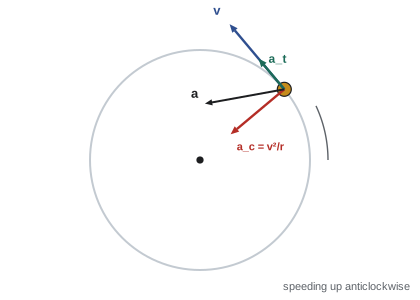
An object moving on a circle of radius r with speed v is accelerating even if its speed is constant, because its velocity keeps changing direction. The acceleration has two perpendicular parts: a centripetal part pointing to the centre and a tangential part along the path that changes the speed (MATH-209):
where \(\omega = v/r\) is the angular speed in radians per second (Lesson 8). The period of one revolution is \(T = 2\pi r/v = 2\pi/\omega\).
Worked problem
A laboratory centrifuge
A centrifuge spins samples at a radius of 0.15 m at 3000 revolutions per minute. Find the centripetal acceleration in multiples of g.
Show solution
- \(\omega = 3000 \times 2\pi/60 = 314\) rad/s.
- \(a_c = \omega^2r = 314^2 \times 0.15 = 14\,800\) m/s².
- In multiples of g: 14 800/9.81 = 1510g.
Answer: About 1500g, which is why centrifuges separate blood cells, purify chemicals and test soil models: in a geotechnical centrifuge, a 1:100 scale model spun at 100g experiences the same stresses as the full-size structure.
Numerical solution
Many motions have no formula: a projectile with drag proportional to v², a vehicle with a complicated engine map, a satellite perturbed by the Moon. They are solved step by step. Starting from the known position and velocity, compute the acceleration, advance the velocity and position over a short time step Δt as if the acceleration were constant during it, and repeat. This is Euler's method (ENCM-100, MATH-300). Its error shrinks in proportion to Δt, so halving the step until the answer stops changing gives confidence in the result.
import math

# Ball launched at 50 m/s, 30 degrees; drag acceleration k v^2 opposite the velocity
g, k, v0, angle = 9.81, 0.004, 50.0, math.radians(30)

def flight(k, dt):
    x, y = 0.0, 0.0
    vx, vy = v0 * math.cos(angle), v0 * math.sin(angle)
    t, ymax = 0.0, 0.0
    while y >= 0.0:
        v = math.hypot(vx, vy)
        ax, ay = -k * v * vx, -g - k * v * vy
        x, y = x + vx * dt, y + vy * dt           # step position with the old velocity (Euler)
        vx, vy = vx + ax * dt, vy + ay * dt       # then update velocity
        t += dt
        ymax = max(ymax, y)
    return x, ymax, t

print(f"Vacuum formula: range {v0**2 * math.sin(2 * angle) / g:.1f} m")
for dt in [0.1, 0.01, 0.001]:
    R, H, T = flight(0.0, dt)
    print(f"No drag, dt = {dt}: range {R:6.1f} m")
for dt in [0.1, 0.01, 0.001]:
    R, H, T = flight(k, dt)
print(f"With drag, dt = {dt}: range {R:6.1f} m, height {H:5.1f} m, time {T:4.2f} s")Vacuum formula: range 220.7 m No drag, dt = 0.1: range 225.2 m No drag, dt = 0.01: range 221.3 m No drag, dt = 0.001: range 220.7 m With drag, dt = 0.1: range 144.6 m, height 25.7 m, time 4.60 s With drag, dt = 0.01: range 141.7 m, height 24.8 m, time 4.49 s With drag, dt = 0.001: range 141.3 m, height 24.8 m, time 4.48 s
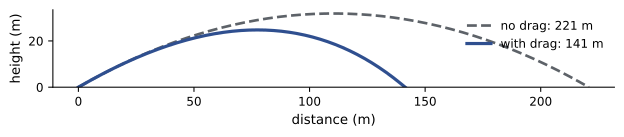
Without drag, the numerical range converges to the formula value of 220.7 m as the step shrinks, which checks the program. With drag, there is no formula, and the converged answer, about 141 m, is a third shorter, with a lower and steeper descent. A golf ball goes farther than this simple model predicts because its dimples and backspin change the aerodynamics, a reminder that a numerical method is only as good as the forces it is given.
Common mistakes
MistakeAdding vector magnitudes directly.
InsteadAdd components, then find the magnitude and direction of the sum.
MistakeTaking arctan(A_y/A_x) without checking the quadrant.
InsteadUse the signs of the components to place the angle correctly.
MistakeUsing constant-acceleration formulas when a depends on t, v or x.
InsteadIntegrate, separating variables, or use a = v dv/dx.
MistakeAssuming constant speed on a circle means zero acceleration.
InsteadThere is always a centripetal acceleration v²/r toward the centre.
MistakeTrusting a numerical answer from one step size.
InsteadHalve the step and check that the result has converged.
Summary and key terms
- Vectors add by components; magnitude √(A_x² + A_y² + A_z²).
- A · B = AB cos θ measures alignment; A × B is perpendicular, with magnitude AB sin θ.
- If a = a(t), integrate in time; if a = a(v), separate variables; if a = a(x), use v dv = a dx.
- Drag proportional to speed gives exponential decay and a finite coasting distance v₀/k.
- Circular motion has centripetal acceleration v²/r = ω²r and tangential acceleration dv/dt.
- Euler's method steps the motion forward; check convergence by halving the step.
- Drag shortens projectile range and makes the trajectory asymmetric.
- Vector
- A quantity with magnitude and direction.
- Unit vector
- A vector of length one indicating a direction, such as i, j, k.
- Dot product
- A · B = AB cos θ, a scalar.
- Cross product
- A × B, a vector perpendicular to both, of magnitude AB sin θ.
- Jerk
- The rate of change of acceleration.
- Centripetal acceleration
- The acceleration v²/r toward the centre of a circular path.
- Tangential acceleration
- The rate of change of speed along the path.
- Angular speed
- ω = v/r, in radians per second.
- Euler's method
- A step-by-step numerical method that treats acceleration as constant over each small step.
Practice problems
Work each problem on paper first, then reveal the answer to check.
Find the magnitude and direction of A = (−3, 4).
Show answer
5, at 126.9° from the +x-axis.
Add (5, 2, −1) and (−2, 3, 4).
Show answer
(3, 5, 3).
Find (1, 2, 3) · (4, −5, 6).
Show answer
4 − 10 + 18 = 12.
Find i × j and j × i.
Show answer
k and −k.
A particle has a = 6t m/s² and starts from rest at x = 0. Find v and x at t = 2 s.
Show answer
v = 3t² = 12 m/s; x = t³ = 8 m.
With a = −0.5v and v₀ = 10 m/s, what total distance is covered?
Show answer
20 m.
With a = −4x (SI) and v = 6 m/s at x = 0, where does the object stop?
Show answer
36 = 4x², x = 3 m.
A car rounds a 50 m radius curve at 15 m/s. Find its centripetal acceleration.
Show answer
4.5 m/s².
The same car speeds up at 2 m/s² in the curve. Find its total acceleration.
Show answer
√(4.5² + 2²) = 4.9 m/s².
Euler's method with Δt = 0.1 s gives an error of 4 m. Estimate the error with Δt = 0.025 s.
Show answer
About 1 m (error proportional to Δt).
Lesson quiz · 5 questions
Score 60% or more to complete this lesson.
Create a free account to save your progress, take quizzes and earn a certificate.