
PHYS-130 · Lesson 10 of 12 · 26 min
Gravitation and orbits
So far gravity has been the constant downward force mg. That is an excellent approximation near the Earth's surface, but it hides one of the great unifications of physics: the force that makes an apple fall also holds the Moon, the planets and every satellite in orbit. Newton's law of universal gravitation explains why g is 9.81 m/s² at the surface and less at altitude, how fast a satellite must travel to stay in orbit, why astronauts float, how much energy it takes to escape the Earth, and how spacecraft move between orbits. Satellites now underpin navigation (GPS and its counterparts), communications, weather forecasting and Earth observation, so orbital mechanics has become everyday engineering. This lesson develops the law of gravitation, gravitational potential energy, circular and elliptical orbits, Kepler's laws and the transfer between orbits.
Newton's law of gravitation
Every two masses attract each other with a force proportional to the product of their masses and inversely proportional to the square of the distance between their centres:
The gravitational constant G is tiny, so gravity between everyday objects is negligible: two 1000 kg cars 3 m apart attract each other with about 7 µN. Only when one mass is enormous, like the Earth (5.97 × 10²⁴ kg), does gravity dominate. For a spherical body, the force outside it is the same as if all its mass were at its centre, a result Newton proved with the calculus he invented for the purpose (and that Gauss's law, MATH-209, makes easy).
At the Earth's surface, \(r = R_E = 6371\) km, and the force on a mass m is mg, so
The product \(GM_E = 3.986 \times 10^{14}\) m³/s² is known far more precisely than G or \(M_E\) separately, and is what orbit calculations use. (The measured g also varies slightly with latitude because of the Earth's rotation and shape, from about 9.78 m/s² at the equator to 9.83 at the poles, and with local geology, which geophysicists use to find ore bodies.)
Worked problem
Gravity at the space station
The International Space Station orbits about 400 km above the surface. Find g there.
Show solution
- \(g(400\text{ km}) = 9.81 \times (6371/6771)^2 = 9.81 \times 0.885 = 8.68\) m/s².
Answer: About 8.7 m/s², 88% of the surface value. Astronauts float not because gravity is absent but because they and their station are falling together around the Earth: they are in free fall, so the station pushes on them with no force and their apparent weight (Lesson 4) is zero.
Gravitational potential energy
The potential energy mgh applies only near the surface, where g is constant. In general, with zero potential energy taken at infinite separation, the gravitational potential energy of a mass m at distance r from the centre of a planet of mass M is
It is negative everywhere and rises toward zero as r increases: work must be done to separate the masses. Near the surface, the difference \(U(R_E + h) - U(R_E)\) reduces to mgh for small h, as Lesson 5 used. Setting the kinetic energy at launch equal to the energy needed to reach infinity gives the escape speed:
For the Earth this is 11.2 km/s, about 40 000 km/h, ignoring air resistance; for the Moon it is only 2.4 km/s, which is why lunar missions could return with a much smaller rocket than the one that left Earth.
Circular orbits
A satellite in a circular orbit of radius r moves at constant speed, and gravity provides exactly the centripetal force (Lesson 4): \(GMm/r^2 = mv^2/r\). The orbital speed and period follow:
Neither depends on the satellite's mass. The square of the period is proportional to the cube of the radius, which is Kepler's third law, found from planetary observations decades before Newton explained it. Higher orbits are slower and have longer periods.
Worked problem
Low orbit and geostationary orbit
Find the speed and period of a satellite at 400 km altitude, and the radius of the orbit whose period equals one sidereal day (86 164 s).
Show solution
- r = 6771 km: \(v = \sqrt{3.986 \times 10^{14}/6.771 \times 10^6} = 7670\) m/s; \(T = 2\pi \times 6.771 \times 10^6/7670 = 5550\) s = 92.5 min.
- For T = 86 164 s: \(r = (GMT^2/4\pi^2)^{1/3} = 4.216 \times 10^7\) m = 42 164 km, an altitude of 35 790 km.
Answer: A low orbit takes about 92 minutes at 7.7 km/s. At 42 164 km from the Earth's centre, above the equator, a satellite turns once per day with the Earth and appears fixed in the sky: the geostationary orbit used by television, weather and some communication satellites. Its distance adds about a quarter-second round-trip delay to signals, one reason low-orbit constellations are used for internet service.
The energy of a satellite in a circular orbit is the sum of its kinetic energy \(\tfrac{1}{2}mv^2 = GMm/(2r)\) and its potential energy \(-GMm/r\):
Raising a satellite to a higher orbit increases its total energy (makes it less negative) even though it then moves more slowly. Conversely, atmospheric drag on a low satellite removes energy, so the satellite drops to a lower orbit and, paradoxically, speeds up; the ISS needs periodic reboosts for this reason.
Elliptical orbits and Kepler's laws
Circular orbits are a special case. In general, a body bound by gravity moves on an ellipse with the central mass at one focus (Kepler's first law). The closest point is the periapsis (perigee for the Earth) and the farthest the apoapsis (apogee). The line from the central mass to the orbiting body sweeps out equal areas in equal times (Kepler's second law), which is conservation of angular momentum (Lesson 8): the body moves fastest at periapsis and slowest at apoapsis. And Kepler's third law holds with r replaced by the semi-major axis a, half the longest diameter of the ellipse: \(T = 2\pi\sqrt{a^3/GM}\). The speed at any point on an elliptical orbit follows from energy conservation:
This "vis-viva" equation reduces to the circular-orbit speed when r = a.
Changing orbits
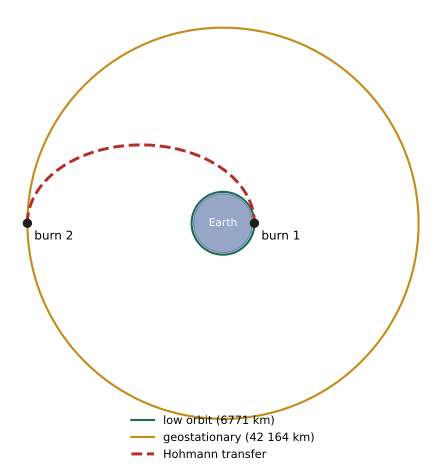
A spacecraft changes orbit by firing its engine to change its velocity, measured as delta-v (Δv). The most economical way to move between two circular orbits in the same plane is the Hohmann transfer: a first burn raises the far side of the orbit to the target radius, putting the craft on a half-ellipse, and a second burn at the far point circularizes the orbit. Delta-v is the currency of space missions, because the propellant needed grows exponentially with it (the rocket equation): every extra kilometre per second costs a large increase in launch mass.
import math

GM = 3.986e14                      # Earth, m^3/s^2
r1, r2 = 6.771e6, 4.2164e7         # low orbit (400 km altitude) and geostationary radius

v1 = math.sqrt(GM / r1)
a = (r1 + r2) / 2                  # semi-major axis of the transfer ellipse
vp = math.sqrt(GM * (2 / r1 - 1 / a))
va = math.sqrt(GM * (2 / r2 - 1 / a))
v2 = math.sqrt(GM / r2)
print(f"Circular speeds: {v1 / 1000:.3f} km/s low, {v2 / 1000:.3f} km/s geostationary")
print(f"Burn 1: {(vp - v1) / 1000:.3f} km/s, burn 2: {(v2 - va) / 1000:.3f} km/s, total {(vp - v1 + v2 - va) / 1000:.3f} km/s")
print(f"Transfer time (half an ellipse): {math.pi * math.sqrt(a**3 / GM) / 3600:.2f} h")

# Check by stepping the transfer orbit with the velocity Verlet method
x, y, vx, vy = r1, 0.0, 0.0, vp
dt, t, rmax = 2.0, 0.0, r1
ax, ay = -GM * x / r1**3, -GM * y / r1**3
while t < 20 * 3600:
    vx += 0.5 * dt * ax; vy += 0.5 * dt * ay
    x += dt * vx; y += dt * vy
    r = math.hypot(x, y)
    ax, ay = -GM * x / r**3, -GM * y / r**3
    vx += 0.5 * dt * ax; vy += 0.5 * dt * ay
    t += dt
    if r > rmax:
        rmax, t_apo = r, t
print(f"Simulated: farthest point {rmax / 1000:.0f} km from the middle of the Earth, reached after {t_apo / 3600:.2f} h")Circular speeds: 7.673 km/s low, 3.075 km/s geostationary Burn 1: 2.399 km/s, burn 2: 1.457 km/s, total 3.857 km/s Transfer time (half an ellipse): 5.29 h Simulated: farthest point 42164 km from the middle of the Earth, reached after 5.29 h
The two burns total about 3.9 km/s, and the transfer takes 5.3 hours. The numerical simulation, using the velocity Verlet method (MATH-300), reaches exactly the geostationary radius at the predicted time, confirming both the formulas and the code. In practice, satellites launched from Canada or the northern United States also need to change their orbital plane to the equator, which adds considerable delta-v; that is why launch sites near the equator are favoured for geostationary missions.
Navigation satellites show how precisely these ideas are used. GPS satellites orbit at about 20 200 km altitude with a period of almost exactly half a sidereal day, so their ground tracks repeat daily. A receiver finds its position from the travel times of signals from four or more satellites, so timing errors of a microsecond would mean position errors of 300 m. The satellite clocks must even be corrected for relativity: they gain about 38 microseconds per day relative to clocks on the ground, mainly because gravity is weaker at their altitude, an effect Newtonian mechanics cannot explain but which engineers must still build in.
Tides and other effects
Because gravity weakens with distance, the Moon pulls harder on the near side of the Earth than on its centre, and harder on the centre than on the far side. These differences stretch the oceans into two bulges, one facing the Moon and one opposite, so most coasts see two high tides a day; the Sun adds a smaller effect, giving larger spring tides when Sun and Moon align and smaller neap tides between. Tidal ranges reach 16 m in the Bay of Fundy, where resonance of the bay amplifies them (Lesson 11), and tidal power projects there and elsewhere tap the energy. Tidal effects of the same kind gradually slow the Earth's rotation and push the Moon farther away, by about 3.8 cm per year.
Common mistakes
MistakeUsing the altitude instead of the distance from the planet's centre.
InsteadIn F = GMm/r², r is measured from the centre: R_E + h.
MistakeUsing U = mgh for large changes in altitude.
InsteadUse U = −GMm/r when g varies appreciably.
MistakeThinking astronauts float because there is no gravity.
InsteadThey are in free fall; gravity at the ISS is still 88% of the surface value.
MistakeAssuming a higher orbit means a faster satellite.
InsteadOrbital speed √(GM/r) decreases with radius.
MistakeUsing the circular-orbit speed on an elliptical orbit.
InsteadUse v² = GM(2/r − 1/a).
Summary and key terms
- F = Gm₁m₂/r²; outside a sphere, all its mass acts at the centre.
- g = GM/R² = 9.8 m/s² at the surface and falls as (R/(R + h))² with altitude.
- U = −GMm/r; escape speed √(2GM/R) = 11.2 km/s for the Earth.
- Circular orbits: v = √(GM/r), T = 2π√(r³/GM); geostationary radius 42 164 km.
- Orbital energy E = −GMm/(2r); drag lowers a satellite and speeds it up.
- Kepler's laws: ellipses with the planet at a focus, equal areas in equal times, T² ∝ a³.
- Hohmann transfers use two burns; LEO to geostationary needs about 3.9 km/s.
- Gravitational constant
- G = 6.674 × 10⁻¹¹ N·m²/kg².
- Escape speed
- The minimum launch speed to leave a planet's gravity without further thrust.
- Orbital period
- The time for one complete orbit.
- Geostationary orbit
- An equatorial circular orbit with a period of one sidereal day.
- Free fall
- Motion under gravity alone, in which apparent weight is zero.
- Periapsis
- The closest point of an orbit to the central body.
- Semi-major axis
- Half the longest diameter of an elliptical orbit.
- Kepler's third law
- The square of the period is proportional to the cube of the semi-major axis.
- Delta-v
- The change in velocity a spacecraft must produce for a manoeuvre.
- Hohmann transfer
- A two-burn elliptical transfer between coplanar circular orbits.
Practice problems
Work each problem on paper first, then reveal the answer to check.
Find the gravitational force between two 1000 kg masses 3 m apart.
Show answer
6.674 × 10⁻¹¹ × 10⁶/9 = 7.4 × 10⁻⁶ N.
Find g at an altitude of one Earth radius.
Show answer
g/4 = 2.45 m/s².
Find the Moon's surface gravity (M = 7.35 × 10²² kg, R = 1737 km).
Show answer
1.62 m/s².
Find the Moon's escape speed.
Show answer
√(2 × 4.905 × 10¹²/1.737 × 10⁶) = 2.38 km/s.
Find the period of a satellite at 800 km altitude.
Show answer
r = 7171 km: T = 2π√(r³/GM) = 6040 s ≈ 101 min.
If an orbit's radius is quadrupled, how does its period change?
Show answer
Multiplied by 4^(3/2) = 8.
Find the energy of a 1000 kg satellite at r = 7000 km.
Show answer
−3.986 × 10¹⁴ × 1000/(2 × 7 × 10⁶) = −2.85 × 10¹⁰ J.
An ellipse has perigee 7000 km and apogee 21 000 km. Find a and the period.
Show answer
a = 14 000 km; T = 2π√(a³/GM) = 16 500 s ≈ 4.6 h.
Find the speed at perigee for that orbit.
Show answer
√(GM(2/7 × 10⁶ − 1/1.4 × 10⁷)) = 9.24 km/s.
Why do satellite operators prefer launch sites near the equator for geostationary missions?
Show answer
Less plane change is needed (and the Earth's rotation gives a larger eastward boost).
Lesson quiz · 5 questions
Score 60% or more to complete this lesson.
Create a free account to save your progress, take quizzes and earn a certificate.