
PHOT-102 · Lesson 3 of 12 · 25 min
Natural light and time of day
Natural light is free, abundant and endlessly variable, and much of the world's finest photography uses nothing else. But the photographer cannot move the sun. Working with natural light means understanding how it changes through the day, the seasons and the weather, predicting what it will do at a location, choosing the time and the camera position that make the most of it, and knowing how to cope when the light is not ideal. This lesson covers the sun's path and elevation, the qualities of light at different times of day, overcast, haze and other weather, open shade, strategies for working in harsh midday sun, planning tools, and light after dark.
The sun's path
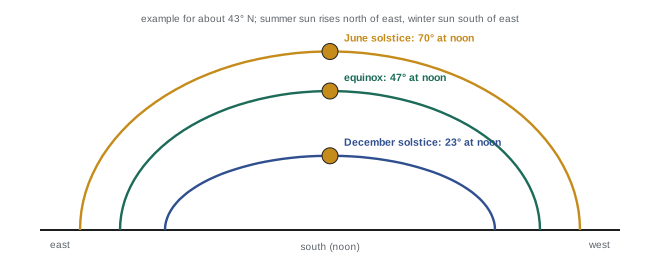
The sun rises roughly in the east and sets roughly in the west, reaching its highest point, solar noon, when it is due south in the northern hemisphere. Its elevation at solar noon depends on latitude and season. At the equinoxes (around March 20 and September 22), the noon sun's elevation is 90° minus the latitude; at the June solstice it is 23.4° higher, and at the December solstice 23.4° lower:
The direction of sunrise and sunset also changes through the year: near the equinoxes the sun rises due east and sets due west, while in summer it rises and sets well to the north of east and west, and in winter well to the south. At higher latitudes, these swings are large; this changes which side of a building or valley receives morning and evening light. Solar noon rarely coincides with 12:00 on the clock, because of time zones and daylight saving time; in summer it is often around 13:00 to 13:30.
Elevation controls shadow length. A vertical object of height h casts a shadow of length h ÷ tan(elevation), so a low sun makes long shadows that stretch across the landscape and reveal texture, while a high sun makes short shadows directly beneath objects.
Worked problem
Noon sun in summer and winter
Vancouver is at latitude 49.3° N. Find the noon sun elevation at the June and December solstices, and the length of a 1.7 m person's shadow at noon on each date.
Show solution
- June: 90 − 49.3 + 23.4 = 64.1°. December: 90 − 49.3 − 23.4 = 17.3°.
- June shadow: 1.7 ÷ tan 64.1° = 1.7 ÷ 2.06 = 0.83 m.
- December shadow: 1.7 ÷ tan 17.3° = 1.7 ÷ 0.31 = 5.5 m.
Answer: At midsummer noon, the sun is high (64°) and harsh, with short shadows; at midwinter noon, it is only 17° above the horizon, giving low, raking light all day. Photographers at Canadian latitudes enjoy long golden hours in winter, but short days.
The light through the day
Natural light changes in a predictable sequence through a clear day:
- Before sunrise, during civil twilight and the blue hour, the sun is a few degrees below the horizon. The light comes entirely from the sky: soft, shadowless and deep blue, with a colour temperature that can exceed 10,000 K. The sky glows pink and orange near the horizon where the sun will rise. Artificial lights in a city, still on, balance beautifully with the blue sky for a short time.
- The golden hour begins as the sun rises. With the sun less than about 6° above the horizon, its light passes through a long path of atmosphere, which scatters away the blue wavelengths and leaves warm, orange-gold light at 2,000 to 3,500 K. The light is low, directional and relatively soft because haze diffuses it, and long shadows reveal texture. Contrast between sunlit and shaded areas is moderate because the sun is dimmer. The golden hour is prized for portraits and landscapes alike.
- Mid-morning and mid-afternoon, with the sun at 20° to 45°, the light becomes whiter, harder and more contrasty, but still directional enough to model forms. Many architectural and travel photographs are made at these times, choosing the side of the subject that the sun strikes at a good angle.
- Around midday, the sun is at its highest. Light is hard, neutral to slightly cool (about 5,000 to 5,500 K in direct sun), and from above, casting deep shadows under eyebrows, noses and hats, and under trees and eaves. Colours can look saturated in direct sun, but landscapes often look flat because shadows are short and hidden beneath objects.
- In the afternoon and evening, the sequence reverses, ending with the evening golden hour, sunset and the blue hour after sunset.
The length of the golden and blue hours depends on latitude and season. Near the equator, the sun rises and sets steeply and the golden hour may last only twenty to thirty minutes; at high latitudes, the sun moves along a shallow path near the horizon and the golden light can last for hours in winter, while in midsummer twilight may never fully end.
| Time | Sun elevation | Colour temperature | Quality and character |
|---|---|---|---|
| Blue hour | −4° to −6° (below horizon) | 9,000 to 15,000 K | Soft, shadowless, deep blue sky |
| Golden hour | 0° to about 6° | 2,000 to 3,500 K | Warm, low, long shadows, moderate contrast |
| Morning or afternoon | 20° to 45° | 4,500 to 5,500 K | Directional, harder, good modelling |
| Midday | Highest of the day | 5,000 to 5,500 K | Hard, top light, high contrast |
| Open shade | Any | 6,500 to 10,000 K | Soft, directional from the open sky, cool |
| Overcast | Any | 6,000 to 7,500 K | Very soft, low contrast, from above |
Overcast, haze and weather
Clouds transform sunlight. A thin layer of high cloud diffuses the sun into a larger, softer source while keeping some direction, often a beautiful light for portraits. A full overcast turns the whole sky into an enormous softbox: light is very soft and comes mainly from above, contrast is low, colours look gentle and saturated without glare, and shadows almost disappear. Overcast light is excellent for portraits (though top light can still leave the eyes dark), for close-ups of plants and textures, for waterfalls and forests where sun would create patches of extreme contrast, and for any subject that would be spoiled by harsh shadows. Its weaknesses are a featureless white sky, which is best kept out of the frame, a lack of modelling on large landscapes, and a slight cool cast.
Weather provides some of the most dramatic natural light. Breaks in storm clouds can spotlight parts of a landscape against dark skies; fog and mist soften distant elements and simplify compositions, creating depth through aerial perspective; rain saturates colours and makes streets reflective; snow acts as a giant reflector, filling shadows and fooling meters into underexposure (PHOT-101, Lesson 6). Haze and smoke soften and warm the sun, sometimes dramatically. Photographers who check forecasts and go out when the weather changes are rewarded with light that a clear day cannot provide.
Open shade
Open shade is shade from direct sun with a large area of open sky visible from the subject's position: the shaded side of a building facing an open street, the edge of a tree's shadow, or under an awning. The subject is lit by the sky, a large and soft source, which comes from one side (the open side) rather than from above. This makes open shade a reliable, flattering light for portraits at any time of day. Place the subject just inside the shade, facing the open sky, and the light will model the face softly with clear catchlights. Moving the subject deeper into the shade makes the light softer, dimmer and more directional; moving toward the edge makes it brighter and flatter.
Open shade is cool, because it comes from the blue sky; set a shade white balance or a custom white balance to avoid blue skin tones. Watch also for coloured reflections from surrounding surfaces: a sunlit red brick wall opposite a subject in shade will cast a warm, reddish light, which may be welcome; green from grass and foliage rarely is. A sunlit pale wall or pavement near a shaded subject can act as a huge natural reflector, adding warm fill.
Working in harsh midday sun
Photographers are often told to avoid midday sun, but sometimes there is no choice, and with the right approach good pictures are possible:
- Find shade: move the subject into open shade, under a tree (avoiding dappled patches) or into a doorway, and expose for the subject.
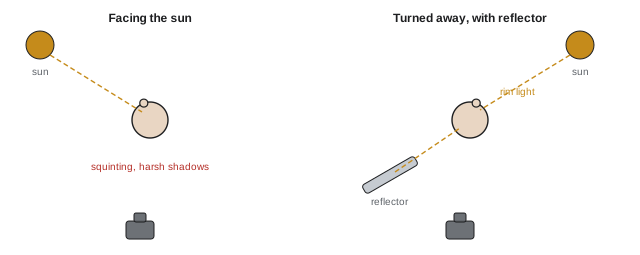
- Turn the subject away from the sun: with the sun behind or beside them, the face is in the shade of the head itself, lit by the bright surroundings, while the sun rims the hair and shoulders. Expose for the face and accept a brighter background, or add fill.
- Add fill: a reflector or fill flash lightens the deep shadows under eyes and hats (Lessons 5 and 7).
- Diffuse: a large diffusion panel held between the sun and the subject turns hard sun into soft light over a small area, ideal for portraits and close-ups.
- Use the hardness: hard midday light suits graphic compositions, strong shadow patterns, architecture with deep geometry, saturated colours on bright days, and black-and-white images with bold contrast. Look down: shadows directly below objects can make striking abstract images.
- Choose subjects with their own shade: interiors lit by windows, forests, narrow streets, covered markets.
Planning natural light
Because natural light is predictable, photographers plan for it. Sun and moon planning apps and websites show the direction and elevation of the sun and moon for any place and time, the times of twilight, golden hour and blue hour, and the direction shadows will fall. Combined with satellite maps and weather forecasts, they let you decide in advance which side of a building will be lit at what time, when the sun will set behind a particular peak, or whether a full moon will rise between two towers. Scouting a location at a different time and noting where the light will fall saves a wasted trip. When shooting portraits outdoors, scheduling within two hours of sunset (and arriving early) is one of the simplest ways to improve results.
Planning also means having a backup. If clouds roll in at a sunset shoot, the soft light is ideal for portraits close up; if the sun is harsh, find open shade. A photographer who understands light adapts the picture to the light rather than waiting for one specific condition.
Light after dark
After the blue hour, natural light gives way to moonlight, starlight and artificial light. Moonlight is simply sunlight reflected from the moon, with the same colour (though the eye sees it as blue and cool), about 18 to 19 stops dimmer than direct sun at full moon. It requires long exposures or high ISO, and its hard, directional quality reveals landscapes in a way that looks like dim daylight in a long exposure. Night skies with stars need dark sites, wide apertures, high ISO and exposure times limited by the earth's rotation (PHOT-101, Lesson 4). City lights at night are mixed in colour, from orange sodium and warm LED street lights to cool LED signs, and the challenge is to balance their brightness and colours, often by shooting in the blue hour when the sky still holds some light.
Common mistakes
MistakeScheduling outdoor portraits at noon without a plan.
InsteadSchedule near the golden hour or plan shade, backlight and fill.
MistakeIncluding a blank overcast sky in the frame.
InsteadFrame it out or use it as a high-key background deliberately.
MistakeLeaving auto white balance in open shade.
InsteadUse shade or custom white balance to avoid blue skin.
MistakePlacing subjects in dappled shade.
InsteadFind even shade or use the edge of the shadow.
MistakeArriving at sunset without scouting.
InsteadUse sun planning tools and arrive early to set up.
Summary and key terms
- Noon sun elevation equals 90° minus latitude, plus or minus up to 23.4° by season.
- Shadow length is height divided by the tangent of the sun's elevation.
- Blue hour, golden hour, mid-morning and midday light differ in direction, colour and contrast.
- Overcast skies act as huge soft sources; weather creates dramatic light.
- Open shade gives soft, directional, cool light for portraits.
- Harsh sun can be managed with shade, backlight, fill, diffusion or graphic compositions.
- Planning tools predict sun and moon positions, twilight times and shadow directions.
- Solar noon
- The time when the sun is highest in the sky.
- Golden hour
- The period when the sun is low, giving warm, directional light.
- Blue hour
- Twilight with the sun just below the horizon, giving deep blue light.
- Open shade
- Shade lit by a large area of open sky.
- Overcast
- Cloud cover that diffuses the sun over the whole sky.
- Dappled light
- Patches of sun and shade, usually through foliage.
- Aerial perspective
- The lightening and softening of distant objects by atmosphere.
- Civil twilight
- The period with the sun between 0° and 6° below the horizon.
- Rim light
- Light outlining the edge of a subject from behind.
- Elevation
- The sun's angle above the horizon.
Practice problems
Work each problem on paper first, then reveal the answer to check.
What is the noon sun elevation at the equinox at latitude 45° N?
Show answer
45°.
How long is the shadow of a 10 m tree with the sun at 30°?
Show answer
10 ÷ tan 30° ≈ 17.3 m.
Why is golden-hour light warm?
Show answer
The long atmospheric path scatters away blue wavelengths.
When is the blue hour?
Show answer
During twilight with the sun a few degrees below the horizon.
Why is overcast light good for waterfalls in forests?
Show answer
It avoids extreme contrast between sunlit patches and shade.
Where should a subject stand in open shade?
Show answer
Just inside the shade, facing the open sky.
What white balance problem occurs in open shade?
Show answer
A blue cast, corrected with shade or custom white balance.
Name three strategies for midday sun portraits.
Show answer
Shade, turning away from the sun, fill, diffusion.
Why does the golden hour last longer at high latitudes?
Show answer
The sun's path near the horizon is shallow.
What is moonlight's actual colour?
Show answer
Similar to sunlight, since it is reflected sunlight.
Lesson quiz · 5 questions
Score 60% or more to complete this lesson.
Create a free account to save your progress, take quizzes and earn a certificate.