
PET-370 · Lesson 9 of 12 · 19 min
Solvent, hybrid and in situ combustion processes
Prairie Crest's carbon costs are rising, and Mei Lin has asked the thermal group a blunt question: how much of the steam at Wapiti Lake could be replaced? Paul Desrosiers gathers the team in the Calgary office. 'Steam works,' he says, 'but every barrel of it is burned natural gas. Industry has spent thirty years looking for ways to do the same job with less heat: adding solvents to the steam, using solvent alone, heating the reservoir electrically or burning part of the oil underground. Some of those ideas are now commercial. Let's see which could work for us.'
This lesson reviews the main alternatives and supplements to steam: solvent-assisted steam processes, solvent-only processes such as VAPEX, electrical and radio-frequency heating, and in situ combustion. For each it explains the mechanism, the main technical challenge and the field experience so far.
Why solvents work
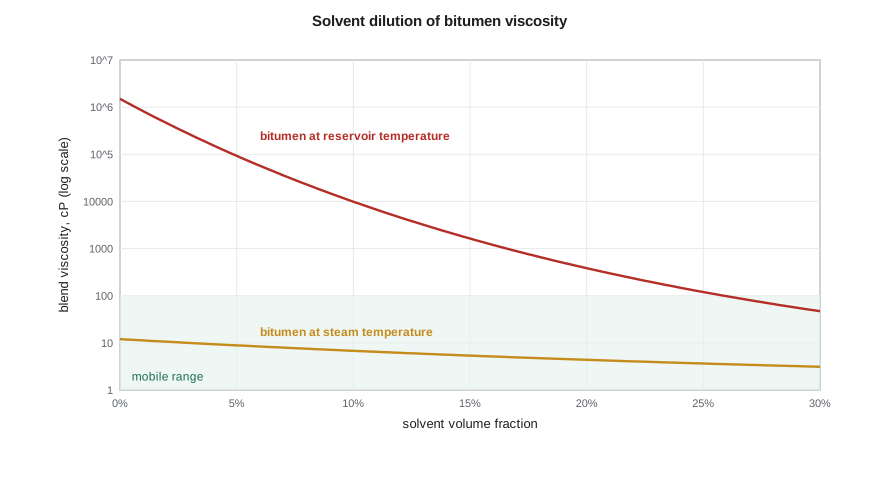
A light hydrocarbon dissolved in heavy oil reduces its viscosity dramatically. Even a modest volume fraction of a solvent such as propane, butane or a natural gas condensate can lower the viscosity of bitumen by orders of magnitude at reservoir temperature, and further reduce it at steam temperature. That effect is the same one used at surface, where bitumen is blended with diluent to make it flow in pipelines. A useful rough guide to the viscosity of a blend is a double-logarithmic mixing rule, in which the logarithm of the logarithm of viscosity varies linearly with the solvent fraction.
Here μ_m, μ_o and μ_s are the viscosities of the mixture, the oil and the solvent and x_s is the solvent volume fraction. The rule is approximate and works best for solvents with viscosities above about 1 cP, but it captures the steep effect of the first few percent of solvent.
# Solvent dilution of bitumen viscosity and a VAPEX-type drainage rate
import math
SI = True
def blend(mu_o, mu_s, x_s):
    # log-log mixing rule (Arrhenius-type): ln ln(mu) varies linearly with solvent volume fraction (rough guide)
    return math.exp(math.exp((1 - x_s) * math.log(math.log(mu_o)) + x_s * math.log(math.log(mu_s))))
mu_hot = 12.0      # cP bitumen at steam temperature
mu_cold = 1.5e6    # cP bitumen at reservoir temperature
mu_c6 = 1.2        # cP condensate-like solvent (log-log mixing needs viscosity above 1 cP)
for x in (0.0, 0.05, 0.10, 0.20, 0.30):
    print(f"solvent fraction {x:4.0%}: at reservoir T {blend(mu_cold, mu_c6, x):>12,.0f} cP   at steam T {blend(mu_hot, mu_c6, x):6.1f} cP")
# VAPEX (no steam) gravity drainage: q = 2 L sqrt(2 k g phi dSo h Ns), Ns lumps diffusion and viscosity
L, h, phi, dSo, k = 800.0, 20.0, 0.33, 0.60, 3.0 * 0.9869e-12
for Ns in (1e-7, 5e-7, 2e-6):
    q = 2 * L * math.sqrt(2 * k * 9.81 * phi * dSo * h * Ns) * 86400
    print(f"Ns = {Ns:.0e}: VAPEX rate ~ {q:5.1f} m3/d per well pair" if SI else f"Ns = {Ns:.0e}: VAPEX rate ~ {q * 6.2898:5.0f} bbl/d per well pair")
# solvent retained in the reservoir is a cost: recovery of injected solvent drives the economics
inj, back = 50.0, 0.75                 # solvent injected per day, fraction recovered
print(f"solvent left in the reservoir: {inj * (1 - back):.1f} m3/d of every {inj:.0f} m3/d injected" if SI
else f"solvent left in the reservoir: {inj * 6.2898 * (1 - back):.0f} bbl/d of every {inj * 6.2898:.0f} bbl/d injected")solvent fraction 0%: at reservoir T 1,500,000 cP at steam T 12.0 cP solvent fraction 5%: at reservoir T 92,720 cP at steam T 8.9 cP solvent fraction 10%: at reservoir T 9,883 cP at steam T 6.8 cP solvent fraction 20%: at reservoir T 384 cP at steam T 4.4 cP solvent fraction 30%: at reservoir T 47 cP at steam T 3.1 cP Ns = 1e-07: VAPEX rate ~ 0.7 m3/d per well pair Ns = 5e-07: VAPEX rate ~ 1.5 m3/d per well pair Ns = 2e-06: VAPEX rate ~ 3.0 m3/d per well pair solvent left in the reservoir: 12.5 m3/d of every 50 m3/d injected
The calculation shows the problem as well as the promise. At reservoir temperature, 20 percent solvent brings the viscosity of bitumen down from 1.5 million to a few hundred centipoise, but the drainage rate from a solvent-only process is limited by how fast the solvent diffuses into the cold bitumen. And any solvent left in the reservoir is a cost: at 75 percent recovery, a quarter of every unit injected stays underground.
Solvent-assisted steam processes
The most successful approach so far adds a few percent to a few tens of percent of solvent to the steam. In solvent-assisted SAGD, also called expanding solvent SAGD, ES-SAGD, a hydrocarbon with a boiling point close to the steam temperature is injected with the steam as a vapour. It condenses with the steam at the edge of the chamber, dissolves into the heated bitumen and lowers its viscosity further, so the drainage rate rises and less steam is needed per unit of oil. Imperial Oil's liquid addition to steam for enhancing recovery, LASER, adds condensate to steam in CSS wells at Cold Lake. Several operators have run solvent-assisted SAGD pilots and commercial schemes in Alberta, reporting reductions in steam-oil ratio and greenhouse gas intensity, and Imperial is applying solvent-assisted SAGD at commercial scale in its Leming redevelopment at Cold Lake.
The main challenges are cost and recovery of the solvent. Condensate and butane are valuable, and much of the economic case depends on recovering most of what is injected, which happens partly in the produced fluids and partly by blowing down the chamber with gas or steam at the end of the project. Solvent choice is also important: lighter solvents such as propane do not condense at steam temperature and stay in the vapour phase, while heavier ones may not vaporise fully.
Solvent-only processes
The vapour extraction process, VAPEX, proposed by Butler and Mokrys in 1989, replaces steam altogether with a hydrocarbon vapour injected into a SAGD-style well pair. The vapour dissolves into the bitumen at the chamber edge and the diluted oil drains by gravity. Because no water is heated, VAPEX uses very little energy and water and emits much less carbon. Its drawback is the low rate: diffusion of solvent into cold bitumen is slow, so laboratory and pilot rates were often an order of magnitude lower than SAGD. A heated version, in which a pure solvent such as propane or butane is injected at a temperature somewhat above reservoir temperature and condenses at the chamber edge, was developed by N-Solv and piloted at a site near Fort McMurray in the 2010s, producing bitumen at encouraging rates without steam.
Electrical and radio-frequency heating
Heat can be delivered to the reservoir without steam. In resistive heating, an electric current passes through the formation water between electrodes. In inductive heating, a cable carrying alternating current induces heat in the formation or in a metal casing. Radio-frequency or microwave heating uses antennas to heat the water in the formation. These methods avoid boilers, water treatment and steam losses in the wellbore, and if the electricity comes from low-carbon sources they can greatly reduce emissions. Pilots in Alberta have combined radio-frequency heating with solvent injection, and electrical heaters are used in some wells to keep near-wellbore oil mobile. In California, a pilot in Kern County used solar collectors to make steam for an oil field in the early 2010s, and the same idea has since been built at larger scale in Oman. Commercial use of electrical heating in heavy oil is still limited, mainly by power costs and the difficulty of heating large volumes evenly.
In situ combustion
In situ combustion, also called fire flooding, injects air into the reservoir and burns a small part of the oil, typically the heaviest fraction left behind as coke, to generate heat underground. A combustion front moves away from the injector, with a steam zone and a bank of heated, partly upgraded oil ahead of it. The process uses the reservoir itself as the boiler, so it avoids surface steam generation, wellbore heat losses and much of the water handling.
In situ combustion has been used for decades in some heavy oil fields, most notably at Suplacu de Barcău in Romania, where it has been operated since the 1960s, and in fields in India and the United States. Its difficulties are controlling the front, which can bypass oil or channel through high-permeability streaks, handling hot, corrosive flue gases at the producers, and ensuring that combustion stays in the high-temperature regime that burns coke rather than low-temperature oxidation that thickens the oil. Toe-to-heel air injection, THAI, which pairs vertical air injectors with horizontal producers, was piloted in Alberta and Saskatchewan in the 2000s and 2010s with mixed results.
Worked problem
Viscosity of a solvent blend
Using the double-logarithmic rule, estimate the viscosity of a blend of 10 percent solvent (μ_s = 1.2 cP) with bitumen of μ_o = 1.5 × 10⁶ cP at reservoir temperature.
Show solution
- ln ln(1.5 × 10⁶) = ln(14.22) = 2.655; ln ln(1.2) = ln(0.1823) = −1.702.
- ln ln μ_m = 0.9 × 2.655 + 0.1 × (−1.702) = 2.389 − 0.170 = 2.219.
- ln μ_m = e^2.219 = 9.198; μ_m = e^9.198 ≈ 9,900 cP.
Answer: About 10,000 cP, roughly 150 times lower than the original bitumen. That is still far too viscous to flow under gravity at a useful rate, which is why solvent alone gives low rates in cold bitumen and why combining solvent with heat works better.
Choosing a solvent
The choice of solvent for a steam process depends mainly on its boiling point at the operating pressure. A solvent that boils at about the same temperature as water at chamber pressure will vaporise with the steam in the injector, travel to the chamber edge and condense there alongside the steam, putting it exactly where the bitumen is being heated. Hexane, heptane and condensate mixtures with similar boiling ranges are often used at typical SAGD pressures. Lighter solvents such as propane and butane remain in the vapour phase at steam temperature and tend to accumulate at the top of the chamber; they are better suited to lower-temperature or solvent-only processes, in which they condense at the cooler edge of the chamber. The solvent must also be available in large volumes at a reasonable price and be compatible with the bitumen, since some solvents can cause asphaltenes to precipitate and reduce permeability near the chamber edge.
Solvent recovery depends on the reservoir and the operating plan. While the chamber is growing, much of the injected solvent comes back with the produced oil and can be separated and reinjected. Solvent that dissolves in bitumen left behind in the chamber, or that fills the pore space as vapour, is recovered later by blowdown, reducing the pressure so that it vaporises and flows to the producer, sometimes helped by injecting non-condensable gas. Pilots have reported solvent recoveries well above half of the volume injected, with the highest values in projects designed for recovery from the start.
Non-condensable gas co-injection
A related technique adds a non-condensable gas, usually methane or flue gas, to the steam, typically in the later life of a SAGD project. The gas accumulates at the top of the chamber, where it insulates the cap rock and reduces heat losses, and helps maintain pressure while less steam is injected. Non-condensable gas co-injection is widely used in Alberta's mature SAGD projects as part of wind-down, when steam rates are being reduced and the chamber is gradually allowed to cool, and it can lower the SOR during that phase.
Comparing the alternatives
No single alternative to steam suits every reservoir. Solvent co-injection works best where a steam process is already viable and solvent can be supplied and recovered economically; solvent-only processes suit reservoirs where steam would lose too much heat, such as thin pay, and where lower rates are acceptable in exchange for much lower emissions; electrical heating is attractive where low-carbon power is available; and in situ combustion suits reservoirs where air can be injected safely and the front can be controlled. The economics of all of them depend on carbon prices, solvent and power costs and the value of lower emissions, which is why interest in these methods has grown as carbon costs have risen.
Common mistakes
MistakeAssuming any solvent will help.
InsteadChoose a solvent whose boiling behaviour matches the chamber conditions.
MistakeIgnoring solvent left in the reservoir.
InsteadSolvent retention is a major cost; plan for recovery.
MistakeExpecting VAPEX rates to match SAGD.
InsteadSolvent-only rates are limited by diffusion into cold bitumen.
MistakeTreating in situ combustion as easy to control.
InsteadFront control, flue gas handling and oxidation regime are major challenges.
Summary and key terms
- Light hydrocarbons dissolved in heavy oil lower its viscosity by orders of magnitude.
- Solvent-assisted steam processes such as ES-SAGD and LASER lower the SOR; solvent recovery drives economics.
- VAPEX and heated solvent processes avoid steam but have lower rates.
- Electrical, radio-frequency and solar heating can supply heat with less combustion.
- In situ combustion burns part of the oil underground; front control is the main challenge.
- ES-SAGD
- Expanding solvent SAGD, which co-injects a vaporised solvent with steam.
- VAPEX
- Vapour extraction, a solvent-only gravity drainage process.
- LASER
- Liquid addition to steam for enhancing recovery, used in CSS at Cold Lake.
- Double-logarithmic rule
- A mixing rule in which ln ln viscosity varies linearly with solvent fraction.
- In situ combustion
- Burning part of the oil underground with injected air to generate heat.
- THAI
- Toe-to-heel air injection, using vertical injectors and horizontal producers.
Practice problems
Work each problem on paper first, then reveal the answer to check.
Why does solvent in steam lower the SOR?
Show answer
It further reduces oil viscosity, raising drainage per unit of steam.
What limits VAPEX rates?
Show answer
Slow diffusion of solvent into cold bitumen.
Why is solvent recovery important?
Show answer
Solvent is valuable; unrecovered solvent is a cost.
What fuel does in situ combustion burn?
Show answer
Mainly coke left from the heaviest fraction of the oil.
Lesson quiz · 5 questions
Score 60% or more to complete this lesson.
Create a free account to save your progress, take quizzes and earn a certificate.