
PET-370 · Lesson 6 of 12 · 19 min
SAGD operations and performance
Ethan's second month in the thermal group begins in Fort McMurray. Tom Ashworth, the operations superintendent at Wapiti Lake SAGD project, meets him at the central processing facility and hands him a hard hat and a printout of the monthly pad report. 'Paul taught you how the chamber grows,' Tom says. 'Out here we manage it one well pair at a time. Every morning we look at three numbers: the steam we put in, the bitumen we got out and the subcool on every producer. If those are right, the rest usually follows.'
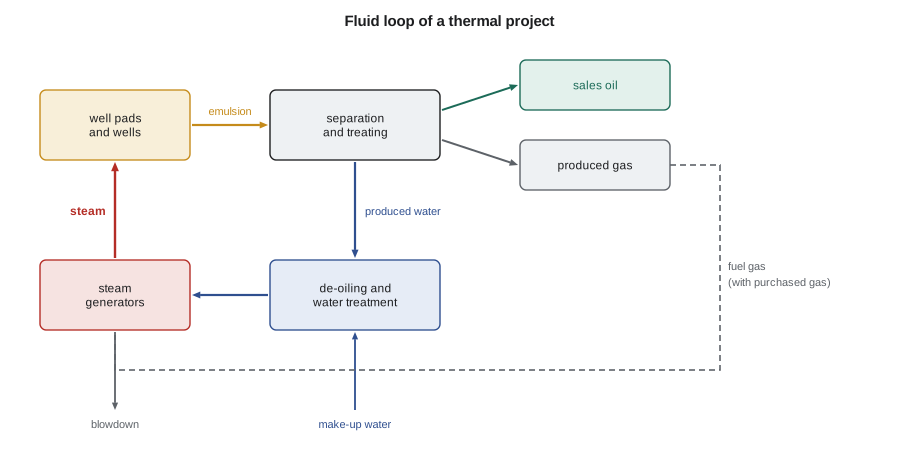
This lesson follows the fluids through a thermal operation: from water treatment and steam generation, through the wells and the reservoir, to the production facility where oil, water and gas are separated and the water is recycled. It explains the steam-oil ratio and the other key performance measures, the subcool control that keeps a SAGD producer working, artificial lift at high temperature and the problems that most often limit production.
The steam-oil ratio
The most important number in any thermal project is the steam-oil ratio, SOR: the volume of steam injected, measured as the cold water equivalent volume of the water used to make it, divided by the volume of oil produced over the same period. An SOR of 3 means three volumes of water were turned into steam for every volume of oil produced. The cumulative SOR, CSOR, uses the totals since the start of the project or of a period, and smooths out the day-to-day noise.
The SOR drives most of the costs. Fuel to make steam is usually the largest operating cost, and in most thermal projects it is also the largest source of greenhouse gas emissions. Every unit of steam needs water treatment and boiler capacity, and every unit of produced water must be separated and handled. Typical SAGD projects in Alberta operate with SORs between about 2 and 4; the best projects in clean, thick pay run below 2.5, while thin or heterogeneous reservoirs may run above 4. Steamfloods typically run between about 3 and 8 over their life, rising as the floods mature. Some operators also report the inverse, the oil-steam ratio, OSR.
A related measure is the energy intensity of production, in gigajoules of fuel per cubic metre of oil, or million Btu per barrel. It accounts for the steam quality and boiler efficiency as well as the SOR, and it converts directly into fuel cost and emissions, which is why lesson 11 uses it.
# SAGD pad performance: steam-oil ratio, steam quality and water balance
SI = True
oil = [310, 300, 295, 280, 260, 255]           # m3/d bitumen, last six months, pad of eight well pairs
cwe = [930, 915, 930, 900, 880, 895]           # m3/d steam as cold water equivalent
for i, (o, s) in enumerate(zip(oil, cwe), 1):
    if SI: print(f"month {i}: oil {o} m3/d, steam {s} m3/d CWE, SOR {s / o:.2f}")
    else:  print(f"month {i}: oil {o * 6.2898:,.0f} bbl/d, steam {s * 6.2898:,.0f} bbl/d CWE, SOR {s / o:.2f}")
csor = sum(cwe) / sum(oil)
print(f"cumulative SOR for the period: {csor:.2f}")
# water balance: produced water returns about 1.0 times the steam; some is lost to blowdown and the reservoir
steam = sum(cwe) / len(cwe)
prod_water = 0.95 * steam
blowdown = 0.10 * steam                        # OTSG blowdown, part recycled after evaporation in some plants
recycle = prod_water - 0.05 * prod_water       # treatment losses about 5 %
makeup = steam + blowdown - recycle
print(f"produced water {prod_water:.0f}, recycled {recycle:.0f}, make-up {makeup:.0f} m3/d ({makeup / steam:.0%} of steam)" if SI
      else f"produced water {prod_water * 6.2898:,.0f}, recycled {recycle * 6.2898:,.0f}, make-up {makeup * 6.2898:,.0f} bbl/d ({makeup / steam:.0%} of steam)")
# subcool: steam temperature at the producer pressure minus fluid temperature at the producer
for T_sat, T_prod in ((215, 210), (215, 195), (215, 214)):
    sc = T_sat - T_prod
    note = "steam may break through to the pump" if sc < 3 else ("liquid pool is high; rate may be held back" if sc > 15 else "inside the target band")
print(f"subcool {sc if SI else sc * 1.8:4.0f} {'C' if SI else 'F'}: {note}")month 1: oil 310 m3/d, steam 930 m3/d CWE, SOR 3.00 month 2: oil 300 m3/d, steam 915 m3/d CWE, SOR 3.05 month 3: oil 295 m3/d, steam 930 m3/d CWE, SOR 3.15 month 4: oil 280 m3/d, steam 900 m3/d CWE, SOR 3.21 month 5: oil 260 m3/d, steam 880 m3/d CWE, SOR 3.38 month 6: oil 255 m3/d, steam 895 m3/d CWE, SOR 3.51 cumulative SOR for the period: 3.21 produced water 863, recycled 820, make-up 179 m3/d (20% of steam) subcool 5 C: inside the target band subcool 20 C: liquid pool is high; rate may be held back subcool 1 C: steam may break through to the pump
The pad report shows the SOR rising from 3.0 to 3.5 over six months while the bitumen rate falls. Tom is not alarmed by the trend itself. 'This pad's chambers have reached the cap rock and are spreading,' he says. 'A rising SOR is normal at this stage. What I watch for is a sudden jump, which usually means steam is going somewhere it should not: into a thief zone, through a casing leak or straight into a producer.'
Water treatment and steam generation
A thermal project is, to a large extent, a water-handling business. Each unit of oil produced comes with several units of produced water, the condensed steam, at high temperature. That water is separated from the oil, cooled in heat exchangers that recover its heat, de-oiled by skim tanks, gas flotation and filters, and then softened or otherwise treated before it is used again to make steam.
Most SAGD and steamflood projects in North America use once-through steam generators, OTSGs, which can tolerate water with more dissolved solids than drum boilers. An OTSG passes the water once through a long tube coil and turns about 75 to 80 percent of it into steam, giving wet steam with a quality of about 0.75 to 0.80. In SAGD plants the remaining liquid is separated in a high-pressure separator and sent to blowdown, so that only dry steam goes to the wells; part of that blowdown can be recycled after evaporation. Some newer plants use evaporators to make distilled water for drum boilers, and many recover heat from the boiler exhaust. Cogeneration, in which a gas turbine makes electricity and its hot exhaust makes steam, is used at several large projects and lowers the combined emissions of power and steam.
Regulation sets how much water a project may draw. Alberta's Directive 081 limits the use of fresh and brackish make-up water at in situ projects and encourages high recycle rates; many SAGD plants recycle more than 90 percent of their produced water. Make-up water comes mainly from deep saline aquifers rather than surface water.
Subcool control
In SAGD the producer must collect bitumen and condensate without letting live steam into it. If steam breaks into the producer, it wastes heat, reduces the pressure difference that moves the liquid, erodes the screens and can damage the pump. The control variable is the subcool: the difference between the saturation temperature of steam at the producer pressure and the actual fluid temperature at the producer. A positive subcool means the fluid at the producer is liquid below its boiling point, which implies a liquid pool sitting above the well.
Operators target a subcool band, often roughly 5 to 15 °C (9 to 27 °F) at surface or measured with fibre-optic or thermocouple strings along the well. Too little subcool risks steam breakthrough; too much means a deep liquid pool that floods the bottom of the chamber, reduces the drainage area and lowers the rate. The producer's pump speed is the usual control: speeding up the pump lowers the liquid level and the subcool, slowing it raises them. Because temperature can vary along a 900 m (3,000 ft) well, operators use the temperature profile to see which parts of the well are draining well, and use dual tubing strings, flow control devices or steam splits between heel and toe to even out the chamber.
In steamfloods the equivalent concern is steam breakthrough at the producers. When a producer's temperature rises toward the steam temperature and its gas or steam rate climbs, operators may restrict it, change the injection pattern, or convert it to an injector.
Artificial lift at high temperature
Thermal wells produce hot fluids that cannot flow to surface on their own, so nearly all need artificial lift. Sucker-rod pumps are widely used, particularly in steamfloods and in many SAGD wells, because they tolerate high temperature and some sand. Electric submersible pumps designed for high temperature, up to about 250 °C (480 °F), allow higher rates and lower operating pressures in SAGD and are now common in Alberta. Progressive cavity pumps are used in cold heavy oil wells but their elastomers limit them in hot service. In the early life of SAGD projects run at high pressure, gas lift or natural steam lift was sometimes used.
Thermal wells also need strong mechanical design. Casing heated from about 10 °C to over 200 °C tries to expand and, being cemented, is put under large compressive stress, which may exceed its yield strength. Thermal casing designs use higher grades, premium connections, thermal cement and controlled heating procedures. Wellhead and surface piping use expansion loops for the same reason.
Common production problems
Several problems recur at thermal projects. Sand production through damaged screens fills wells and erodes equipment, and may need workovers or remedial liners. Emulsions of water and heavy oil can be difficult to break and require chemicals, heat and long residence times. Scaling and fouling in steam generators and wellbores result from silica, calcium and iron in the water. Hydrogen sulphide forms by aquathermolysis, the reaction of steam with sulphur compounds in the bitumen, and must be managed for safety. Geological problems include thief zones, top water or gas that drain heat, and mud layers that stop chambers rising. Most can be managed, but each tends to raise the SOR.
Worked problem
Reading a pad report
A SAGD pad produced 260 m³/d of bitumen using 880 m³/d of steam in May. In June, bitumen fell to 230 m³/d while steam rose to 960 m³/d. Calculate the SOR for each month and suggest what Tom should check.
Show solution
- May SOR = 880 / 260 = 3.38.
- June SOR = 960 / 230 = 4.17.
- A jump of almost 25 percent in one month is far beyond the slow rise expected from chamber spreading.
Answer: The SOR rose from about 3.4 to 4.2. Tom should look for steam going somewhere unproductive: check the subcool and temperature profiles for steam breakthrough, check casing and wellhead integrity, and look for a thief zone or a chamber that has broken into a water or gas zone.
Turnarounds, reliability and the daily routine
A thermal facility runs around the clock, and its performance depends as much on reliability as on reservoir engineering. Steam generators are taken offline in rotation for tube inspection and cleaning, and major plant turnarounds are scheduled every few years, during which steam injection falls and the reservoir begins to cool. Operators plan these carefully, often injecting extra steam before a turnaround and ramping back up gradually afterward to protect well integrity. Daily work includes well tests on each producer, usually through a test separator, to allocate production back to wells; chemical programs for emulsion breaking, scale and corrosion; and surveillance of temperatures, pressures and pump performance from a central control room. Small improvements across many wells, a slightly better subcool here, a faster pump repair there, add up to a lower SOR and a higher field rate.
Over a year, those daily decisions are what separate a well-run project from an average one, and the steam-oil ratio is where the difference shows first.
Common mistakes
MistakeReporting SOR from steam mass without saying so.
InsteadSOR uses cold water equivalent volume of steam; state the basis.
MistakeRunning a SAGD producer with zero subcool.
InsteadKeep a positive subcool so live steam stays out of the producer.
MistakeIgnoring casing thermal stress.
InsteadUse thermal casing designs and controlled heating.
MistakeTreating a sudden SOR jump as normal decline.
InsteadA sudden change points to a leak, thief zone or breakthrough.
Summary and key terms
- The steam-oil ratio is cold water equivalent steam divided by oil produced; it drives fuel, water and emissions.
- Most projects use OTSGs, which make steam of about 0.75 to 0.80 quality from treated produced water.
- High produced-water recycle reduces make-up water needs; regulators limit fresh water use.
- SAGD producers are controlled by subcool, keeping a liquid pool above the well without flooding the chamber.
- Rod pumps and high-temperature ESPs provide lift; casing must be designed for thermal stress.
- Sand, emulsions, scale, H₂S and thief zones are common problems, and each tends to raise the SOR.
- SOR
- Steam-oil ratio, cold water equivalent steam per unit of oil produced.
- CWE
- Cold water equivalent, the volume of water used to make the steam.
- OTSG
- Once-through steam generator, which makes wet steam from treated water.
- Blowdown
- The unvaporized water removed from a steam generator or separator.
- Aquathermolysis
- Reaction of steam with bitumen that forms H₂S and other gases.
- Thermal casing
- Casing and connections designed for the stress of heating a cemented well.
Practice problems
Work each problem on paper first, then reveal the answer to check.
Why does a rising SOR raise costs?
Show answer
More steam means more fuel, water treatment and emissions per unit of oil.
What does a subcool of zero imply?
Show answer
Live steam is reaching the producer.
Why do OTSGs not make dry steam?
Show answer
About 20 to 25 percent of the water is left liquid to carry dissolved solids.
Why can a cemented casing fail on heating?
Show answer
It cannot expand freely, so large compressive stress builds up.
Lesson quiz · 5 questions
Score 60% or more to complete this lesson.
Create a free account to save your progress, take quizzes and earn a certificate.