
PET-370 · Lesson 4 of 12 · 19 min
Surface mining and bitumen extraction
Prairie Crest does not own a mine, but Paul insists that Ethan spend two days at one. A neighbouring operator north of Fort McMurray hosts a tour for engineers from the in situ companies, and Ethan stands at the edge of a pit where shovels the height of a three-storey building load trucks that carry about 400 tonnes each. 'Mining and in situ compete for the same capital, the same pipelines and the same workers,' Paul says. 'And the mines recover more of the bitumen than any of us ever will. You should know how they do it.'
This lesson describes how bitumen is recovered by surface mining, which produces nearly half of Alberta's oil sands output. It follows the ore from the mine face through hot-water extraction and froth treatment to market, and then covers fluid tailings, the largest environmental challenge of mining, and the reclamation of mined land.
From ore to pit
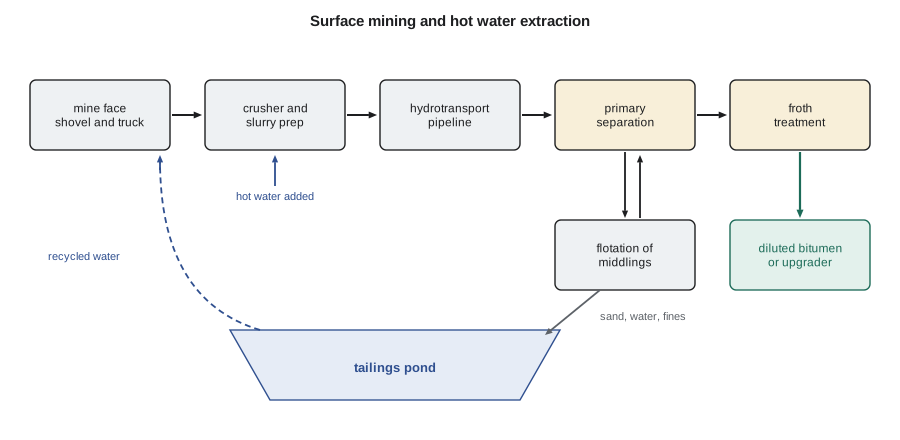
Mining is used where the McMurray Formation lies under less than about 70 m of overburden, mostly north of Fort McMurray along the Athabasca River. The overburden of muskeg, glacial deposits and shale is removed first and stockpiled or used to build dykes. The ore is then mined with large electric or hydraulic shovels and carried by truck to crushers. A typical ore grade is about 10 to 12 weight percent bitumen, so roughly two tonnes of oil sand must be mined for each barrel of bitumen. A large mine moves hundreds of thousands of tonnes of ore a day.
Crushed ore is mixed with hot water, and sometimes a little caustic soda, to make a slurry that is pumped through large pipelines to the extraction plant. This hydrotransport step already starts to separate the bitumen from the sand, because the agitation and heat let the water film around each grain release the bitumen and allow air bubbles to attach to it.
Hot-water extraction
The extraction method used by the mines descends from work by Karl Clark of the Research Council of Alberta in the 1920s and is still called the Clark hot water process. In the primary separation vessel, a large cone-bottomed tank, aerated bitumen rises as a froth, the sand settles to the bottom and a middlings stream of water, fines and some bitumen is drawn from the middle and sent to flotation cells to recover more bitumen. Modern plants recover about 88 to 95 percent of the bitumen in the ore. The froth is roughly 60 percent bitumen, 30 percent water and 10 percent solids, and must be cleaned before it can be sold.
Froth treatment removes water and solids by diluting the froth with a solvent and separating it in settlers or centrifuges. Two families are used. Naphthenic froth treatment uses a naphtha diluent and produces a bitumen that still contains some water and solids, suited to an upgrader on site. Paraffinic froth treatment uses a lighter paraffinic solvent that also rejects part of the asphaltenes, producing a cleaner bitumen that can be sold directly. The solvent is recovered and reused, and the losses are tightly regulated because solvent lost to tailings ponds becomes an emission.
Getting bitumen to market
Bitumen is too viscous to flow in a pipeline at normal temperatures. Mines either upgrade it on site, cracking and treating it to make a light synthetic crude oil, or mix it with a diluent such as natural gas condensate to make diluted bitumen, often called dilbit, which typically contains about 25 to 30 percent diluent. In situ projects face the same choice and most sell dilbit. The diluent itself must be bought and shipped to the oil sands, which is a significant cost that shows up in the price difference between heavy and light crude.
Fluid tailings
Tailings are the largest environmental issue of oil sands mining. The coarse sand settles quickly and is used to build dykes and beaches, but the fine clays stay suspended. Over a few years the fines settle to a soft deposit called fluid fine tailings, typically about 30 percent solids, which remains fluid for decades. Large volumes have accumulated in tailings ponds since mining began. The the AER's Directive 085, Fluid Tailings Management for Oil Sands Mining Projects, requires operators to set targets so that fluid tailings are treated and reclaimed progressively and are ready to reclaim within a set period after mining ends. Treatment methods include adding flocculants and drying the treated tailings in thin layers, centrifuging, mixing fines with sand to make composite tailings that consolidate, and placing fluid tailings in a mined-out pit under a water cap to create an end-pit lake.
# Oil sands mining: ore grade, extraction recovery, product and tailings per day
ore_tpd = 250000.0          # tonnes of ore mined per day
grade = 0.105               # bitumen weight fraction in ore
rec = 0.91                  # extraction plant bitumen recovery
rho_bit = 1010.0            # kg/m3
bit_t = ore_tpd * grade * rec
bit_m3 = bit_t * 1000 / rho_bit
print(f"bitumen recovered: {bit_t:,.0f} t/d = {bit_m3:,.0f} m3/d = {bit_m3 * 6.2898:,.0f} bbl/d")
print(f"tonnes of ore per barrel of bitumen: {ore_tpd / (bit_m3 * 6.2898):.2f}")
# tailings: sand, fines and water; fines held as fluid tailings at about 30 % solids by mass
fines_frac = 0.20           # fraction of mineral solids finer than 44 microns
solids = ore_tpd * (1 - grade - 0.04)     # 4 % connate water
fines = solids * fines_frac
ft_mass = fines / 0.30                     # fluid tailings mass at 30 % solids
ft_vol = ft_mass * 1000 / 1250.0           # m3, density about 1,250 kg/m3
print(f"mineral solids to tailings: {solids:,.0f} t/d, of which fines {fines:,.0f} t/d")
print(f"new fluid tailings if fines stay at 30 % solids: {ft_vol:,.0f} m3/d ({ft_vol / bit_m3:.1f} m3 per m3 of bitumen)")bitumen recovered: 23,888 t/d = 23,651 m3/d = 148,760 bbl/d tonnes of ore per barrel of bitumen: 1.68 mineral solids to tailings: 213,750 t/d, of which fines 42,750 t/d new fluid tailings if fines stay at 30 % solids: 114,000 m3/d (4.8 m3 per m3 of bitumen)
The calculation shows the scale of mining: 250,000 tonnes of ore a day for about 24,000 m³ (149,000 barrels) of bitumen, and nearly five cubic metres of new fluid tailings for every cubic metre of bitumen if the fines stay at 30 percent solids. 'That last number is why tailings technology gets so much attention,' Paul says. 'Every cubic metre of fines you can dewater is a cubic metre less pond.'
Reclamation
Mines are required to reclaim the land they disturb to a self-sustaining landscape with forests, wetlands and lakes. Reclamation is slow: overburden and tailings must be placed and capped, soils salvaged and replaced, and vegetation established and monitored for years before the the AER certifies the land. By the 2020s only a small fraction of disturbed land had been formally certified as reclaimed, although much more was in some stage of reclamation. Mine operators are also shifting investment toward in situ production, which disturbs far less surface per barrel, as some mines approach the end of their ore reserves.
Worked problem
Ore needed per barrel
A mine processes ore averaging 11 weight percent bitumen with 92 percent extraction recovery. Bitumen density is 1,010 kg/m³. How many tonnes of ore are mined per cubic metre of bitumen?
Show solution
- Bitumen recovered per tonne of ore = 0.11 × 0.92 = 0.101 t.
- One cubic metre of bitumen weighs 1.01 t.
- Ore per cubic metre = 1.01 / 0.101 ≈ 10.0 t.
Answer: About ten tonnes of ore per cubic metre of bitumen, or about 1.6 tonnes per barrel, before counting the overburden that must be moved first.
Froth treatment and upgrading
The bitumen froth from primary separation contains roughly 60 percent bitumen, 30 percent water and 10 percent solids. Before it can be sold or upgraded, most of the water and solids must be removed in froth treatment. Two approaches are used. Naphthenic froth treatment dilutes the froth with naphtha and separates the water and solids with inclined plate settlers and centrifuges, producing a diluted bitumen that still contains a small fraction of water and fine solids, which suits a coking upgrader. Paraffinic froth treatment uses a lighter paraffinic solvent, such as pentane and hexane, which causes some of the asphaltenes to precipitate and carry the fine solids and water with them. The product is cleaner and can be sold to pipelines directly, at the cost of rejecting part of the bitumen with the asphaltenes. In both methods, the solvent is recovered in a solvent recovery unit, and the remaining tailings go to the tailings system.
Some mining operations upgrade the bitumen on site. Upgraders use coking, in which the heaviest fractions are cracked thermally into lighter liquids and petroleum coke, or hydroprocessing, in which hydrogen is added over a catalyst. Hydrotreating removes sulphur and nitrogen, and the product is blended into synthetic crude oil, a light, sweet crude that most refineries can process. Upgrading adds value and widens the market, but it is capital intensive and adds energy use and emissions, which is why newer mines have chosen paraffinic froth treatment and sell diluted bitumen instead.
Mine planning and energy
A mine plan sets the order in which ore is dug, which areas are reclaimed and where overburden and tailings go. Two ratios shape the plan. The strip ratio compares the volume of overburden removed with the volume of ore, and rises as the mine moves into areas where the ore is deeper. The ore grade, the mass fraction of bitumen, sets how much bitumen each tonne of ore yields; ore below a cutoff grade, often about 6 to 7 percent, is treated as waste. Mines also blend ores of different grade and fines content to keep extraction recovery steady.
Mining is energy intensive in its own way. The trucks and shovels burn diesel, extraction needs hot water and froth treatment needs heat for solvent recovery. Most of the heat comes from natural gas, often through cogeneration plants that also supply electricity to the grid. Operators have introduced autonomous haul trucks, which reduce fuel use and improve safety, and are testing lower-temperature extraction and electrified equipment to reduce emissions per barrel.
Whatever the process, the engineer's job is the same: trace each unit of energy from the fuel to the oil, find where it is lost and decide which losses are worth reducing.
Safety in the mine
An oil sands mine is a large industrial site, and safety practice shapes every part of it. Haul trucks the size of houses share roads with light vehicles, so mines use strict traffic rules, proximity detection systems and, increasingly, autonomous trucks in separate zones. Pit walls and dump slopes are monitored with radar and survey prisms for movement. Tailings dams are among the largest earth structures in the world and are designed, inspected and monitored under Alberta's dam safety rules, with independent review boards at each mine. Winter conditions, with temperatures far below freezing, add hazards for equipment and people, and the soft, wet ground of the boreal forest makes road and dyke construction challenging. Many of these practices are shared with metal and coal mining, but the scale of oil sands operations makes them particularly demanding.
Ethan finishes the lesson with a short table that compares the energy used to deliver one unit of bitumen or heavy oil to the sales point by each route: mining and hot water extraction, SAGD and steamflooding. The numbers differ widely with ore grade, SOR and wellbore design, but the comparison makes Paul's point clearly: in every route, most of the energy goes into heating water and rock, and the best projects are the ones that waste the least of it.
Common mistakes
MistakeAssuming all the oil sands can be mined.
InsteadOnly bitumen under less than about 70 m of overburden is mineable; most must be produced in situ.
MistakeTreating fine tailings as settling quickly.
InsteadFines form fluid tailings that stay fluid for decades without treatment.
MistakeIgnoring diluent in the economics.
InsteadDiluent cost and supply affect every bitumen barrel sold as dilbit.
MistakeEquating reclamation with certification.
InsteadLand must be monitored and certified before it counts as reclaimed.
Summary and key terms
- Mining is used under less than about 70 m of overburden; about two tonnes of oil sand yield a barrel of bitumen.
- The Clark hot water process separates bitumen as a froth in primary separation vessels, recovering about 88 to 95 percent.
- Naphthenic and paraffinic froth treatment clean the froth; paraffinic treatment also rejects some asphaltenes.
- Bitumen is upgraded to synthetic crude or blended with diluent to make dilbit.
- Fluid fine tailings stay fluid for decades; Directive 085 requires progressive treatment and reclamation.
- Mined land must be reclaimed and certified, which takes many years.
- Clark hot water process
- The hot-water extraction method that separates bitumen from mined oil sand.
- Primary separation vessel
- The tank in which bitumen froth rises and sand settles.
- Froth treatment
- Removal of water and solids from bitumen froth using a solvent.
- Diluted bitumen (dilbit)
- Bitumen blended with a light diluent so it can flow in pipelines.
- Fluid fine tailings
- A slow-settling mixture of water and fine clays from extraction.
- End-pit lake
- A mined-out pit filled with tailings and capped with water as part of reclamation.
Practice problems
Work each problem on paper first, then reveal the answer to check.
Why is mining limited to shallow deposits?
Show answer
Removing overburden becomes uneconomic below about 70 m.
What is in bitumen froth?
Show answer
About 60 percent bitumen, 30 percent water and 10 percent solids.
Why do fluid tailings accumulate?
Show answer
Fine clays settle very slowly and remain fluid for decades.
What does paraffinic froth treatment do that naphthenic does not?
Show answer
It rejects part of the asphaltenes and makes a cleaner bitumen.
Lesson quiz · 5 questions
Score 60% or more to complete this lesson.
Create a free account to save your progress, take quizzes and earn a certificate.