
PET-370 · Lesson 3 of 12 · 18 min
Viscosity, heat and the thermal properties of reservoirs
Before he can judge any thermal process, Ethan needs to know how the Wapiti Lake bitumen behaves when it is heated. Mei Lin, the company's production chemist, has sent samples from both pads to a laboratory in Edmonton for viscosity measurements at several temperatures. When the results come back, the numbers span six orders of magnitude: about 1.5 million centipoise at 20 °C and about 3,000 centipoise at 80 °C. 'That is the whole story of SAGD in one table,' Paul says. 'Heat the bitumen to steam temperature and it flows like light motor oil.'
This lesson covers the physical properties that every thermal design uses: how viscosity falls with temperature, how much heat rock and fluids store, how heat moves by conduction and convection, and the properties of steam itself. These numbers explain why steam is the workhorse of heavy oil recovery and why the steam-oil ratio is so sensitive to heat losses.
How viscosity falls with temperature
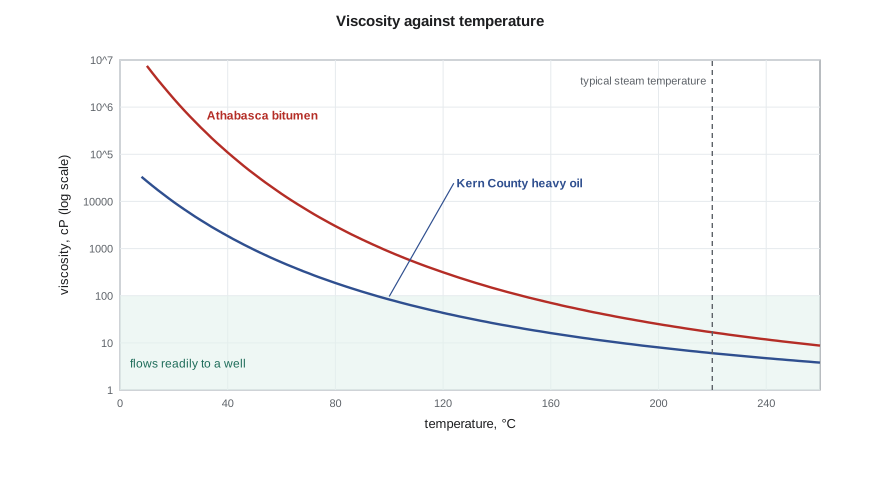
Heavy oil viscosity falls steeply as temperature rises. A rough rule is that bitumen viscosity drops by about a factor of ten for every 15 to 25 °C (30 to 45 °F) of heating near reservoir temperature, with the rate of decline slowing at higher temperatures. Over the range from reservoir temperature to steam temperature, typically from about 10 °C (50 °F) to about 200 to 250 °C (390 to 480 °F), the viscosity falls by five or six orders of magnitude.
Several empirical equations describe this behaviour. The most widely used for petroleum liquids is the Walther equation, adopted in the ASTM D341 viscosity-temperature charts, in which the double logarithm of the kinematic viscosity, plus a small constant, is a straight line against the logarithm of absolute temperature.
Here ν is the kinematic viscosity in centistokes, T is the absolute temperature in kelvin and A and B are constants fitted to two or more measurements. For heavy oils with densities close to that of water, the kinematic viscosity in centistokes and the dynamic viscosity in centipoise are nearly equal, which simplifies quick calculations. Another common form is the Andrade or Arrhenius equation, ln μ = a + b/T, which fits well over narrower temperature ranges. Whatever equation is used, engineers fit it to measured data from the actual crude, because heavy oils from different leases, and even different zones, can differ by an order of magnitude at the same temperature.
Dissolved gas and solvents also reduce viscosity, which is why live oil in the reservoir is less viscous than the dead oil measured at surface, and why light hydrocarbon solvents are added in the processes of lesson 9. Water-in-oil emulsions, by contrast, are more viscous than the oil itself, and the emulsions produced by thermal wells are a constant concern in the treating plant.
Storing heat: heat capacity
A thermal project heats rock as well as oil, and the rock takes most of the heat. The volumetric heat capacity of a reservoir, often written M, is the heat needed to raise one unit volume of reservoir by one degree. It combines the solid grains and the fluids in the pores.
For an unconsolidated sand with 30 to 35 percent porosity filled with oil and water, M is typically about 2.3 to 2.6 MJ per cubic metre per kelvin, or roughly 35 to 40 Btu per cubic foot per degree Fahrenheit. Quartz grains have a specific heat of about 0.8 kJ/(kg K) and a density of 2,650 kg/m³; water has the highest specific heat of the common fluids, about 4.2 kJ/(kg K), and bitumen about 2 kJ/(kg K). Because the solid fraction is about two thirds of the volume, roughly two thirds of the heat in a heated sand sits in the grains. Shale layers and the rock above and below the reservoir also absorb heat, and that heat is mostly lost to production.
Moving heat: conduction and convection
Heat moves through a reservoir in two ways. Conduction moves heat through the grains and fluids without fluid flow, at a rate set by the thermal conductivity, typically 1.5 to 3 W/(m K), or about 1 to 1.7 Btu/(h ft °F), for saturated sands and shales. Convection moves heat with flowing fluids, mainly steam and hot water. Conduction is slow: the distance heat penetrates by conduction grows with the square root of time, as the square root of the thermal diffusivity times time. For typical rocks the diffusivity is about 10⁻⁶ m²/s, so conduction carries heat only a few metres in a year. At the edge of a steam chamber, conduction ahead of the steam front heats a thin layer of oil, and that thin layer is what drains in SAGD. Above and below a steam zone, conduction into cap and base rock is the main heat loss, and it grows with time as a larger area of hot rock is exposed.
The properties of steam
Steam carries heat in two forms. Sensible heat is the heat needed to raise water to its boiling point. Latent heat is the much larger amount needed to turn boiling water into vapour at the same temperature. Saturated steam exists at a temperature fixed by its pressure: about 180 °C at 1,000 kPa (356 °F at 145 psia), about 212 °C at 2,000 kPa and about 250 °C at 4,000 kPa. Steam quality is the mass fraction of the steam-water mixture that is vapour. Most oilfield steam generators produce steam of about 75 to 80 percent quality, because the remaining water carries dissolved solids out of the boiler tubes.
The latent heat falls as pressure rises: about 2,015 kJ/kg at 1,000 kPa but only about 1,640 kJ/kg at 5,000 kPa, reaching zero at the critical point near 22,100 kPa. So low-pressure steam delivers more of its heat as latent heat at a lower temperature, while high-pressure steam is hotter but carries less latent heat per kilogram. This tradeoff shapes operating strategy. Thermal projects usually operate at the lowest pressure that keeps the producers flowing and the chamber stable, because lower pressure means lower steam temperature, smaller heat losses to the overburden and less heat stored in the rock behind the front.
| Pressure | Saturation temperature | Latent heat |
|---|---|---|
| 1,000 kPa (145 psia) | 180 °C (356 °F) | 2,015 kJ/kg (866 Btu/lb) |
| 2,000 kPa (290 psia) | 212 °C (414 °F) | 1,891 kJ/kg (813 Btu/lb) |
| 3,000 kPa (435 psia) | 234 °C (453 °F) | 1,796 kJ/kg (772 Btu/lb) |
| 5,000 kPa (725 psia) | 264 °C (507 °F) | 1,640 kJ/kg (705 Btu/lb) |
# Viscosity against temperature (Walther / ASTM D341 form) and saturated steam properties
import math
SI = True
def walther(T1, mu1, T2, mu2):
    # log log (nu + 0.7) = A - B log T, with T in kelvin; fit through two measured points
    f = lambda mu: math.log10(math.log10(mu + 0.7))
    B = (f(mu1) - f(mu2)) / (math.log10(T2) - math.log10(T1))
    A = f(mu1) + B * math.log10(T1)
    return lambda T: 10 ** (10 ** (A - B * math.log10(T))) - 0.7
# lab points for the lease crude: 20 C and 80 C (dead oil, cP used for cSt with SG near 1)
mu = walther(293.15, 1.5e6, 353.15, 3000.0)
temps_c = [10, 20, 50, 80, 120, 160, 200, 230]
for tc in temps_c:
    lab = f"{tc:4d} C" if SI else f"{tc * 9 / 5 + 32:4.0f} F"
    print(f"T = {lab}   viscosity = {mu(tc + 273.15):>12,.0f} cP")
# saturated steam: pressure (kPa) -> temperature (C), liquid enthalpy hf and latent heat hfg (kJ/kg); rounded table values
table = [(1000, 179.9, 762.6, 2015.3), (2000, 212.4, 908.6, 1890.7), (3000, 233.9, 1008.4, 1795.7),
         (4000, 250.4, 1087.4, 1714.1), (5000, 263.9, 1154.5, 1640.1), (7000, 285.8, 1267.4, 1505.1)]
def steam(p):
    for (p1, *a), (p2, *b) in zip(table, table[1:]):
        if p1 <= p <= p2:
            w = (p - p1) / (p2 - p1)
            return [x + w * (y - x) for x, y in zip(a, b)]
for p in (1500, 2500, 3500):
    T, hf, hfg = steam(p)
    x = 0.80
    if SI: print(f"steam at {p} kPa: T = {T:.0f} C, hf = {hf:.0f} kJ/kg, hfg = {hfg:.0f} kJ/kg; 80 % quality carries {hf + x * hfg:.0f} kJ/kg")
else: print(f"steam at {p * 0.145038:.0f} psia: T = {T * 9 / 5 + 32:.0f} F, hf = {hf * 0.4299:.0f} Btu/lb, hfg = {hfg * 0.4299:.0f} Btu/lb; 80 % quality carries {(hf + x * hfg) * 0.4299:.0f} Btu/lb")T = 10 C viscosity = 7,483,142 cP T = 20 C viscosity = 1,500,000 cP T = 50 C viscosity = 37,386 cP T = 80 C viscosity = 3,000 cP T = 120 C viscosity = 314 cP T = 160 C viscosity = 70 cP T = 200 C viscosity = 25 cP T = 230 C viscosity = 14 cP steam at 1500 kPa: T = 196 C, hf = 836 kJ/kg, hfg = 1953 kJ/kg; 80 % quality carries 2398 kJ/kg steam at 2500 kPa: T = 223 C, hf = 958 kJ/kg, hfg = 1843 kJ/kg; 80 % quality carries 2433 kJ/kg steam at 3500 kPa: T = 242 C, hf = 1048 kJ/kg, hfg = 1755 kJ/kg; 80 % quality carries 2452 kJ/kg
The fit shows how sharply viscosity falls: from about 1.5 million centipoise at room temperature to about 300 centipoise at 120 °C (248 °F) and about 25 centipoise at 200 °C (392 °F). Ethan notices that above about 200 degrees the gain from further heating is small. 'That is why SAGD operators are happy to run at moderate pressure,' Paul says. 'Going from 200 to 250 degrees costs heat and only halves the viscosity.'
Steam measured as cold water equivalent
Steam rates are reported as the volume of liquid water that was converted to steam, called the cold water equivalent or CWE. One cubic metre of CWE is one tonne of water, and one barrel of CWE is about 350 pounds. Reporting steam this way makes steam-oil ratios dimensionless and easy to compare, but it hides the steam quality. A barrel of 80 percent quality steam carries more heat than a barrel of 70 percent quality steam, so good operators track the heat injected as well as the CWE.
Worked problem
Heat needed to warm a block of oil sand
How much heat is needed to raise one cubic metre of oil sand with M = 2.5 MJ/(m³ K) from 10 °C to 210 °C, and how much 80 percent quality steam at 2,000 kPa delivers that heat, assuming the steam condenses to water at the same temperature?
Show solution
- Heat = M ΔT = 2.5 MJ × 200 = 500 MJ.
- Each kilogram of 80 percent quality steam releases about 0.80 × 1,891 = 1,513 kJ when it condenses.
- Steam needed = 500,000 kJ / 1,513 kJ/kg ≈ 330 kg, or 0.33 m³ CWE.
Answer: Heating the reservoir alone takes about a third of a unit of steam per unit of bulk volume. That bulk volume holds only about a quarter of a unit of oil, so even a perfect process would need an SOR of about 1.3. Heat left behind in the swept zone and lost to the cap and base rock push practical SORs to 2 or more.
Where the property values come from
Every number in this lesson should be traced to a source. Viscosity-temperature data come from laboratory measurements on dead or recombined oil samples, often several samples across a field, because viscosity can vary by an order of magnitude laterally and with depth. Thermal conductivity and heat capacity are measured on core plugs at reservoir saturation or estimated from mineralogy and porosity with published correlations. Steam properties come from standard steam tables, such as the IAPWS formulation, which software implements directly. When data are missing, engineers use correlations and analogues from nearby fields, but they record which values were measured and which were assumed, because the assumptions carry into every rate, SOR and cost estimate that follows. A sensitivity case on the most uncertain property, usually viscosity, is part of any thermal screening study.
Common mistakes
MistakeUsing a viscosity correlation from another field.
InsteadFit the viscosity-temperature equation to measured data from the lease crude.
MistakeAssuming the oil takes most of the injected heat.
InsteadMost heat goes into the rock grains, the water and the surrounding layers.
MistakeThinking hotter steam is always better.
InsteadHigher pressure steam carries less latent heat and loses more heat to the overburden.
MistakeReporting steam only in CWE.
InsteadTrack steam quality and heat as well as CWE volume.
Summary and key terms
- Heavy oil viscosity falls by five or six orders of magnitude between reservoir and steam temperature.
- The Walther (ASTM D341) and Arrhenius equations fit viscosity against temperature; fit them to measured data.
- Reservoir volumetric heat capacity is about 2.3 to 2.6 MJ/(m³ K); about two thirds of the heat goes into the grains.
- Conduction is slow, with penetration growing with the square root of time; convection carries heat with the steam.
- Steam temperature is fixed by pressure, and latent heat falls as pressure rises.
- Steam is measured as cold water equivalent; quality and heat must be tracked too.
- Walther equation
- An empirical relation in which log log viscosity is linear in log absolute temperature.
- Volumetric heat capacity
- The heat needed to raise a unit volume of reservoir by one degree.
- Thermal diffusivity
- Thermal conductivity divided by volumetric heat capacity; it controls how fast conduction spreads heat.
- Latent heat
- The heat needed to turn boiling water into steam at the same temperature.
- Steam quality
- The mass fraction of a steam-water mixture that is vapour.
- Saturation temperature
- The boiling temperature of water at a given pressure.
Practice problems
Work each problem on paper first, then reveal the answer to check.
Why do thermal projects prefer moderate steam pressure?
Show answer
Lower temperature reduces heat losses and stored heat, and latent heat per unit mass is higher.
Where does most of the heat in a steamed sand reside?
Show answer
In the rock grains, about two thirds of it.
How far does conduction carry heat in a year in typical rock?
Show answer
A few metres (roughly 10 to 20 feet).
Why are thermal well emulsions a concern?
Show answer
They are more viscous than the oil and hard to separate in the plant.
Lesson quiz · 5 questions
Score 60% or more to complete this lesson.
Create a free account to save your progress, take quizzes and earn a certificate.